
The battery is the part every EV buyer talks about in a low voice. Not the touchscreen, not the range, not even the charging time. The battery. Because in an electric car, the battery is not just one component. It is the fuel tank, the engine room, the resale value, and the biggest long-term worry rolled into one large sealed pack under the floor.
That worry is not silly. An EV battery is expensive. It can cost several lakh rupees to replace outside warranty. But the fear is often bigger than the real risk, mostly because buyers do not know what is covered, how long batteries actually last, and what happens when capacity drops after years of use.
This guide explains the EV battery cost story in plain language: price per kWh, replacement cost, warranty terms, battery lifespan, recycling, swapping, and the ownership decisions that actually matter.
What is the EV Battery replacement cost
The first thing to understand is that there are two battery prices.
One is the global battery pack price you see in industry reports. The other is the replacement price an Indian EV owner may pay at an authorised service centre. These are not the same thing.
Global battery pack prices have fallen sharply because of cheaper LFP chemistry, overcapacity in cell manufacturing, and stronger competition between suppliers. But when a buyer replaces an electric car battery in India, the bill is not just for cells. It includes the full battery pack, battery management system, cooling hardware, casing, wiring, diagnostics, GST, labour, transport, and the manufacturer’s service margin.
That is why Indian EV battery replacement estimates are usually much higher than a simple dollar-per-kWh conversion.
As a practical working range, most mainstream electric car batteries in India cost around ₹15,000 to ₹22,000 per kWh at the replacement level. This is an estimate, not an official rate card, because most carmakers do not publicly list battery replacement prices.
Here is what that means in real ownership terms:
| Battery Size | Typical EV Segment | Estimated Replacement Cost |
|---|---|---|
| 19 to 24 kWh | Entry EV hatchbacks | ₹3 lakh to ₹5 lakh |
| 30 to 35 kWh | Compact EVs | ₹4.5 lakh to ₹7 lakh |
| 40 to 45 kWh | Long-range compact SUVs | ₹6 lakh to ₹9 lakh |
| 50 to 60 kWh | Premium EV SUVs | ₹8 lakh to ₹12 lakh |
| 70 kWh and above | Large premium EVs | ₹12 lakh+ |
Do not read this table as a quotation. Read it as a risk map. The bigger the battery, the higher the replacement cost. But bigger batteries also cycle less often for the same distance, which can help long-term health.
The smarter question is not “How much does an EV battery cost?” The smarter question is: “What is the chance I will actually pay this during my ownership?” For most first owners, the answer is low, because battery warranties are now doing most of the heavy lifting.
EV Battery Warranty Coverage in India
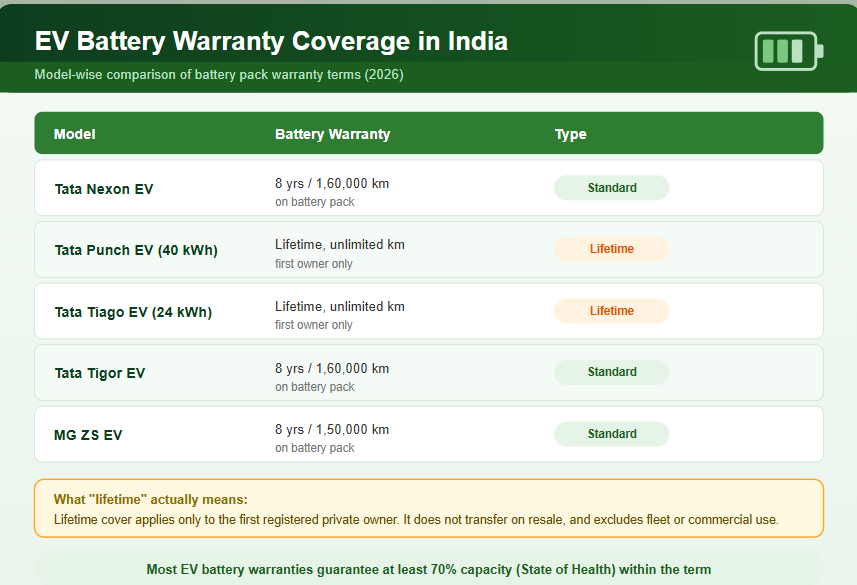
Most electric cars in India come with a high-voltage battery warranty of around 8 years and 1,50,000 to 1,60,000 km, depending on the brand. This is separate from the normal vehicle warranty. Your car may have a 3-year vehicle warranty, but the battery usually gets a much longer cover.
The important part is not just the number of years. It is the State of Health clause, often called SoH. A battery does not usually fail like a phone suddenly dying. It loses capacity slowly. A new battery starts at 100 per cent usable health. Over time, that may fall to 95, then 90, then 85 per cent.
Most EV battery warranties protect you if the battery drops below a minimum SoH threshold during the warranty period. In many cases, that threshold is around 70 percent. So if your battery falls below the covered health limit within the warranty period, the manufacturer may repair, replace, or restore the pack according to its policy.
This is where buyers need to read carefully. A warranty does not mean the company will replace your battery because the range dropped from 320 km to 280 km after five years. Some degradation is considered normal. Warranty support usually applies only if the battery falls below the official SoH limit or suffers a covered defect.
Tata has changed the conversation in India by offering lifetime HV battery warranty on selected larger-battery EVs. But “lifetime” does not mean forever in the emotional sense. Tata defines it as 15 years from the vehicle’s first registration, and the terms apply to selected models and ownership categories. For many buyers, that is still a very strong offer, because 15 years is longer than most people keep a car.
MG, Hyundai, Mahindra and other brands also offer long battery warranties, but the exact kilometre cap, ownership transfer rules and exclusions vary. Before buying any EV, ask the dealer for the battery warranty document, not just the brochure line.
The most common exclusions are abuse, accident damage, unauthorised repair, water damage beyond design limits, using non-approved charging equipment, tampering with the battery pack, and commercial use where the warranty is only for private ownership.
How Long an EV Battery Actually Lasts
A well-managed EV battery can last much longer than most buyers expect. In normal Indian use, a modern LFP or lithium-ion electric car battery should comfortably last 8 to 10 years, and often more, before the range loss becomes serious enough to affect daily ownership.
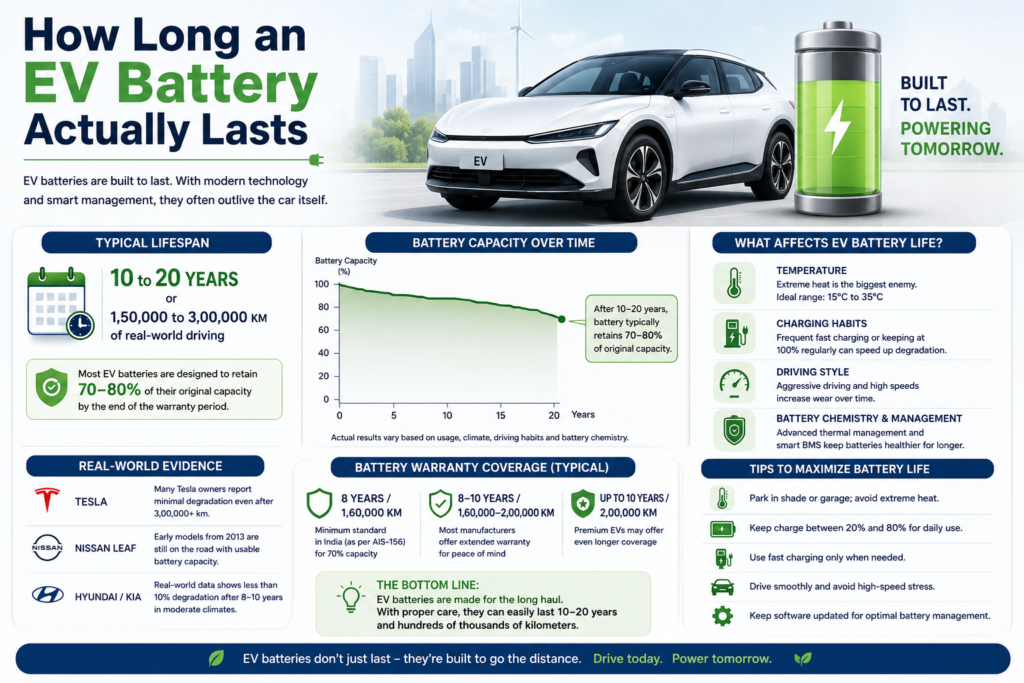
The pack does not become useless at the end of warranty. It simply carries less energy than it did when new. A car that delivered 300 km in its early years may deliver 250 to 260 km after many years, depending on use, charging habits and climate.
Heat is the biggest enemy. India is a tough market because batteries deal with high ambient temperatures, traffic, fast charging, and long summer parking. That is why thermal management matters. Liquid-cooled EV batteries generally handle Indian conditions better than air-cooled or passively cooled designs.
Charging habit also matters, but not in the dramatic way social media makes it sound. You do not need to treat an EV like a fragile science experiment. Still, a few habits help.
For daily use, charging between 20 and 80 percent is healthy. Use 100 percent before long trips, not every time unless the manufacturer specifically says the chemistry is comfortable with it. Avoid letting the car sit at 0 percent. Avoid daily DC fast charging if home AC charging is available. Park in shade when possible during peak summer.
Battery chemistry also changes the ownership feel. LFP batteries are becoming popular in India because they are safer, more heat tolerant, and usually longer lasting. NMC batteries can offer higher energy density, which helps range and performance, but they are generally more sensitive to heat and charging behaviour.
At EVUnlock, we cross-check specifications against official manufacturer documentation before publishing, but battery life is one area where real owner use matters as much as the spec sheet. Two people can buy the same EV and see different degradation after seven years because one charges gently at home and the other fast-charges daily in peak heat.
What Happens to Old EV Batteries
An old EV battery is not the same as a dead battery. This is one of the biggest misunderstandings in the market.
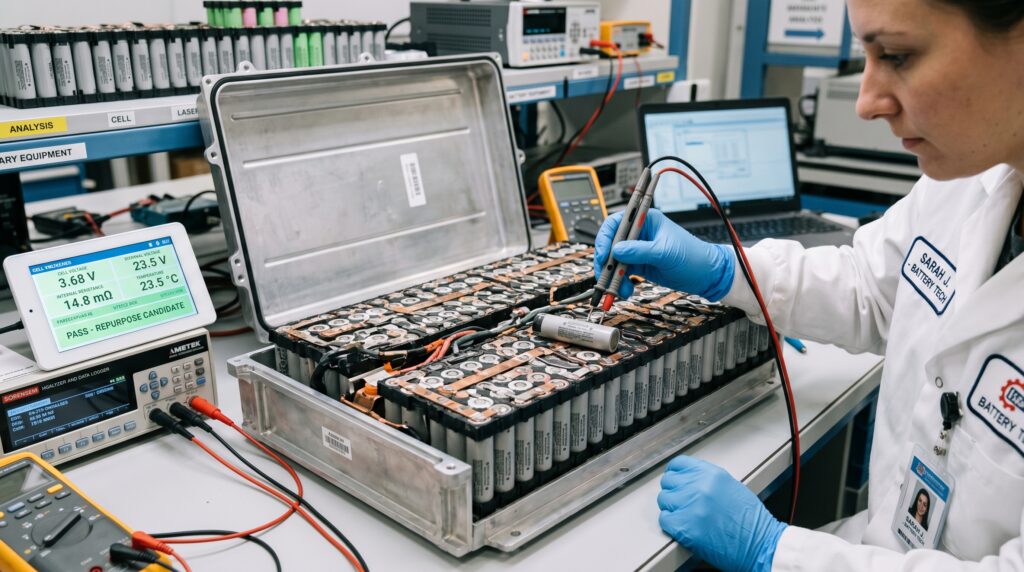
When an EV battery is no longer ideal for driving, it may still have 60 to 80 percent of its original capacity left. That may not be enough for a car owner who expects full driving range, but it is still useful for stationary energy storage. Old EV batteries can be used in solar backup systems, telecom towers, small commercial storage, residential backup, and grid support applications.
This is called second-life use. It matters because it gives the battery value after automotive use, which can improve the economics of EV ownership and reduce waste.
After second-life use, the battery moves toward recycling. India’s Battery Waste Management Rules are built around Extended Producer Responsibility, which means producers, importers and manufacturers are responsible for collection and recycling or refurbishment of waste batteries. Batteries are not supposed to end up in landfills or be burnt.
Recycling matters because EV batteries contain valuable materials. Lithium, nickel, cobalt, manganese, copper and aluminium can be recovered depending on the chemistry and recycling process. LFP batteries contain less high-value nickel and cobalt, but they still contain lithium, copper, aluminium and other recyclable material.
For owners, the important takeaway is simple: do not sell or dispose of an EV battery through an informal scrap route. High-voltage batteries need proper handling. If your EV battery reaches end of life, go through the authorised service network or an approved recycler.
The used EV market will also become more battery-health driven. A five-year-old EV with 90 percent battery health will command a very different resale value from the same car at 74 percent. This is why battery health reports will become as important as service history in used EV transactions.
Battery Swapping and Battery-as-a-Service
Battery swapping sounds like the perfect solution. Instead of waiting at a charger, you remove the discharged battery and replace it with a charged one in minutes. For two-wheelers, three-wheelers and delivery fleets, this can work beautifully. For private electric cars, it is much harder.
Car batteries are large, heavy, structural and model-specific. They are not easy to standardise across brands. A Tata EV pack, an MG pack and a Mahindra pack are not interchangeable like LPG cylinders. They have different casing, software, voltage, cooling, crash structure and battery management systems.
That is why battery swapping in India is mainly growing in two-wheelers, three-wheelers and commercial fleets. These vehicles use smaller packs, run predictable routes and benefit directly from reduced downtime.
For passenger cars, Battery-as-a-Service may be more realistic than physical swapping. In a BaaS model, the customer pays less upfront for the vehicle and pays separately for battery use, usually per kilometre or through a subscription. This reduces the initial purchase price but changes the ownership calculation. You save money on day one, but you keep paying for battery usage.
This is where buyers need to do the maths honestly. If you drive very little, BaaS can look attractive because the lower entry price matters more. If you drive a lot, the per-km battery rental can slowly eat into the saving. For high-mileage owners, owning the battery may still be cheaper over time.
Battery swapping and BaaS are both attempts to solve the same fear: “What if the battery becomes too expensive?” Swapping solves downtime for fleets. BaaS solves upfront price anxiety for buyers. Neither model fully replaces battery ownership for mainstream electric cars yet.
EV Battery Ownership Verdict
The battery is the most expensive part of an EV, but it is no longer the unknown monster it was five years ago. Prices are falling globally. Indian warranties are getting stronger. LFP chemistry is making batteries more heat-tolerant. Recycling rules are now in place. And larger EV makers are using longer warranty terms to remove buyer anxiety.
The real ownership advice is this: do not buy an EV only by looking at claimed range. Look at battery size, warranty terms, chemistry, cooling, charging speed, SoH coverage, and whether the warranty transfers to the second owner.
If you are buying new and keeping the car for five to eight years, battery replacement cost should not scare you away. Your warranty will cover the riskiest period. If you are buying used, ask for a battery health report before negotiating price. If you are buying an EV for commercial use, read the warranty terms twice because private-owner benefits may not apply.
This guide is the ownership hub. For deeper reading, see our detailed guides on EV battery price and replacement cost in India, EV battery warranty in India, EV battery life and degradation, used EV batteries and recycling, and EV battery swapping in India. If you want to understand the technology behind these packs, start with our EV battery basics, types and technology guide.
Frequently Asked Questions
Is EV battery replacement covered under warranty?
Yes, but only under specific conditions. EV battery warranty usually covers manufacturing defects and excessive degradation below the company’s State of Health limit during the warranty period. It does not usually cover normal range loss, accident damage, misuse, water damage beyond rated limits, unauthorised repairs or commercial use exclusions.
How much does it cost to replace an EV battery in India?
For mainstream electric cars, EV battery replacement in India can range from around ₹3 lakh for small entry-level packs to ₹10 lakh or more for larger premium EV packs. A practical estimate is ₹15,000 to ₹22,000 per kWh at service-centre replacement level, but official prices vary by brand and model.
What is the price of an electric car battery?
The electric car battery price depends on battery size, chemistry, cooling system, BMS, brand pricing, taxes and labour. A 24 kWh pack will cost far less than a 50 kWh pack. Global battery prices are falling, but Indian replacement bills remain higher because owners pay for the complete installed pack, not just cells.
How long does an EV battery last in India?
A modern EV battery should usually last 8 to 10 years or more in normal Indian use. It does not suddenly die after warranty. It slowly loses capacity. Good charging habits, liquid cooling and avoiding frequent high-heat fast charging can help preserve battery health over time.
What does 70 percent battery State of Health mean?
A 70 percent State of Health means the battery can hold about 70 percent of its original usable capacity. If your EV delivered 300 km when new, a 70 percent battery may deliver roughly 210 km under similar conditions. Many warranties use SoH thresholds to decide whether degradation is covered.
Are EV batteries expensive because of lithium?
Lithium is one part of the cost, but not the whole story. Battery price also depends on cell chemistry, nickel, cobalt, manganese, graphite, pack casing, electronics, cooling hardware, BMS software, testing, logistics, taxes and service labour. The final replacement price is much more than raw material cost.
What happens to an EV battery after it wears out?
An EV battery that is no longer ideal for driving can still be used for stationary energy storage. After second-life use, it should go to authorised recycling. India’s battery waste rules require producers to manage collection and recycling through Extended Producer Responsibility, so batteries should not enter informal scrap channels.
Is battery swapping available for electric cars in India?
Battery swapping is mainly practical for electric two-wheelers, three-wheelers and fleets. For private electric cars, battery packs are too large, heavy and brand-specific to swap easily. Battery-as-a-Service is more likely for cars than physical swapping, but it changes the cost model because the owner pays for battery use separately.
Should I worry about EV battery replacement before buying?
If you are buying a new EV with a strong battery warranty, replacement cost should not be your biggest worry. Focus instead on warranty terms, battery chemistry, real-world range and charging access. If you are buying used, battery health matters much more and should be checked before purchase.
Is it better to buy an EV with a bigger battery?
A bigger battery gives more range and may experience fewer full charge cycles for the same driving distance. But it also increases purchase price and potential replacement cost. For city use, a smaller battery may be enough. For highway use or long ownership, a larger battery with strong warranty coverage is usually the safer choice.

Gagandeep Singh
Founder, EV UnlockGagandeep Singh is an Electronics and Communication Engineering graduate from BGIET Sangrur and holds an M.Tech in eMobility from IIT Madras (CODE IITM). He is the founder of EV Unlock, an independent electric vehicle research platform. His work combines engineering knowledge, SEO strategy and electric mobility research to deliver verified EV specifications, buying guides and charging information that help buyers make confident, informed decisions.