
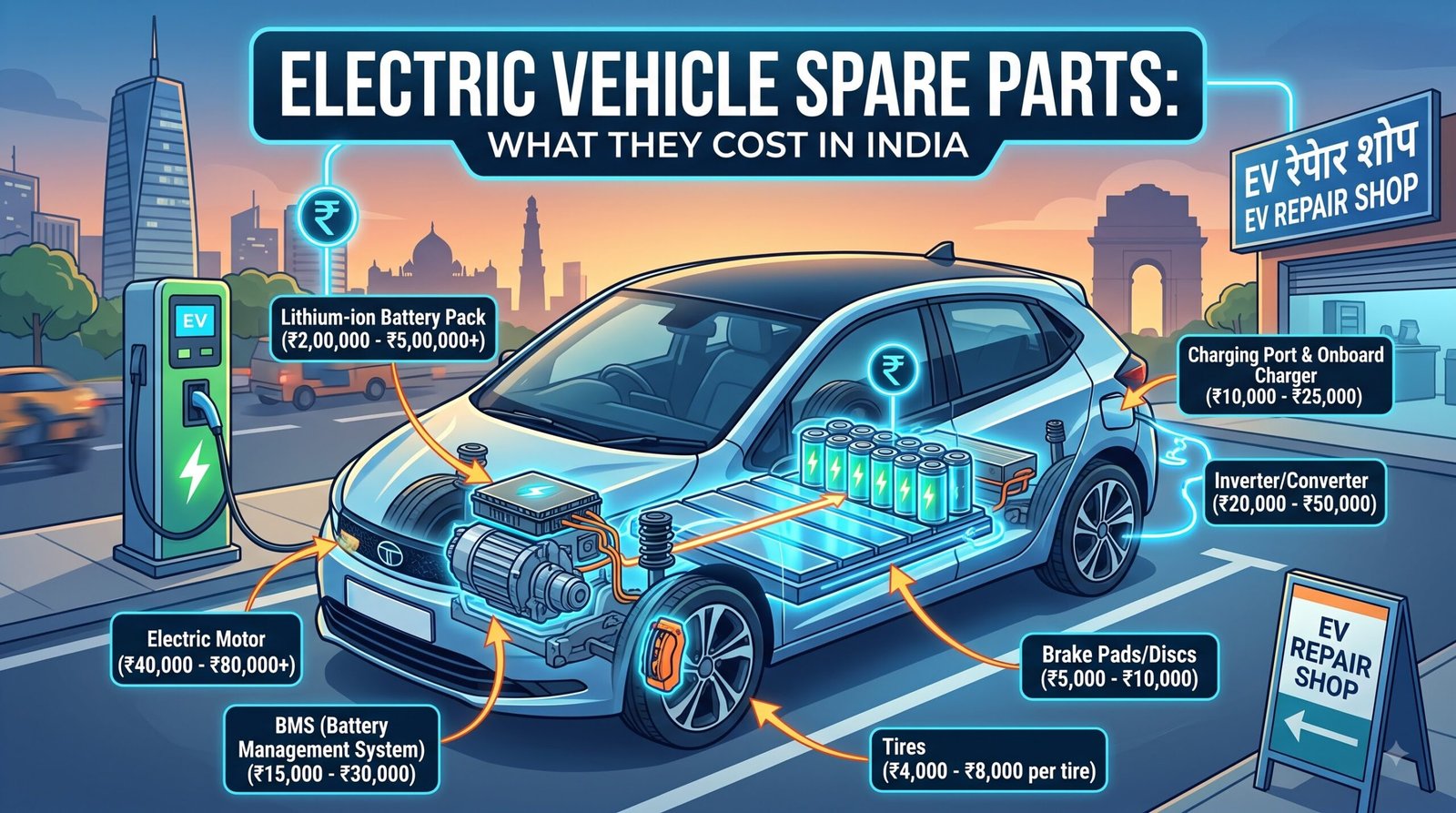
A replacement battery pack for an older Tata Nexon EV was quoted at Rs 6.5 lakh at a service centre in early 2026. A drive motor on the same generation of car came in at Rs 4.5 lakh. Those two numbers explain why electric vehicle spare parts worry buyers more than any other part of EV ownership, and why the honest answer is more complicated than either side of the argument admits.
What parts does an electric vehicle actually have
An electric car has roughly 20 moving parts in its drivetrain against several hundred in a petrol equivalent. That difference is real, and it is the reason routine servicing is cheaper. It is also the reason the parts that do fail cost so much.
The high voltage parts
Four components carry almost all the cost risk in an EV: the battery pack, the drive motor, the inverter or motor control unit, and the onboard charger. These are the parts a local garage cannot touch and a parts market cannot supply.
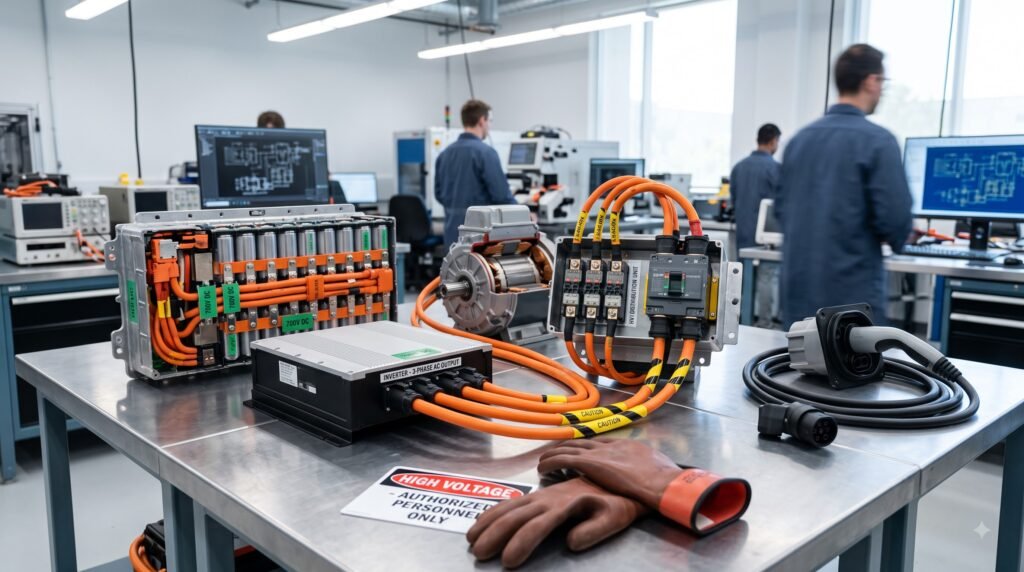
Everything else follows conventional car logic. Suspension, brakes, steering, air conditioning, lights, glass, body panels and interior trim are ordinary automotive components sourced from ordinary suppliers. On a Tata or Mahindra EV, many of these are shared with the petrol version of the same car, which means the parts are already in the dealer system and priced normally.
At EVUnlock, we cross-check specifications against official manufacturer documentation before publishing.
Parts an EV does not have at all
An electric car has no engine oil, oil filter, air filter, spark plugs, fuel pump, fuel injectors, exhaust system, catalytic converter, clutch or multi-speed gearbox.
Strip those out, and you have removed most of what a petrol car goes to a workshop for. No oil change every 10,000 km. No timing belt at 90,000. No clutch job at a lakh and a half. This is where the 30 to 50 percent lower periodic maintenance figure that gets quoted for EVs comes from, and unlike a lot of EV marketing, that one holds up.
Parts that wear differently
Brake pads and discs last considerably longer on an EV because regenerative braking does most of the slowing. Tyres wear faster because EVs are heavier and deliver instant torque.
The tyre point catches people out. A 1,700 kg electric SUV on a set of tyres rated for its weight will typically go through them quicker than a comparable petrol car, and EV specific tyres cost more. Budget for one extra set over five years of ownership and you will not be surprised.
There is also a part petrol cars do not have that fails often enough to matter: the coolant pump for the battery thermal management system. Reported replacement costs sit in the Rs 12,000 to Rs 25,000 range, with coolant service around Rs 3,500 to Rs 8,000. Not catastrophic, but not the zero maintenance story either.
Electric vehicle spare parts prices in India
Here is what the expensive components actually cost, sourced from owner-reported quotes and dealer estimates rather than manufacturer price lists, since Indian manufacturers do not publish battery or motor prices publicly.
| Component | Indicative cost | Basis |
|---|---|---|
| Battery pack, 30 kWh class | Rs 3.5 lakh to Rs 7 lakh | Owner-reported dealer quotes |
| Battery pack, 40 to 45 kWh class | Rs 5.5 lakh to Rs 9 lakh | Published estimates, not official |
| Drive motor | Around Rs 4.5 lakh | Owner-reported dealer quote |
| Battery coolant pump | Rs 12,000 to Rs 25,000 | Workshop estimates |
| Coolant replacement | Rs 3,500 to Rs 8,000 | Workshop estimates |
| Annual periodic service | Rs 2,000 to Rs 5,000 | Manufacturer published ranges |
| Brakes, suspension, body | Same as petrol equivalent | Shared parts on most Indian EVs |
Treat every figure above as an estimate. Quotes vary by city, by dealer, by model year and by whether a module or the full pack is being replaced. What the table gets right is the shape of the problem: two components carry lakhs of risk, and everything else costs what it would on any car.
Why the battery is priced the way it is
The battery pack accounts for roughly 40 to 50 per cent of an electric car’s manufacturing cost, and the replacement price reflects that plus dealer margin and GST.
Cell prices globally have been falling year after year, which means a pack replacement in 2032 should cost meaningfully less in real terms than the same job today. That is a genuine reason not to panic about a number quoted in 2026 for a car you have owned for two years. It is not a reason to ignore it entirely.
Why most owners never pay these prices
Almost every battery and motor failure reported in India so far has been settled under warranty rather than paid for by the owner.
Indian manufacturers cover the battery pack and motor for 8 years or 1,60,000 km as a baseline, and Tata has moved its newer models to a lifetime high voltage battery warranty, defined as fifteen years from first registration for the original private owner. Our guide to EV battery warranty rules in India covers what these terms actually commit a manufacturer to and where they stop.
One owner on Team-BHP described a Nexon EV Prime arriving at a service centre for a pack replacement at 4,00,000 km. The quoted price was Rs 6.5 lakh. At that mileage, the car had saved several times that amount in running costs. Context matters when you look at a scary number.
Which EV parts actually fail, and why
Failure patterns in Indian EVs are now clear enough to talk about honestly, because there is finally a fleet old enough to generate data.
Individual cells fail before packs do
The most common high voltage problem reported by Indian EV owners is not a dead battery. It is one or two weak cells inside an otherwise healthy pack, showing up as sudden state of charge drops or the car entering limp mode at low charge.
Owners have reported this appearing anywhere between 40,000 and 80,000 km on certain Tata packs, which works out to roughly 200 to 250 full charge cycles. That is early. A well-made LFP cell should hold around 80 percent of its capacity after some 3,000 cycles.
So why does a cell die at 250 cycles when the chemistry is good for 3,000?
The cell topology problem nobody explains to buyers
This is the part I think matters most and the part no spare parts listing will tell you. It comes down to whether a pack’s cells are wired in series or in parallel.
When cells sit in series, the battery management system can see each one individually. If a cell drifts, the BMS can balance it, and there is a decent chance it recovers. When cells sit in parallel banks, the BMS sees the bank, not the cell. A cell in that bank with slightly lower internal resistance will take a disproportionate share of the current on every charge and every discharge. It ages faster than its neighbours, nobody notices, and it fails years before the pack should.
Small cylindrical cells have to be wired in parallel to reach useful capacity. Large prismatic and blade format cells carry enough capacity on their own to be wired in series only. That is the real reason newer packs using prismatic LFP cells, including the current Tata Punch EV, are behaving better than the older cylindrical cell packs that generated most of India’s cell failure complaints.
This also kills a comforting idea. You cannot simply swap one dead cell out of a parallel bank. Drop a fresh cell with low internal resistance next to aged ones and current will rush through the new cell while the old ones sit idle. The whole module gets replaced, not the cell, and that is why these repairs cost what they cost.
If you are choosing between two electric cars at a similar price, cell format and pack topology is a more useful question than most of what appears on a spec sheet. It is also almost never disclosed. Ask the dealer anyway. The good ones now know the answer.
Software and electronics, the quiet failure category
Sensors, control units, chargers and connectors generate a steady trickle of faults that are cheap in parts and expensive in diagnosis time.
These are the failures that make service network quality matter more than parts pricing. A workshop with a trained EV technician and the right diagnostic tool clears these in a day. A workshop without either keeps your car for three weeks and replaces things that were not broken. Roadside events follow the same pattern, which is why roadside assistance for electric cars works differently to a petrol breakdown.
Buying EV spare parts in India
The market splits cleanly into two halves that have almost nothing to do with each other.
Two-wheeler and three-wheeler parts are an open market
A large aftermarket exists for electric two-wheeler and e-rickshaw components. BLDC motors, controllers, throttles, chargers, converters, lead-acid and lithium packs are all available online and through parts dealers in most major cities.
Quality varies enormously. Controllers and chargers in particular are the components where cheap generic parts cause fires, and a charger mismatched to a pack is a genuine safety issue rather than a warranty technicality. If you are sourcing parts for an e-rickshaw fleet, buy from established suppliers and match specifications exactly.
Electric car parts are a closed system
For electric cars, high voltage components are available only through authorised dealers. There is no third-party battery pack for a Nexon EV, no aftermarket motor for a Windsor, and no independent workshop authorised to open a pack.
Fitting a non-genuine battery voids the vehicle warranty permanently and carries real fire risk, since packs are engineered around a specific BMS, specific cooling and specific cell chemistry. This is one of the few areas of car ownership where the manufacturer restriction is not simply about protecting revenue.
The practical consequence is that your brand choice determines your parts access for the life of the vehicle. That is a much bigger deal on an EV than on a petrol car, where a Maruti part is available in every town in India whether or not the dealer cooperates.
What to check before you buy the car
Parts availability is a pre purchase question, not a post purchase problem. Work through this before you sign:
- How many authorised service centres with high voltage certified technicians are within 50 km of you?
- Does the brand publish a battery warranty in writing, and does it transfer to a second owner?
- What is the stated turnaround for a battery diagnostic, not a replacement?
- Are the suspension, brake and body parts shared with a petrol model from the same manufacturer?
- Has the brand sold enough units nationally for parts inventory to exist in your region?
- What cell format does the pack use, and are the cells in series or parallel?
The last question will get you a blank look at most dealerships. Ask it anyway, and treat a confident correct answer as a signal about the dealer. Current models on sale are listed in our electric cars section.
Frequently asked questions
Are EV spare parts expensive in India?
Some are, most are not. The battery pack and drive motor run into lakhs, with owner-reported quotes of Rs 6.5 lakh for a pack and Rs 4.5 lakh for a motor. Everything else, including suspension, brakes, body panels and air conditioning, costs roughly the same as the petrol equivalent because the parts are shared.
How much does an EV battery replacement cost in India?
Indicative figures run from around Rs 3.5 lakh for a 30 kWh class pack to Rs 9 lakh for a 45 kWh pack, based on owner reported dealer quotes rather than published price lists. Indian manufacturers do not publish battery prices officially. Most failures within 8 years or 1,60,000 km are covered by warranty rather than paid by the owner.
Can I buy third party spare parts for my electric car?
Not for high voltage components. Battery packs, motors and inverters are available only through authorised dealers, and fitting a non-genuine pack voids the warranty permanently while creating a real fire risk. Conventional parts such as brakes, suspension and body panels can be sourced normally from the aftermarket.
Which EV parts fail most often?
Individual battery cells are the most reported high-voltage issue in India, appearing as sudden state-of-charge drops rather than total pack failure. Coolant pumps, sensors and control electronics generate a steadier trickle of faults. Full pack or motor failures are relatively rare and usually settled under warranty when they happen.
Do electric cars need less maintenance than petrol cars?
Yes. An EV has no engine oil, filters, spark plugs, clutch or exhaust system, which removes most routine workshop visits. Periodic maintenance typically runs 30 to 50 per cent lower than a comparable petrol car, with annual service commonly quoted between Rs 2,000 and Rs 5,000 depending on model and usage.
Are EV spare parts easily available in India?
Availability depends on the brand rather than the technology. Manufacturers with existing petrol vehicle networks stock parts widely because many components are shared. Smaller EV-only brands with thin dealer coverage can leave owners waiting weeks. Check service centre density near you before buying rather than after.
Where can I buy electric scooter and e rickshaw spare parts?
Electric two-wheeler and three-wheeler parts are sold through a large open aftermarket, both online and through parts dealers in most cities. Motors, controllers, throttles and chargers are all available. Quality varies sharply, and mismatched chargers or generic controllers are a genuine fire risk, so buy from established suppliers.
Does replacing a battery cell fix an EV battery pack?
Rarely. In packs where cells are wired in parallel, inserting one new cell alongside aged ones causes most current to flow through the new cell, which then fails early. Workshops replace the whole module rather than a single cell, which is a large part of why these repairs cost what they do.
Is the tyre and brake cost higher on an electric car?
Tyres cost more and wear faster because EVs are heavier and deliver instant torque, and EV-rated tyres carry a premium. Brakes go the other way, lasting considerably longer because regenerative braking handles most deceleration. Over five years, the two roughly offset each other, with tyres slightly ahead.
Should parts cost stop me buying an electric car?
Not by itself, but it should shape which one you buy. The exposure is concentrated in two components, both covered by warranty for eight years or more, and running cost savings usually exceed the eventual risk. What deserves your attention is service network reach and brand stability, not the headline price of a battery pack.
Electric vehicle spare parts are cheaper than petrol parts almost everywhere except the two places that matter most. That is the honest summary, and it is why brand choice and warranty terms deserve more of your attention than the parts catalogue does. Before you commit to a model, read the warranty terms properly and check what service coverage exists near you. Our EV ownership guides cover both.

Gagandeep Singh
Founder, EV UnlockGagandeep Singh is an Electronics and Communication Engineering graduate from BGIET Sangrur and holds an M.Tech in eMobility from IIT Madras (CODE IITM). He is the founder of EV Unlock, an independent electric vehicle research platform. His work combines engineering knowledge, SEO strategy and electric mobility research to deliver verified EV specifications, buying guides and charging information that help buyers make confident, informed decisions.