
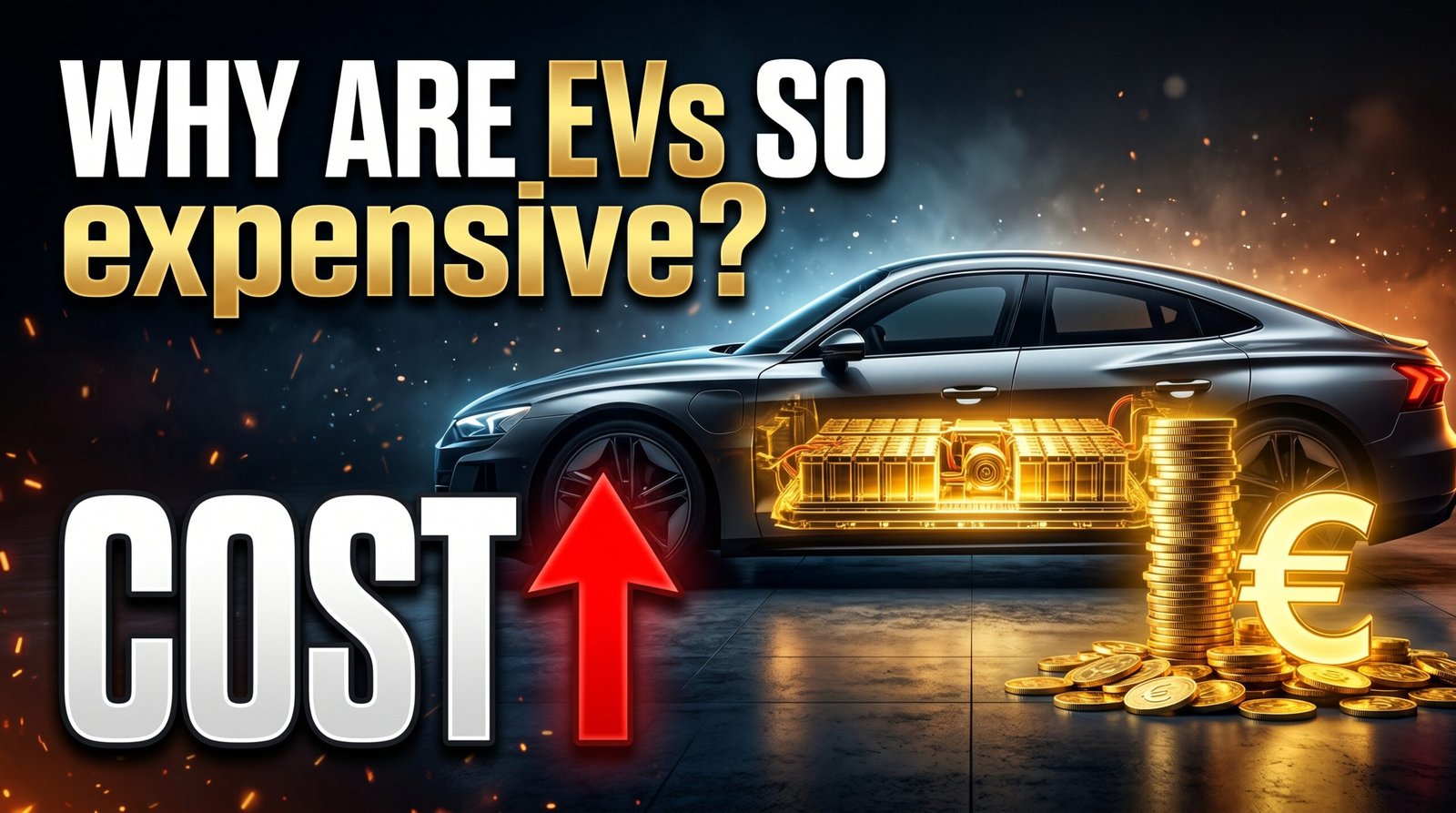
The battery. That is the short answer to why electric cars are expensive, and on most models it accounts for 30 to 40 per cent of what the car costs to build. Imagine buying a petrol car where the fuel tank alone costs as much as a small hatchback. That is roughly the situation. The longer answer involves import duties, manufacturing scale and an Indian policy target that has quietly missed by a mile.
Where the money goes in an electric car
Roughly how the cost of a typical electric car splits, using industry standard estimates. Exact figures shift by model and by market, but the shape holds.
| Battery pack | 30 to 40% | Cells, modules, cooling, BMS, crash casing |
| Body, chassis and interior | 20 to 25% | Similar to a petrol car, plus reinforcement for pack weight |
| Power electronics | 10 to 15% | Inverter, DC-DC converter, onboard charger |
| Motor and drivetrain | 10 to 15% | Motor, single speed reduction gear, axles |
| Thermal management and software | 5 to 10% | Battery cooling loop, vehicle control software |
Two things stand out. The motor and drivetrain are genuinely cheaper than an engine and gearbox, which is why the drivetrain line looks so modest. The software line is not padding either. Vehicle control software in an EV does work that mechanical systems used to do in a petrol car, and it costs real money to develop.
At EVUnlock, we cross-check specifications against official manufacturer documentation before publishing.
What a battery pack actually costs today
The global volume weighted average price of a lithium-ion battery pack fell to 108 dollars per kilowatt hour in 2025, down 8 percent on the previous year, according to BloombergNEF’s annual battery price survey.
Some detail worth having, because the headline number hides useful variation. Packs going specifically into battery electric vehicles averaged 99 dollars per kWh. LFP packs across all applications averaged $ 81 per kWh. Stationary storage packs collapsed 45 percent in a single year to 70 dollars. BNEF expects the overall average to fall again to around 105 dollars in 2026.
Set against 2010, when packs cost well over 1,000 dollars per kWh, that is a decline of roughly 93 percent in fifteen years.
Run the numbers on an actual Indian EV
Take the 40 kWh pack in the current Tata Punch EV, at the 2025 global BEV pack average of 99 dollars per kWh, that pack costs roughly 3,960 dollars to produce, which is somewhere around Rs 3.5 lakh at current exchange rates.
The Punch EV starts at about Rs 8 lakh ex-showroom. Even allowing for dealer margin, GST and the fact that Indian pack costs sit above the global average because cells are imported, you can see the problem immediately. On an entry-level electric car, the battery is not one line item among many. It is close to half the vehicle.
This is also why the cheapest EVs use the smallest packs, and why a manufacturer adding 15 kWh of range to a model bumps the price far more than adding a sunroof. Range costs money in a way that features do not, and that logic carries through the rest of the cost breakdown.
Why the cells themselves are expensive
Cells need lithium, and depending on chemistry, nickel, cobalt, and manganese. These minerals are concentrated in a handful of countries, and their prices swing hard. Lithium spiked in 2022, crashed through 2023 and 2024, and battery prices followed with a lag.
Cobalt is the tighter constraint. A large share of global supply comes from the Democratic Republic of Congo, with the ethical and supply security problems that implies, and that scarcity holds the price up.
Which is exactly why the industry moved to LFP. Lithium iron phosphate cells use no cobalt and no nickel; they last longer, and at 81 dollars per kWh they are meaningfully cheaper than nickel-based chemistries. Almost every Indian EV in the mass market now runs LFP, as does most of BYD’s lineup. The trade-off is lower energy density, which means a slightly bigger, heavier pack for the same range. For an Indian car doing mostly city duty, that trade-off makes sense.
The costs that have nothing to do with the battery
Make the battery free tomorrow and electric cars would still carry a premium, because the industry building them is younger and smaller than the one it is replacing. That is why the next section shifts from cell chemistry to manufacturing scale.
A century of manufacturing head start
Petrol cars have had more than a hundred years to squeeze cost out of every component, supplier contract and assembly line. EVs started that process about a decade ago.
Manufacturers are still amortising billions spent on new platforms, new gigafactories and research that has not yet paid for itself, and they are spreading those costs across relatively few vehicles. As volumes rise, the per-car burden falls. It is the flat screen television story repeating itself, and it is the least mysterious part of the whole question.
The electronics you never see
An EV carries a set of expensive systems that a basic petrol car simply does not need. The inverter converting DC to AC for the motor. The DC-DC converter running the 12-volt electrics. The onboard charger. The thermal loop keeping the pack inside its safe window.
That last one matters more in India than in most markets. Cell ageing accelerates with heat, and a pack sitting in 45-degree ambient temperature in a Rajasthan summer needs a cooling system doing real work, not a token one. This is a place where cost-cutting shows up years later as degradation, and knowing whether your car has active liquid cooling or passive air cooling matters more here than in Europe. Check it before you commit.
Why India adds its own cost layer
India taxes EVs at 5 percent GST with no cess. Petrol and diesel cars sit at 18 percent for small cars and 40 percent for everything else after the GST reform that took effect on 22 September 2025. That tax gap matters because it changes the showroom comparison before the manufacturing differences are even considered.
That is a very large gap, and it does real work on the showroom price. A 5 percent rate against 40 percent on a comparable SUV closes much of the manufacturing cost difference on its own.
The import problem
Almost every lithium-ion cell in an Indian EV arrives from abroad, mostly from China. Importing cells means import duty, shipping, and exposure to the rupee. When the currency moves, EV costs move with it, and manufacturers cannot hedge that away indefinitely. This is why the next section turns to domestic cell manufacturing.
This is the single biggest structural reason an EV costs more in India than the same engineering would cost in China, and it is the reason local cell manufacturing became a policy priority.
The domestic manufacturing story is not going to plan
India’s Production Linked Incentive scheme for Advanced Chemistry Cells set a target of 50 GWh of domestic cell manufacturing capacity when it launched in October 2021. As of 2025, roughly 1.4 GWh had actually been commissioned. That is about 2.8 percent of the target, four years in, and it explains why the policy story matters for prices.
Ola Electric was the only company to commission cell production under the scheme in that period. Reliance says its plant starts in 2026. Exide has pointed to March 2026. Tata’s Agratas targets commercial output in 2027.
I want to be careful here, because this is not a reason to write off Indian manufacturing. Cell plants are genuinely hard, and every major battery-producing country took longer than planned to get its first lines running. But it is a reason to be sceptical of the line that appears in almost every article on this subject, including an earlier version of this one, that domestic manufacturing will bring EV prices down soon. On current progress, meaningful volumes of Indian made cells reaching Indian cars is a 2027 to 2030 story, not a 2026 one.
The practical takeaway for a buyer is simple. Do not wait for local manufacturing to make your EV cheaper. Buy on today’s economics, which the current subsidy and incentive picture improves considerably, or do not buy yet. Models still to arrive are tracked in our upcoming electric cars list.
Are electric cars getting cheaper?
Yes, and the direction is not in serious doubt. What is genuinely uncertain is the timeline, which is why the next section lays out the forces pushing prices down.
What is pushing prices down
Four forces, all currently working:
- Pack prices falling year on year, with BNEF projecting around 105 dollars per kWh for 2026
- LFP displacing nickel-based chemistries across the mass market at roughly 81 dollars per kWh
- Sodium-ion cells entering production, using no lithium at all, aimed at exactly the affordable segment India needs
- Chinese scale and vertical integration, led by BYD, dragging global price expectations down, a trend tracked in the IEA Global EV Outlook
When will EVs match petrol car prices?
Price parity, meaning an electric car costing the same to buy as its petrol equivalent, is expected in several markets during the second half of this decade. Treat any specific year you read as a forecast rather than a date. That forecast follows from the price pressures above, but India still needs its own check.
India is a special case that most global parity forecasts handle badly. The 5 percent GST rate means some Indian EVs are already at or near parity on showroom price against comparably specified petrol cars, well ahead of markets with neutral tax treatment. That parity is policy-driven rather than cost-driven, which means it depends on the tax gap staying where it is.
Hold both thoughts at once. Indian EV pricing looks better than the global cost picture would suggest, and it looks that way because of a tax decision that could change.
The running cost side of the ledger
Purchase price is half the calculation and usually the less important half for anyone covering real distance.
Home charging costs a fraction of petrol per kilometre. Servicing is minimal because there is no engine oil, no clutch, no exhaust, no spark plugs and no timing belt. Brake pads last far longer thanks to regenerative braking. Set against that, tyres wear faster on a heavier car, and the battery carries a replacement risk once out of warranty, which our guide to EV battery warranty rules in India covers in detail. These running costs are what make the earlier price discussion only part of the answer.
For a high mileage driver, the maths usually favours the EV inside three to four years. For someone doing 6,000 km a year, it often does not. The honest version of this answer depends on your odometer, not on your opinion of electric cars.
Frequently asked questions
Why are electric cars more expensive than petrol cars?
The battery pack is the main reason, accounting for 30 to 40 percent of an EV’s build cost. On top of that, manufacturers are still recovering research and factory investment across relatively low volumes, and EV-specific electronics like inverters and thermal management add cost that a petrol car does not carry.
What is the most expensive part of an electric car?
The battery pack, without close competition. It is the EV equivalent of an engine and gearbox combined, and on an entry-level electric car it can approach half the vehicle’s cost. A 40 kWh pack at 2025 global average prices works out to roughly Rs 3.5 lakh before margin, tax or import costs.
How much does an EV battery cost per kWh in 2026?
The global volume-weighted average pack price was 108 dollars per kWh in 2025, with packs specifically for battery electric vehicles averaging 99 dollars and LFP packs 81 dollars. BloombergNEF projects around 105 dollars per kWh for 2026. Indian costs sit above these averages because cells are imported.
Will electric cars get cheaper in India?
Yes, though slower than commonly claimed. Cell prices keep falling, and LFP and sodium-ion chemistries push costs down further. Domestic cell manufacturing, often cited as the fix, had delivered roughly 2.8 percent of its 50 GWh target as of 2025, so that particular saving is further away than most articles suggest.
Why are EV batteries so expensive?
Cells require lithium and, depending on chemistry, nickel, cobalt and manganese, all scarce and price-volatile. Those cells then need assembly into modules, a cooling system, a battery management system and a crash-resistant casing. Each layer adds cost on top of the raw material bill.
Is GST lower on electric cars in India?
Yes. Electric vehicles are taxed at 5 percent GST with no cess. Small petrol and diesel cars sit at 18 percent and other vehicles at 40 percent following the GST reform effective 22 September 2025. That gap is the single largest reason Indian EV pricing looks better than global cost structures would suggest.
Are electric cars cheaper to own despite the higher price?
Often, and it depends entirely on your annual mileage. Home charging costs a fraction of petrol per kilometre, and servicing is minimal with no oil, clutch or exhaust. High mileage drivers typically recover the price difference within three to four years. Low mileage drivers frequently do not.
Why are EVs cheaper in China than in India?
China has enormous cell manufacturing scale, vertically integrated makers like BYD, and a mature domestic supply chain built over more than a decade. India imports most of its cells, which adds duty, freight, and currency exposure. That gap narrows only when Indian cell plants reach real volume.
Does a bigger battery mean a much more expensive car?
Yes, and more than most buyers expect. Because the pack dominates the cost structure, adding capacity raises the price far more sharply than adding features. This is why manufacturers offer small and large pack variants of the same model at substantially different prices while the rest of the car stays identical.
Should I wait for electric cars to get cheaper?
Waiting for a specific price drop rarely works out, because the fall is gradual rather than stepped. The stronger argument for waiting is that charging access or a model that suits you isn’t yet on sale. If today’s total ownership cost already works for your mileage, waiting mostly costs you the savings you would have made in the meantime.
Electric cars are expensive because a battery pack is a large, complicated, mineral-heavy component that a petrol car does not need, and because the industry making them has not yet reached the scale that makes cars cheap. Both of those are changing, though the Indian manufacturing piece is moving slower than the headlines imply. Whether the price makes sense for you comes down to how far you drive, and our electric cars section lists what is currently on sale.

Gagandeep Singh
Founder, EV UnlockGagandeep Singh is an Electronics and Communication Engineering graduate from BGIET Sangrur and holds an M.Tech in eMobility from IIT Madras (CODE IITM). He is the founder of EV Unlock, an independent electric vehicle research platform. His work combines engineering knowledge, SEO strategy and electric mobility research to deliver verified EV specifications, buying guides and charging information that help buyers make confident, informed decisions.