
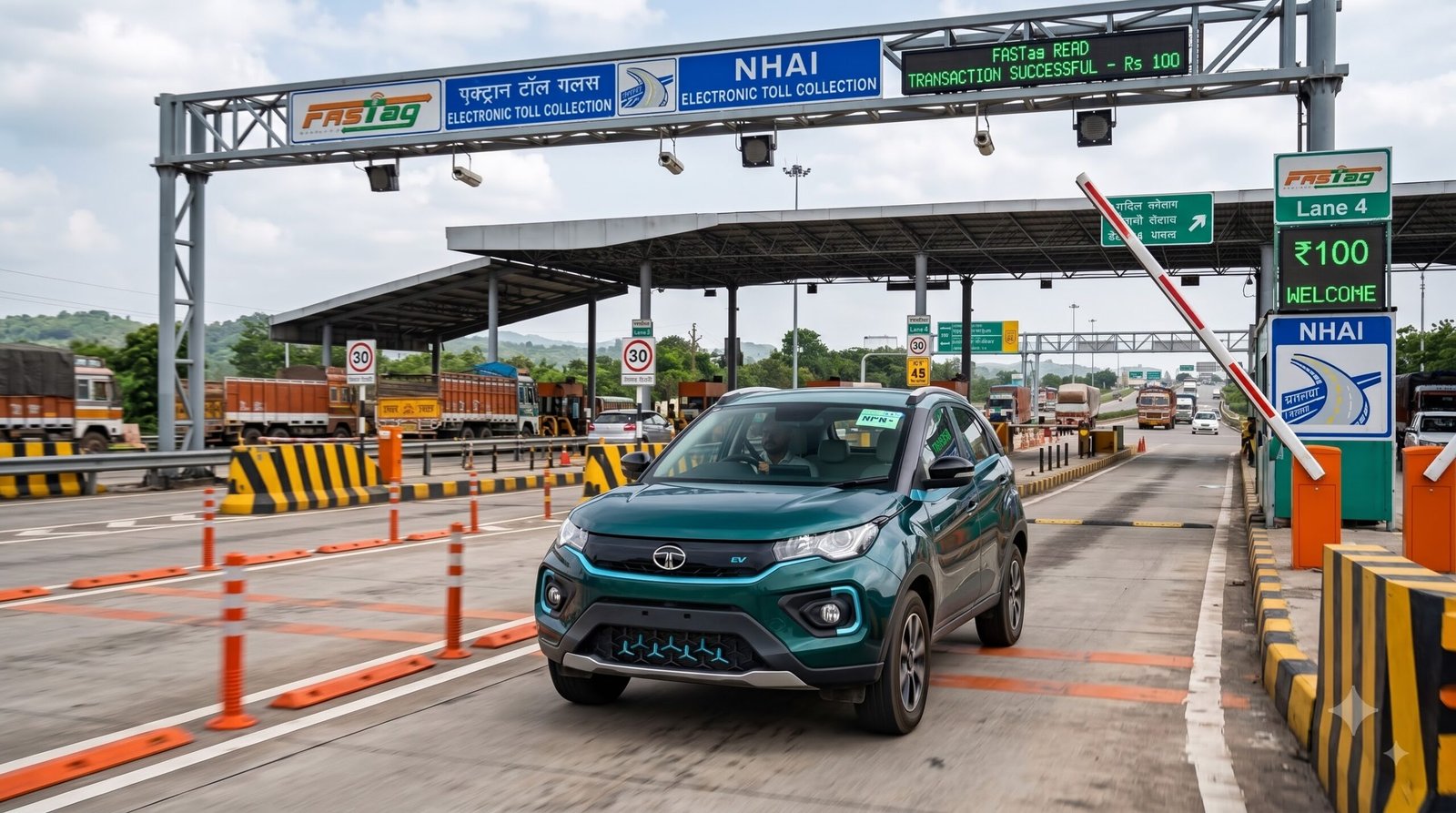
No, not across India. Electric cars pay full toll at every National Highways Authority of India plaza, exactly like petrol and diesel cars. Electric vehicle toll-free status only gets a yes in Maharashtra, which waives toll for passenger EVs and electric buses on three major routes. Everything else green number plates, purchase subsidies, road tax waivers changes nothing at the boom barrier. Here is the complete 2026 picture.
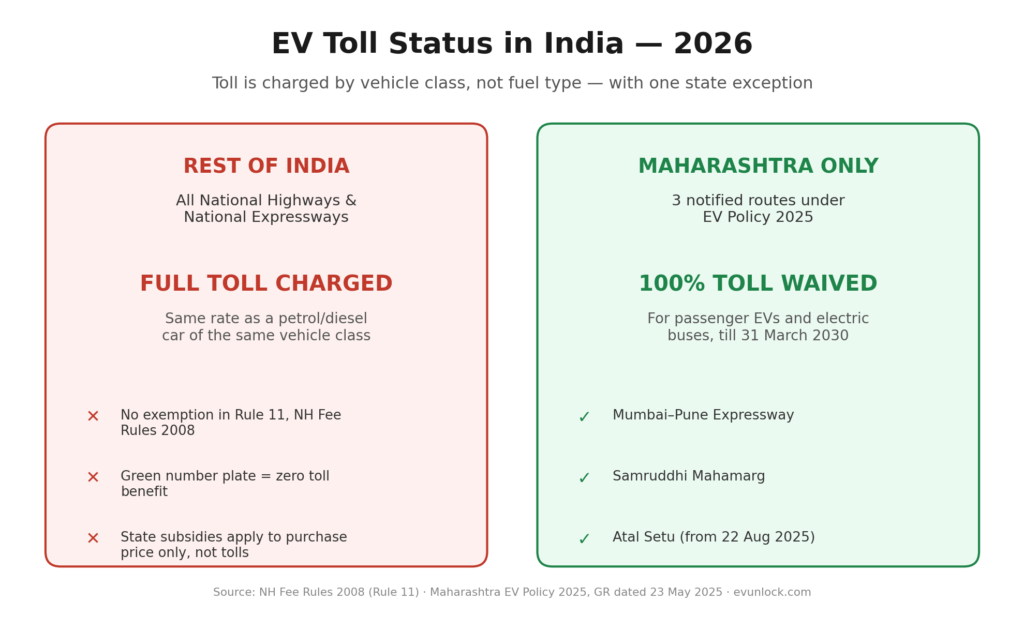
Where Electric Vehicles Pay Toll and Where They Do Not
Toll in India is charged by vehicle class and axle count, never by fuel type. A 1,900 kg electric SUV and a 1,900 kg diesel SUV fall into the same category at the plaza and pay the same amount.
Is Electric Vehicle Toll Free on National Highways? Not Yet
Every national highway and national expressway plaza charges EVs the standard car rate. The exemption list sits in Rule 11 of the National Highways Fee (Determination of Rates and Collection) Rules, 2008, and electric vehicles do not appear anywhere in it. No amendment has added them.
A green number plate signals a battery electric vehicle to traffic police and parking operators. It carries no toll privilege. Plenty of first-time EV buyers assume otherwise, and that assumption likely comes from how loudly state subsidies were marketed while the toll question was left vague. The plate gets you into some low-emission zones and certain municipal parking concessions. It does not open a barrier for free.
Who Actually Gets Toll Exemption Under Central Rules
Exemption is tied to who is in the vehicle or what job the vehicle does. The list covers the President, Prime Minister, Chief Justice, Governors, Members of Parliament on duty, Ministry of Defence vehicles covered by the Indian Toll (Army and Air Force) Act 1901, ambulances, fire tenders, funeral vans, and police vehicles on duty.
These vehicles need a specific exempted-category FASTag issued by NHAI rather than a bank. It is provided free. A regular bank-issued FASTag on an ambulance still deducts money a detail that catches operators out regularly.
Maharashtra Is the Only State With a Confirmed EV Toll Waiver
Maharashtra’s Electric Vehicle Policy 2025, notified through a Government Resolution dated 23 May 2025, grants a 100 per cent toll exemption to passenger electric four-wheelers and electric buses on three routes. The policy period runs from 1 April 2025 to 31 March 2030.
The three covered roads are the Yashwantrao Chavan Mumbai Pune Expressway, the Hindu Hrudaysamrat Balasaheb Thackeray Maharashtra Samruddhi Mahamarg, and the Atal Setu, formerly the Mumbai Trans Harbour Link. Toll collection for EVs on Atal Setu stopped from 22 August 2025.
Why Some Maharashtra EV Owners Still Got Charged
Several owners reported toll deductions and challans on Atal Setu during mid-2025, after the GR was issued but before plaza-level instructions reached operators. FASTag deducts automatically by vehicle class, so an unamended plaza system treats an EV like any other car.
If a covered plaza charges your EV, the practical route is a written complaint to the toll operator and MSRDC quoting the GR date, with your RC showing fuel type as Electric. For national highway disputes, NHAI runs the 1033 helpline. Keep the transaction ID from your FASTag app, because refunds are processed against it.
What Other States Give You Instead
Most state EV policies attack the purchase price rather than the running cost. Haryana approved a 100 per cent vehicle tax exemption on EV registration. Delhi and Meghalaya both refreshed their EV policies with purchase incentives across two-, three- and four-wheelers. Road tax and registration fee waivers are common, and they are worth real money on a ₹15 lakh car.
Toll is a different budget line, controlled by whoever built the road. That split explains why a state can hand you a ₹1.5 lakh subsidy and still charge you ₹300 at the plaza an hour later.
How EV Owners Can Cut Toll Costs in 2026
With no national exemption available, the savings have to come from the same tools every car owner uses. The good news is that EVs qualify for all of them.
The ₹3,000 FASTag Annual Pass Applies to EVs
NHAI launched the FASTag Annual Pass on 15 August 2025 at ₹3,000. It covers 200 toll crossings or one year, whichever ends first, at national highway and national expressway plazas.
Eligibility runs on vehicle class and usage, verified through the VAHAN database. Private cars, jeeps and vans qualify. Commercial registrations do not. Battery electric cars pass the test because nothing in the criteria references fuel type.
At 200 crossings, the effective rate works out to ₹15 per plaza. The chart below shows roughly where the pass starts saving you money against paying toll on every trip — the exact crossover point depends entirely on the toll rates on the route you actually drive.
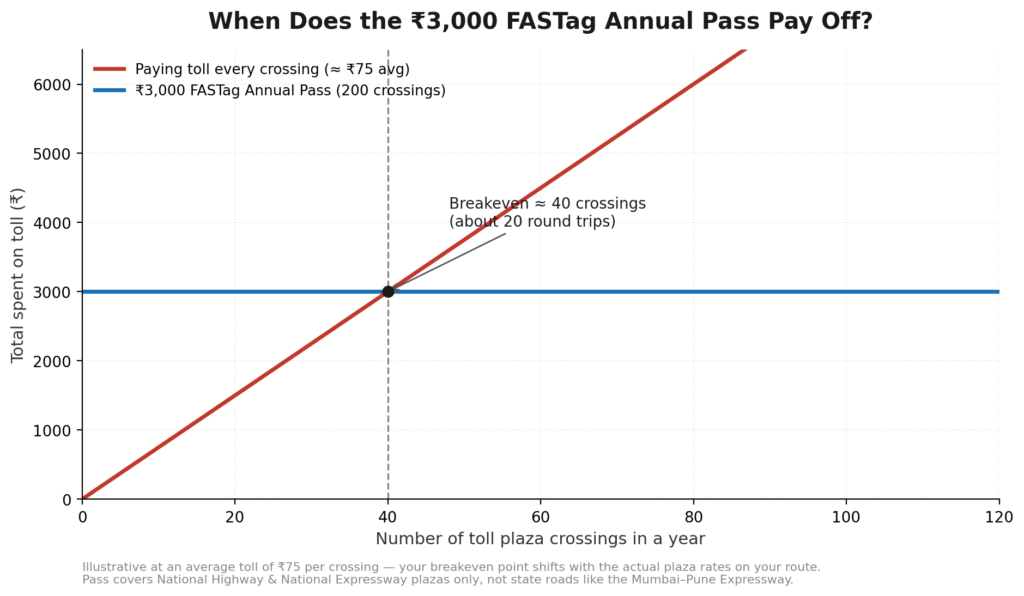
The pass does not work on state roads, so a Mumbai-Pune Expressway trip sits outside it entirely that is where the Maharashtra waiver picks up instead.
Keep Your RC, FASTag and Vehicle Class Aligned
Three errors cause most EV toll problems. A FASTag issued in the wrong vehicle class deducts the wrong amount. A blacklisted or low-balance tag doubles your charge at the barrier. An RC that still lists the wrong fuel type after a transfer weakens any exemption claim in Maharashtra.
MoRTH amended the Central Motor Vehicles Rules in January 2026 to make clearance of pending toll dues mandatory before ownership transfer and before a fitness certificate is issued. NHAI has also been phasing out cash collection at national highway plazas from April 2026. A funded, correctly classified FASTag matters more now than it did two years ago.
What a Toll Waiver Is Actually Worth on a Long Drive
On a Mumbai to Pune return run, the Maharashtra exemption saves a few hundred rupees each way, which lands close to the cost of a full DC fast-charging session. Over a year of fortnightly trips, it becomes a genuine line item.
One planning note for highway drives: budget your charging stops against real-world highway range, not the ARAI-certified figure on the brochure. Sustained 100 km/h running typically pulls real range 20 to 30 per cent below the certified number, and that gap decides whether you stop once or twice.
What Could Change Next
MoRTH has discussed toll concessions for electric vehicles more than once, and NITI Aayog’s August 2025 EV report pushed for stronger usage-stage incentives. Newer concession frameworks reference EV discounts capped at the level applicable to an ICE vehicle of equivalent gross vehicle weight, which suggests parity rather than free passage is the direction of travel.
A blanket national waiver looks unlikely while toll revenue funds highway construction. A discount band for EVs is far more plausible than a zero. Nothing has been notified as of now, so treat any viral claim of nationwide free tolls for EVs as false until it appears in a MoRTH notification.
Frequently Asked Questions
Is electric vehicle toll free on national highways in India?
No. Electric cars pay the standard car rate at every NHAI plaza. Rule 11 of the National Highways Fee Rules, 2008 lists exempt categories such as defence vehicles, ambulances and constitutional dignitaries, and electric vehicles are not included. No central notification has changed this position, so budget toll into any interstate EV trip.
Which roads in India are toll free for electric cars?
Three Maharashtra routes under the state EV Policy 2025: the Mumbai Pune Expressway, the Samruddhi Mahamarg and the Atal Setu. Passenger electric four-wheelers and electric buses get a 100 per cent waiver on these, valid through the policy period ending 31 March 2030. No other state has notified a comparable toll exemption.
Do electric two-wheelers and scooters pay toll?
Two-wheelers are exempt from toll on national highways regardless of fuel type, so electric scooters and motorcycles pass free. This is a two-wheeler rule rather than an EV benefit. Some state roads and bridges apply their own two-wheeler charges, so check local signage before assuming free passage on non-NHAI stretches.
Is Atal Setu toll-free for EVs?
Yes, from 22 August 2025. The Maharashtra government extended its EV Policy 2025 toll exemption to the Mumbai Trans Harbour Link from that date. Passenger EV cars and electric buses cross without charge. Owners who were charged before implementation can raise a refund claim with the toll operator using their FASTag transaction ID.
Do electric buses get toll exemption anywhere?
Electric buses are covered by the Maharashtra EV Policy 2025 waiver on the three notified routes, alongside passenger EV cars. Outside Maharashtra, electric buses pay standard bus category toll on national highways. Fleet operators should confirm the class assigned to their FASTag, since bus category rates vary sharply by axle count.
Does a green number plate mean toll exemption?
No. The green plate identifies a battery electric vehicle for enforcement, parking and low-emission-zone purposes. It carries no toll benefit at any plaza. Toll systems read the FASTag and the registered vehicle class, not the plate colour, so an EV with a green plate is charged exactly like a comparable petrol car.
Can EV owners buy the ₹3,000 FASTag Annual Pass?
Yes. The pass launched on 15 August 2025 for private non-commercial cars, jeeps and vans verified through VAHAN, and eligibility does not reference fuel type. It covers 200 crossings or one year on national highways and national expressways. Commercial registrations are excluded, and it does not apply on state roads.
What should I do if a Maharashtra plaza charges my EV?
Save the FASTag transaction ID immediately, then file a written complaint with the toll operator and MSRDC quoting the Government Resolution dated 23 May 2025. Attach your RC showing fuel type as Electric. For national highway plazas, use the NHAI 1033 helpline. Refunds are processed against the transaction record rather than a verbal claim.
Do EVs get toll exemption in Delhi, Karnataka or Tamil Nadu?
No. These states offer purchase-side incentives such as road tax exemption, registration fee waivers and subsidies, but none has notified a toll waiver for electric vehicles. Toll on roads within these states is charged normally. Maharashtra remains the outlier on usage-stage toll benefits as of 2026.
Will electric vehicles become toll-free across India?
Unlikely in blanket form. Toll revenue services highway construction debt, so a full national exemption would need a funding replacement. Recent concession frameworks point toward capped discounts for EVs rather than free passage. Any claim of nationwide free tolls should be verified against a MoRTH notification before you plan a trip around it.

Gagandeep Singh
Founder, EV UnlockGagandeep Singh is an Electronics and Communication Engineering graduate from BGIET Sangrur and holds an M.Tech in eMobility from IIT Madras (CODE IITM). He is the founder of EV Unlock, an independent electric vehicle research platform. His work combines engineering knowledge, SEO strategy and electric mobility research to deliver verified EV specifications, buying guides and charging information that help buyers make confident, informed decisions.