
Three companies sell more than eight out of every ten electric cars in India. That is the number that matters, and almost nobody puts it at the top of a page about electric vehicle companies in India. Directories list a hundred-plus names, government portals count several hundred manufacturers, and none of it tells you who is actually shifting metal. This ranking uses VAHAN registration data from July 2026 instead.
Electric car companies in India ranked by sales
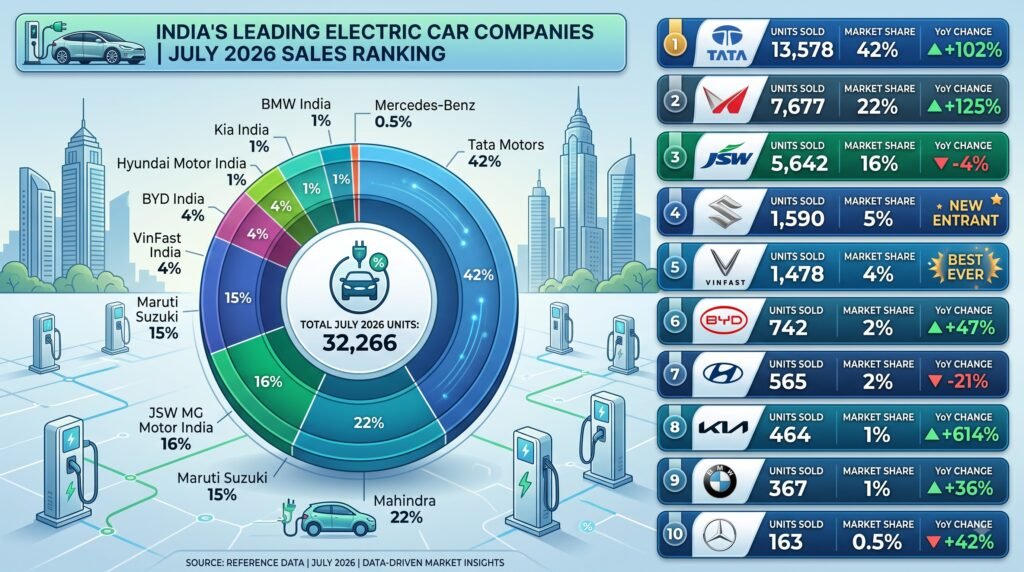
India registered 32,609 electric passenger vehicles in July 2026, up 83 percent from the 17,823 units of July 2025. Here is how that split by company.
Which company sells the most electric cars in India?
Tata Motors sells the most electric cars in India, with 13,578 units registered in July 2026 and a 42 per cent market share. That was the company’s highest-ever monthly EV figure and a 102 per cent jump year on year.
| Rank | Company | July 2026 units | Market share | YoY change |
|---|---|---|---|---|
| 1 | Tata Motors | 13,578 | 42% | +102% |
| 2 | Mahindra | 7,677 | 22% | +125% |
| 3 | JSW MG Motor India | 5,642 | 16% | -4% |
| 4 | Maruti Suzuki | 1,590 | 5% | New entrant |
| 5 | VinFast India | 1,478 | 4% | Best ever |
| 6 | BYD India | 742 | 2% | +47% |
| 7 | Hyundai Motor India | 565 | 2% | -21% |
| 8 | Kia India | 464 | 1% | +614% |
| 9 | BMW India | 367 | 1% | +36% |
| 10 | Mercedes-Benz India | 163 | 0.5% | +42% |
Below the top ten, the tail gets thin fast. Toyota managed 123 units, Tesla 115, Stellantis 51, Volvo 48, Porsche 6. Audi, Rolls-Royce and Jaguar Land Rover registered nothing at all that month. These are companies with functioning showrooms and press fleets, selling in single or double digits.
At EVUnlock, we cross-check specifications against official manufacturer documentation before publishing, and registration figures against the VAHAN dashboard maintained by the Ministry of Road Transport and Highways.
Mahindra and JSW MG are moving in opposite directions
Mahindra grew 125 percent year on year to 7,677 units while JSW MG shrank 4 percent to 5,642. Both sit in the same broad price band. Only one is winning.
Mahindra’s run comes from the BE 6, XEV 9e and the three-row XEV 9S. It has now cleared 7,000 units a month twice in a row, which two years ago would have been a national record rather than a Mahindra one.
MG’s story is the more instructive one. A year ago it held roughly 33 percent of this market. Today it holds 16. The Windsor EV still does most of the brand’s volume, and it still sells well. MG did not get worse. Everyone else got serious, and a single strong model cannot hold a third of a market once three rivals show up with full lineups. If you are shopping this segment, the current options are listed in our electric cars section.
Maruti, Hyundai and the foreign brands
Maruti Suzuki entered the electric car market properly with the e-Vitara and has held four-figure monthly volumes for five months running. For the company that owns roughly 40 percent of India’s petrol car market, 1,590 electric units is a rounding error, and it is also a start.
The foreign brand picture is stranger. VinFast, a Vietnamese company almost nobody in India had heard of three years ago, outsold BYD, Hyundai, Kia, BMW and Tesla combined in July. Its VF Limo Green does most of that volume, largely through fleet channels.
Tesla sold 115 cars. That is its best-ever month in India, achieved after a price cut, and it is still fewer cars than Tata sells before lunch. Import duties explain part of it. The rest is that a Model Y costs what a small apartment costs in most Indian cities. Brands still to launch here are tracked in our upcoming electric cars list.
Why three companies control 82 percent of the market
Tata, Mahindra and JSW MG together registered 26,897 of July’s 32,609 electric cars. That is 82.5 per cent held by three names out of the dozens that technically sell EVs here.
This concentration is not an accident and it is not really about the cars. It is about three things that are expensive and slow to build: a service network that reaches beyond metros, a dealer network willing to stock something new, and enough manufacturing scale to price an EV within reach of a petrol equivalent. A startup can engineer a good electric car. It cannot conjure 300 service centres in Tier 2 towns.
There is a second, quieter reason. Tata and Mahindra both build their EVs on platforms that share plant capacity and supplier contracts with their petrol vehicles. That shared base is why they can absorb thin EV margins while a pure-play EV company cannot. It is the same structural advantage that let legacy Japanese brands survive the hybrid transition, and it is why I would be careful about any prediction that startups will disrupt the four-wheeler EV market in India this decade. The barrier is not battery technology. It is the boring stuff.
Electric two wheeler and three wheeler companies in India
The two-wheeler segment is five times the size of the car segment by volume and gets a fraction of the coverage. India registered around 1,92,000 electric two wheelers in July 2026, a 77 per cent rise year on year.
Which company sells the most electric scooters in India?
TVS Motor Company sells the most electric two-wheelers in India, with a record 52,130 units in July 2026.
| Rank | Brand | July 2026 units | Lead model |
|---|---|---|---|
| 1 | TVS Motor | 52,130 | iQube |
| 2 | Bajaj Auto | 43,229 | Chetak |
| 3 | Ather Energy | 28,602 | Rizta, 450 series |
| 4 | Hero MotoCorp (Vida) | 19,294 | VX2, V2 |
| 5 | Ola Electric | 12,507 | S1 series |
TVS, Bajaj and Ather together took 1,23,938 units, or about 64 percent of the segment. Same pattern as the car market, slightly less extreme.
What is worth noticing is who those top two are. TVS and Bajaj are not EV companies. They are eighty year old petrol two wheeler manufacturers who decided to take this seriously, and they are now beating the companies that were built specifically to disrupt them.
What happened to Ola Electric
Ola Electric led India’s electric two-wheeler market as recently as early 2025 and now sits fifth with 12,507 units, roughly a quarter of TVS
The short version is service. Ola scaled sales faster than it scaled the ability to fix what it sold, and in a market where a scooter is often a household’s only vehicle, a three-week workshop wait ends a brand’s word of mouth permanently. The company also built its own retail network from scratch while TVS and Bajaj simply pointed their existing dealer networks at a new product.
I find this the single most useful case study in Indian EV history, and I would want anyone buying any electric vehicle to read it as a warning rather than a story about one company. Ask where the nearest service centre is before you ask about range.
Electric three-wheeler companies you have probably never heard of
Three wheelers are the most electrified segment in India by a wide margin, with well over half of new registrations in some months being electric. Almost none of those brands are household names.
The players here include Mahindra Last Mile Mobility, YC Electric, Dilli Electric Auto, Saera Electric, Bajaj Auto, Piaggio and Euler Motors. Many operate regionally, several sell mainly to fleet operators and last-mile logistics companies, and a large share of the market still runs on small unbranded assemblers.
The reason this segment went electric first is straightforward economics rather than policy. An e-rickshaw pays for itself on fuel savings inside a year because it runs all day. No consumer emotion involved, no range anxiety debate, just arithmetic. Anyone arguing that Indian buyers are not ready for EVs should look at what happened here when the maths worked.
Electric bus makers in India
Olectra Greentech, Tata Motors, Switch Mobility and JBM Auto supply most of India’s electric buses, mainly through state transport tenders rather than open market sales.
This segment moves on government procurement cycles, so its numbers swing wildly month to month. It matters more than the volumes suggest, because a single city bus replaces a lot of diesel and runs high daily distances. Funding largely flows through the Ministry of Heavy Industries schemes, currently PM E-DRIVE.
How to judge an EV company before you buy from it
Brand choice matters more with an electric vehicle than with a petrol one, because the expensive parts are proprietary and the service knowledge is not yet widespread at independent garages.
How many EV manufacturers are there in India?
NITI Aayog’s e-AMRIT portal counted around 380 EV manufacturers as far back as 2021, and consumer directories currently list well over a hundred active brands across all vehicle types.
Set that against what we just counted. Six companies account for the overwhelming majority of electric cars and scooters sold in this country. The gap between 380 and 6 is where buyers get into trouble, because a company can be perfectly real, legally registered, listed on every directory, and still sell a few hundred units a year with no service presence in your city.
What happens if your EV brand shuts down
You keep the vehicle and lose the support system. Spare parts stop, software updates stop, and the battery warranty becomes a piece of paper with nobody behind it.
India has already run this experiment. Several two-wheeler brands that were genuinely near the top of the sales charts during the FAME subsidy years have effectively vanished from current rankings. Their customers still have scooters. What those customers do not have is a dealer who can source a controller or honour a warranty claim.
The battery is the part that hurts. A replacement pack can cost a third of the vehicle’s original price, and it is the one component you cannot source from a local parts market. Our guide to EV battery warranty rules in India covers what these warranties actually commit a manufacturer to.
Questions to ask before buying from a smaller EV brand
Before you sign anything, work through this list:
- How many service centres does the brand have within 50 km of you, and are they company-owned or third-party?
- How many units has it sold nationally in the last twelve months, not since inception?
- Who owns the company, and does that parent have other profitable businesses?
- Is the battery pack a standard cell format or a proprietary design only they can supply?
- What has resale value on this brand looked like over the past two years?
- Does the warranty transfer to a second owner, and under what conditions?
None of this means you should only buy from the top three. It means you should know what you are trading away for a lower price or a better spec sheet. A smaller brand with a strong regional service presence can be a perfectly sensible buy. A smaller brand with a nice website and no workshop within 200 km is not.
Purchase side support also varies by state and by manufacturer, which our EV subsidy guide breaks down.
Frequently asked questions
Which is the No 1 EV company in India?
Tata Motors is the number one electric car company in India, with 13,578 units and a 42 percent share of electric passenger vehicle registrations in July 2026. In electric two-wheelers, TVS Motor leads with 52,130 units. The answer depends entirely on which segment you mean, since no single company leads across both.
How many EV manufacturers are there in India?
NITI Aayog’s e-AMRIT portal has listed around 380 EV manufacturers, and consumer directories carry over a hundred active brands. The practical number is far smaller. Six companies account for the large majority of electric cars and two-wheelers actually sold, so the headline count overstates how much real choice exists.
Who is the largest electric two wheeler manufacturer in India?
TVS Motor Company, with a record 52,130 electric two wheelers registered in July 2026. Bajaj Auto follows with 43,229 units through the Chetak, and Ather Energy third with 28,602. Those three brands together hold roughly 64 percent of India’s electric two wheeler market.
Is Tata the biggest EV company in India?
Tata is the biggest electric car maker in India but not the biggest EV company overall, since electric two wheelers outsell electric cars by roughly six to one and TVS leads that segment. Tata also builds electric buses and commercial vehicles, which makes it the broadest EV manufacturer across categories.
Which foreign EV brands sell in India?
BYD, VinFast, Tesla, BMW, Mercedes-Benz, Volvo, Porsche, Hyundai, Kia and Toyota all sell electric vehicles in India. Volumes are small. VinFast leads the group with 1,478 units in July 2026, while Tesla managed 115 and Porsche six. Import duties keep most of these brands in niche territory.
What happened to Ola Electric?
Ola Electric fell from market leadership to fifth place, selling 12,507 units in July 2026 against TVS Motor’s 52,130. Service capacity was the main issue, alongside the cost of building a retail network from scratch while established rivals used existing dealer infrastructure. The company still sells in volume, just no longer at the top.
Are electric three wheelers a bigger market than electric cars in India?
Yes, by a wide margin. Electric three wheelers outsell electric cars several times over and represent India’s most electrified vehicle segment. The economics drive it, since a vehicle running all day recovers its price premium through fuel savings quickly. Most brands in this segment are regional and unfamiliar to car buyers.
Which EV company is best for after-sales service in India?
Companies with existing petrol vehicle networks generally offer wider service coverage, since Tata, Mahindra, TVS and Bajaj can route EV servicing through dealerships that already exist in smaller towns. Rather than trusting a brand’s national claim, check how many centres sit within 50 km of your address before buying.
Are there any profitable EV companies in India?
Profitability in this sector is mixed and reported at group level rather than per vehicle, so a clean answer is hard to give. Established manufacturers absorb thin EV margins using shared platforms and plants. Pure-play EV companies have generally found the path to profit slower than projected. Treat any specific claim here with caution.
Should I buy from a small EV brand in India?
It can work if the brand has real service presence near you and a parent company with other revenue. The risk is not that the vehicle fails; it is that support disappears. Battery replacement is the exposure that matters, since a pack can cost a third of the vehicle price and cannot be sourced locally.
India’s EV market has consolidated faster than most people realise. Six companies now decide what the majority of buyers actually drive, and the directory listing a hundred brands is telling you about registrations rather than reality. Judge a company by units sold and service reach, not by how good the launch video looked. If you are working out which model fits, start with our electric car comparisons, and check charging infrastructure in your city before you commit.

Gagandeep Singh
Founder, EV UnlockGagandeep Singh is an Electronics and Communication Engineering graduate from BGIET Sangrur and holds an M.Tech in eMobility from IIT Madras (CODE IITM). He is the founder of EV Unlock, an independent electric vehicle research platform. His work combines engineering knowledge, SEO strategy and electric mobility research to deliver verified EV specifications, buying guides and charging information that help buyers make confident, informed decisions.
1 thought on “Electric Vehicle Companies in India: Who Actually Leads in 2026”