
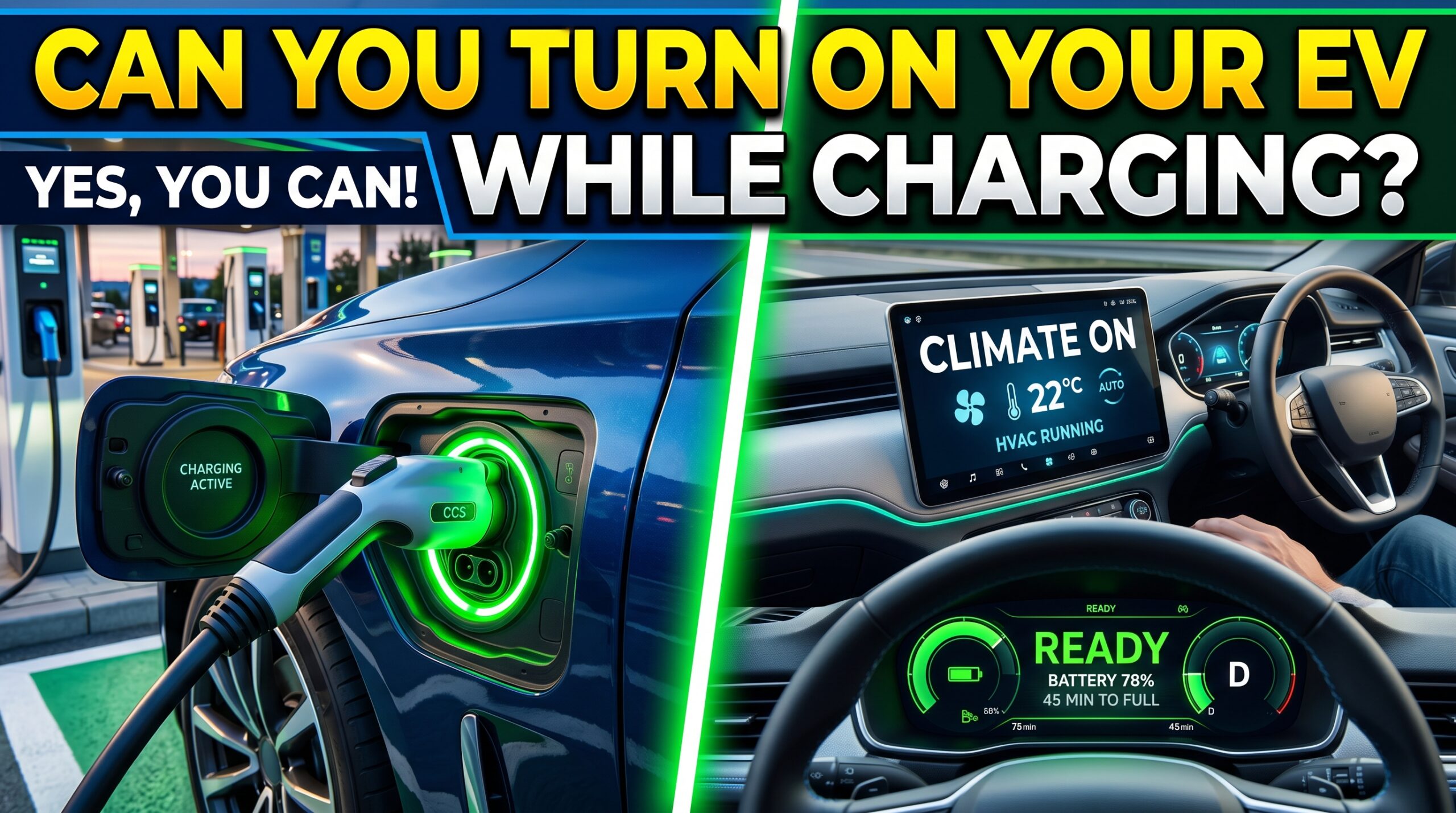
Yes. Switching an EV on while it is plugged in is safe, allowed by every mainstream manufacturer, and something owners do constantly. The car will run its screens, climate control and accessories quite happily. What it will not do is move, and there is a specific piece of engineering that makes sure of it. The more useful questions are what actually slows down, what stays off, and whether sitting inside during a fast charge is a good idea.
What happens when you turn on an EV while charging
Pressing the start button on a plugged in EV wakes the low voltage systems and the cabin. It does not engage the drivetrain. Those are two separate things, and the car keeps them separate on purpose.
Can you turn on an electric car while charging?
Yes, on effectively every EV sold today. Manufacturers design for it because charging stops are long enough that people need the car usable while they wait.
With the car switched on and charging, you get the infotainment screen, navigation, music, phone charging, seat heaters and full climate control. Lights and wipers work. The 12 volt system runs off the main pack rather than draining the small battery, which is one reason leaving it on during a charge is harmless.
At EVUnlock, we cross-check specifications against official manufacturer documentation before publishing.
Why the car will not let you drive away
The connector itself tells the car it is plugged in. Charging standards include a proximity pilot circuit, a dedicated pin in the connector that carries a resistance value the vehicle reads continuously. While that circuit reports a connected plug, the vehicle blocks drive engagement.
Shift to Drive on a plugged in EV and you get a message telling you to unplug first. The car does not creep, does not lurch, and cannot rip the cable out of the socket. This is not a software nicety that varies by brand, it is built into the connector standards that SAE J1772 and its international equivalents define, and that the IEC 61851 standard mirrors internationally, which is why it behaves the same way on a Hyundai in Seoul and a Tata in Pune.
Worth understanding for a second reason too. Because the interlock lives in the connector circuit rather than in the charger, it works even on a dumb home socket setup. The protection travels with the cable.
What works and what does not with the car switched on
| System | While plugged in and switched on |
|---|---|
| Infotainment, navigation, audio | Full function |
| Air conditioning and heating | Works, may draw from the charger |
| Seat heaters, USB charging, 12V sockets | Full function |
| Lights, wipers, windows | Full function |
| Drive and Reverse | Blocked until unplugged |
| Some driver assistance calibrations | Unavailable while stationary and plugged in |
Does having the car on slow down charging?
Slightly, and how much depends on what you are running and how fast the charger is. Anything the car consumes while plugged in comes out of the power arriving at the connector, so it is energy not going into the pack.
On a home AC charger pulling 3 to 7 kW, running the air conditioning hard is a real proportion of the total. Climate systems can draw one to three kilowatts, so on a slow charger you might add a noticeable chunk of time. On a 150 kW DC charger, the same climate load is a rounding error.
The honest summary is that this matters at home overnight far less than people think, because you have hours of slack, and matters least of all at a fast charger, where you have the power to spare. The case where it genuinely bites is a slow public AC charger you are relying on to reach a specific state of charge before a deadline.
Is it safe to sit in an electric car while charging?
Yes. There is no meaningful electrical risk to occupants sitting in an EV during a normal charging session, at home or at a public charger, on AC or on DC.
Why sitting inside is safe
High voltage in an EV is fully enclosed and isolated from the body shell. The pack, cabling and connectors are sealed, and the car runs continuous insulation monitoring that shuts the system down if it detects a fault. Charging equipment carries its own residual current protection, and the charging levels themselves are described by the US Department of Energy.
Compare it to the thing everyone is comfortable with. Standing next to a petrol pump means standing next to flowing fuel and its vapour. Charging an EV produces no fumes, no spillage and nothing flammable at the point of connection. On any honest reading, the EV situation is the calmer of the two.
Sitting inside during DC fast charging
Also fine, and this is where most of the anxiety sits. A 150 kW DC charger moves serious power, which makes people nervous, but the current flows through a sealed cable into a sealed inlet and then into a sealed pack.
Two practical notes rather than safety ones. Opening a door mid session does not interrupt a DC charge, so you can get in and out freely. And on very hot days the pack cooling system works harder during a fast charge, so you may hear pumps and fans running and feel warm air under the car. That is the thermal management doing its job, not a warning sign. Pack cooling behaviour also shapes long term health, which our guide to EV battery warranty and degradation gets into.
What manufacturers actually say
Guidance varies more than you would expect. Most manufacturers say nothing prohibitive and design the car for occupancy during charging. A few owner’s manuals include cautious wording suggesting occupants step away during high power charging, which reads to me as legal conservatism rather than a described hazard.
Check your own manual if you want certainty, because that is the document a manufacturer will point to. What I have not seen anywhere is a manufacturer describing an actual mechanism by which sitting in the car during charging causes harm.
Thunderstorms, heat and the edge cases
Charging during a thunderstorm is a reasonable thing to pause. Not because the car is unsafe, but because a nearby strike can damage charging equipment through the supply, and outdoor charging posts are exposed. Home installations should have surge protection on the circuit.
Flooded or waterlogged ground is the other one worth avoiding, and that is a general electrical caution rather than an EV specific rule. Charging in ordinary rain is fine and the connectors are designed for it.
Using air conditioning and accessories while charging
Running the climate control while plugged in is not only allowed, it is often the smartest thing to do with the car.
Can you use the AC in an EV while charging?
Yes, and while plugged in it costs you nothing in range. The energy comes from the charger rather than from the pack, so you arrive with the same state of charge and a cool cabin.
This is genuinely one of the better parts of EV ownership and it gets undersold. Waiting in a car park in 40 degree heat with full air conditioning running, drawing nothing from your battery, is not something a petrol car can offer without idling an engine.
How much does climate control affect charging speed?
Expect the effect to scale inversely with charger power. On a 3 kW home socket, a 2 kW climate load is enormous. On a 50 kW DC unit it is minor. On a 150 kW or faster charger it disappears into the noise.
There is a second effect that only shows up during fast charging. On a very hot day the same cooling system serves both the cabin and the battery pack, and cooling capacity is finite. If the pack needs everything the cooling system can give, the car prioritises the pack and charging speed can taper. This is uncommon and it is a hot climate scenario, but it is the one real technical answer to the question of whether AC slows a fast charge.
Preconditioning is the same idea running in reverse
Most modern EVs let you warm or cool the cabin on a schedule while still plugged in, before you leave. The car uses grid power for it and departs at full charge with the interior already comfortable.
The same feature often preconditions the battery, bringing the pack to a temperature where it can accept higher charging power. Cold packs charge slowly because lithium ion cells resist fast charging at low temperature. Warming the pack before you arrive at a fast charger can cut a session meaningfully in winter, which is why route planners in newer cars trigger it automatically. More on getting the most from a session sits in our EV charging guides.
What you should never do while charging an EV
Very little is genuinely dangerous, but a handful of things are worth avoiding:
- Do not use a damaged cable or a connector with visible burn marks or corrosion
- Do not run a portable charger through an extension lead or a multi plug board
- Do not charge from a domestic socket that has not been checked for continuous load, since granny cable charging draws near maximum current for hours
- Do not force a connector that will not seat properly
- Do not attempt to disconnect a DC session by pulling the cable, always stop the session at the unit or in the car first
- Do not leave the vehicle occupied by children or pets unattended in extreme heat relying on climate control alone
- Do not block a fast charging bay after your session ends, which is etiquette rather than safety but matters more than most safety concerns in practice
The extension lead point is the one that causes real incidents. Household extension leads are not rated for hours of near continuous high current, and overheating at the plug is a known failure. If you charge from a domestic socket regularly, get a dedicated wall unit installed. Models differ in onboard charger capacity, which our upcoming EV listings note alongside the specs. Availability of public charging where you live shapes how often that matters, which our EV charging station guide covers.
Frequently asked questions
Can you turn on an electric car while charging?
Yes. Every mainstream EV allows the car to be switched on while plugged in, giving you full use of the screens, climate control, audio and accessories. The drivetrain stays disabled until you unplug. Manufacturers design for this because charging sessions are long and people need the cabin usable.
Can you drive an electric car while it is charging?
No. The connector contains a proximity pilot circuit that tells the vehicle a plug is attached, and the car blocks drive engagement while it reads that signal. Selecting Drive produces a message asking you to unplug. This interlock is part of the charging connector standards rather than a manufacturer preference.
Is it safe to sit in an electric car while charging?
Yes, at home or in public, on AC or DC charging. High voltage components are sealed and isolated from the body, the car monitors insulation continuously, and charging equipment carries its own protection. There are no fumes or flammable vapour, which makes it arguably calmer than standing at a petrol pump.
Is it safe to sit in an EV during DC fast charging?
Yes. The higher power makes people uneasy but the current stays inside a sealed cable, inlet and pack throughout. Opening a door does not interrupt a DC session, so you can get in and out freely. On hot days you will hear the cooling system working harder, which is normal thermal management.
Can you use the air conditioning while charging an EV?
Yes, and while plugged in it draws from the charger rather than the battery, so it costs you no range. On a slow home charger it will extend the session somewhat. On a fast DC charger the effect is negligible, except on very hot days when pack cooling takes priority over cabin cooling.
Does leaving the car on slow down charging?
A little, in proportion to charger power. Anything the car consumes is energy not entering the pack. A two kilowatt climate load against a three kilowatt home socket is significant. The same load against a 150 kW fast charger is trivial. Overnight home charging usually has enough slack that it does not matter.
Can you leave an EV switched on while charging overnight?
You can, though there is rarely a reason to. The car manages charging perfectly well when locked and asleep, and will still run scheduled climate preconditioning before departure. Leaving it awake simply adds a small parasitic draw that slightly extends the session on a slow charger.
What happens if you try to drive off while still plugged in?
Nothing happens, which is the point. The vehicle refuses to engage Drive and displays a warning to disconnect the cable first. Charging connectors also latch mechanically during a session, so the cable cannot simply pull free. Drive off damage of the kind people worry about is designed out.
Can you sit in an electric car with the AC on while charging in summer?
Yes, and it is one of the more useful things an EV can do. The cabin stays cool using charger power rather than battery charge, with no idling engine and no exhaust. Do not leave children or pets unattended relying on it, since that advice applies to any vehicle in extreme heat.
Should you avoid charging an EV during a thunderstorm?
Pausing is reasonable, though the concern is equipment rather than personal safety. A nearby strike can send a surge through the supply and damage charging hardware, and outdoor posts are exposed. Home installations benefit from surge protection on the circuit. Charging in ordinary rain is entirely fine.
The short version is that an EV is designed to be lived in while it charges. Sit inside, run the climate control, watch something on the screen, and let the connector interlock worry about the rest. The only habits worth changing are the ones around cables and sockets rather than around occupancy. If you are still weighing up whether an EV fits your routine, our electric cars section covers what is currently on sale.

Gagandeep Singh
Founder, EV UnlockGagandeep Singh is an Electronics and Communication Engineering graduate from BGIET Sangrur and holds an M.Tech in eMobility from IIT Madras (CODE IITM). He is the founder of EV Unlock, an independent electric vehicle research platform. His work combines engineering knowledge, SEO strategy and electric mobility research to deliver verified EV specifications, buying guides and charging information that help buyers make confident, informed decisions.