

40 percent. That is the depreciation rate an electric vehicle attracts under the Income Tax Act when it is used for business, against 15 percent for a petrol or diesel car. On a Rs 20 lakh vehicle that difference is worth roughly Rs 7.3 lakh in extra deductions across five years. This guide covers who qualifies, what the conditions are, and the two rules that quietly disqualify most people who assume they are eligible.
What is the depreciation rate for electric vehicles
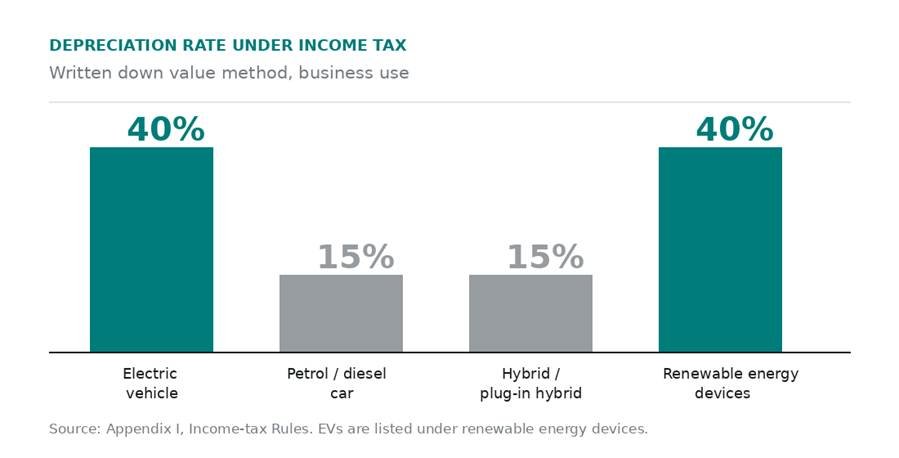
Electric vehicles are depreciated at 40 percent on the written down value basis. The rate comes from Appendix I of the Income-tax Rules, where the entry reads “electrically operated vehicles including battery powered or fuel-cell powered vehicles” and sits under the heading of renewable energy devices rather than under motor cars.
That classification is the whole story. A petrol car is a motor car and gets 15 per cent. An electric car is treated as a renewable energy device and gets 40 percent, the same rate applied to solar collectors and wind energy equipment. Whether that classification makes engineering sense is debatable. That it produces a very large tax difference is not.
| Vehicle type | Depreciation rate | Basis |
| Pure electric vehicle | 40% | Renewable energy device entry, Appendix I |
| Fuel cell vehicle | 40% | Same entry |
| Petrol or diesel car | 15% | Motor cars entry |
| Conventional hybrid | 15% | Not exclusively electric |
| Plug-in hybrid | 15% | Not exclusively electric, treated conservatively |
At EVUnlock, we cross-check specifications against official manufacturer documentation before publishing.
What counts as an electric vehicle for this purpose
CBDT Circular No. 04/2022 dated 15 March 2022 defines an electric vehicle as one “powered exclusively by an electric motor whose traction energy is supplied exclusively by a traction battery installed in the vehicle.” Circular No. 10/2022 reinforced the same position.
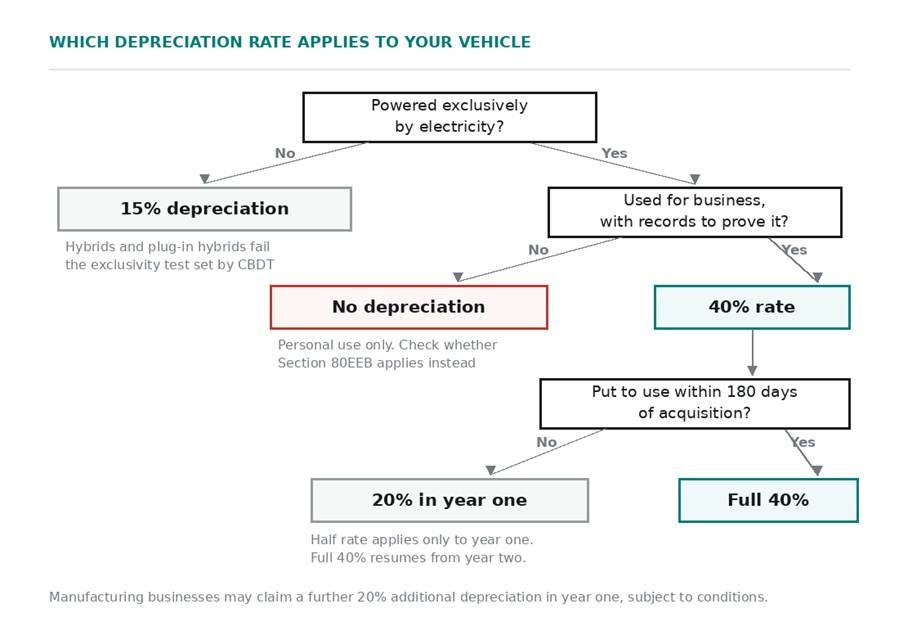
The word doing all the work is exclusively, and it appears twice. A strong hybrid that can run on petrol does not qualify. A plug-in hybrid with a 60 km electric range and a petrol engine behind it does not qualify either, and most practitioners treat it conservatively at 15 percent rather than risk a dispute.
If you are choosing a vehicle partly for this benefit, the fuel type on the registration certificate is what decides it. Any of the models in our electric cars section are pure battery electric and qualify. Anything with an engine does not.
Who can actually claim it?
Depreciation is available only against business or professional income. A salaried person buying an EV for personal use claims nothing under this head, regardless of the rate.
The claimants are proprietors, partnership firms, LLPs and companies that own the vehicle and use it in the business. Fleet operators weighing this against running costs will also want our charging infrastructure guide, since depreciation is only one line in that decision. The vehicle has to be registered in the name of the business or the proprietor, appear in the books as a fixed asset, and be genuinely used for business purposes. Buying a car in a company name and driving it exclusively to family functions is not a tax strategy; it is a disallowance waiting to happen.
How much tax does the 40 percent rate actually save
Take a Rs 20 lakh vehicle bought by a business and compare an EV at 40 percent against a petrol car at 15 percent, both on the written down value method.
| Year | EV depreciation | EV cumulative | Petrol depreciation | Petrol cumulative |
| 1 | Rs 8,00,000 | Rs 8,00,000 | Rs 3,00,000 | Rs 3,00,000 |
| 2 | Rs 4,80,000 | Rs 12,80,000 | Rs 2,55,000 | Rs 5,55,000 |
| 3 | Rs 2,88,000 | Rs 15,68,000 | Rs 2,16,750 | Rs 7,71,750 |
| 4 | Rs 1,72,800 | Rs 17,40,800 | Rs 1,84,238 | Rs 9,55,988 |
| 5 | Rs 1,03,680 | Rs 18,44,480 | Rs 1,56,602 | Rs 11,12,589 |
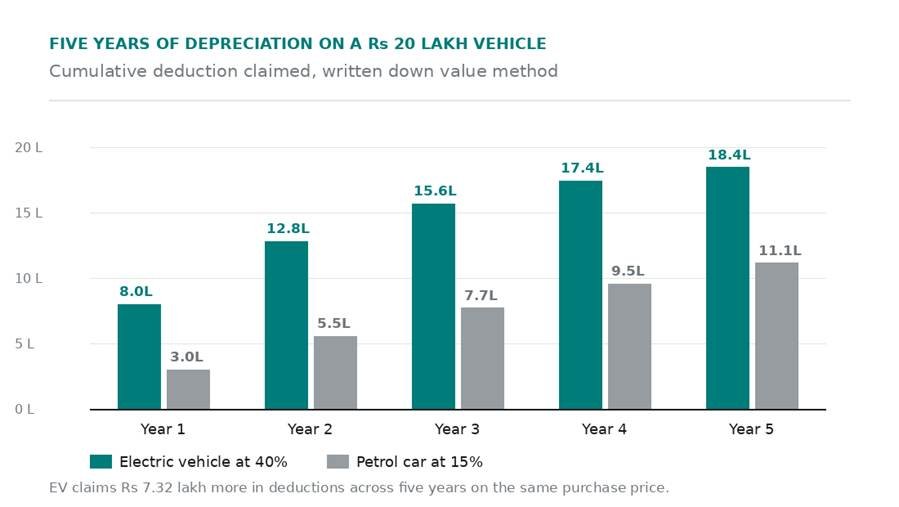
Across five years, the EV generates Rs 7,31,891 more in deductions on an identical purchase price. Convert that to tax saved, and the answer depends on your bracket:
- Individual at the 30 percent slab with 4 percent cess: roughly Rs 2,28,000 saved
- Domestic company at 25 percent plus surcharge and cess: roughly Rs 1,84,000
- Company under the 22 percent concessional regime: roughly Rs 1,26,000
Two things worth saying about these numbers, because tax content on this topic tends to oversell them.
The first is that depreciation is a timing benefit, not free money. The written-down value method never fully exhausts the asset, and when you sell the vehicle, the sale proceeds reduce the block of assets, which claws back part of what you claimed. What you genuinely gain is the time value of taking the deduction earlier, and on a five-year horizon at Indian interest rates, that is still meaningful.
The second is that the gap narrows in later years. By year four the petrol car is actually claiming more annual depreciation than the EV, because the EV’s written down value has already collapsed. The benefit is heavily front-loaded, which matters if you plan to change the vehicle every three years rather than run it for eight.
The 180-day rule that halves your first year
If the vehicle is put to use for less than 180 days in the year of purchase, only half the rate applies for that first year. For an EV, that means 20 percent instead of 40 percent.
On a Rs 20 lakh vehicle, that is Rs 4 lakh of deduction instead of Rs 8 lakh, deferred to later years. In practice, it means a vehicle delivered in November gets half rate, while the same vehicle delivered in September gets full rate. If you are already planning a purchase in the second half of a financial year and the delivery date is flexible, this is worth a conversation with your dealer.
Put to use is the operative phrase, not purchased or registered. The asset has to actually be in service.
Additional depreciation for manufacturing businesses
Businesses engaged in manufacturing or production may claim an additional 20 percent depreciation on new plant and machinery in the year of acquisition, subject to conditions, which can take the first year figure to 60 percent for a qualifying EV.
This one has meaningful conditions attached and is not available to every business that calls itself a manufacturer. Trading, services and professional practices do not qualify. If you think this applies to you, it needs a conversation with your chartered accountant rather than a blog post, because the conditions around eligible business and eligible asset are where these claims fall apart under scrutiny.
The two rules that catch people out
Most disputes on this subject come down to documentation rather than rates. The rate itself is clear. Proving you were entitled to it is where claims die.
Mixed use has to be apportioned, and proved
If the vehicle serves both business and personal purposes, depreciation and running expenses are claimable only in the business use proportion. An EV used 70 percent for business gives you 70 percent of the 40 percent depreciation, and 70 percent of the electricity, insurance and maintenance costs under Section 37(1).
There is no statutory percentage you are allowed to assume. The split has to be substantiated, which in practice means a logbook or an electronic mileage record maintained through the year rather than reconstructed the week before an assessment.
Keep the purchase invoice, the registration certificate showing fuel type as electric, the loan documents if any, and the usage records. On an EV specifically, keep the battery specification too, since the exclusively electric test is what makes the 40 percent rate available in the first place.
Section 80EEB has closed for new buyers
This is the correction that matters most, because a large amount of content still gets it wrong. Section 80EEB allows an individual to deduct up to Rs 1.5 lakh of interest paid on an electric vehicle loan. It applies only to loans sanctioned between 1 April 2019 and 31 March 2023, and only under the old tax regime.
If you take an EV loan today, you cannot claim 80EEB. The window closed. If you took one in 2021 and are still repaying it, you can continue claiming, provided you are filing under the old regime.
That second condition catches even more people than the first. The new tax regime is now the default, and most taxpayers who have not actively opted out are in it. Under the new regime, 80EEB is unavailable regardless of when the loan was sanctioned.
I would treat any article telling you to buy an EV today for the 80EEB benefit as a signal to stop reading it. State-level incentives are a different matter, and several remain live, which our guide to EV subsidies in India covers.
A note on the new Income-tax Act
The Income-tax Act, 2025 came into effect from 1 April 2026 and repeals the 1961 Act, though the older provisions continue to govern tax years beginning before that date.
Depreciation provisions have been renumbered in the new Act, so the familiar Section 32 reference does not carry over unchanged. The rates themselves, which live in the Rules rather than the Act, are not affected by the renumbering. Practically this means older guidance on this topic remains substantively correct while its section references go stale, so confirm the current section mapping with your CA before citing anything in a filing.
Frequently asked questions
What is the depreciation rate on electric vehicles as per the Income Tax Act?
40 percent on the written down value basis for business use, against 15 percent for petrol and diesel cars. The rate comes from Appendix I of the Income-tax Rules, where electrically operated vehicles, including battery-powered and fuel-cell-powered vehicles, are listed under renewable energy devices rather than under motor cars.
Can a salaried person claim depreciation on an electric car?
No. Depreciation is available only against business or professional income, so a salaried individual buying an EV for personal use cannot claim it. The relevant benefit for individuals was Section 80EEB on loan interest, and that has closed for loans sanctioned after 31 March 2023.
Do hybrid cars get 40 percent depreciation?
No. CBDT Circular 04/2022 defines an electric vehicle as one powered exclusively by an electric motor drawing traction energy exclusively from a battery. Conventional hybrids and plug-in hybrids both fail that test because they carry a petrol engine, so they are treated at the standard 15 percent motor car rate.
What is the 180-day rule for vehicle depreciation?
If an asset is put to use for less than 180 days in the year it is acquired, only half the applicable rate is allowed for that first year. For an electric vehicle, that means 20 percent instead of 40 percent. Full rate resumes from year two, so the effect is deferral rather than loss.
How much tax can a business save with EV depreciation?
On a Rs 20 lakh vehicle over five years, an EV generates about Rs 7.32 lakh more in deductions than a petrol car. At a 30 percent slab with cess, that works out to roughly Rs 2.28 lakh of tax saved. The benefit is front-loaded, with most of the advantage arriving in years one and two.
Is Section 80EEB still available in 2026?
Only for loans sanctioned between 1 April 2019 and 31 March 2023, and only under the old tax regime. New EV loans do not qualify. Since the new tax regime is now the default, many taxpayers still repaying an eligible loan are also unable to claim it without opting into the old regime.
Can I claim depreciation on an EV used partly for personal purposes?
Yes, in proportion to business use. An EV used 70 percent for business allows 70 percent of the depreciation and 70 percent of running expenses such as electricity, insurance and maintenance. The proportion must be substantiated with contemporaneous logbooks or mileage records rather than estimated later.
Does an electric two wheeler get the same 40 percent rate?
Yes, if it is exclusively electric and used for business. The Appendix I entry refers to electrically operated vehicles generally rather than to cars specifically, so electric two wheelers and three wheelers used in a business qualify on the same basis, with the same business use and documentation requirements.
What documents do I need to claim EV depreciation?
Keep the purchase invoice, the registration certificate showing fuel type as electric, battery specifications establishing the vehicle is exclusively electric, loan papers where applicable, and usage logs supporting the business proportion. These records need to align with your books of account and survive a tax audit under Section 44AB where applicable.
Is depreciation on an EV actually free money?
No, it is a timing benefit. The written-down value method never fully writes off the asset, and sale proceeds later reduce the block of assets, recovering part of what was claimed. What you gain is the time value of an earlier deduction, which on a five-year horizon is still worth having but is smaller than headline figures suggest.
The 40 percent rate is real, it is well documented, and it is one of the few EV incentives in India that has not been quietly withdrawn. What it demands in return is a genuine business use case and records that hold up. Treat this article as a starting point rather than advice on your own return, since the right answer depends on your business structure and tax regime, and speak to a chartered accountant before you file. For the vehicle side of the decision, our EV buying guides cover what to look at.
Reference for editor (do not publish)
Meta title: EV Depreciation Rate Under Income Tax India 2026 (48 characters)
Meta description: Electric vehicle depreciation rate under income tax is 40% against 15% for petrol cars. Rules, the 180 day catch, and what it saves on a Rs 20 lakh car. (152 characters)
Slug: electric-vehicle-depreciation-rate-income-tax
Primary keyword: electric vehicle depreciation rate income tax
Schema: Article plus FAQPage
Word count: approximately 2,200
IMAGES: three charts are embedded above in position. Source PNG files are supplied separately for upload to WordPress. Use the alt text printed under each one.
img-dep-rates.png, img-dep-5yr.png, img-dep-flow.png
INFORMATION GAIN IN THIS ARTICLE:
1. The five-year written-down value comparison with actual rupee figures. Every competing article states 40 percent versus 15 percent and stops. None of them shows what that is worth. The Rs 7.32 lakh differential and the tax saved at three different rates is the original calculation.
2. The correction on Section 80EEB. Most content still promotes it as a live benefit. It applies only to loans sanctioned between 1 April 2019 and 31 March 2023 and only under the old tax regime, which is now not the default. This alone makes the article more useful than the pages ranking above it.
3. The honest framing that depreciation is a timing benefit rather than free money, and that the advantage is front-loaded with the petrol car actually claiming more from year four.
4. The note on the Income-tax Act 2025 taking effect 1 April 2026 and renumbering the depreciation provisions. No consumer-facing article on this keyword mentions it.
VERIFY BEFORE PUBLISHING:
1. The 40 percent rate is confirmed from Appendix I on incometaxindia.gov.in, entry for electrically operated vehicles including battery-powered or fuel-cell powered vehicles under renewable energy devices.
2. CBDT Circulars 04/2022 dated 15 March 2022 and 10/2022 are cited from a chartered accountancy firm summary rather than the circular text itself. Pull the circulars from the CBDT site and confirm the wording before publishing, since the exclusivity definition is the load-bearing part of the article.
3. Section numbering under the Income-tax Act 2025. The article deliberately avoids asserting a specific new section number and says the provisions have been renumbered. Keep it that way unless a CA confirms the exact mapping.
4. The additional 20 percent depreciation for manufacturing businesses has conditions the article does not enumerate. That is intentional. Do not expand it without professional review.
5. This is tax content. Consider adding a visible disclaimer line and, if possible, a named reviewer credential on the page. Google applies higher trust standards to money and legal topics, and an unreviewed tax page on an EV site will struggle regardless of accuracy.

Gagandeep Singh
Founder, EV UnlockGagandeep Singh is an Electronics and Communication Engineering graduate from BGIET Sangrur and holds an M.Tech in eMobility from IIT Madras (CODE IITM). He is the founder of EV Unlock, an independent electric vehicle research platform. His work combines engineering knowledge, SEO strategy and electric mobility research to deliver verified EV specifications, buying guides and charging information that help buyers make confident, informed decisions.