
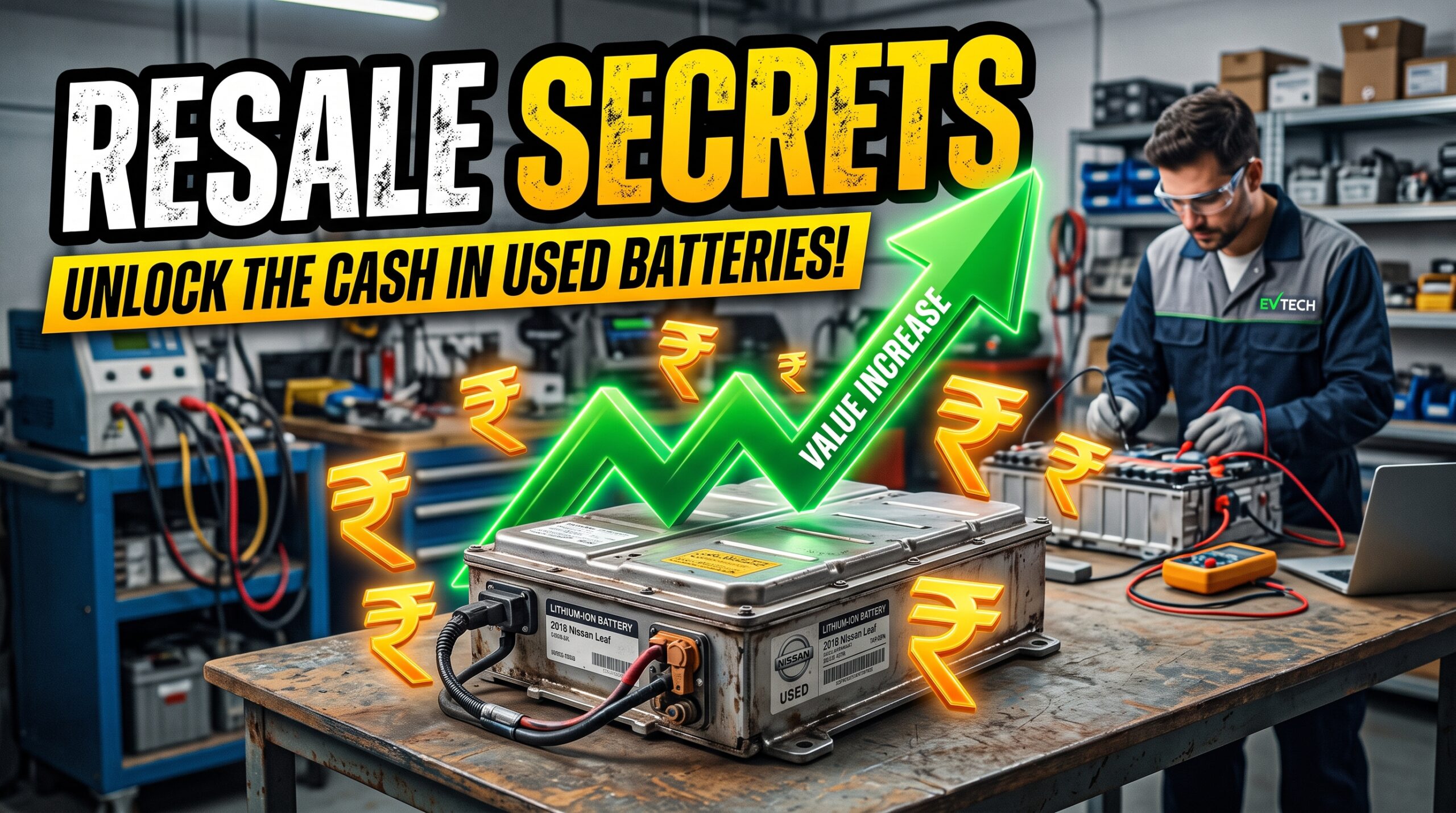
An EV battery doesn’t die when it leaves your car. It retires. When a pack drops to around 70 to 80 percent of its original capacity, it’s no longer ideal for driving range, but it still holds enough energy to do useful work for another decade in a different job.
After that, it gets recycled, and its lithium, cobalt and nickel are pulled out and used to build new batteries. Almost nothing is wasted. Here’s the full journey of a used EV battery in India.
Do EV Batteries Actually Get “Used Up”?
No, EV batteries don’t get used up the way a petrol tank empties. They gradually lose capacity over the years, and a battery considered “finished” for a car is still 70 to 80 percent healthy. That’s the key thing most people misunderstand. A battery is neither working nor dead. It slowly fades, and “end of life” for a car simply means it can no longer deliver the range the driver expects.
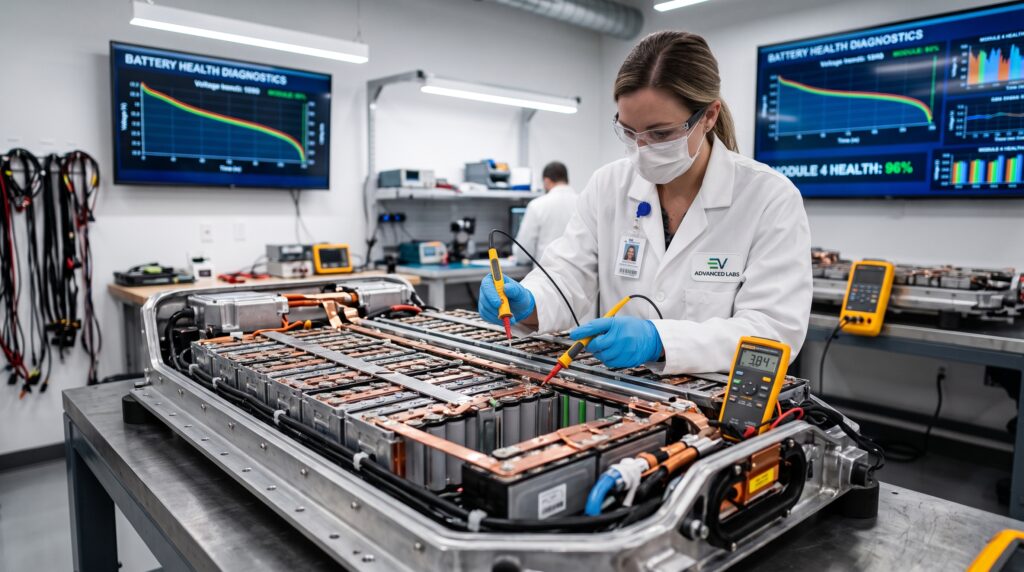
A pack that’s lost 25 percent of its capacity is useless for a long highway drive but perfectly capable of storing solar energy for a home. This is why the industry talks about a battery’s “first life” in a vehicle and its “second life” somewhere else.
What “End of Life” Really Means
A car battery typically reaches its automotive end of life when it falls below about 70 to 80 percent State of Health. At that point, the range drop becomes noticeable enough that the battery is retired from the vehicle, often replaced under or after warranty. But the cells inside are far from finished.
They’ve simply aged past what a demanding application like driving needs, while still being ideal for gentler, stationary uses.
Second-Life Uses for Old EV Batteries
Retired EV batteries get a second life in energy storage, where weight and size don’t matter and the remaining capacity is still valuable. A battery that can’t move a car can quietly power a building, a phone tower, or back up a solar installation for years. This second life is one of the most important and least understood parts of the EV story.
Common second-life uses include:
- Home and commercial solar storage: Old packs store energy from rooftop solar during the day for use at night, a strong fit for India’s growing solar market.
- Telecom tower backup: Mobile towers need reliable backup power, and second-life batteries are a cheaper alternative to diesel generators.
- Grid support and load balancing: Utilities use banks of retired batteries to smooth out electricity supply and demand.
- EV charging stations: Some chargers use second-life battery buffers to reduce strain on the grid during fast charging.
For India specifically, second-life batteries make real sense. They cut the cost of energy storage, reduce diesel dependence at telecom sites, and give a cheaper path to backup power. The economics work because the battery has already paid for itself in the car.
How a Used Battery Affects an EV’s Resale Value
A used EV’s resale value is affected more by battery health than by anything else, which is the opposite of how a petrol car’s resale value works. With a petrol car, engine and service history drive the price. With an EV, a buyer’s first question is “how healthy is the battery,” because it’s the most expensive component and the one that degrades.
Why Battery Health Drives EV Resale
An EV with a strong, warranty-covered battery holds its value far better than one nearing the end of its warranty. Two factors matter most to a second-hand buyer: the battery’s current State of Health, and whether the manufacturer’s warranty still applies. A car with several years of battery warranty left is much easier to sell, because the buyer inherits protection against the one cost they fear.
This is also why the lifetime battery warranties now offered on some Tata EVs are a double-edged thing for resale. They protect the first owner completely, but since they don’t transfer, the second-hand buyer doesn’t get that benefit, which can soften used prices. EV resale in India is still maturing, and battery transparency is slowly becoming the deciding factor it should be.
How EV Battery Recycling Works in India
EV battery recycling in India works by collecting spent packs, breaking them down, and recovering the valuable metals inside to make new batteries. India has formal rules requiring this.
The Battery Waste Management Rules place responsibility on producers to ensure batteries are collected and recycled rather than dumped, under what’s called Extended Producer Responsibility.
Note for editor: Verify the current status and details of India’s Battery Waste Management Rules and EPR targets before publishing.
The recycling process generally runs in stages:
- Collection and discharge: Spent batteries are gathered and safely fully discharged to remove any remaining charge.
- Dismantling: Packs are broken down into modules and cells, and casing, wiring and electronics are separated.
- Shredding: Cells are shredded into a material known as “black mass,” which contains the valuable metals.
- Material recovery: Through hydrometallurgical or pyrometallurgical processing, lithium, cobalt, nickel and manganese are extracted in reusable form.
- Reuse: These recovered metals go back into making new battery cells, closing the loop.
This is a genuine circular economy. The cobalt in a recycled Indian battery can end up in a brand-new pack, reducing the need to mine and import fresh material, which matters a lot for a country that imports most of its battery minerals.
Companies Recycling EV Batteries in India
A handful of specialist companies handle most EV battery recycling in India, and the sector is growing fast as more EVs reach the end of their first life. The established names include:
- Attero: One of India’s largest electronic and battery recyclers, with the capability to recover lithium, cobalt and other metals from spent packs.
- Lohum: Focused specifically on lithium-ion battery recycling and second-life solutions, including repurposing packs for energy storage.
- Tata Chemicals: Has moved into lithium-ion recycling, fitting naturally alongside Tata’s wider EV ecosystem.
- Exide and Amara Raja: India’s traditional battery giants, both investing in lithium-ion manufacturing and recycling as the market shifts.
Note for editor: Verify each company’s current recycling capacity, operational status and any recent developments before publishing, as this sector is changing quickly.
The growth of these recyclers matters because it keeps valuable materials inside India’s supply chain. To understand how these recovered materials feed back into new packs, our EV battery basics and technology guide explains how batteries are made and who makes them.
FAQs
Q: Does a used EV lose value because of the battery?
A: Yes, more than anything else. An EV’s resale value depends heavily on its battery’s State of Health and remaining warranty. A car with a healthy, warranty-covered battery holds value well, while one near the end of its battery life sells for less.
Q: Who recycles EV batteries in India?
A: Specialist recyclers like Attero and Lohum handle most EV battery recycling in India, alongside Tata Chemicals and traditional battery makers like Exide and Amara Raja moving into lithium-ion recycling. India’s Battery Waste Management Rules require producers to ensure batteries are recycled.
Q: What happens to an EV battery when it’s no longer good for driving?
A: It gets a second life. At around 70 to 80 percent capacity, it’s retired from the car but still useful for stationary energy storage, like home solar backup, telecom towers or grid support, often for another decade before being recycled.
Q: Can old EV batteries be reused?
A: Yes. Retired EV batteries are widely reused for energy storage where their remaining 70 to 80 percent capacity is still valuable. Only after this second life, when capacity falls too low even for storage, are they sent for recycling to recover their metals.
Q: Is it worth buying a second-hand EV battery?
A: It can be, for energy storage rather than driving. Second-hand or second-life batteries are a cost-effective option for solar storage or backup power. For a car, though, a used battery’s reduced capacity means less range, so battery health must be checked carefully.
Q: Are EV batteries bad for the environment when discarded?
A: Only if dumped, which India’s rules aim to prevent. When properly recycled, most of an EV battery’s materials are recovered and reused, making it far better than landfill. Recycling also reduces the need to mine fresh lithium and cobalt.

Gagandeep Singh
Founder, EV UnlockGagandeep Singh is an Electronics and Communication Engineering graduate from BGIET Sangrur and holds an M.Tech in eMobility from IIT Madras (CODE IITM). He is the founder of EV Unlock, an independent electric vehicle research platform. His work combines engineering knowledge, SEO strategy and electric mobility research to deliver verified EV specifications, buying guides and charging information that help buyers make confident, informed decisions.