
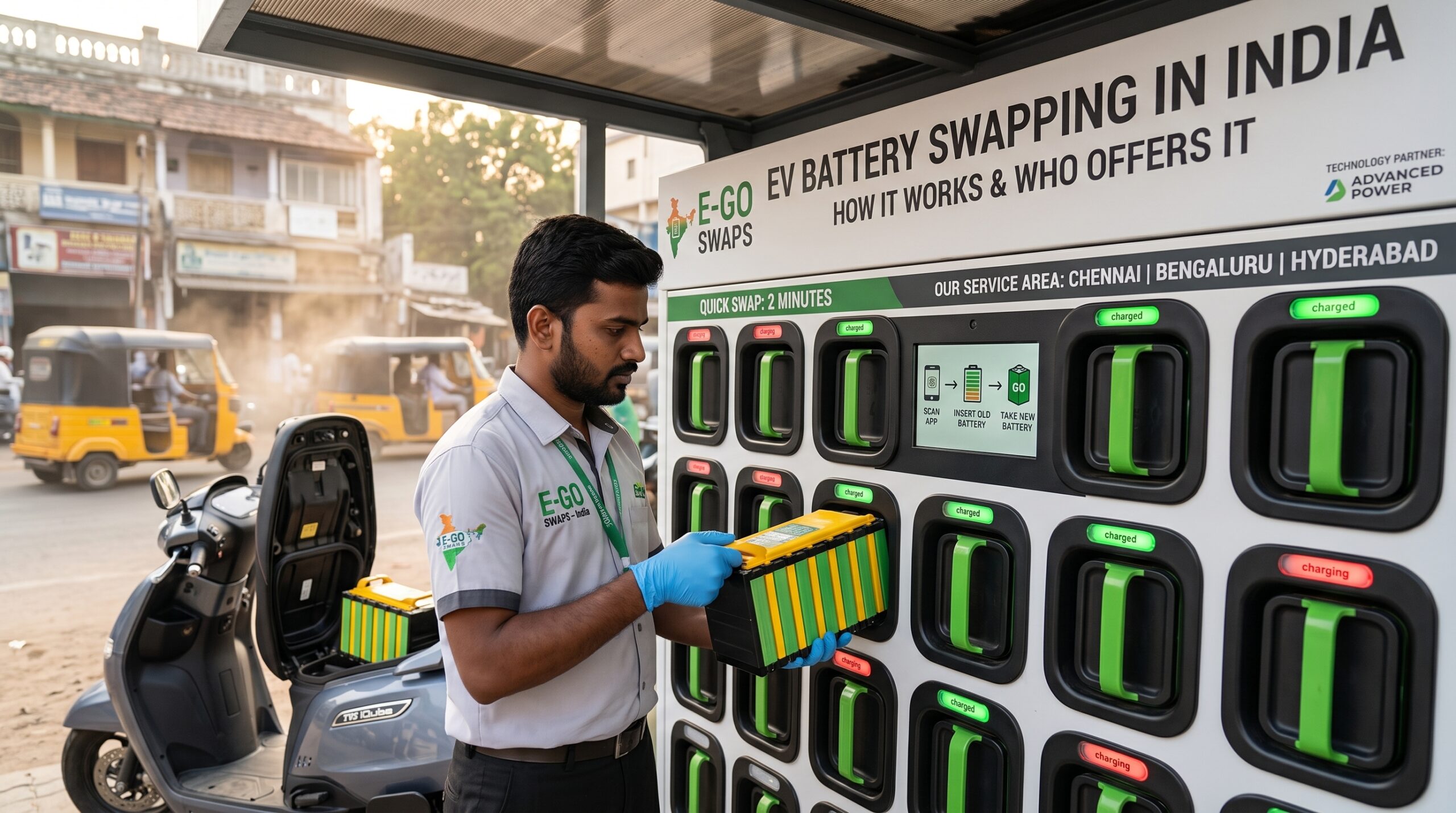
Before stsrting hi i am Gagan EV Certified engineer, full-time Author on EV Unlock. In this era, a technology in EVs that is very famous is known as Battery Swapping. This technology works
You drive into a swap station, a depleted pack comes out, a charged pack goes in, and you’re back on the road faster than filling a petrol tank. In India, it’s huge for electric two and three-wheelers, growing for fleets, and still rare for personal cars, with one notable exception. Here’s how it actually works and who’s doing it.
What Is EV Battery Swapping?
Battery swapping is a system where you exchange your drained EV battery for a charged one at a dedicated station, rather than plugging in and waiting. The core idea is simple: charging takes time, but swapping takes minutes. Instead of owning and recharging a fixed battery, you use a standardised pack that you trade for a fresh one whenever it runs low.
This only works when batteries are designed to be removable and standardised. That’s easy on a scooter, where the pack is small enough to lift by hand, and much harder on a car, where the battery is a large structural part of the floor.
How a Swap Actually Happens
A battery swap takes two to five minutes from start to finish. You arrive at a swap station, which is often a compact kiosk or cabinet. For a two-wheeler, you remove the discharged battery and slot it into a charging dock, then take out a fully charged pack and fit it to your vehicle. For larger vehicles, automated stations use machinery to remove and replace the pack underneath. You pay per swap or through a subscription, and the station charges the depleted batteries for the next customer.
Swapping vs Charging vs Battery as a Service
Swapping, charging, and BaaS are three different ways to power and pay for an EV battery, and they’re easy to confuse. Understanding the difference matters because they solve different problems.
Here’s how the three compare:
| Approach | What it is | Time | You own the battery? |
|---|---|---|---|
| Charging | Plug in and refill the fixed battery | 30 min to several hours | Yes |
| Swapping | Exchange the pack for a charged one | 2 to 5 minutes | No, you use a shared pack |
| BaaS (Battery as a Service) | Buy the car, rent the battery | Charge it yourself | No, you rent it |
The Key Difference
Swapping removes both the wait and the battery ownership, while BaaS removes only the ownership cost. With charging, you own everything and wait. With swapping, you own neither the battery nor the waiting time, but you depend on a swap network being nearby. With BaaS, you own the car and rent the battery to cut the upfront price, but you still charge it yourself like normal.
BaaS is the one most relevant to car buyers in India right now, because it lowers the showroom price without needing a swap network. Tata offers this on some models, letting buyers pay less upfront and a per-kilometre battery rental instead.
Who Offers Battery Swapping in India?
Battery swapping in India is dominated by two and three-wheeler networks, with car swapping still very limited. The economics work best for smaller vehicles with standardised, removable packs, which is why the big players focus there.
The main providers include:
- Sun Mobility: One of India’s largest swapping networks, focused on electric two and three-wheelers, with swap stations across many cities.
- Battery Smart: A fast-growing swap network serving electric two and three-wheeler drivers, especially commercial riders and delivery fleets.
- Gogoro (with partners): The Taiwanese swapping giant has entered India through partnerships, targeting the two-wheeler market.
- Bounce Infinity: Offers swap-enabled electric scooters with its own network.
Note for editor: Verify each network’s current scale, city coverage and operational status before publishing, as this sector is expanding rapidly.
For cars, swapping is mostly limited to commercial fleets and pilot projects so far. The standout consumer example isn’t true swapping but a closely related rental model on the MG Comet. To understand who actually makes these swappable and standard packs, our EV battery manufacturers and technology guide covers the companies behind them.
How the MG Comet EV Battery Rental Works
The MG Comet EV battery rental isn’t swapping, but a Battery as a Service plan that lowers the car’s price. Instead of paying for the battery up front, you buy the Comet at a reduced price and pay a separate rental for the battery, typically charged per kilometre driven. You still charge the car normally at home or at a public charger. The battery simply stays owned by the provider rather than you.
This matters because it cuts the highest cost of an EV, the battery, out of the purchase price. It makes the entry price look far more affordable, though you pay for the battery over time through the rental. It’s the closest thing to a swapping-style ownership model that a mainstream Indian car buyer can actually use today.
Note for editor: Verify the current MG Comet rental pricing and terms before publishing.
Pros and Cons of Swapping vs Owning Your Battery
Swapping’s biggest strength is speed, and its biggest weakness is that you give up control of your battery. Whether it suits you depends entirely on how and what you drive.
Advantages of swapping:
- Refuelling takes minutes, not hours
- No large upfront battery cost
- You never worry about battery degradation, since you don’t own the pack
- No need for home charging infrastructure
Disadvantages of swapping:
- You depend on a swap station being nearby
- Needs standardised batteries, which limits which vehicles can use it
- You might receive a pack that’s older or less healthy than your last one
- Network coverage for cars is still very thin in India
For two-wheeler riders and delivery fleets that run all day, swapping is genuinely excellent, since downtime costs them money. For most private car owners who charge overnight at home, regular charging or a BaaS plan makes more sense today. Swapping for personal cars in India is a promising idea, still waiting for the network to catch up.
FAQs
Q: Is battery swapping available for cars or only two-wheelers?
A: In India, swapping is mainly available for electric two and three-wheelers, where packs are small and standardised. Car swapping exists only in limited fleet and pilot projects so far. For private cars, the closest option is a Battery as a Service rental, like the MG Comet’s plan.
Q: How does the MG Comet EV battery rental work?
A: It’s a Battery as a Service plan, not swapping. You buy the Comet at a lower price and pay a separate battery rental, usually per kilometre, instead of paying for the battery up front. You still charge the car yourself normally, but the battery is owned by the provider.
Q: How long does an EV battery swap take?
A: A swap takes roughly two to five minutes, far quicker than charging. For two-wheelers, you manually exchange the pack at a station. For larger vehicles, automated machinery swaps the battery. It’s faster than refuelling a petrol vehicle.
Q: Is battery swapping cheaper than charging?
A: It depends on usage. Swapping removes the big upfront battery cost and saves time, which suits high-mileage commercial riders. But you pay per swap or via subscription, which can cost more over time than charging your own battery at home, especially for low-mileage drivers.
Q: Who are the main battery swapping companies in India?
A: The leading networks include Sun Mobility and Battery Smart, both focused on electric two and three-wheelers, along with Gogoro through partnerships and Bounce Infinity. Most operate swap stations for smaller commercial vehicles rather than cars.
Q: Do I get a lower-quality battery when I swap?
A: Potentially, yes. Since swap batteries are shared, you might receive a pack that’s older or slightly less healthy than the one you returned. Good networks monitor pack health and retire weak batteries, but you give up control over which specific battery you get.

Gagandeep Singh
Founder, EV UnlockGagandeep Singh is an Electronics and Communication Engineering graduate from BGIET Sangrur and holds an M.Tech in eMobility from IIT Madras (CODE IITM). He is the founder of EV Unlock, an independent electric vehicle research platform. His work combines engineering knowledge, SEO strategy and electric mobility research to deliver verified EV specifications, buying guides and charging information that help buyers make confident, informed decisions.