
A car battery can mean a 12V lead acid starter battery, an EV auxiliary battery, or the main lithium ion traction pack, so the answer to how long do car batteries last depends on battery type. A petrol car battery may need replacement in a few years, while an EV battery pack is built for much longer service. The mistake many owners make is mixing these batteries into one answer, which creates bad maintenance decisions.
Battery Types That Decide Car Battery Life
Conventional 12V lead acid car batteries often last around 3 to 5 years, EV auxiliary batteries can follow a similar short service pattern, and main EV lithium ion battery packs are designed for long vehicle life. The difference comes from job role, chemistry, charging control, heat exposure, and warranty coverage.
This is the key point for EV owners: a weak 12V battery can stop an electric car even when the main battery pack has plenty of charge. That feels strange to new EV buyers, but it is normal because the low voltage system wakes up computers, locks, contactors, lights, sensors, and safety systems.
For EVUnlock readers, the useful answer is not one number. It is a layered answer. Owners need to ask which battery they are talking about before they ask how long it lasts.
Normal Lead Acid Car Batteries
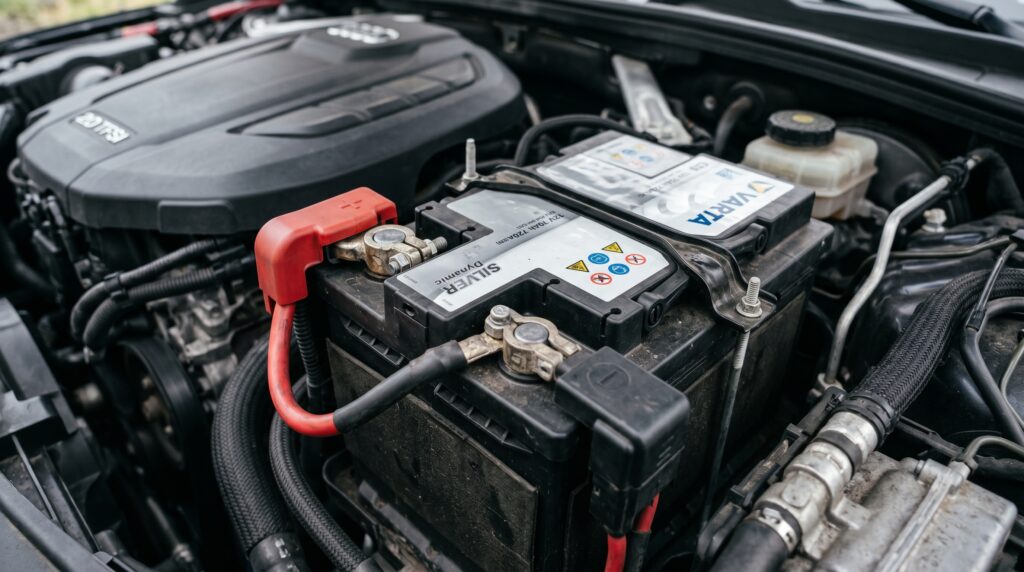
A normal lead acid car battery starts a petrol or diesel engine and supports 12V accessories when the alternator is not supplying enough power. It works hard for a few seconds during engine start, then the alternator takes over and charges it back.
Most owners notice battery ageing when the engine cranks slowly, the dashboard lights flicker, or the car needs a jump start after sitting for a few days. Heat damages these batteries faster than many drivers expect. In hot Indian cities, battery ageing can feel sudden because heat speeds up internal chemical wear.
Short trips also hurt battery life. A car that runs only five or ten minutes at a time may not recharge the battery fully after each start. Add parked electronics, dash cameras, alarms, and infotainment standby loads, and the battery can stay undercharged for long periods.
A good service habit is simple: test the 12V battery after its third year, especially before peak summer or winter. The test should include voltage, cold cranking ability, and charging system health, not just a quick visual check.
Electric Car Secondary Lead Acid Batteries
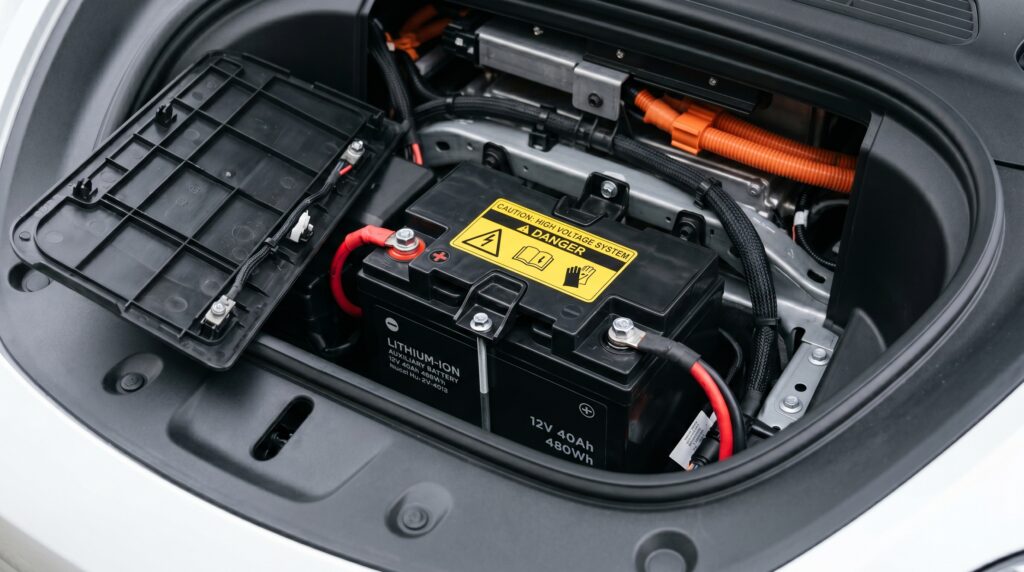
An electric car secondary battery is a low-voltage battery that supports vehicle electronics, safety systems, locks, relays, lighting, infotainment, and control modules. Many EVs use a 12V lead acid battery for this job, although some newer EVs now use lithium-ion low-voltage batteries.
This battery does not drive the car. The main pack drives the motor. The secondary battery helps the car wake up safely and close high voltage contactors so the main pack can supply the system.
That is why an EV with 60 percent main battery charge can still refuse to start if the 12V battery is weak. The main pack may be full enough for a long drive, but the car still needs the low voltage system to switch itself on.
This is one of the most underrated EV ownership points. Many buyers ask only about electric car battery lifespan, but the low voltage battery may be the first battery they replace.
Main Lithium Ion EV Battery Packs
The main EV battery pack is the high voltage battery that stores energy for traction. Modern battery electric cars mainly use lithium-ion chemistries, with common pack families including LFP, NMC, and NCA depending on brand, model, market, and production year.
LFP packs are known for strong cycle life and lower reliance on nickel and cobalt. NMC and NCA packs usually offer high energy density, which helps range in cars where weight and space matter. The exact chemistry should always be checked from the manufacturer data for that model.
At EVUnlock, we cross-check specifications against official manufacturer documentation before publishing.
The main pack does not age like a phone battery in a simple one-year or two-year pattern. It loses capacity slowly based on calendar age, charging habits, high temperature exposure, fast charging frequency, high state of charge storage, and how deeply the pack is discharged.
A healthy EV battery does not need to stay at 100 percent every night. For daily use, many owners are better served by charging to a moderate level and saving full charges for longer trips, unless the vehicle manual gives different advice for that pack chemistry.
Certified Range and Real World Range
Certified range comes from a test cycle such as ARAI, WLTP, EPA, or another official market method, while real-world range is what drivers see on roads with traffic, climate control, speed, tyre pressure, payload, terrain, and battery age. These two numbers should never be treated as the same.
Battery ageing affects usable range, but range loss is not always equal to battery capacity loss. A 10 percent capacity reduction can combine with weather, driving speed, or tyre condition and make the real-world experience feel better or worse than the battery health number alone.
For India, this matters more because owners deal with hot summers, mixed traffic, slow city movement, and highway runs where air conditioning use stays high. A certified range figure helps compare vehicles, but a real owner should also look for realistic city and highway data.
EVUnlock readers can compare models through the EVUnlock electric car research hub before judging range or battery life from one number.
Why Battery Warranty Does Not Equal Battery Life
Battery warranty is a legal coverage period, not a guaranteed end date for the battery. Many EV battery warranties use time, mileage, and minimum retained capacity terms. A pack can remain usable after warranty ends, but its value depends on health, range, software limits, and repair cost.
This is where buyers should read warranty language carefully. Some brands cover battery defects, some also mention capacity retention, and coverage can differ by country. India, the United States, Europe, and other markets may not have identical terms for the same vehicle name.
The researcher view is clear: warranty length is a confidence signal, but it is not a full battery health report. A used EV buyer should still check battery health, charging history where available, service records, and real-world range during a test drive.
How to Extend Battery Life and Replace at the Right Time
What Shortens Car Battery Life?
Heat, undercharging, long parking periods, electrical drain, vibration, and poor maintenance shorten normal 12V battery life. EV main battery packs also dislike long exposure to high heat, repeated deep discharge, and constant storage at very high charge.
For petrol and diesel cars, the battery often suffers when the car sits unused for weeks. Security systems and connected features keep drawing small current. Over time, that drain can pull the battery below a healthy charge level.
For EVs, the main pack has advanced battery management, but owners still influence ageing. Storing an EV at 100 percent for long periods is usually not ideal unless the owner’s manual says that pack type needs periodic full charge balancing. Letting the pack fall near empty and stay there is also poor practice.
A practical rule works well: follow the manufacturer charging advice first, then adjust daily charging based on climate, commute, and battery chemistry. Blindly copying another EV owner can be wrong because two cars may use different battery packs.
Signs Your Car Battery Is Dying
Signs your car battery is dying include slow engine crank, repeated jump starts, dim lights, clicking noise during start, warning messages, swollen case, acid smell, and sudden electrical glitches. In EVs, a weak auxiliary battery may cause door access issues, boot release problems, or failure to wake the car.
For 12V lead acid batteries, a load test is better than guesswork. A battery can show decent resting voltage and still fail when asked to deliver current. This is common with older batteries that look fine on the outside.
For EV main battery packs, the signs are different. Watch for a clear drop in usable range, unusually high energy consumption that cannot be explained by driving conditions, repeated charging faults, or service warnings from the vehicle. EV battery problems should be diagnosed by trained high voltage technicians.
Owners should not open or repair high voltage battery packs themselves. The risk is serious, and modern packs need isolation checks, diagnostic tools, software access, and model-specific procedures.
How Often Do Car Batteries Need to Be Replaced?
Normal 12V lead acid batteries are often replaced after 3 to 5 years, but testing should guide the final decision. EV secondary 12V batteries may need attention on a similar cycle, while main EV battery packs are not routine replacement items for most owners.
This difference is important for cost planning. A 12V battery replacement is a maintenance item. A main EV battery pack replacement is a major repair, and most owners should first check warranty, module repair options, diagnostics, and battery health reports before assuming full pack replacement.
In used EV buying, battery replacement questions should be asked in a more precise way:
- What is the current battery health percentage?
- What is the real-world range in city and highway use?
- Is the battery still under warranty?
- Does the car show charging or thermal management faults?
- Has the 12V battery been replaced recently?
Those questions give a better picture than asking only how long do EV batteries last.
How Owners Can Extend 12V Battery Life
A 12V battery lasts longer when it stays charged, clean, secure, and protected from avoidable electrical drain. The biggest gains come from testing it yearly after three years, cleaning terminals, fixing parasitic drains, and avoiding very long parking without maintenance charging.
For low-use cars, a smart battery maintainer can help. This is common for second cars, classic cars, and vehicles parked during travel. Owners should choose a maintainer suitable for the battery type and follow the vehicle manual.
For EVs, the secondary battery may be charged by the main pack through a DC converter, but the control strategy differs by model. Some EVs top up the 12V battery automatically while parked. Others may need specific conditions. That is why owner manual guidance matters.
My editorial view: EV buyers should treat the 12V auxiliary battery as a small part with a big impact. It is cheaper than the main pack, but when it fails, the car can feel completely dead.
How Owners Can Extend EV Main Battery Pack Life
An EV main battery pack lasts longer when it avoids avoidable stress. Most owners can help battery health by using moderate daily charging, avoiding frequent deep discharge, reducing long hot parking at high charge, and using fast charging mainly when needed for travel.
Battery chemistry matters here. Some LFP-equipped cars may ask owners to charge to 100 percent at intervals for calibration. Many NMC or NCA-equipped cars are commonly kept below full charge for daily use. The correct answer comes from the specific vehicle manual, not a generic social media tip.
Thermal management also plays a major role. EVs with active liquid cooling usually handle heat better than simpler systems, but even a good thermal system cannot remove all stress from poor use. Parking in shade during intense heat, preconditioning before fast charging, and avoiding repeated high-speed charging sessions on hot days can help.
For more owner-focused charging advice, EVUnlock keeps practical guides in the EV buying and charging guides section.
Battery Life for Hybrids and Plug-In Hybrids
Hybrid and plug-in hybrid batteries are different from normal starter batteries because they help drive the vehicle. A strong hybrid may use a smaller high-voltage pack than a full EV, while a plug-in hybrid uses a larger pack that can be charged from an external power source.
Hybrid battery life depends on chemistry, cooling, vehicle use, and warranty terms. Some older hybrids used nickel metal hydride packs, while newer vehicles often use lithium-ion packs. The 12V battery still exists in many hybrids and can fail separately from the hybrid battery.
This is why buyers searching how long do hybrid car batteries last should separate the 12V battery from the hybrid drive battery. The replacement cost, symptoms, and diagnostic process are different.
Best Replacement Decision by Battery Type
A normal 12V battery should be replaced when testing shows weak capacity, when it fails load testing, or when it becomes unreliable after several years. Waiting until it leaves you stranded is rarely smart.
An EV secondary battery should be checked quickly when the car shows low voltage warnings, access problems, or wake-up failures. Replacing it on time can prevent confusing faults that look more serious than they are.
A main EV battery pack should not be replaced based on fear alone. First check battery health data, warranty status, diagnostic fault codes, charging behaviour, and real-world range. A module, sensor, wiring, cooling, or software issue may be involved depending on the vehicle.
New EV buyers should track upcoming battery improvements through EVUnlock upcoming electric cars and battery updates, because chemistry, charging speed, and pack warranties keep changing by model year.
Frequently Asked Questions
How long do car batteries last in a petrol or diesel car?
Most petrol and diesel car 12V lead acid batteries commonly last around 3 to 5 years, but heat, short trips, parking time, and electrical drain can shorten that period. A battery test after the third year is a sensible move. Age alone does not tell the full story, because a hard-used two-year-old battery can be weaker than a well-maintained older one.
How long do electric car batteries last?
Main electric car battery packs are designed for long service and are often covered by long battery warranties. Many packs can remain useful well beyond the warranty period, but usable range will reduce gradually with age and use. The better question is battery health, real-world range, and warranty status, not only the calendar age of the EV.
Why do EVs still need a secondary battery?
EVs use a secondary low-voltage battery to power control modules, locks, lights, safety electronics, and the system that wakes the vehicle. The high voltage traction pack cannot simply remain connected to every circuit all the time. The low voltage battery helps the car start its electronic systems before the main pack is connected for driving.
Is an EV secondary battery the same as the main battery pack?
No, the EV secondary battery and the main battery pack are different. The secondary battery is usually a 12V low-voltage battery used for accessories and control systems. The main traction battery is a high-voltage lithium-ion pack that stores driving energy for the motor. Their lifespan, warranty, cost, and failure signs are different.
What are the signs your car battery is dying?
Signs your car battery is dying include slow starting, clicking sounds, dim lights, warning messages, repeated jump starts, and weak accessory power. In EVs, a weak auxiliary battery may cause access or wake-up problems. For the main EV battery pack, look for range drop, charging faults, battery warnings, or service alerts rather than engine start symptoms.
How often do car batteries need to be replaced?
Normal 12V car batteries are often replaced after 3 to 5 years, but testing should guide the timing. EV secondary batteries may need similar attention. Main EV battery packs are not replaced on a fixed service interval for most owners. Battery health checks, warranty terms, and real-world range matter more than a simple replacement calendar.
Do lithium ion EV batteries die suddenly?
Lithium-ion EV battery packs usually degrade gradually rather than dying suddenly. Range may reduce slowly as capacity drops. Sudden issues can still happen due to electronics, thermal system faults, cell imbalance, crash damage, or manufacturing defects. A proper diagnostic scan is needed when an EV shows battery warnings, charging errors, or abnormal range behaviour.
Does fast charging reduce EV battery life?
Frequent fast charging can add heat and stress, especially in hot weather or when the battery is already warm. Occasional fast charging on trips is normal for modern EVs The better habit is to use home or AC charging for routine needs and reserve repeated fast charging for travel, unless the vehicle maker gives different advice.
Is certified range the same as real-world EV range?
Certified range is a test result from a regulated cycle, while real world range depends on speed, temperature, air conditioning, road type, tyres, payload, driving style, and battery age. Certified range helps compare vehicles under one method, but owners should judge daily use with real driving data. EVUnlock separates certified range from real-world range when data is available.
Which battery should owners worry about first?
Most owners should check the 12V battery first when a car refuses to start, shows random electrical warnings, or fails to wake up. In petrol cars, the 12V battery starts the engine. In EVs, the auxiliary battery wakes the vehicle. The main EV battery pack deserves attention when range loss, charging faults, or high voltage warnings appear.
Car battery life depends on the battery you mean. A normal lead acid battery is a short-cycle maintenance item; an EV secondary battery can cause wake-up problems, and a main lithium ion pack is a long-life high-voltage system. Smart ownership means testing the small battery early and tracking real EV battery health over time. For more battery care and buying help, use the EVUnlock EV guides library
Image 2: EV low voltage auxiliary battery with warning label and service access panel | Alt text:Image 3: Electric car skateboard platform with main lithium-ion battery pack visible | Alt text: how long do electric car batteries last lithium ion EV battery pack
Image 4: EV battery health screen showing range and state of charge | Alt text: EV battery degradation and real-world range battery health display
Image 5: Technician testing a 12V battery with diagnostic meter | Alt text: signs your car battery is dying 12V battery test

Gagandeep Singh
Founder, EV UnlockGagandeep Singh is an Electronics and Communication Engineering graduate from BGIET Sangrur and holds an M.Tech in eMobility from IIT Madras (CODE IITM). He is the founder of EV Unlock, an independent electric vehicle research platform. His work combines engineering knowledge, SEO strategy and electric mobility research to deliver verified EV specifications, buying guides and charging information that help buyers make confident, informed decisions.