
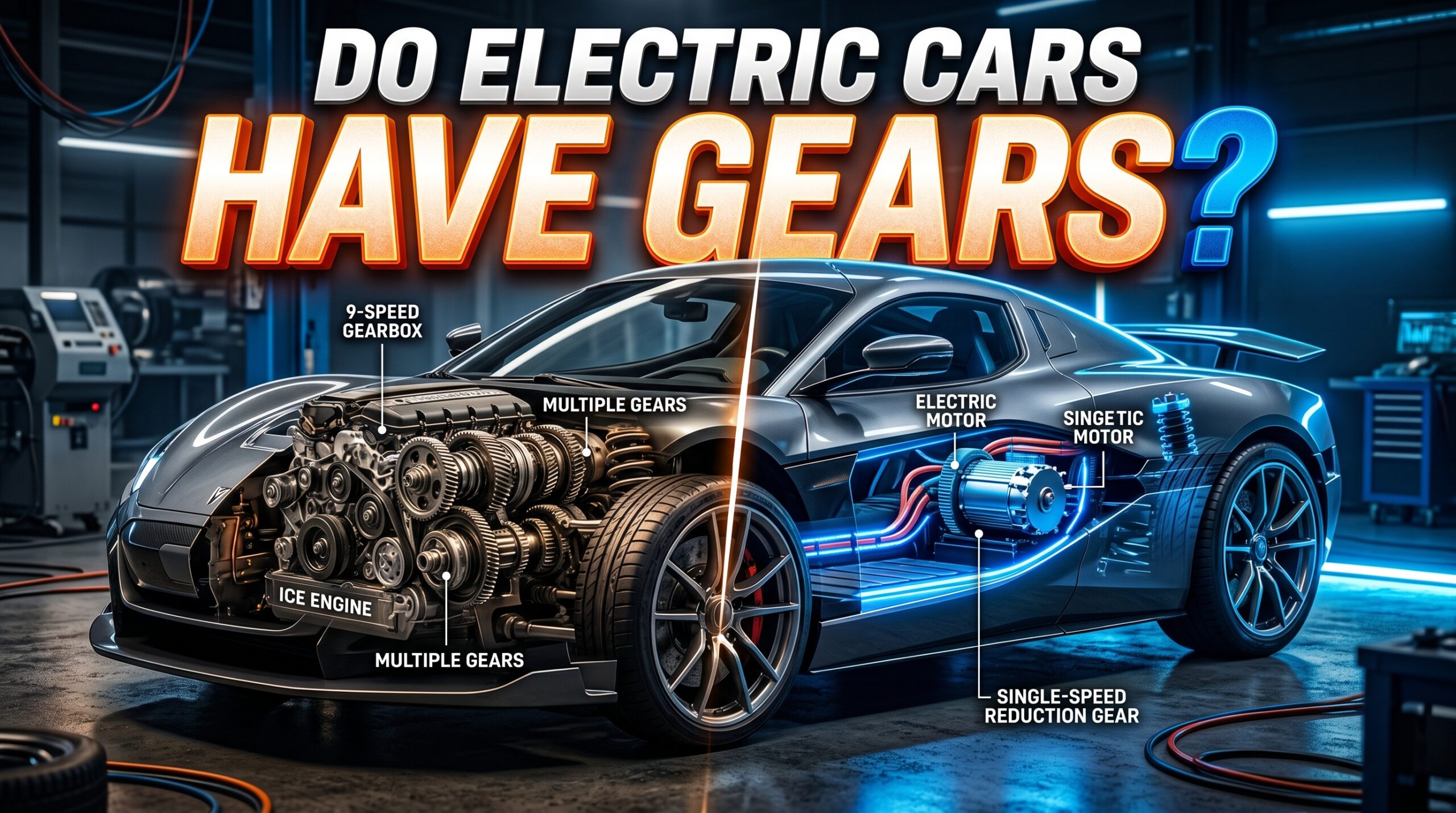
Yes – virtually every electric car has a transmission; it’s just a single-speed reduction gearbox (one fixed gear) rather than the multi-ratio unit found in a combustion car. The widespread line that “EVs have no gearbox” is a terminology error: a one-speed reduction gear still transmits power from motor to wheels and multiplies torque, which is exactly what a transmission does.
TL;DR
- Every EV has a transmission. The vast majority use a single-speed reduction gearbox: one fixed gear that steps the motor’s high rpm down to wheel speed and multiplies torque. It is a real transmission just the simplest kind ever fitted to a car.
- The reason is physics, not cost-cutting. An electric motor makes peak torque from zero rpm and spins usefully across a vast band (roughly 0 to 16,000–20,000 rpm), so it never needs to “shift” to stay in its powerband the way a narrow-band combustion engine does.
- Multi-speed EVs exist but stay niche. Two-speed setups (Porsche Taycan, Audi e-tron GT) and multi-speed commercial gearboxes (Eaton, Volvo, Mercedes trucks) deliver real performance and gradeability benefits, while “virtual gears” (Hyundai Ioniq 5 N, Toyota’s patents) are pure software theatre — no extra cogs involved.
Key Findings
- A single-speed reduction gear is a transmission. The popular claim “EVs have no gearbox” confuses “no transmission” with “a one-speed transmission.”
- Typical EV reduction ratios sit around 7:1 to 10:1, commonly near 9:1 (e.g., the Tesla Model 3 rear drive unit is roughly 9:1).
- The Porsche Taycan and its platform-twin, the Audi e-tron GT (both on VW Group’s J1 platform), are the headline two-speed passenger EVs: a short 1st gear for launch, a tall 2nd gear for efficiency and top speed — on the rear axle only.
- The Rimac Nevera famously tested a two-speed during development but ships with single-speed gearboxes.
- Heavy trucks frequently use multi-speed gearboxes (Eaton 2- and 4-speed, Volvo, Mercedes eActros), while the Tesla Semi and many transit buses (e.g., BYD) stay single-speed.
- “Virtual gears” in the Hyundai Ioniq 5 N and Toyota’s simulated-manual patents are software and audio illusions, not real gearboxes.
- EVs have no dedicated reverse gear; the inverter simply spins the motor the other way.
- Suppliers (ZF, Schaeffler/Vitesco, Inmotive) claim efficiency/range gains of roughly 5–15% from two-speed e-drives, but these are supplier marketing figures, not independently benchmarked.
Why most EVs use a single-speed transmission
Internal-combustion engines have a narrow useful rev range, little torque at idle, a peak somewhere in the mid-range, and running out of breath near redline. To keep the engine inside that sweet spot across all road speeds, you need a multi-ratio gearbox constantly swapping ratios.
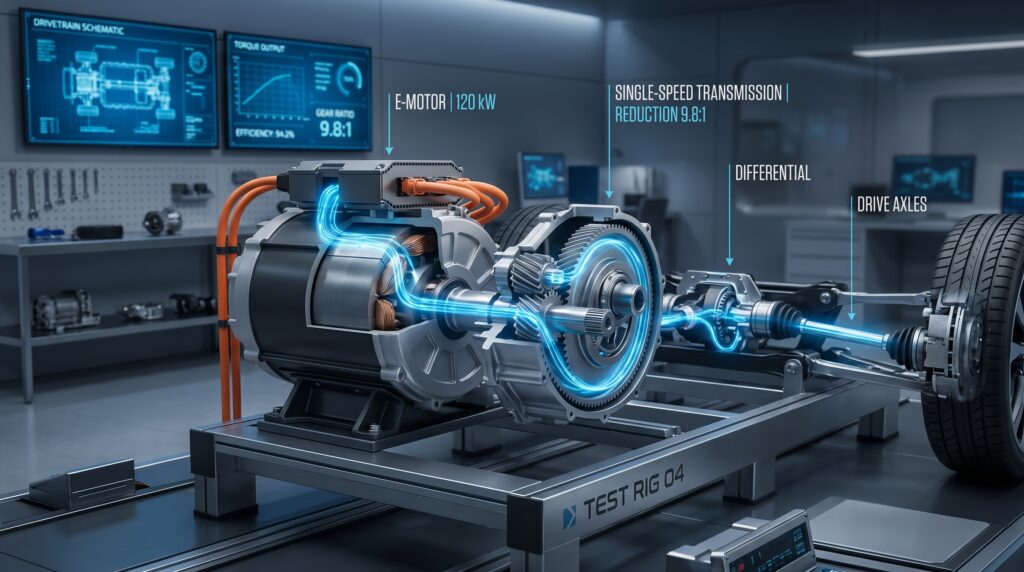
Electric motors don’t have that problem. They produce maximum torque from a standstill (near-zero rpm) and pull strongly across an enormously wide rev range, typically from 0 up to around 16,000–20,000 rpm in modern traction motors. Because one ratio can cover the entire speed range from a parking-lot crawl to a motorway cruise while keeping the motor responsive and efficient, a single fixed reduction gear is all most EVs need. That gear does two jobs: it reduces the motor’s high rpm to sensible wheel speed, and it multiplies torque on the way through.
Typical reduction ratios land around 7:1 to 10:1, most commonly near 9:1; for example, the Tesla Model 3’s rear drive unit uses roughly a 9:1 reduction. (Note that exact single-speed ratios vary by source and drive-unit generation; the Nissan Leaf, for instance, is cited anywhere from roughly 7.9:1 to 8.2:1.)
Terminology: do EVs “have a transmission”?
Strictly, yes. A transmission is any device that transmits power from the motor to the wheels while changing the gear ratio. A single-speed reduction gearbox does exactly that; it just has one ratio instead of six or eight. So the accurate statement isn’t “EVs have no transmission”; it’s “most EVs have a single-speed transmission.”
The confusion arises because there’s no clutch, no multi-position gear lever, and no shifting sensation, so it doesn’t feel like a gearbox to the driver.
Multi-speed EVs – verified examples
Porsche Taycan / Audi e-tron GT (J1 platform): Both use a single-speed gearbox on the front axle and a two-speed transmission on the rear axle. First gear is very short (commonly cited around 15:1) for ferocious off-the-line acceleration; the car then upshifts to a much taller second gear (around 8:1) for efficiency and high-speed running.
The Taycan Turbo S is electronically limited to about 260 km/h (162 mph), and Porsche quotes roughly 2.8 seconds for 0–100 km/h with launch control, independent instrumented tests (e.g., Car and Driver) have recorded even quicker 0–60 mph times, largely because U.S. testing convention subtracts a one-foot rollout.
The Audi e-tron GT shares this exact two-speed rear-axle architecture. Treat the exact ratios as needing confirmation against Porsche’s press materials; the two-speed-rear architecture itself is well established.
Rimac Nevera: Early development cars (and the earlier Concept_One) experimented with a two-speed gearbox, but the production Nevera uses single-speed reduction gearboxes on its four motors. Rimac claims a top speed of 412 km/h (about 256 mph), a manufacturer figure rather than an independently verified V-max one.
Supplier two-speed units: ZF, Schaeffler (which absorbed Vitesco in 2024), and Canadian firm Inmotive (with its “Ingear” two-speed) all offer or are developing two-speed EV transmissions aimed at improving efficiency, gradeability and towing.
Trucks and buses: Heavy-duty applications benefit most from multiple ratios because of huge loads and steep grades. Eaton markets both 2-speed and 4-speed EV transmissions for medium- and heavy-duty trucks.
Volvo’s electric trucks use a dedicated multi-speed gearbox, and the Mercedes-Benz eActros uses a multi-speed e-axle. Allison offers eGen Power e-axles and eGen Flex for transit buses.
By contrast, the Tesla Semi uses single-speed reduction (with multiple independent motors that decouple at cruise to save energy), and
many transit buses BYD’s, for example run single-speed/direct drive. The clean takeaway: heavy trucks often go multi-speed; passenger cars and most buses stay single-speed.
The CVT / “fake gears” myth
No mainstream EV uses a CVT or a true multi-ratio automatic in the combustion sense. But two kinds of simulated gears exist:
- Hyundai Ioniq 5 N “N e-Shift”: This simulates an 8-speed dual-clutch transmission purely in software, modulating motor torque to mimic gear changes including a deliberate jolt at each “upshift” and the feeling of hitting a rev limiter — paired with synthesised engine noise via “N Active Sound+”.There is no physical multi-speed gearbox; the drivetrain remains single-speed reduction. It’s torque mapping plus audio, nothing more.
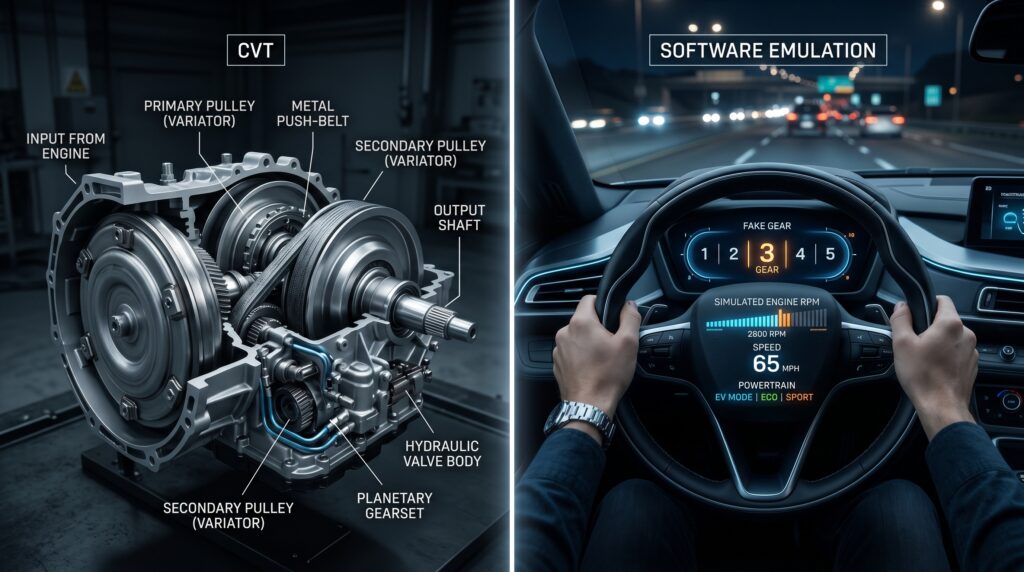
- Toyota’s simulated-manual patents: Toyota has patented an EV system that mimics a manual gearbox, complete with a clutch pedal, an H-pattern shifter, simulated engine sound, and the ability to “stall” if the driver mishandles the fake clutch. This is patent and prototype work that has been demonstrated — not a production product on sale.
EV vs ICE transmission comparison
ICE cars need 5–7+ gears because their engines make usable power only across a narrow rpm band, so the transmission constantly re-matches engine speed to road speed, keeping revs in the powerband for acceleration, then dropping them for economy at cruise.
An electric motor’s flat torque curve and wide rev range make all of that unnecessary: one ratio covers everything from a standstill to top speed. That’s why EV drivetrains are mechanically far simpler, with fewer moving parts to wear out.
Does an EV have a reverse gear?
No. There is no separate reverse gear. The inverter simply reverses the motor’s direction of rotation, so the same single gear drives the car backwards. This is universal across modern EVs and is one of the elegant simplifications electric drive allows.
Reduction gear maintenance
Single-speed EV gearboxes are mechanically simple and run under relatively low stress, so maintenance is minimal, a major contrast with the periodic fluid services of a conventional multi-speed automatic.
Tesla’s drive-unit gearboxes are sealed and effectively “filled for life,” with no scheduled gear-oil change in Tesla’s published maintenance schedule (which focuses on items like cabin filters, brake-fluid testing and A/C desiccant).
Most passenger EVs follow the same lifetime-fill approach, though some commercial-vehicle e-axles and a handful of manufacturers do specify inspection or change intervals worth checking the specific owner’s manual.
Are future trends more multi-speed EVs coming?
Suppliers argue that two-speed transmissions can improve range/efficiency by roughly 5–15% (Inmotive’s marketing sits at the high end of that band; tier-1 suppliers like ZF nearer the low end), plus better towing capacity and hill-climbing.
These are supplier claims, not independently benchmarked figures, and the gain has to be weighed against added cost, weight, and complexity.
For now, multi-speed remains niche in passenger EVs, reserved for high-performance cars where both blistering launch and high top speed matter and is more established in heavy trucks where load and grade genuinely demand multiple ratios.
Whether two-speed goes mainstream in ordinary EVs largely depends on whether the efficiency gain ever beats the simpler alternatives of fitting a bigger battery or a more efficient single-speed motor and inverter.
Recommendations
- Lead with the myth-bust. “EVs do have a transmission, just a one-speed one” is the precise, defensible hook and immediately differentiates the post from the lazy “EVs have no gearbox” framing.
- Use the Taycan/e-tron GT as the marquee two-speed example and the Ioniq 5 N as the “fake gears” example; both are the clearest, best-documented cases for a general audience. Add the Eaton/Volvo/Mercedes truck angle to show the concept scales globally across vehicle classes.
- Label every performance and efficiency number as manufacturer-claimed vs independently tested, especially Rimac’s 412 km/h top speed, max-rpm figures (Lucid, Tesla Plaid), and the 5–15% supplier efficiency claims.
- Lock exact decimals before publishing. Verify the Taycan’s precise gear ratios and acceleration figures against the Porsche press kit and a Car and Driver instrumented test; verify any single-speed ratio you cite against the relevant manufacturer spec, since these vary by source and model year.
- Benchmark that changes the story: if an independent (SAE-grade) study confirms a real-world double-digit efficiency gain from two-speed e-drives at acceptable cost, expect more mainstream multi-speed EVs; absent that, the single-speed reduction gear will remain the default for the foreseeable future.

Gagandeep Singh
Founder, EV UnlockGagandeep Singh is an Electronics and Communication Engineering graduate from BGIET Sangrur and holds an M.Tech in eMobility from IIT Madras (CODE IITM). He is the founder of EV Unlock, an independent electric vehicle research platform. His work combines engineering knowledge, SEO strategy and electric mobility research to deliver verified EV specifications, buying guides and charging information that help buyers make confident, informed decisions.