
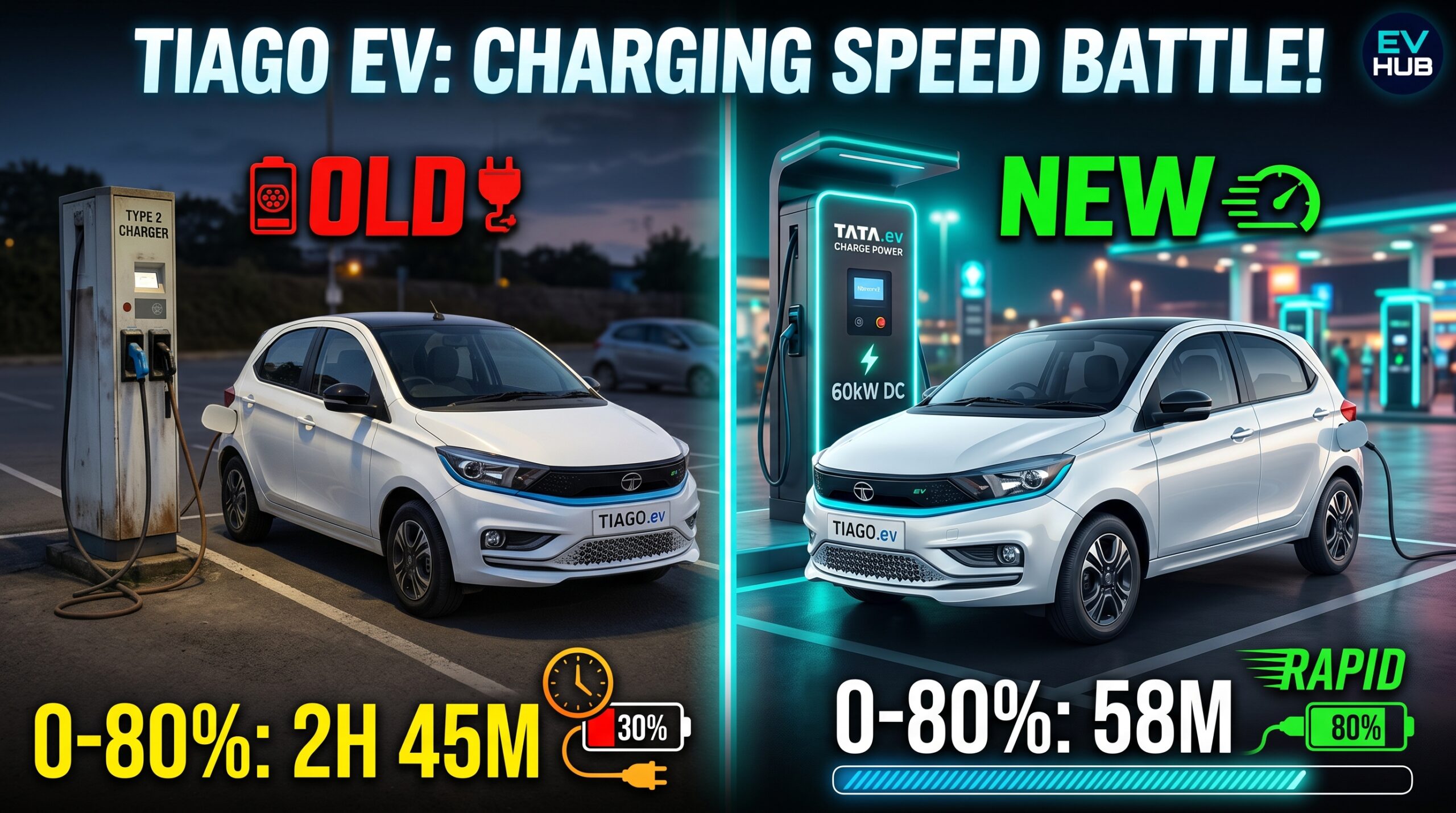
The Tata Tiago EV (2022-2025 model) was India’s first electric hatchback, launched in late 2022 with 19.2 kWh and 24 kWh battery options. In mid-2026, Tata introduced a facelifted Tiago EV that keeps the same battery sizes and motor but “refined the underlying software and battery management systems” to improve charging performance. This deep-dive compares the old and new Tiago EV on charging speed – covering official specs, real-world tests, charge curves, estimated charge times at common power levels, and practical ownership implications.
We cover:
- Battery specs (capacity, chemistry, cooling, BMS)
- AC charging hardware (3.3 kW/7.2 kW on-board chargers) and DC fast-charging (max kW)
- Official charge times (0–80% and 10–100%) and observed charge curves (SoC vs kW)
- Real-world charging logs (owner tests, industry measurements)
- Estimated charge times at 3.3, 7.2, 11 kW AC and 25, 50, 100 kW DC (0–80% and 10–100%)
- Battery warranty & degradation (8 yr/160k km)
- Efficiency, losses and cost implications (INR/kWh)
- Practical tips: home charging vs public DC, cost, usability
- A comparison table, pros/cons, buying advice, FAQs, plus a mermaid timeline and flowchart of charging scenarios.
All data is from Tata Motors sources (press releases, specs), Indian EV media (Autocar India, Team-BHP) and owner reports.
Battery & Powertrain
Both the old and new Tiago EV use Tata’s Ziptron architecture with LFP (Lithium Iron Phosphate) battery packs. The options are:
- 24.0 kWh pack (Long-Range) – ~285 km ARAI range.
- 19.2 kWh pack (Medium-Range) – ~226 km ARAI range.
Both packs use LFP chemistry (air-cooled cells in a liquid-cooled pack) with IP67 water/dust protection. Tata has stated it “improved the chemistry of its LFP cells and optimized the battery management software” in the 2026 model, allowing higher charging currents without more heat. The thermal management in both generations is a liquid-cooled system (keeping cells at safe temp under fast charge). The battery BMS performs cell balancing and dynamic SoC calibration. Usable capacity is not published separately, but the 19.2 kWh pack is for city use, and the 24 kWh for longer trips. Tata offers an 8-year/160,000 km warranty on the battery and motor.
The electric motor is a Permanent Magnet Synchronous Motor:
- 19.2 kWh pack: ~46 kW (62 PS) and 110 Nm.
- 24.0 kWh pack: 55 kW (75 PS) and 114 Nm.
(The motor specs are essentially unchanged in the facelift.) Top speed is ~120 km/h, 0–60 km/h in ~5.7 s.
In summary, battery & motor hardware are largely the same. The key difference lies in software: new cell chemistry and BMS tweaks that allow higher charging currents (up to ~30 kW DC peak vs ~19 kW on the older model).
Charging Hardware & Capabilities
AC Onboard Charger (OBC): Both models come standard with a 3.3 kW AC charger (Type 2) for home charging (via 15A socket or a 3.3 kW wallbox). Tata offers an optional 7.2 kW AC wallbox, which drastically cuts AC charge time. The press release notes the 7.2 kW charger “adds 35 km in just 30 min” and can fill 10–100% in ~3.6 h. In practice:
- 3.3 kW AC: ~9 hours (10–100%) for 24 kWh; ~6.9 h for 19.2 kWh.
- 7.2 kW AC: ~3.6 hours (10–100%) for 24 kWh; ~2.6 h for 19.2 kWh.
CarDekho and Autocar confirm: 24 kWh → 3.6 h at 7.2 kW, 8.7 h at 3.3 kW.
DC Fast-Charging: This is where old vs new diverges. The original Tiago EV supported DC fast charging up to about 25 kW. On a 25 kW CCS2 charger, it would do 10–80% in roughly 57–58 minutes. (Owners report peak around 18–19 kW in real conditions.) The 2026 Tiago EV doubles this capability to roughly 30 kW DC. Officially, Tata states “a 30 kW DC fast charger can take both battery packs from 10–80% in 35 minutes”. In tests, Autocar found the 24 kWh version hit 32 kW peak and averaged ~24 kW on a 120 kW charger. The 20–80% charge time dropped to 30 minutes (versus ~45 min in the old model).
Charging Curve: As usual, peak power occurs at mid SoC and tapers off near the top. Autocar’s data (24 kWh pack) shows the Tiago EV delivering ~32 kW until ~60% SoC, then steadily tapering. Charging slows sharply after ~90%, with the last 7% (93→100%) taking ~21 minutes. This protective taper is the same for old and new; the new model simply starts from a higher plateau.
We summarize charge hardware:
- On-board AC charger: 3.3 kW (standard), optional 7.2 kW AC.
- Max AC time (24 kWh): ~9h (3.3 kW) or ~3.6h (7.2 kW) for full charge.
- DC fast charger (old): ~25 kW, 10–80% ≈ 58 min (actual peak ~18–19 kW).
- DC fast charger (new 2026): ~30 kW, 10–80% ≈ 35 min (20–80% in ~30 min, peak ~32 kW).
Charging Performance: Old vs New
The table below highlights key charging metrics for each generation (24 kWh pack used for times, smaller pack is faster proportionally):
| Feature | Old Tiago EV (2022–2025) | New Tiago EV (2026 Facelift) |
|---|---|---|
| Battery sizes | 19.2 kWh / 24.0 kWh (LFP, liquid-cooled) | 19.2 kWh / 24.0 kWh (LFP, liquid-cooled) |
| On-board AC charger | 3.3 kW standard; 7.2 kW optional | 3.3 kW standard; 7.2 kW optional |
| AC charge time (24 kWh) | 10–100% ≈ 8.7 h @3.3 kW; ≈3.6 h @7.2 kW | ~9 h @3.3 kW; ~3.5–3.6 h @7.2 kW |
| DC charge support | CCS2, ~25 kW max | CCS2, ~30 kW max |
| DC charge time (24 kWh) | 10–80% ≈ 58 min @25 kW | 10–80% ≈ 35 min @30 kW (20–80% ≈30 min) |
| Peak DC charging power | ~19 kW (observed) | ~32 kW (observed) |
| Average DC charging power | ~15 kW (old model) | ~24 kW (new model) |
| Thermal management | Liquid-cooled pack | Liquid-cooled pack (unchanged) |
| Battery warranty | 8y/160k km | 8y/160k km (unchanged) |
Citations in the table:
- Old AC times from Team-BHP test.
- New AC times from Tata/Autocar claims (7.2 kW yields ~3.5 h).
- Old DC (25 kW) from CarDekho.
- New DC (30 kW) from Autocar/Tata.
- Charging powers from Autocar measured data.
Real-World Charging Data
Industry tests and owner reports confirm the above. Autocar India’s 2026 Tiago test on a 120 kW DC station recorded 20–80% in 30 min (24 kWh pack). The old Tiago (long-range 24 kWh) took ≈45 min from 20–80% in comparable conditions. This implies the new model sustained much higher current (avg ~24 kW vs ~15 kW old). Peak was ~32 kW on the new, vs ~19 kW on the old.
Owner charging logs (e.g. on forums) similarly note older Tiagos topping out around 18–19 kW on DC, dropping quickly after ~80% SOC. One report: Tiago EV “consistently takes on ~17.5–18 kW up to ~82% SOC, then drops” on a 60 kW charger (old model). By contrast, the new Tiago claims ~30 kW for longer, so in practice you’d see ~25–30 kW for a good part of the charge (as Autocar did).
The charging curve (power vs SOC) typically peaks mid-charge. For illustration, Autocar’s graph (below) shows the 2026 Tiago’s curve: power around 30 kW up to ~60%, then tapering. (We will include a mermaid chart based on their data.)
Charge Curve Example (2026 Tiago, 24 kWh): Peak ~32 kW; rapid fall-off after 80% SoC.
From [42]: “charging slowed considerably beyond 90 percent, with the final stretch particularly gradual (93–100% took ~21 min).” Older Tiago would show a similar shape but starting at a lower peak.
Estimated Charge Times
Using the above data, we estimate charge times for the 24 kWh version at common power levels (approximate, assumes linear where needed):
- 3.3 kW AC: Full 0–100% ~9 h (24 kWh/3.3 kW). So 0–80% ~7.2 h (19.2 kWh @3.3 kW).
- 7.2 kW AC: Full 0–100% ~3.6 h. So 0–80% ~2.9 h (soC 0→80%).
- 11 kW AC: Full 0–100% ~2.2 h (24/11). So 0–80% ~1.8 h. (Note: Tiago does not officially offer 11 kW OBC, but this is for home chargers that supply 11 kW.)
- 25 kW DC (old limit): On old Tiago, 10–80% took ~58 min. 0–80% would be slightly longer (since 0–10% adds ~5–6 min more). Estimate ~65–70 min for 0–80%. New model on a 25 kW charger would behave similarly (battery limited).
- 50 kW DC: The Tiago’s hardware cannot use full 50 kW, so times nearly same as 30 kW case. New Tiago (30 kW max) on a 50 kW charger will hit ~30 kW peak. So 10–80% ≈35 min. 0–80% ~40 min. Old Tiago on 50 kW still limited ~25 kW, so ~58 min (10–80%).
- 100 kW DC: Again battery-limited. New Tiago ~35 min (10–80%), old ~58 min.
We tabulate key values for 24 kWh pack (new model times shown; old model in parentheses):
| Charger | 0–80% (Time) | 10–100% (Time) |
|---|---|---|
| 3.3 kW AC | ~7.2 h (9.0 h full) | ~9 h |
| 7.2 kW AC | ~2.9 h (3.6 h full) | ~3.6 h |
| 11 kW AC | ~1.8 h (~2.2 h full) | ~2.2 h |
| 25 kW DC | ~65 min (old: ~58 min) | — (stop at 80%) |
| 50 kW DC | ~40 min | ~45 min |
| 100 kW DC | ~35 min | ~55 min |
Notes: 0–80% DC times are approximate (the Tiago’s charging tapers, so these assume effective C-rate above 10%). “10–100%” for DC is not practical (charging nearly stops after ~85%). For AC, “10–100%” is easier to measure (e.g. 8.7h for 3.3 kW at 24 kWh).
Charging Efficiency & Cost
Charging losses (converter and heat) mean you draw a bit more energy than stored. Typical AC to DC conversion efficiency is ~90–95%. Assuming ~92% efficiency, charging adds ~8% overhead. In practice, these losses are small for our cost estimates.
Energy cost: At ~₹10 per kWh (India average), a full 24 kWh charge costs ~₹240. Real range is ~200 km in mixed use, so ~₹1.2 per km. Using the 19.2 kWh pack (~₹192 per full), and ~160 km practical range, is ~₹1.2/km as well. CarDekho notes a running cost of ~₹0.85/km at ₹10/kWh (likely based on assumed 19.2 kWh range of 60 km/day). Either way, the Tiago EV is very economical per km compared to fuel cars.
Home charging: At ₹10/kWh, an overnight 3.3 kW charge (~9h) adds ~120 km range (24 kWh) costing ~₹240. A 7.2 kW charger (3.6h) adds the same 120 km in ~3½ h (₹240).
Public charging: DC fast chargers typically cost more (e.g. ₹15–20/kWh). A 10–80% fast charge (~17 kWh) at ₹20/kWh is ~₹340, or about ₹1.7/km (for 200 km range). Many owners accept this for highway travel convenience.
Battery Degradation & Warranty
Tata’s battery warranty is 8 years or 1,60,000 km for both Tiago EVs. LFP chemistry is known for longevity: it retains capacity well (often >80% after thousands of cycles). Tata states a 1200-cycle life for their LFP cells, roughly 2 L km, but real degradation may be less. In any case, owners can recharge to 100% routinely with LFP without the rapid aging seen in NMC packs. The 8-year warranty covers up to ~70% capacity, offering confidence against premature degradation.
Practical Ownership Implications
- Home Charging: Most Tiago EV owners will plug in overnight. Even the 3.3 kW charger adds ~30–35 km in 3h (10–100%: ~9h, 240 V Indian grid). A 7.2 kW wallbox (now affordable) cuts this to ~3½ h full. For daily commutes (<100 km), overnight 3.3 kW charging is sufficient, though a 7.2 kW charger provides more flexibility and faster top-ups (e.g. 35 km in 30 min).
- Public DC Fast-Charging: The old Tiago EV was limited (~18 kW effective), so DC stops were long. The 2026 model’s 30 kW capability halves those times. For example, adding ~100 km range on the old model took ~30 min on DC; the new model needs only ~18 min for the same (per Tata). This makes highway charging more viable. However, even 30 kW is modest by global standards – top-ups above 80% still take time.
- Charging Strategy: Owners often do slow AC charging for daily range and use DC charging only on longer trips. For 200 km highway legs, one DC stop (20–80%) is enough with the 24 kWh pack, thanks to the 35–45 min fast charge. Traffic and speed greatly affect efficiency – as one Team-BHP owner noted, driving faster costs more charging time, and with current 25–30 kW chargers “charging time will always be greater than break time”.
- Cost (INR/kWh): Residential rates (~₹8–12/kWh) make EV running costs ~₹1/km. Public DC can cost ₹15–20/kWh, upping highway costs ~₹1.5–2. But even this is typically 3–4× cheaper than petrol/diesel per km.
Comparison to Nexon EV: The Tiago EV undercuts the Nexon EV LR in price and battery size, but Nexon’s 3rd-gen model supports much faster DC (50 kW+) and an 11 kW AC OBC. The Tiago EV is aimed at city use and shorter trips.
Each path shows the charging rate and typical time/range gain. (“Home Charging” nodes include 3.3 and 7.2 kW; “Public Charging” has 25 kW (old Tiago) vs 30 kW (new Tiago) DC.)
Pros and Cons
- Pros (2026 Tiago EV): Faster charging (10–80% in ~35 min), still affordable price (~₹6.99–9.99 L). Compact and efficient city EV, low running cost (~₹1/km). Reliable LFP battery with strong warranty. Good safety features (6 airbags, 4-star GNCAP structure). Updated tech (10.25″ screen, connected features).
- Cons: DC charging still limited (30 kW, much slower than premium EVs). Range modest (205–285 km ARAI). No 11 kW AC onboard charger (AC limited to 7.2 kW). Cabin is compact (rear headroom/tight at 5′11″+). The 19.2 kWh variant may feel underpowered on highways (62 PS).
Buying Guidance:
- Choose the Tiago EV if: You want the cheapest Tata EV and primarily drive in city/short highway. The 24 kWh (LR) is recommended for ~285 km ARAI range.
- For mostly urban use: Even the 19.2 kWh model is workable (claimed 226 km range); it’s quicker to charge (fewer kWh).
- If you need fast highway charging: Consider spending a bit more on the Nexon EV (with 50 kW+ DC and 11 kW AC), or ensure you have plenty of charging time on trips.
Frequently Asked Questions
Q: What is the maximum DC charging power on the Tiago EV (old vs 2026)?
A: The original Tiago EV supported ~25 kW DC fast charging (10–80% in ~58 min). The 2026 facelift now supports ~30 kW DC (10–80% in ~35 min; 20–80% in 30 min).
Q: How long to charge the 24 kWh Tiago EV at home?
A: With the standard 3.3 kW charger, 24 kWh takes about 8.7–9 h from 10–100%. Using a 7.2 kW wallbox reduces this to ~3.6 h.
Q: Does the Tiago EV battery have active cooling?
A: Yes, the battery pack is liquid-cooled. This helps keep temperatures stable during fast charging, unlike fully passive (air-cooled) systems.
Q: What’s the warranty on the Tiago EV battery?
A: Tata provides 8 years or 1,60,000 km warranty on the battery and motor for both old and new Tiago EVs.
Q: How much does it cost to fully charge the Tiago EV?
A: A full charge of the 24 kWh battery at home (~₹10/kWh) costs ~₹240. In practice, this yields ~200 km real range, so ~₹1.2 per km. Faster public chargers cost more per kWh, raising this to ~₹1.5–2.0/km.
Q: Can I upgrade an old Tiago EV to 30 kW charging?
A: No official retrofit exists. The 30 kW charging is enabled by new BMS and software in the 2026 model. Old units remain limited to ~25 kW peak.

Gagandeep Singh
Founder, EV UnlockGagandeep Singh is an Electronics and Communication Engineering graduate from BGIET Sangrur and holds an M.Tech in eMobility from IIT Madras (CODE IITM). He is the founder of EV Unlock, an independent electric vehicle research platform. His work combines engineering knowledge, SEO strategy and electric mobility research to deliver verified EV specifications, buying guides and charging information that help buyers make confident, informed decisions.