
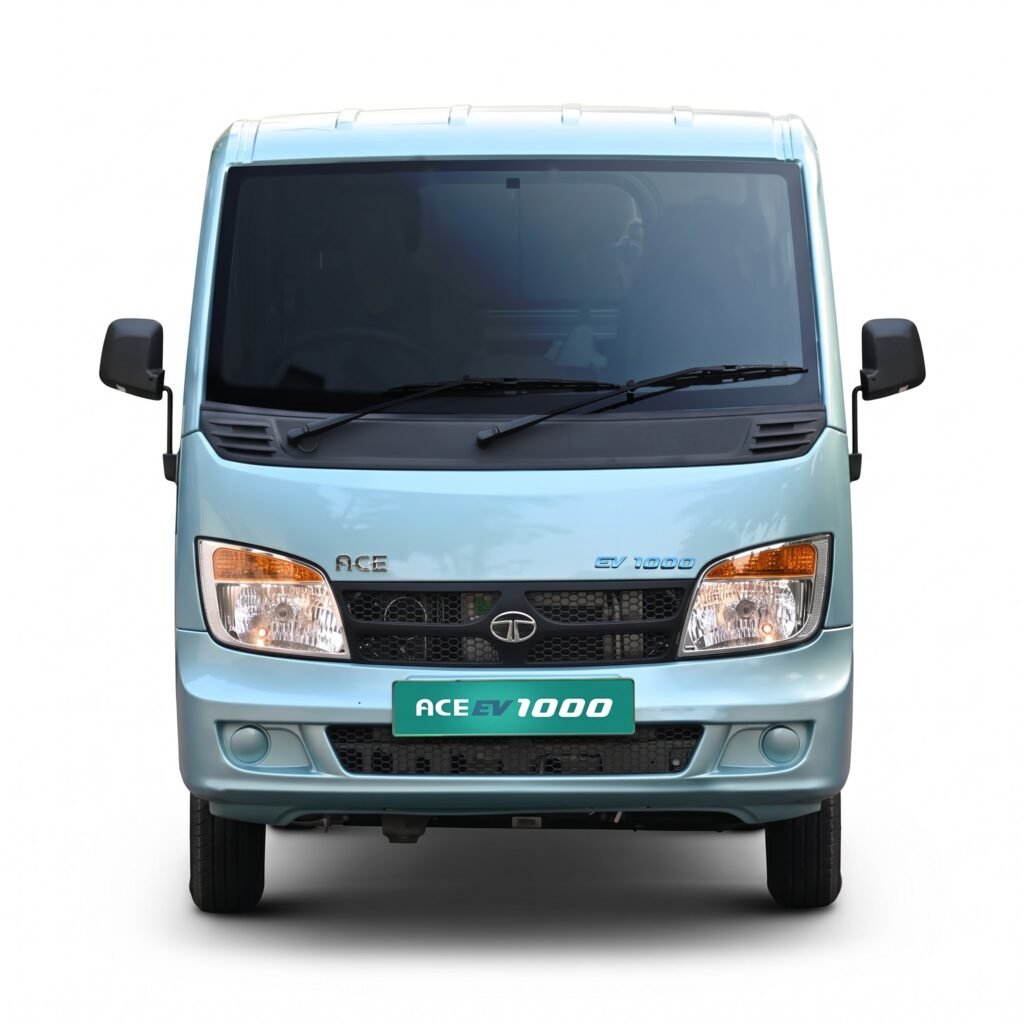
 1 / 2 Images
Tata Ace EV
Electric Small Commercial Vehicle (Cargo)

Tata's electric mini-truck for last-mile cargo. A 21.3 kWh LFP battery, 154 km ARAI range, 600 kg payload and 22 percent gradeability - from Rs 10.51 lakh, with the Ace Pro EV from Rs 6.50 lakh.
*Ex-showroom Price in New Delhi
Tata Ace EV EV essentials
Tata Ace EV pros and cons
Pros
- Running cost of around Rs 1.78 per km against roughly Rs 5 per km for the diesel Ace
- LFP battery is well suited to daily charging and long cycle life
- 7 year / 1,75,000 km high-voltage battery warranty
- 22 percent gradeability under load handles steep inclines and ramps
- Built on the Ace nameplate, India's most established mini-truck
- Tata's commercial vehicle service network is the largest in India
- Near-silent operation suits early-morning and residential deliveries
- Telematics and geo-fencing built in for fleet management
- Three payload options across the range, from 600 kg to 1,000 kg
- Zero tailpipe emissions help with urban clean-air restrictions
Cons
- Commercial vehicle only - not a passenger car
- 60 km/h top speed rules out highway or intercity routes
- 154 km certified range drops meaningfully under full load
- Costs several lakh more upfront than the diesel or CNG Ace
- Business case depends on installing depot charging infrastructure
- Basic cabin - no air conditioning focus, minimal creature comforts
- Rigid leaf spring suspension gives a firm ride when unladen
- Public charging is expensive enough to erode the savings if relied on
- Resale values for electric commercial vehicles are still unproven in India
Best for
Tata Ace EV specifications
Vehicle Type - read this first
Battery & Charging
Efficiency & Real-world Range
Motor & Performance
Payload & Load Body
Dimensions & Chassis
Cabin, Tech & Fleet Management
Warranty & Ownership
Features
Battery & Performance
- 21.3 kWh Lithium Iron Phosphate (LFP) battery on the standard Ace EV
- 14.4 kWh LFP pack on the more affordable Ace Pro EV
- LFP chemistry chosen for thermal stability and long cycle life
- Better suited to daily charging than nickel-based passenger EV chemistries
- ARAI-certified range of 154 km (Ace EV) and 161 km (Ace EV 1000)
- 155 km certified range on the Ace Pro EV
- 27 kW AC induction motor producing 130 Nm on the Ace EV
- 38 bhp permanent magnet synchronous motor with 104 Nm on the Ace Pro EV
- AC charging: 0 to 100 percent in 6 to 7 hours, suited to overnight depot charging
- Fast charging option covers the battery in about 105 minutes
- Ace Pro EV charges in approximately 3 to 6 hours
- 22 percent gradeability under full load
- Single-speed automatic - no clutch or gearshifts for drivers
- Regenerative braking recovers energy in stop-start delivery routes
- High-voltage battery warranty of 7 years or 1,75,000 km
Comfort & Interior
- Digital instrument cluster
- 7-inch infotainment system
- Adjustable driver seat with armrest
- Lockable glove box for documents and valuables
- USB charging ports for driver devices
- Two-seat cabin - driver plus one
- Single-speed automatic transmission reduces driver fatigue on delivery routes
- Smart connectivity suite with navigation
- Vehicle tracking and telematics for fleet managers
- Geo-fencing alerts
- Quiet operation - a genuine advantage for early-morning and night deliveries
- Compact 4,300 mm minimum turning radius for narrow urban lanes
Safety
- Dual-circuit hydraulic braking system
- Disc brakes at the front, drum brakes at the rear
- Tyre Pressure Monitoring System
- Rear view camera
- 60 km/h top speed acts as a built-in safety ceiling for fleet drivers
- Geo-fencing and vehicle tracking for fleet oversight
- Rigid leaf spring suspension front and rear for load stability
- 160 mm ground clearance
- LFP battery chemistry is more thermally stable than nickel-based alternatives
- Note: commercial vehicles in India are not rated by Bharat NCAP or Global NCAP
Tata Ace EV trims and pricing
Compare available Tata Ace EV trims, their ex-showroom prices and key configuration details.
Ace EV 2100 (Standard)
21.3 kWh LFP - 154 km ARAI - 27 kW / 130 Nm - 600 kg payload - 2,100 mm wheelbase
Ace EV 1000
Higher capacity - 161 km range - 1,000 kg payload for heavier loads
Ace Pro EV
14.4 kWh LFP - 155 km - PMSM 38 bhp / 104 Nm - 750 kg payload - 6.5 ft deck - launched June 2025
About Tata Ace EV
One thing to be clear about upfront: the Tata Ace EV is a commercial mini-truck, not a passenger car. It is built to carry cargo, and it is bought by last-mile delivery operators, e-commerce logistics fleets, small business owners and distributors rather than by families. If you are shopping for an electric car, this is not it – but if you move goods for a living, it is one of the most consequential electric vehicles Tata has ever built.
The Ace nameplate matters here. The diesel Tata Ace effectively created India’s small commercial vehicle segment in 2005 and has sold in enormous numbers since. Electrifying it takes that established, trusted product and attacks its single largest running cost – fuel – in a use case where vehicles cover predictable daily routes and return to the same depot every night. That is close to the ideal application for an EV.
The standard Ace EV uses a 21.3 kWh lithium iron phosphate battery driving an AC induction motor producing 27 kW and 130 Nm. ARAI-certified range is 154 km, top speed is 60 km/h, and gradeability is 22 percent under load – meaning it will pull a full payload up a steep incline without drama. Payload is 600 kg with a gross vehicle weight of 1,840 kg, and the load body measures 2,163 mm long.
LFP chemistry is a deliberate and sensible choice for this application. It is more thermally stable than the nickel-based chemistries used in passenger EVs, tolerates frequent charging better, and delivers longer cycle life – which matters enormously on a vehicle that may charge every single night for years.
Charging takes 6 to 7 hours on a standard AC charger, which fits an overnight depot pattern, with a fast-charging option covering the battery in about 105 minutes for operators who need a mid-day top-up.
The range extends beyond the standard model. The Ace EV 1000 raises payload to 1,000 kg with a 161 km range at around Rs 11.40 lakh, while the more affordable Ace Pro EV, launched in June 2025, uses a smaller 14.4 kWh LFP pack with a permanent magnet motor making 38 bhp and 104 Nm, carrying 750 kg for 155 km from Rs 6.50 lakh.
The standard Ace EV is priced at Rs 10.51 lakh ex-showroom, and Tata backs the high-voltage battery for 7 years or 1,75,000 km.
Trending news for Tata Ace EV
Two developments define the Ace EV range today.
First, Tata widened the range downward with the Ace Pro EV, unveiled at the Auto Expo in January 2025 and launched on 23 June 2025. It uses a smaller 14.4 kWh LFP battery driving a permanent magnet synchronous motor producing 38 bhp and 104 Nm, delivers a certified 155 km, carries 750 kg on a 6.5 foot deck, and starts from around Rs 6.50 lakh - roughly Rs 4 lakh below the standard Ace EV. That price point matters enormously in a segment where the buyer is often an owner-driver rather than a corporate fleet, and it makes the electric option viable for a much larger group of operators. The Ace Pro launched as a full family across multiple powertrains with a starting price of Rs 3.99 lakh for the non-electric versions.
Second, the range now spans three distinct payload points. The standard Ace EV carries 600 kg, the Ace Pro EV 750 kg and the Ace EV 1000 a full 1,000 kg with a 161 km certified range at around Rs 11.40 lakh. That spread lets operators match the vehicle to the load rather than paying for capacity they do not use - a meaningful consideration when the cost difference across the range is close to Rs 5 lakh.
The practical picture for operators: the electric small commercial vehicle segment has moved from a single expensive option to a proper ladder, and the entry price has fallen far enough that the payback period against a diesel Ace now sits within a typical ownership cycle rather than beyond it.
Tata Ace EV range and performance
Range on a commercial vehicle means something different from range on a car - it determines how many deliveries a vehicle completes before it stops earning.
The standard Ace EV is ARAI-certified at 154 km, the Ace EV 1000 at 161 km and the Ace Pro EV at 155 km. In real working conditions - a full payload, constant stop-start traffic, frequent door opening and an urban duty cycle - expect roughly 110 to 130 km. That gap between certified and real is larger on a loaded commercial vehicle than on a car, because weight has a direct and continuous effect on consumption.
Against typical use, that is comfortable rather than tight. Most last-mile delivery routes in Indian cities run 60 to 100 km per shift, which the Ace EV handles on a single overnight charge with meaningful margin. Where it becomes constraining is on double-shift operations or routes with long empty-return legs, and those cases need proper route modelling before committing.
Performance is engineered for load rather than pace. The 27 kW motor produces 130 Nm from a standstill, and because electric torque arrives instantly, a fully loaded Ace EV pulls away from a stop more confidently than a diesel equivalent that needs revs to make power. Gradeability of 22 percent under full load is a genuinely useful figure - it means steep basement parking ramps, flyover approaches and hill routes are handled without struggle, which is where loaded diesel mini-trucks most often labour.
The hard constraint is top speed: 60 km/h on the Ace EV, 50 km/h on the Ace Pro EV. This is not a limitation to work around but a boundary on deployment. Urban and suburban routes are fine. Highway legs, ring-road runs at speed and intercity work are not.
Ride quality follows commercial vehicle convention. Rigid leaf springs front and rear are chosen for load stability rather than comfort, so the vehicle rides firmly when empty and settles noticeably once loaded. The 160 mm ground clearance and 4,300 mm turning radius suit congested urban lanes well.
Tata Ace EV safety overview
Safety on a commercial vehicle needs framing differently from a passenger car, and one point needs stating clearly at the outset.
Small commercial vehicles in India are not crash-tested by Bharat NCAP or Global NCAP. Those programmes cover passenger cars, so there is no star rating for the Ace EV, and there is no comparable rated alternative to benchmark it against either. That is a feature of the segment rather than a shortcoming specific to this vehicle.
On equipment, the Ace EV carries a dual-circuit hydraulic braking system with disc brakes at the front and drums at the rear, a Tyre Pressure Monitoring System and a rear view camera. Rigid leaf spring suspension front and rear is chosen for load stability, which matters for safety when carrying 600 kg through urban traffic - an unstable load is a genuine hazard.
Two aspects deserve more credit than they usually get. The first is the 60 km/h top speed. In a vehicle driven by rotating drivers across shifts, a hard speed ceiling removes the highest-risk behaviour entirely without relying on driver discipline or telematics enforcement. The second is the LFP battery chemistry, which is markedly more thermally stable than the nickel-based chemistries used in most passenger EVs - a meaningful consideration on a vehicle that works hard in Indian summer heat and charges every night.
The telematics suite adds a fleet safety dimension: vehicle tracking, geo-fencing alerts and route data give managers visibility of how vehicles are actually being driven, which is often the most effective safety intervention available on a commercial fleet.
Two practical recommendations for operators. Build regular high-voltage system inspection into your maintenance schedule, since these vehicles accumulate charge cycles far faster than private cars. And enforce load securing properly - the vehicle's stability is designed around a properly restrained load, and a shifting 600 kg payload undermines every other safety measure on the list.
Tata Ace EV battery and charging guide
Charging strategy determines whether an electric commercial fleet is profitable, and the Ace EV is designed around one specific pattern.
Depot AC charging overnight is the intended method and the cheapest by a wide margin. A full charge takes 6 to 7 hours, which fits a vehicle that returns from its route in the evening and starts again the following morning. At a depot tariff of around Rs 10 per unit, filling the 21.3 kWh battery costs roughly Rs 213 - and this is where the Rs 1.78 per kilometre figure that justifies the entire purchase comes from.
Any operator considering the Ace EV should treat depot charging infrastructure as part of the vehicle cost, not as an optional add-on. It is the business case. A fleet without depot charging is a fleet that will end up paying public commercial tariffs of Rs 18 to Rs 24 per unit, which pushes cost per kilometre to roughly Rs 3.20 to Rs 4.30 - close enough to CNG that the additional upfront investment stops making sense.
Fast charging exists for exception handling. The Ace EV can be fast-charged in about 105 minutes, which is useful when a vehicle needs to complete a second shift or recover from an unplanned long route. The Ace Pro EV charges in approximately 3 to 6 hours depending on the charger used. Neither is quick by passenger-EV standards, but neither needs to be for a depot-return duty cycle.
Two operational recommendations. First, stagger charging across the fleet rather than plugging every vehicle in simultaneously - simultaneous charging spikes demand charges on commercial electricity connections, which can quietly add a great deal to the monthly bill. Second, monitor per-vehicle charging behaviour through the telematics suite. Fleets that let drivers default to public charging lose much of the saving that justified going electric, and the data to catch that is already built into the vehicle.
One genuine advantage of LFP chemistry: unlike nickel-based packs, LFP tolerates being charged to 100 percent regularly, so there is no need to cap daily charging at 80 percent as passenger EV owners are advised to do.
Tata Ace EV warranty details
Tata covers the Ace EV's high-voltage battery for 7 years or 1,75,000 km, whichever comes first. On a commercial vehicle that is a strong commitment, and the kilometre figure matters more than the years - a delivery vehicle covering 100 km a day across 300 working days accumulates 30,000 km annually, so 1,75,000 km represents roughly six years of typical operation.
Some listings reference alternative terms, including a 6-year battery warranty paired with a 5-year comprehensive maintenance package. Terms may differ by variant, purchase route and fleet agreement, so this is not a detail to assume. Get the exact coverage confirmed in writing before purchase.
Three things to establish specifically. First, the battery capacity degradation threshold below which a replacement is covered - this is the single most important line in any EV warranty and it matters more on a vehicle completing this many charge cycles. Second, whether coverage transfers on resale, which affects residual value in a segment where used electric commercial vehicle values are still unproven. Third, the exact servicing schedule required to keep coverage valid, since commercial vehicles are easy to run past a scheduled interval when they are earning.
Because the Ace EV is bought largely by fleets, warranty is only part of the commercial conversation. Annual maintenance contracts, uptime guarantees, service turnaround commitments and battery health monitoring are typically negotiable on volume, and operators should treat them as part of the purchase negotiation rather than fine print. A shorter guaranteed service turnaround directly protects earning days.
Tata's structural advantage here is network reach - the largest commercial vehicle service footprint in India, extending well beyond metros into the smaller towns where distribution fleets actually operate. For a commercial buyer, a vehicle waiting for service is a vehicle producing no revenue, and network density is what determines how long that wait is.
Quick verdict: Tata Ace EV
The Tata Ace EV is one of the more genuinely sensible electric vehicles sold in India, precisely because it targets a use case that suits electrification almost perfectly.
Last-mile delivery is fixed-route, low-speed, high-stop, depot-returning work - which is exactly where an EV's weaknesses stop mattering and its strengths compound. Limited range is irrelevant on a 80 km daily round. Slow charging is irrelevant when the vehicle sits at a depot for ten hours every night. Regenerative braking is unusually effective on a route with a stop every few hundred metres. And the running cost saving - roughly Rs 3.20 per kilometre against a diesel Ace - lands on a vehicle covering 30,000 km a year, which is where that saving actually becomes substantial.
The engineering choices back this up. LFP chemistry is correct for a vehicle charged nightly in Indian heat. The 22 percent gradeability handles loaded ramps and flyovers. The 7 year, 1,75,000 km battery warranty is structured around commercial mileage rather than private mileage. And the Ace nameplate brings two decades of established service infrastructure with it.
The limitations are real and should not be minimised. The 60 km/h top speed rules out entire categories of route. The upfront cost is several lakh above a diesel Ace, and the payback depends on depot charging infrastructure you have to build and fund. The cabin is basic. And residual values for electric commercial vehicles in India remain genuinely unproven, which is a real risk on a business asset.
Who should buy it: urban and suburban delivery operators with depot parking, predictable daily routes and enough annual mileage for the running-cost saving to compound.
Who should look elsewhere: anyone running highway routes, operators without depot charging access, and anyone wanting a passenger vehicle - this is a cargo truck.
Tata Ace EV vs rivals: how it compares
The Ace EV's competitive set is other small commercial vehicles, not cars.
Against the diesel Tata Ace: the diesel version costs several lakh less upfront, has no charging infrastructure requirement, refuels in minutes and can run highway routes. The Ace EV costs roughly Rs 1.78 per kilometre against about Rs 5, needs far less servicing, runs near-silently and produces no tailpipe emissions - increasingly relevant in cities tightening restrictions on diesel commercial vehicles. Break-even depends on annual mileage; high-utilisation urban fleets get there within a typical ownership cycle, low-mileage owner-drivers may not.
Against the CNG Tata Ace: CNG is the tougher comparison, because it already offers low running costs at around Rs 3.08 per kilometre with none of the infrastructure burden. The EV still saves roughly Rs 1.30 per kilometre and wins decisively on servicing costs, noise and emissions, but the payback period against CNG is considerably longer than against diesel. Operators in CNG-rich markets should model this carefully rather than assuming the EV wins.
Against the Tata Ace Pro EV: within the family, the Ace Pro EV costs around Rs 4 lakh less, carries 150 kg more payload and offers a similar certified range from a smaller 14.4 kWh battery - but tops out at 50 km/h rather than 60. For dense urban routes with short hops between stops, the Ace Pro EV is arguably the better commercial proposition. For routes with longer legs, the standard Ace EV's higher speed and larger battery earn their premium.
Against the Ace EV 1000: if your loads regularly approach 600 kg, the 1,000 kg version is worth the roughly Rs 90,000 premium, and it adds range too at 161 km. If your cargo is bulky rather than heavy - which most parcel work is - the standard model is sufficient, since the load body fills before the weight limit is reached.
Tata Ace EV: who should buy it (and who should not)
This advice is written for operators, since the Ace EV is a business purchase rather than a personal one.
Start with your route profile, because the speed limit is a hard constraint. Map your actual daily routes and check average and maximum speeds. If any meaningful portion involves highways, ring roads at speed or intercity legs, the Ace EV is the wrong vehicle - the 60 km/h ceiling cannot be worked around. Urban and suburban distribution with depot return is where it belongs.
Second, confirm depot charging before you order vehicles. This is not an accessory; it is the business case. Depot AC charging at around Rs 10 per unit produces the Rs 1.78 per kilometre figure that justifies the purchase. Without it, drivers default to public charging at commercial tariffs and your cost per kilometre roughly doubles, at which point CNG becomes the better commercial choice. Budget for the electrical supply upgrade as well as the chargers themselves.
Third, choose the right model for your load. If your cargo is bulky rather than heavy - which most parcel and e-commerce work is - the standard 600 kg Ace EV is sufficient, because the load body fills before the weight limit is reached. If you regularly move dense goods approaching 600 kg, the Ace EV 1000 is worth its premium. If your routes are dense urban with short hops and budget is the binding constraint, the Ace Pro EV at Rs 6.50 lakh is the value option, accepting the lower 50 km/h ceiling.
Fourth, negotiate the service agreement as hard as the price. AMC terms, guaranteed service turnaround, uptime commitments and battery health monitoring are all negotiable on volume. A vehicle waiting for service earns nothing, so turnaround guarantees are often worth more than an invoice discount.
Fifth, check your state's commercial EV incentives and permit rules before finalising, as these vary substantially and some states offer meaningful support specifically for commercial electric vehicles.
Finally, run a pilot. Deploy two or three vehicles on your actual routes for a full quarter, measure real energy consumption, uptime and driver feedback, then scale on evidence rather than on a brochure.
Tata Ace EV ownership and running costs
For a commercial vehicle, cost per kilometre is the only number that ultimately decides the purchase. Here is how the Ace EV works out.
Depot charging: filling the 21.3 kWh battery at around Rs 10 per unit costs roughly Rs 213. Against a real working range of about 120 km with a load, that is approximately Rs 1.78 per kilometre.
Against diesel: a diesel Ace returning about 18 kmpl at Rs 90 per litre costs roughly Rs 5 per kilometre. The Ace EV saves around Rs 3.20 per kilometre. For a vehicle covering 100 km a day across 300 working days - 30,000 km a year - that is close to Rs 96,000 saved annually per vehicle. Across a fleet of twenty vehicles, roughly Rs 19 lakh a year.
Against CNG: a CNG Ace returning about 26 km per kg at roughly Rs 80 per kg costs near Rs 3.08 per kilometre, so the EV saves around Rs 1.30 per kilometre - about Rs 39,000 a year per vehicle. A real saving, but the payback period against CNG is considerably longer than against diesel.
Public charging: at commercial tariffs of Rs 18 to Rs 24 per unit, cost per kilometre rises to roughly Rs 3.20 to Rs 4.30. That is the number that erodes the business case, which is why depot charging is essential rather than optional.
Servicing: no engine oil, filters, fuel injectors, clutch or exhaust. The single-speed transmission eliminates clutch replacement entirely, which on a commercial vehicle with rotating drivers is one of the most common recurring repairs. Regenerative braking extends brake life substantially. Expect maintenance at roughly a third of a diesel Ace.
Upfront and infrastructure: the Ace EV costs several lakh more than a diesel equivalent, and depot charging plus any electrical supply upgrade must be added. Payback against diesel typically falls within a normal ownership cycle for high-utilisation fleets; against CNG it takes longer.
The uncertainty to plan for is residual value. Used electric commercial vehicle values in India are still forming, and this is genuinely harder to predict than for a diesel Ace with two decades of resale history behind it. Build a conservative assumption into the model rather than an optimistic one.
Tata Ace EV tax benefits and incentives
Electric commercial vehicles in India benefit from several tax provisions, and some are specifically valuable to business buyers rather than individuals.
GST on electric vehicles is charged at 5 percent, against a considerably higher rate on diesel and CNG commercial vehicles. On a fleet purchase of any size that difference is substantial in absolute terms and is already reflected in the ex-showroom price.
Depreciation treatment is where commercial buyers gain most, and it is frequently under-modelled. Electric vehicles used for business purposes attract a more favourable depreciation rate than conventional vehicles, which materially improves post-tax total cost of ownership. On a fleet purchase this is often worth more than any negotiated discount on the invoice. Work it through with your accountant before deciding order size.
Road tax and registration exemptions vary substantially by state. Delhi, Maharashtra, Gujarat, Tamil Nadu, Karnataka, Telangana and several others waive or sharply reduce these charges for electric vehicles, and a number of state EV policies include provisions aimed specifically at commercial and last-mile delivery fleets. Because distribution fleets often register vehicles across multiple states, map this deliberately rather than assuming uniform treatment.
Several states also offer capital subsidy or concessional tariffs for commercial charging infrastructure installation - directly relevant given that depot charging is essential to the Ace EV's business case. This is worth investigating before you build, since retrospective claims are usually not possible.
Operationally, electric commercial vehicles are exempt from certain city-level restrictions that increasingly affect diesel goods carriers, and green number plates ease permit requirements in some regions. For an operator in a city tightening diesel restrictions, that access can be worth more than the fuel saving.
All of these policies are revised periodically. Confirm the current position with your state transport department and your tax advisor before committing to a fleet order.
Tata Ace EV maintenance and service
Maintenance is one of the strongest arguments for an electric commercial vehicle, and on a mini-truck covering 30,000 km a year the difference compounds quickly.
There is no engine oil to change, no oil or fuel filter, no fuel injectors, no timing belt and no exhaust system. Critically for a commercial vehicle, there is no clutch - the single-speed transmission eliminates what is often the largest recurring repair on a high-mileage mini-truck driven by rotating drivers who each treat it differently.
What remains is inspection: brake fluid, battery system checks, cabin filter, tyre rotation, suspension and leaf spring inspection, and a battery and software health check. Service intervals are longer than a diesel Ace and labour content per visit is lower, so expect maintenance at roughly a third of the diesel equivalent.
Brakes last considerably longer thanks to regenerative braking, with the standard EV caveat: because friction brakes are used so little, the rear drums can accumulate rust or seize, particularly on vehicles that sit idle during low-demand periods. Make rear brake inspection and cleaning a standing item at every service.
Leaf springs are the commercial-specific wear item to watch. Repeated loading to capacity works them hard, and a sagging or cracked spring affects both ride and load stability. Include a proper suspension inspection at every service rather than treating it as a passenger-car afterthought.
Tyres are the dominant recurring consumable. A vehicle carrying 600 kg through urban traffic across 30,000 km a year gets through them, and underinflated tyres cost range as well as tyre life - which on an EV fleet shows up directly as reduced daily earning capacity. Enforce weekly pressure checks.
Battery care is simpler here than on a passenger EV, because LFP chemistry tolerates daily full charging without the accelerated ageing that affects nickel-based packs. There is no need to cap charging at 80 percent. Do schedule an annual battery health assessment per vehicle so degradation is tracked as data rather than discovered as a surprise.
Tata's largest-in-India commercial vehicle service network is the practical advantage, because for a fleet the relevant metric is not service cost but vehicle downtime.
EV Running Cost Calculator
*Estimated figures based on entered electricity price, fuel price, mileage and average daily driving. Actual running costs can vary.
Related articles for Tata Ace EV

Frequently asked questions about Tata Ace EV
What is the price of the Tata Ace EV?
The standard Tata Ace EV is priced at around Rs 10.51 lakh ex-showroom, the higher-payload Ace EV 1000 at approximately Rs 11.40 lakh, and the more affordable Ace Pro EV from Rs 6.50 lakh. Because these are commercial vehicles sold largely to fleets, actual pricing varies with order volume, state subsidies and financing arrangements. Contact Tata's commercial vehicle sales team for fleet terms rather than working from the listed figure alone.
What is the range of the Tata Ace EV?
The standard Ace EV is ARAI-certified at 154 km, the Ace EV 1000 at 161 km, and the Ace Pro EV at 155 km. In real working conditions with a full payload, frequent stops and urban traffic, expect roughly 110 to 130 km. That is comfortably enough for the vast majority of last-mile delivery routes, which typically run 60 to 100 km in a shift, but it does mean route planning matters - and it rules out long intercity runs entirely.
How much does the Tata Ace EV cost to run compared with the diesel Ace?
Charging the 21.3 kWh battery at a depot tariff of around Rs 10 per unit costs roughly Rs 213. Against a real-world working range of about 120 km, that is approximately Rs 1.78 per kilometre. A diesel Ace returning around 18 kmpl at Rs 90 per litre costs about Rs 5 per kilometre. The EV therefore saves roughly Rs 3.20 per kilometre. For a vehicle covering 100 km a day across 300 working days, that is close to Rs 96,000 saved a year on fuel alone, before counting the much lower servicing costs.
How long does the Tata Ace EV take to charge?
On a standard AC charger the Ace EV takes 6 to 7 hours from empty to full, which fits an overnight depot charging pattern perfectly - plug in at the end of a shift and it is ready the next morning. A fast-charging option covers the battery in about 105 minutes for operators who need a mid-day top-up. The Ace Pro EV takes approximately 3 to 6 hours depending on the charger used. Depot AC charging is by far the cheapest option and is what the business case depends on.
What is the payload capacity of the Tata Ace EV?
The standard Ace EV carries 600 kg with a gross vehicle weight of 1,840 kg. The Ace EV 1000 raises that to 1,000 kg for operators moving heavier goods, and the Ace Pro EV sits in between at 750 kg. The standard model's load body measures 2,163 mm long, 1,475 mm wide and 1,847 mm high, while the Ace Pro EV offers a 6.5 foot deck. Choose based on whether your loads are volume-limited or weight-limited, since delivery cargo often fills the space before it reaches the weight ceiling.
What is the difference between the Tata Ace EV and the Ace Pro EV?
They target different budgets. The Ace EV uses a 21.3 kWh LFP battery with a 27 kW AC induction motor producing 130 Nm, carries 600 kg, tops out at 60 km/h and costs around Rs 10.51 lakh. The Ace Pro EV, launched in June 2025, uses a smaller 14.4 kWh LFP pack with a permanent magnet synchronous motor making 38 bhp and 104 Nm, carries 750 kg on a 6.5 foot deck, tops out at 50 km/h and starts from Rs 6.50 lakh. The Ace Pro EV is the more affordable entry point with more payload but less battery and a lower top speed - well suited to dense urban routes with short distances between stops.
Why does the Tata Ace EV use an LFP battery?
Lithium iron phosphate is the right chemistry for this job. It is more thermally stable than the nickel-based chemistries used in most passenger EVs, which matters on a vehicle that works hard in Indian heat. It tolerates being charged to 100 percent every single night without the accelerated ageing that affects other chemistries. And it delivers considerably longer cycle life, which is decisive on a commercial vehicle that may complete more charge cycles in three years than a private car does in fifteen. The trade-off is lower energy density, which is why the range figures are modest - but for fixed urban routes that is an acceptable compromise.
Is the Tata Ace EV suitable for highway use?
No. The top speed is limited to 60 km/h on the Ace EV and 50 km/h on the Ace Pro EV, which makes highway or intercity operation both impractical and unsafe. These vehicles are engineered specifically for urban and suburban last-mile work - short distances between stops, low average speeds, frequent regenerative braking and a return to depot each night. Assess your actual route profile against that ceiling before ordering, because no amount of range compensates for a speed limit.
What warranty does the Tata Ace EV come with?
Tata covers the high-voltage battery for 7 years or 1,75,000 km, whichever comes first - a strong commitment on a vehicle that accumulates kilometres far faster than a private car. Some listings also reference a 6-year battery warranty alongside a 5-year comprehensive maintenance package, so terms may vary by variant and purchase arrangement. Get the exact coverage confirmed in writing from your dealer, including the battery capacity degradation threshold that triggers a replacement, and the servicing schedule required to keep the warranty valid.
Owner feedback for Tata Ace EV
No approved owner feedback yet. Be the first to share your experience.
Available colours
The Ace EV is supplied in white as its standard finish, which is the near-universal convention for small commercial vehicles in India and a practical choice rather than a limitation. White is the cheapest paint to produce at volume and the easiest to touch up and match after the inevitable urban scrapes and loading-bay knocks. It reflects heat rather than absorbing it, which reduces cabin temperature and, on an electric vehicle, marginally reduces the air-conditioning load that eats into range. Most importantly for a commercial buyer, it provides the cleanest base for fleet branding - a white body takes vinyl wrapping, company livery and regulatory markings better than any other colour, and keeps a mixed-age fleet looking consistent even when vehicles are bought several years apart. Operators buying in volume should ask Tata's commercial vehicle team about custom livery and factory branding arrangements, which are sometimes available on larger orders and work out considerably cheaper than aftermarket wrapping.