
 1 / 2 Images
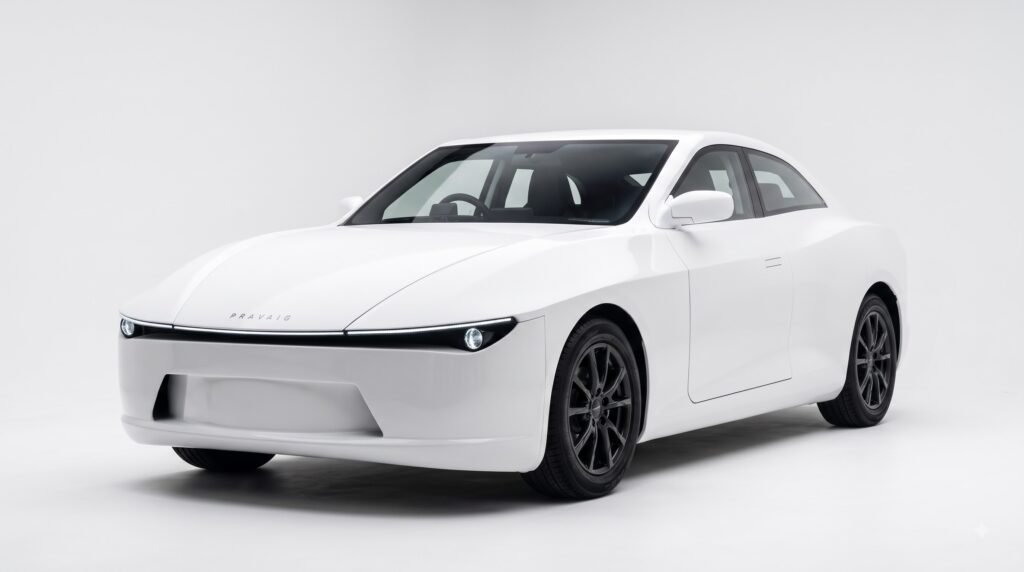
Pravaig Extinction MK1
Luxury Electric Sedan (shelved, never mass-produced)

Shelved before full production. A Bengaluru startup's 96 kWh luxury electric sedan claiming 504 km range, 5.4-second acceleration and a chauffeur-focused rear cabin. Pravaig pivoted to the Defy SUV instead.
*Ex-showroom Price in Bengaluru
Pravaig Extinction MK1 EV essentials
Pravaig Extinction MK1 pros and cons
Pros
- Genuinely ambitious engineering for an Indian startup in 2020
- 504 km claimed range was class-leading for India at the time
- 0 to 100 km/h in 5.4 seconds would have made it seriously quick
- Rear cabin concept was original - 165-degree recline, partition, Devialet audio
- Around 95 percent claimed Indian localisation was a real achievement
- Air filtration focus was ahead of its time for Indian urban conditions
- Fleet subscription model avoided the dealership investment startups struggle with
- Pravaig did eventually deliver a product - the Defy SUV reached the market
Cons
- Never reached full commercial production
- Project slipped repeatedly past its 2021 launch target and was shelved
- Was never available to individual buyers - B2B fleet lease only
- All performance figures were company claims, never independently verified
- No crash test rating of any kind exists
- Contemporary reports carried conflicting motor output figures
- No warranty, service network or parts supply was ever established
- 96 kWh in a 2020-era Indian car implied a very high cost base
- Pravaig redirected its resources to the Defy SUV instead
Best for
Pravaig Extinction MK1 specifications
Reality Check - read this first
Battery, Motor & Performance (2020 claims)
Efficiency & Real-world Estimate
Dimensions & Body
Chauffeur-focused Cabin
Company & Business Model
Why it never reached production
What you can buy today instead
Features
Battery & Performance
- 96 kWh lithium-ion battery, floor-mounted for a low centre of gravity
- Claimed energy density of 155 Wh/kg - positioned as ahead of contemporary rivals
- Company-claimed range of 504 km on a single charge
- 150 kW motor producing 204 PS
- 300 Nm at the motor, with 2,400 Nm quoted at the wheels after gear multiplication
- 0 to 100 km/h in a claimed 5.4 seconds
- Top speed of 196 km/h
- DC fast charging claimed to reach 80 percent in about 30 minutes
- Around 95 percent of the vehicle claimed to be made in India
- Single-speed transmission with rear-wheel drive
- Developed over roughly nine years by Pravaig Dynamics in Bengaluru
- Note: all figures are company claims - no independent verification or certification exists
- Note: one contemporary report quoted a 130 hp motor, conflicting with the 204 PS figure
Comfort & Interior
- Rear seats reclining through up to 165 degrees
- Chauffeur-focused four-seat cabin layout
- Fold-out tray tables for work or dining
- Individual rear air vents
- Thunderbolt charging ports
- 12-inch rear mirrors
- Devialet premium audio system
- Glass partition between front and rear cabins
- Limousine-style privacy partition
- Removable front passenger seat to extend rear legroom
- Himalayan air filtration - claimed to cut cabin CO2 tenfold
- Air filtration claimed to remove 99 percent of PM 2.5 particulates
- Onboard WiFi
- Vanity mirrors
- Minimalist exterior with LED projector headlamps and LED daytime running lights
- Slim LED tail light strips with front and rear light bars
- 17-inch alloy wheels
- 4,820 mm overall length - substantial road presence
Safety
- Company anticipated a five-star crash rating, pending formal testing
- No crash test was ever conducted - the car did not reach mass production
- Floor-mounted battery pack lowers the centre of gravity, aiding stability
- Glass partition between cabins for chauffeur-driven passenger privacy
- Cabin air filtration system targeting PM 2.5 and CO2 levels
- Detailed safety equipment list was never published by Pravaig
- Airbag count was never disclosed
- No ADAS specification was announced
- Note: startup vehicles that never reach production carry no verified safety data whatsoever
Pravaig Extinction MK1 trims and pricing
Compare available Pravaig Extinction MK1 trims, their ex-showroom prices and key configuration details.
Extinction MK1 Prototype (Dec 2020)
Two-door coupe, 4,820 mm long, 17-inch wheels, sloping roofline - as publicly shown
Planned: Production 4-door sedan
Four doors, higher ground clearance, longer wheelbase within the same length - never built at scale
Planned: Corporate fleet lease
Monthly subscription for B2B clients in Bengaluru and Delhi, with optional chauffeur service
About Pravaig Extinction MK1
The Pravaig Extinction MK1 is the most ambitious electric car India nearly built. Revealed in December 2020 by Pravaig Dynamics, a Bengaluru startup that had spent roughly nine years developing it, it claimed 504 km of range from a 96 kWh battery, 0 to 100 km/h in 5.4 seconds, and a chauffeur-focused rear cabin that read more like a private jet than a car. It never reached full commercial production, and Pravaig subsequently pivoted to the Defy SUV.
The engineering claims were genuinely bold for an Indian startup in 2020. The 96 kWh floor-mounted pack claimed an energy density of 155 Wh/kg, which the company positioned as ahead of established rivals at the time. A 150 kW motor produced 204 PS and, after gear multiplication, a quoted 2,400 Nm at the wheels. Top speed was 196 km/h, and DC fast charging was claimed to take the battery from 0 to 80 percent in about 30 minutes. Co-founder Siddhartha Bagri stated that around 95 percent of the car was made in India.
The interior was the real statement. Built for the person sitting behind the driver rather than the driver, it offered up to four seats, rear seats reclining through 165 degrees, fold-out tray tables, individual air vents, Thunderbolt ports, 12-inch rear mirrors, a Devialet audio system, a glass partition between cabins, a removable front passenger seat and an air filtration system the company called Himalayan air – claimed to cut cabin CO2 tenfold and remove 99 percent of PM 2.5 particulates.
The business model was as unusual as the car. The Extinction was never intended for individual buyers. Pravaig planned to offer it exclusively to corporate fleets on a lease and monthly subscription basis, starting in Bengaluru and Delhi with optional chauffeur service, sold digitally with no dealership network, and capped at 2,500 units in the first year.
The prototype shown was a two-door coupe measuring 4,820 mm long on 17-inch wheels, with circular headlamps, LED daytime running lights and slim LED tail light strips. The production version was to be a four-door sedan with higher ground clearance and a longer wheelbase within the same length.
It did not happen. The project slipped repeatedly past its 2021 target and was shelved, with Pravaig redirecting its effort into the Defy electric SUV – which did reach the market.
Trending news for Pravaig Extinction MK1
There is no current news about the Extinction MK1, and that absence is itself the story.
The project was revealed in December 2020 after roughly nine years of development, with a stated 2021 launch. Prototypes were built and were spotted testing on Indian roads, which put it further along than most startup concepts ever get. But the launch date slipped, then slipped again, and the programme was ultimately shelved without a formal cancellation announcement.
What Pravaig Dynamics did instead is the more useful development to track. The company redirected its engineering and capital into the Pravaig Defy, an electric SUV, which did reach the market. That pivot reflects two realities. First, Indian demand moved decisively towards SUVs during exactly the period the Extinction was in development, leaving a premium electric sedan increasingly out of step with the market. Second, a 96 kWh battery pack in a 2020-era Indian vehicle implied a bill of materials that was extremely difficult to recover at a planned volume of 2,500 units a year.
So the Extinction MK1 is best understood not as a failure but as an expensive and instructive development exercise - the engineering platform on which Pravaig learned to build a car, with the Defy as the product that resulted.
For anyone who arrived at this page expecting a launch: there is no launch coming. The Extinction MK1 will not be sold, and no Pravaig announcement supports any listing that shows it as upcoming.
Pravaig Extinction MK1 range and performance
Every figure here is a company claim from December 2020. The Extinction MK1 was never independently tested, never certified by ARAI or any other body, and never produced in numbers that would have generated real-world owner data. Read accordingly.
Pravaig claimed 504 km of range from the 96 kWh battery. Applying the typical gap between manufacturer claims and real conditions, a production car would plausibly have delivered somewhere around 380 to 400 km with the air-conditioning running, and perhaps 330 to 360 km at sustained highway speed. For 2020 in India, when the Hyundai Kona Electric led the market at 452 km claimed from 39.2 kWh, a 504 km claim from a much larger pack was ambitious but not implausible.
Performance claims were genuinely quick. A 150 kW motor producing 204 PS, with 0 to 100 km/h in 5.4 seconds and a 196 km/h top speed, would have made the Extinction faster than almost anything else on Indian roads at its price. The company also quoted 2,400 Nm at the wheels - a figure that requires context, since it represents motor torque multiplied by the gear ratio rather than the motor's own 300 Nm output. Manufacturers occasionally quote wheel torque because the number sounds dramatic; it is not directly comparable to the torque figures other carmakers publish.
One inconsistency worth noting honestly: while most coverage quoted 204 PS, at least one contemporary report cited a 130 horsepower motor. That kind of discrepancy in published specifications is itself a signal about how settled the engineering was.
The chassis fundamentals were sound in principle. A floor-mounted 96 kWh pack in a 4,820 mm car would have kept the centre of gravity low and given the car a planted feel. The production version was to gain higher ground clearance and a longer wheelbase within the same overall length - sensible changes for Indian roads and for the rear-passenger space the car was built around.
Pravaig Extinction MK1 safety overview
The Pravaig Extinction MK1 has no safety rating of any kind, because it was never crash-tested. It did not reach mass production, and no independent testing body ever assessed it.
Pravaig stated at the time that it anticipated a five-star crash rating pending formal testing. That was an aspiration, not a result, and it should be read as such. Anticipated ratings from manufacturers carry no weight until a test is actually conducted and published, and this one never was.
The company also never published a detailed safety equipment list. Airbag count was not disclosed. No ADAS specification was announced. No structural details about the body were shared beyond general design description. For a vehicle positioned at an estimated Rs 30 to 35 lakh, that absence of published safety detail is notable.
What can be said in the car's favour structurally is limited but real. A 96 kWh floor-mounted battery pack lowers the centre of gravity substantially, which improves stability and reduces rollover risk. The glass partition between cabins served privacy rather than safety. The Himalayan air filtration system, claimed to cut cabin CO2 tenfold and remove 99 percent of PM 2.5 particulates, addressed a genuine health concern in Indian cities - though air quality is a different category of safety from crash protection.
The broader lesson matters more than the specifics. Vehicles from startups that never reach production carry no verified safety data whatsoever - no crash results, no long-term reliability record, no recall history and no established parts supply. This is one of the strongest practical arguments for buying from an established manufacturer, and it applies regardless of how impressive a startup's claimed specifications look on a slide.
Pravaig Extinction MK1 battery and charging guide
Pravaig claimed the Extinction MK1 could charge from 0 to 80 percent in about 30 minutes on a DC fast charger. On a 96 kWh battery that would require a charging rate in the region of 150 kW sustained - genuinely fast, and considerably beyond what India's public charging infrastructure could deliver in 2020, when most public DC chargers ran at 50 kW or below.
That mismatch is worth dwelling on, because it illustrates a wider problem the Extinction faced. A car built around fast charging needs an ecosystem that can supply it. In 2020 India, that ecosystem barely existed outside a handful of metro locations.
Pravaig's fleet-lease business model was, in fairness, a sensible answer to exactly this. By operating the vehicles itself in just two cities - Bengaluru and Delhi - the company could have installed and controlled its own depot charging infrastructure rather than depending on public networks. Fleet vehicles returning to a central depot each night is close to the ideal charging pattern for an EV, and it would have neatly sidestepped the infrastructure gap that made a 96 kWh private car impractical at the time.
AC charging specifications were never published, though overnight depot charging was clearly the intended primary method for a fleet operation.
The charging standard was never confirmed publicly. CCS-II subsequently became the Indian standard, but in 2020 the picture was less settled.
As with everything else on this page, none of these claims were ever tested in a production vehicle. No customer ever charged an Extinction MK1 at scale, so the real charging curve, thermal behaviour and sustained rate are all unknown.
Pravaig Extinction MK1 warranty details
No warranty terms were ever announced for the Pravaig Extinction MK1, and the reason is structural rather than an oversight: the car was never going to be sold to individuals.
Pravaig planned to offer the Extinction exclusively to corporate fleets on a lease and monthly subscription basis. Under that model, the vehicle remains the manufacturer's property throughout, and warranty in the conventional consumer sense does not apply. Maintenance, repair and battery health would have been Pravaig's responsibility as part of the subscription, and the commercial terms would have been negotiated per fleet contract rather than published as a standard warranty booklet.
That model has genuine advantages and was a rational choice for a startup. It removes battery replacement risk from the customer entirely, keeps servicing centralised and controllable, and avoids the enormous capital requirement of building a nationwide service and parts network before the first delivery.
What it also means, practically, is that no service infrastructure for the Extinction MK1 was ever established. There is no parts supply, no trained technician network and no warranty framework - because the vehicle never entered commercial operation.
The wider point is worth stating for anyone evaluating any startup vehicle. A specification sheet tells you nothing about what happens three years in, when a component fails and needs replacing. Established manufacturers carry service networks, parts inventories and warranty obligations that outlast individual models. Startups building their first product often do not, and that gap is one of the most common reasons ambitious vehicles disappoint their earliest customers - or, as here, never reach them at all.
Quick verdict: Pravaig Extinction MK1
The Pravaig Extinction MK1 deserves to be remembered with genuine respect, even though it never reached customers.
In 2020, a Bengaluru startup with no manufacturing heritage revealed a car claiming 504 km of range from a 96 kWh pack, 0 to 100 km/h in 5.4 seconds, roughly 95 percent Indian localisation, and a chauffeur-focused rear cabin with 165-degree reclining seats, a glass partition, Devialet audio and an air filtration system targeting PM 2.5. That is not a rendering or a slide deck - prototypes were built and were spotted testing on Indian roads. Whatever happened afterwards, the ambition and the engineering effort behind nine years of development were real.
It also got several strategic calls right. Designing for the rear passenger rather than the driver correctly read how premium cars are actually used in India. Choosing a fleet lease model over building a dealership network was the rational answer for a startup without capital for retail infrastructure. Focusing on cabin air quality was ahead of its time and remains relevant.
What it could not overcome was arithmetic and timing. A 96 kWh battery in 2020 implied a bill of materials that 2,500 units a year could never recover. India's charging infrastructure could not support the fast charging the car was designed around. And the market moved decisively towards SUVs during exactly the years the Extinction was in development, leaving a premium electric sedan increasingly out of step.
Pravaig's response was the right one: shelve the sedan, redirect the engineering into the Defy SUV, and ship a product. A company that ships is worth more than a company with a beautiful specification.
Who should read this page: anyone interested in Indian EV history, or in why ambitious automotive startups so often struggle to reach production.
What to look at instead: the Pravaig Defy, which actually exists.
Pravaig Extinction MK1 vs rivals: how it compares
The Extinction MK1 never reached the market, so the useful comparisons are historical and instructive.
Against the Pravaig Defy: the Defy is the company's product that actually launched, and it is the direct successor to the Extinction programme. It is an SUV rather than a sedan, which reflects both market reality and the lesson Pravaig learned. If you want a Pravaig, this is the one you can consider.
Against the Hyundai Kona Electric, its 2020 contemporary: the Kona was India's first genuinely long-range EV, claiming 452 km from 39.2 kWh, and it was on sale with a warranty and a nationwide service network. It struggled commercially anyway and was discontinued in 2024. That a well-funded global manufacturer could not make a premium EV work in India at that time puts the Extinction's challenge in perspective.
Against the Tesla comparison media made at the time: superficially similar - direct digital sales, no dealerships, long range, startup energy. Fundamentally different in every way that mattered. Tesla built for drivers; the Extinction was built for chauffeur-driven rear passengers. Tesla pursued mass volume; Pravaig planned 2,500 units. Tesla reached production; the Extinction did not.
Against what delivers its ideas today: the MG Windsor EV offers 135-degree reclining rear seats and a genuinely lounge-like rear cabin from around Rs 14.70 lakh - less than half the Extinction's estimated price, available now, and India's best-selling EV. The rear-passenger-first concept the Extinction pioneered in India turned out to be commercially sound; it simply needed to arrive at a mainstream price rather than a premium one.
That is the most interesting comparison of all: the Extinction's core idea succeeded, just not in the Extinction.
Pravaig Extinction MK1: who should buy it (and who should not)
You cannot buy a Pravaig Extinction MK1. It never reached commercial production, no units were delivered to customers at scale, and there is no used market for it because none were ever sold to individuals.
If you arrived here from a listing that showed the Extinction MK1 as upcoming with an expected price and launch date, that listing is stale. No Pravaig announcement supports it. The project was shelved and the company moved on to the Defy.
What to consider instead depends on what attracted you.
If you wanted a Pravaig specifically, the Defy electric SUV is the company's product that reached the market. It carries the engineering thinking developed on the Extinction programme in a body style that matches where Indian demand actually went.
If the chauffeur-focused rear cabin was the appeal - the reclining seats, the sense of travelling rather than driving - the MG Windsor EV delivers a remarkably similar experience with 135-degree reclining rear seats, a panoramic glass roof and a genuinely lounge-like rear bench, from around Rs 14.70 lakh. It is India's best-selling EV, which suggests the Extinction read the market correctly even if it could not serve it.
If the range and performance were the draw, current premium electric SUVs from established manufacturers deliver both, with published crash ratings, real warranties and service networks behind them.
The broader lesson is worth carrying into any EV purchase. When evaluating a vehicle from a new manufacturer, weigh three things above the specification sheet: whether cars have actually been delivered to customers, whether a service and parts network exists, and whether an independent crash rating has been published. A specification is a promise. Those three things are evidence.
Pravaig Extinction MK1 ownership and running costs
No real ownership cost data exists for the Extinction MK1, because no customer ever operated one at scale. What follows is a reconstruction from the claimed specification, useful mainly for understanding what the car would have offered.
Charging: filling a 96 kWh battery at a tariff of around Rs 10 per unit would have cost roughly Rs 960. Against a likely real-world range of about 390 km, that works out to approximately Rs 2.45 per kilometre. That is high for an EV, simply because a large, heavy, powerful car consumes more energy - the same physics that applies to any premium electric vehicle.
Against petrol: a comparable petrol luxury sedan returning about 12 kmpl at Rs 100 per litre costs roughly Rs 8.30 per kilometre. The Extinction would therefore have saved around Rs 5.85 per kilometre - close to Rs 88,000 a year at 15,000 km, and considerably more for a chauffeur-driven fleet vehicle covering 40,000 km annually. For the fleet use case Pravaig targeted, those savings would have been substantial.
Servicing would have followed the EV pattern - no engine oil, filters, spark plugs, clutch or exhaust - though under the subscription model this would have been bundled rather than billed separately.
The cost that ultimately mattered was not the owner's but the manufacturer's. A 96 kWh battery pack in 2020 represented an enormous share of the vehicle's bill of materials, at a time when cell prices were considerably higher than today. Recovering that across a planned 2,500 units a year, in a market where premium EVs were selling in the low hundreds, was the arithmetic the Extinction could not solve.
That is the genuinely instructive number on this page: not the cost per kilometre to a customer, but the cost per unit to a startup attempting a premium EV at low volume.
Pravaig Extinction MK1 tax benefits and incentives
The Extinction MK1 never reached commercial operation, so no buyer ever claimed an incentive on one. This section covers the provisions that would have applied and that remain relevant to any EV purchase today.
GST on electric vehicles is charged at 5 percent, against a much higher rate plus cess on comparable petrol vehicles. On a car at the Extinction's estimated Rs 30 to 35 lakh price point, that difference would have been very substantial in absolute terms.
Because Pravaig planned to lease the vehicles to corporate fleets rather than sell them to individuals, the relevant tax treatment would have been commercial rather than personal. Businesses can claim more favourable depreciation on electric vehicles than on conventional ones, and lease payments are typically treated as operating expenses - both meaningful advantages for the corporate fleet customers Pravaig was targeting. For a fleet operator, that combination often matters more than the headline vehicle price.
Road tax and registration exemptions on electric vehicles vary substantially by state. Delhi and Karnataka - the two states covering Pravaig's planned launch cities of Delhi and Bengaluru - both offer meaningful EV concessions, which would have been a deliberate part of the launch city selection rather than a coincidence.
Section 80EEB, offering individual buyers a deduction of up to Rs 1.5 lakh on EV loan interest, would not have applied to a fleet lease arrangement.
Green number plates exempt EVs from certain city-level restrictions and permit requirements in some regions - a genuine operational advantage for a chauffeur-driven fleet operating in congested metros.
All of these policies are revised periodically. Anyone applying them to a current EV purchase should confirm the position with their dealer, their state transport department and, for commercial purchases, their tax advisor.
Pravaig Extinction MK1 maintenance and service
No maintenance schedule was ever published for the Extinction MK1, because it never entered commercial operation. What follows is the general picture plus the specific lesson this vehicle teaches.
An electric car of this type would have needed no engine oil, no oil or combustion air filter, no spark plugs, no timing belt, no clutch and no exhaust system. Servicing would have consisted largely of inspection - brake fluid, battery thermal management, cabin air filter, tyre rotation, suspension checks and software and battery health checks. Under Pravaig's subscription model, all of this would have been the company's responsibility rather than the customer's, which was one of the model's genuine attractions.
Regenerative braking would have extended brake life considerably.
The air filtration system would have been the one unusual maintenance item. A filtration unit claiming to remove 99 percent of PM 2.5 particulates requires regular filter replacement to keep performing, and in Indian urban conditions those filters load quickly. Any vehicle marketed on air quality needs a filter replacement schedule that owners actually follow, or the claimed benefit quietly disappears.
The more important lesson concerns parts and support, and it applies to any vehicle from a new manufacturer. The Extinction MK1 illustrates the extreme case - a vehicle so short-lived that no parts supply, service network or trained technician base was ever established. Even prototypes that were built have no support framework behind them.
Before buying any vehicle from a startup or a very low-volume manufacturer, establish three things: whether a service network exists within reasonable distance, whether battery modules and major components are available as spares, and what happens to support obligations if the company changes direction or ceases operations. Those questions matter more on a startup vehicle than any specification on the brochure.
EV Running Cost Calculator
*Estimated figures based on entered electricity price, fuel price, mileage and average daily driving. Actual running costs can vary.
Related articles for Pravaig Extinction MK1


Frequently asked questions about Pravaig Extinction MK1
Can you buy a Pravaig Extinction MK1?
No. The Extinction MK1 never reached full commercial production. It was revealed in December 2020 with a planned 2021 launch, that timeline slipped repeatedly, and Pravaig Dynamics subsequently shelved the project in favour of the Defy electric SUV. Even if it had launched, it would not have been available to individual buyers - Pravaig planned to offer it exclusively to corporate fleets on a lease and monthly subscription basis, starting in Bengaluru and Delhi.
What happened to the Pravaig Extinction MK1?
It was shelved. Pravaig Dynamics had spent roughly nine years developing the car before revealing it in December 2020, targeting a 2021 launch. Prototypes were built and spotted testing on Indian roads, but the project never made it to full commercial production. The company redirected its resources into the Pravaig Defy, an electric SUV, which did reach the market. That pivot is the practical answer: the Extinction became the engineering foundation rather than the product.
What were the Pravaig Extinction MK1 specifications?
As claimed by Pravaig at the December 2020 reveal: a 96 kWh floor-mounted lithium-ion battery with an energy density of 155 Wh/kg, driving a 150 kW motor producing 204 PS and 300 Nm - quoted as 2,400 Nm at the wheels after gear multiplication. Claimed range was 504 km, top speed 196 km/h, and 0 to 100 km/h took 5.4 seconds. DC fast charging was claimed to reach 80 percent in about 30 minutes. The prototype measured 4,820 mm long on 17-inch wheels. None of these figures were ever independently verified or officially certified.
Why was the Extinction MK1 only offered to fleets?
It was a deliberate business model choice, and a logical one for a startup. Selling to individual buyers requires a dealership network, a service infrastructure, spare parts distribution and consumer financing arrangements - enormous capital commitments before the first car is delivered. By leasing to corporate fleets on monthly subscriptions in just two cities, Pravaig could control servicing centrally, keep vehicle count manageable at a planned 2,500 units in year one, and sell digitally with no showrooms at all. Chauffeur services were offered as an option, which fitted the car's rear-focused cabin design.
What was special about the Extinction MK1 interior?
It was designed around the rear passenger rather than the driver, which was unusual for an Indian car at any price. The four-seat cabin offered rear seats reclining through up to 165 degrees, fold-out tray tables, individual air vents, Thunderbolt charging ports, 12-inch rear mirrors, a Devialet audio system, onboard WiFi and a glass partition between the front and rear cabins. The front passenger seat was removable to extend rear legroom further. Pravaig also fitted an air filtration system it called Himalayan air, claiming it cut cabin CO2 tenfold and removed 99 percent of PM 2.5 particulates - a genuinely relevant feature for Indian urban conditions.
Was the Pravaig Extinction MK1 made in India?
Substantially, according to the company. Co-founder Siddhartha Bagri stated that around 95 percent of the car was made in India, with only lower-value components imported. Pravaig Dynamics is based in Bengaluru and developed the vehicle in-house over roughly nine years. For an Indian startup attempting a premium electric sedan in 2020, that level of claimed localisation was a genuine achievement - though it was never independently audited, and the car never reached the production volumes that would have tested the supply chain.
What should I look at instead of the Extinction MK1?
If you want a Pravaig, the Defy electric SUV is the company's product that actually reached the market - it is the direct successor to the Extinction programme and carries much of its engineering thinking. If you wanted the Extinction's chauffeur-focused rear cabin concept in something available today, the MG Windsor EV offers 135-degree reclining rear seats at a far lower price, and the BYD eMAX 7 provides a genuinely spacious rear cabin. For the performance and range the Extinction promised, current premium electric SUVs from established brands deliver it with a verified crash rating and a service network behind them.
Was the Extinction MK1 really India's answer to Tesla?
Media coverage at the time framed it that way, and the comparison was understandable - an ambitious Indian startup promising a long-range premium EV with direct digital sales and no dealerships. But the differences were substantial. The Extinction was designed for chauffeur-driven rear passengers rather than drivers, sold only to fleets rather than individuals, and planned at 2,500 units a year rather than mass volume. And ultimately it did not reach production, which is the difference that matters most. The comparison says more about how India was thinking about EVs in 2020 than about the car itself.
Owner feedback for Pravaig Extinction MK1
No approved owner feedback yet. Be the first to share your experience.
Available colours
Pravaig never announced a production colour palette for the Extinction MK1, because the car never reached commercial production. What is documented is how the vehicle appeared publicly: the December 2020 reveal prototype wore a restrained metallic finish with gloss black lower trim and dark 17-inch alloy wheels, a deliberately understated treatment that suited the car's minimalist design language and its chauffeur-driven positioning. Prototypes subsequently spotted testing on Indian roads appeared in similarly muted tones. That restraint was consistent with the target customer - a corporate fleet vehicle carrying executives is expected to look discreet rather than attention-seeking, and premium chauffeur-driven cars worldwide sell overwhelmingly in blacks, greys, silvers and dark blues. Had the Extinction reached production, a palette built around those shades would have been the near-certain choice, most likely with three to five options rather than a wide consumer range - fleet vehicles are typically offered in a narrow palette to simplify inventory and keep a fleet looking consistent. No production colour information exists, and any palette published for this car elsewhere is speculation.