
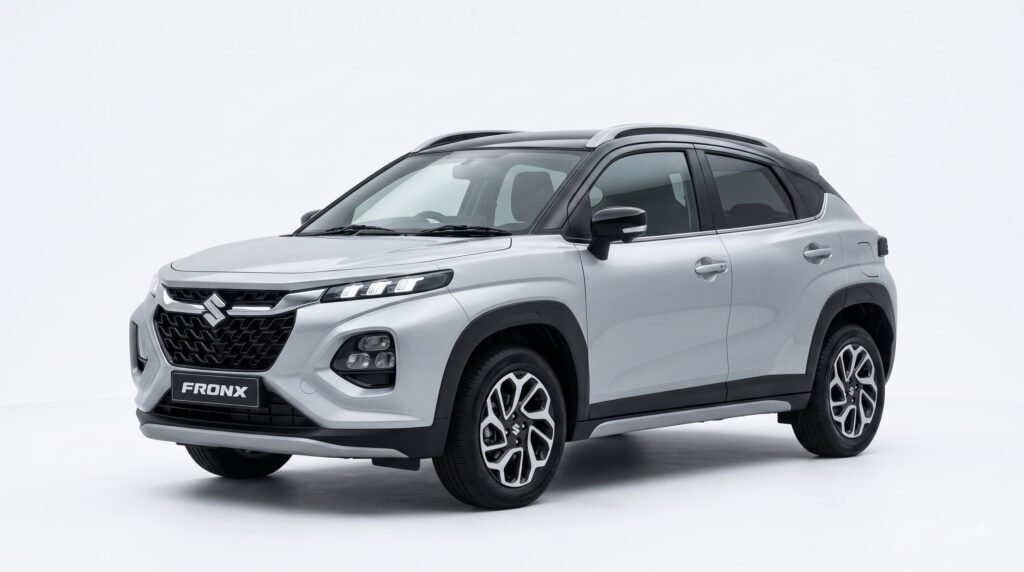
 1 / 2 Images
Maruti Suzuki Fronx EV (Rumoured)
Rumored (no variants announced)

An electric version of Maruti's popular Fronx crossover has not been announced. This listing sets out what a Fronx EV would realistically look like, and why Maruti's current strategy makes it less likely than buyers assume.
*Ex-showroom Price in New Delhi
Maruti Suzuki Fronx EV (Rumoured) EV essentials
Maruti Suzuki Fronx EV (Rumoured) pros and cons
Pros
- Fronx is already a proven seller, so an electric version would arrive with established buyer familiarity
- Compact 3,995 mm footprint suits Indian city driving and parking constraints well
- Maruti's service network of over 4,000 outlets is unmatched, which matters enormously for first-time EV buyers
- Nexa retail experience is better suited to EV buyers than a standard Maruti Arena dealership
- Head-up display and 360-degree camera already exist on the petrol car, giving a strong feature baseline
- Running cost near Rs 1.05 per km against roughly Rs 4.73 for the petrol Fronx
- Flat floor from a battery layout would improve the rear middle seat, a genuine petrol Fronx weakness
Cons
- Maruti has made no announcement, so this vehicle may never exist in this form
- Fronx uses the HEARTECT petrol platform, and adapting it for batteries typically costs space and efficiency
- Maruti's mass-market strategy currently favours CNG and hybrid over battery electric
- An expected Rs 13 lakh entry price is nearly double the petrol Fronx's starting price
- Around 380 km expected range is adequate for cities but limiting for regular highway use
- Maruti has no established EV charging network of its own in India
- The e Vitara occupies Maruti's EV attention and budget, leaving little room for a second BEV soon
Best for
Maruti Suzuki Fronx EV (Rumoured) specifications
Battery & Charging
Efficiency & Real-world Range
Motor & Performance
Dimensions & Weight
Suspension Brakes & Tyres
Comfort & Tech
Safety
Warranty
Features
Battery & Performance
- Around 40 kWh battery expected, sized for a compact crossover rather than long distance touring
- Roughly 380 km certified range expected, positioned for city and intercity commuting
- Lithium-ion chemistry expected, with LFP a realistic choice given the price target
- Liquid cooled thermal management expected, necessary for Indian summer conditions
- Floor mounted battery pack lowering the centre of gravity below the petrol Fronx
- Regenerative braking with selectable levels expected
- Maruti's e Vitara battery technology would be the logical donor for cells and pack design
- Flat floor benefit, improving middle rear seat comfort over the petrol Fronx
- IP67 rated pack expected, standard practice for Indian market electric vehicles
Comfort & Interior
- 9-inch SmartPlay Pro Plus touchscreen carried from the petrol Fronx
- Head-up display, a rare feature at this price and already offered on the petrol Fronx
- 360-degree camera available on the petrol Fronx top trim, expected to continue
- Wireless Android Auto and Apple CarPlay
- Automatic climate control with an electric compressor for the EV
- Wireless phone charging on higher trims
- Cruise control expected
- Suzuki Connect telematics with remote functions
- Rear AC vents
- Pre-conditioning via app expected, allowing cabin cooling while plugged in
Safety
- 6 airbags expected as standard, in line with current Bharat NCAP expectations
- ABS with EBD and electronic stability programme expected as standard
- Hill hold assist expected
- ISOFIX child seat anchors
- 360-degree camera on higher trims, carried from the petrol Fronx
- Tyre pressure monitoring system expected
- High voltage automatic disconnect in a collision, standard on production EVs
- IP67 battery pack rating expected
- ADAS unlikely at this price point, Maruti does not currently offer it on the Fronx
Maruti Suzuki Fronx EV (Rumoured) trims and pricing
Compare available Maruti Suzuki Fronx EV (Rumoured) trims, their ex-showroom prices and key configuration details.
Fronx EV Base (expected)
~35 kWh expected - ~320 km expected - Automatic
Fronx EV Mid (expected)
~40 kWh expected - ~380 km expected - Automatic
Fronx EV Top (expected)
~40 kWh expected - ~380 km expected - Automatic
About Maruti Suzuki Fronx EV (Rumoured)
The Maruti Suzuki Fronx EV does not exist yet, and that is worth stating plainly before anything else. Maruti has made no announcement about an electric Fronx, published no specification, and confirmed no launch window. Search demand for the maruti fronx ev is real and growing, driven by the petrol Fronx’s success as one of Nexa’s strongest sellers since its April 2023 launch, but demand and product are two different things. This listing exists because people are searching for it, and they deserve an honest answer rather than a page of invented numbers.
There is a structural reason to be cautious about a Fronx EV, and it is more interesting than the usual wait and watch commentary. Maruti’s electrification strategy has been deliberately split. For mass-market cars it has pushed CNG and mild hybrid technology hard, because those deliver lower running costs without requiring buyers to change how they refuel. Battery electric development has been concentrated on the e Vitara, which sits on HEARTECT-e, a dedicated electric platform. The Fronx sits on HEARTECT, a conventional platform designed around an engine and fuel tank. Converting it to battery electric would mean either adapting a petrol architecture, which typically costs interior space and efficiency, or engineering a new platform for a sub-Rs 15 lakh crossover, which is difficult to justify commercially. Neither path is impossible, but neither is quick.
That said, the case for a Fronx EV is not weak. The petrol Fronx is a 3,995 mm crossover with 308 litres of boot space and 2,520 mm of wheelbase, which is a sensible footprint for a city electric vehicle. Its buyer profile skews urban, and urban buyers are exactly who benefits most from electric running costs. If Maruti does build it, a maruti fronx ev price near Rs 13 lakh to Rs 17 lakh with roughly 350 km to 400 km of range would place it in a segment that currently has very few strong options. Every performance and pricing figure in this listing is an estimate derived from the petrol Fronx’s dimensions and Maruti’s e Vitara technology, and is labelled as expected rather than confirmed. At EVUnlock, we cross-check specifications against official manufacturer documentation before publishing, and for the Fronx EV no such documentation exists.
Trending news for Maruti Suzuki Fronx EV (Rumoured)
Maruti concentrates battery electric effort on the e Vitara. Maruti's first battery electric vehicle for India uses HEARTECT-e, a dedicated electric platform rather than an adapted petrol architecture. Building a second BEV on a lower price point would require either a new platform investment or a compromise conversion, and Maruti has publicly signalled neither for the Fronx.
CNG and mild hybrid remain Maruti's mass-market efficiency answer. Rather than pushing battery electric down into the sub-Rs 15 lakh bracket, Maruti has expanded CNG availability across its range and applied mild hybrid technology to models including the Fronx. This approach lowers running costs for buyers without requiring charging infrastructure, which shapes how likely a Fronx EV realistically is in the near term.
Maruti Suzuki Fronx EV (Rumoured) range and performance
A battery near 40 kWh would give the Fronx EV roughly 380 km of certified range, translating to perhaps 300 km to 330 km in real-world city use and 260 km to 290 km at sustained highway speeds. That is a city car's range profile rather than a touring one, which suits the Fronx's urban buyer base but limits it for regular long-distance driving. On performance, an expected 120 bhp and 190 Nm would make the electric version noticeably quicker in traffic than the petrol Fronx, whose 1.0 Boosterjet turbo produces 100 PS and 148 Nm and needs revs to deliver it. Electric torque arrives instantly, which changes low-speed driving more than any 0 to 100 km/h figure conveys. There is a second, less obvious gain. The petrol Fronx's rear middle seat is compromised by a transmission tunnel. A floor-mounted battery pack produces a flat floor, which would make the middle rear seat genuinely usable rather than a token position, and that matters more for family buyers than a second off the acceleration time.
Maruti Suzuki Fronx EV (Rumoured) safety overview
No crash testing has been carried out on a Fronx EV because the vehicle does not exist. The petrol Fronx offers 6 airbags, ABS with EBD, electronic stability programme, hill hold assist, and a 360-degree camera on its top trim, which establishes a reasonable equipment baseline for any electric version. Bharat NCAP testing has been mandatory for new models since October 2023, so a Fronx EV would require assessment before launch. Buyers should verify the actual rating at that point rather than assuming it carries over from the petrol car, since battery weight changes crash dynamics and manufacturers occasionally see different results between powertrain variants of the same model. One genuine safety advantage would come from the battery itself. A floor-mounted pack lowers the centre of gravity substantially compared with a petrol crossover, which improves stability in emergency lane changes and reduces roll-over risk on a relatively tall body.
Maruti Suzuki Fronx EV (Rumoured) battery and charging guide
Expect DC fast charging around 50 kW, giving a 10 to 80 percent charge in roughly 50 minutes on a 40 kWh pack, with 7.2 kW AC charging delivering a full charge in about 6 hours at a home wallbox. On a standard 3.3 kW household connection, a full charge would take approximately 12 hours, which is workable overnight but slow for daytime top-ups. A CCS-II port is the Indian standard and would be expected. One practical consideration deserves emphasis. Maruti does not operate its own charging network in India, unlike Tata, which has invested heavily in highway fast charging. A Fronx EV owner would depend entirely on third-party charge point operators for public charging, and coverage varies considerably outside major metros. For a buyer with reliable home charging and a predominantly urban driving pattern, this is a minor issue. For anyone regularly driving intercity, it is a significant one worth investigating before purchase.
Maruti Suzuki Fronx EV (Rumoured) warranty details
No warranty terms exist because the Fronx EV has not been announced. Maruti currently offers a standard warranty of 3 years or 1,00,000 kilometres on its petrol models, with extended plans available. On battery and motor coverage, the established Indian market norm across Tata, Hyundai, MG, and Mahindra is 8 years or 1,60,000 kilometres, and Maruti applies comparable terms to the e Vitara. A Fronx EV would face competitive pressure to match this. The clause worth reading closely at launch would be the guaranteed battery state of health percentage, since this determines what degradation is actually covered rather than simply how long the warranty runs.
Quick verdict: Maruti Suzuki Fronx EV (Rumoured)
The Fronx EV is a car that makes obvious sense on paper and much less sense inside Maruti's current strategy. On paper the logic is clean. The Fronx is a successful, well-proportioned urban crossover with an established buyer base, sold through Nexa, and backed by the largest service network in India. Those are strong foundations for a first mainstream electric car. The problem is that Maruti has already decided how it wants to reduce running costs for mass-market buyers, and the answer has been CNG and mild hybrid rather than batteries. Battery electric investment has gone into the e Vitara on a dedicated platform, and the Fronx sits on a conventional petrol architecture that would need either compromise or expensive rework. So the honest position is this. If you are waiting for a Fronx EV, you are waiting for something Maruti has not committed to and may never build in this form. If Maruti does change course and price it near Rs 13 lakh with 380 km of range, it would be a genuinely compelling city electric car. But that is a conditional worth being clear-eyed about rather than planning a purchase around.
Maruti Suzuki Fronx EV (Rumoured) vs rivals: how it compares
In the expected Rs 13 lakh to Rs 17 lakh band, a Fronx EV would face established competition rather than an open field. Tata's electric range covers this bracket with proven products, a large owner base, and the country's most developed EV service and charging infrastructure. MG and Hyundai also compete here with vehicles that have real reliability records rather than projections. Against Maruti's own e Vitara, a Fronx EV would sit clearly below it in size, range, and price, serving as an entry point rather than a rival. Against the petrol Fronx, the electric version would win decisively on running cost and refinement while losing on purchase price and refuelling convenience. The most useful comparison for a prospective buyer, though, is against what is actually purchasable today, because a vehicle that has not been announced cannot be meaningfully compared on specifications that do not exist.
Maruti Suzuki Fronx EV (Rumoured): who should buy it (and who should not)
Do not plan a purchase around the Fronx EV. Maruti has not announced it, no timeline exists, and there is a reasonable chance it never arrives in this form given the company's current strategy. If you want an electric car in the Rs 13 lakh to Rs 17 lakh range now, several established options are available with genuine ownership histories, and buying a proven product beats waiting indefinitely for an unconfirmed one. If you specifically want a Maruti electric vehicle, the e Vitara is the only option, though it sits higher at around Rs 17.49 lakh onwards. If you like the Fronx itself and running cost is your priority, the CNG variant delivers meaningfully lower fuel costs than petrol without requiring any charging infrastructure. Do not pay any booking or token amount to a dealer or website claiming to accept Fronx EV orders, since no order book exists.
Maruti Suzuki Fronx EV (Rumoured) ownership and running costs
At an estimated Rs 15 lakh on-road and roughly 8 km/kWh real-world efficiency, running cost would be approximately Rs 1.06 per kilometre at Rs 8.5 per kWh. Over 15,000 km a year that is around Rs 16,000 in electricity. The petrol Fronx at 21.79 km/l ARAI and Rs 103 per litre costs approximately Rs 4.73 per kilometre, or Rs 70,950 over the same distance, giving an annual saving of roughly Rs 55,000. Annual maintenance on a compact EV typically runs Rs 6,000 to Rs 10,000 against Rs 12,000 to Rs 18,000 for the petrol Fronx, since there is no engine oil, spark plugs, or air filter servicing. The purchase price gap is the critical number. If an electric Fronx costs roughly Rs 6 lakh more than an equivalent petrol variant, recovering that through running cost savings alone would take approximately 9 to 10 years at 15,000 km annually, or around 5 to 6 years at 25,000 km. High-mileage users benefit substantially. Low-mileage users may not recover the premium at all.
Maruti Suzuki Fronx EV (Rumoured) tax benefits and incentives
A Fronx EV would qualify for the standard Indian electric vehicle incentives if launched. Section 80EEB of the Income Tax Act allows individual buyers a deduction of up to Rs 1.5 lakh on interest paid on an electric vehicle loan, worth roughly Rs 46,800 in tax saved over the loan tenure for someone in the 30 percent bracket. GST on electric vehicles is 5 percent against 28 percent plus cess on comparable petrol cars, which is already reflected in ex-showroom pricing. State-level benefits vary, with Delhi offering a purchase subsidy and registration fee waiver, Maharashtra and Gujarat offering purchase subsidies, and several states including Uttar Pradesh and Rajasthan waiving road tax on electric vehicles. At a Rs 15 lakh price point, a full registration waiver alone saves Rs 1 lakh to Rs 1.5 lakh in most states. These incentives materially improve the payback calculation and should be factored in before dismissing an EV on purchase price alone. State policies change frequently, so confirm current terms at the dealership.
Maruti Suzuki Fronx EV (Rumoured) maintenance and service
A Fronx EV would follow the pattern of other compact electric cars in India, with service intervals expected at 15,000 km or annually. The electric drivetrain removes engine oil and filter changes, spark plugs, air filters, fuel filters, and clutch wear, which together make up the bulk of what petrol Fronx owners currently pay at each service. What remains is tyre rotation, brake fluid checks at extended intervals since regenerative braking substantially reduces pad wear, cabin air filter replacement, wiper blades, battery coolant, and an annual battery health check. Estimated annual servicing would be Rs 6,000 to Rs 10,000 against Rs 12,000 to Rs 18,000 for the petrol version. Tyre wear would run slightly higher because of roughly 250 kg of additional weight. The significant advantage here is Maruti's service network, which covers over 4,000 outlets across India including small towns where no other manufacturer has comparable reach. For a first-time EV buyer outside a metro, that coverage is arguably worth more than any specification advantage a rival might offer.
EV Running Cost Calculator
*Estimated figures based on entered electricity price, fuel price, mileage and average daily driving. Actual running costs can vary.
Related articles for Maruti Suzuki Fronx EV (Rumoured)
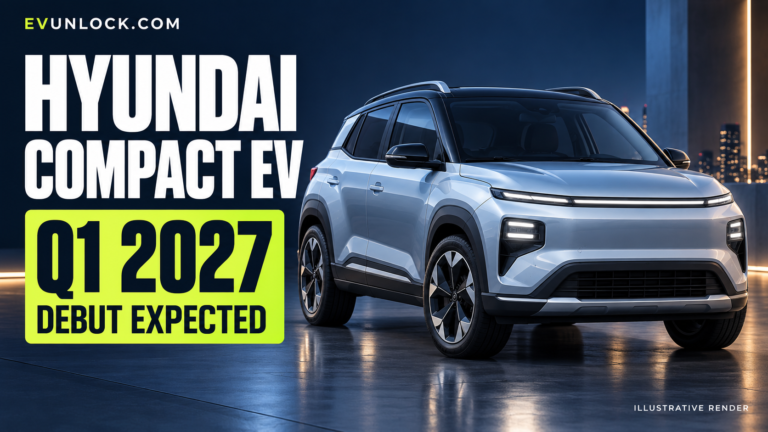

Frequently asked questions about Maruti Suzuki Fronx EV (Rumoured)
Is the Maruti Fronx EV launched in India?
No. Maruti Suzuki has not launched, announced, or confirmed a Fronx EV. The Fronx is currently sold with 1.2 litre naturally aspirated petrol, 1.0 litre Boosterjet turbo petrol, and CNG options through Nexa dealerships. Maruti's only battery electric vehicle in India is the e Vitara. Any website showing Fronx EV specifications or a launch date is presenting speculation rather than official information.
What would the Maruti Fronx EV price be?
Roughly Rs 13 lakh to Rs 17 lakh ex-showroom would be the realistic band, though Maruti has confirmed nothing. The reasoning is straightforward. Electric versions of compact cars typically carry a premium of Rs 5 lakh to Rs 6 lakh over their petrol equivalents in India because of battery cost. The petrol Fronx starts near Rs 7.5 lakh, which places an electric version in the low to mid teens. Below Rs 13 lakh, the battery would have to be small enough to compromise range meaningfully.
Is Maruti Suzuki planning a Fronx EV?
There is no public indication that Maruti is developing a Fronx EV. Maruti's strategy has split deliberately. Mass-market models like the Fronx receive CNG and mild hybrid technology, which cut running costs without changing how buyers refuel. Battery electric development has concentrated on the e Vitara, built on the dedicated HEARTECT-e platform. Adding a second BEV in a lower price bracket would require either adapting a petrol platform or funding a new one, and Maruti has signalled neither.
What range would a Fronx EV have?
Around 380 km certified would be a realistic target with a battery near 40 kWh, giving perhaps 300 km to 330 km in real-world city conditions with the air conditioning running. Highway driving at sustained speeds would bring that closer to 260 km to 290 km. These are estimates based on the Fronx's dimensions and weight combined with efficiency figures from comparable Indian electric vehicles. No certification exists because no vehicle exists.
Which electric car should I consider instead of waiting for a Fronx EV?
If you want a Maruti specifically, the e Vitara is the only battery electric option, though it sits considerably higher at around Rs 17.49 lakh onwards. In the Fronx EV's expected price band of Rs 13 lakh to Rs 17 lakh, established options from Tata, MG, and Hyundai already offer proven products with real service histories. Waiting for an unannounced vehicle with no confirmed timeline is rarely a sound plan when comparable alternatives are available now.
Does the Fronx have a hybrid version?
The petrol Fronx offers mild hybrid technology, branded SHVS, on the 1.2 litre manual variant. This is a belt-driven integrated starter generator that assists the engine during acceleration and enables idle stop-start, improving fuel efficiency modestly. It is not a strong hybrid and cannot drive the car on electricity alone. Maruti has not offered a strong hybrid or plug-in hybrid Fronx in India.
What is the Maruti Fronx EV launch date?
There is no launch date because there is no announced vehicle. Maruti has not indicated any timeline for a Fronx EV. Given that the e Vitara currently occupies Maruti's battery electric attention and that the Fronx sits on a petrol platform, a Fronx EV would realistically require several years of development even if Maruti committed to it today. Treat any specific date circulating online as fabricated.
How much would a Fronx EV save on running costs?
Roughly Rs 55,000 a year at 15,000 km. The petrol Fronx returns 21.79 km/l ARAI on the 1.2 litre manual, which works out to approximately Rs 4.73 per kilometre at Rs 103 per litre. An electric version at around 8 km/kWh would cost approximately Rs 1.06 per kilometre at Rs 8.5 per kWh. The gap is meaningful, though it takes several years of driving to offset the higher purchase price, which is the calculation every prospective EV buyer needs to run for their own mileage.
Owner feedback for Maruti Suzuki Fronx EV (Rumoured)
No approved owner feedback yet. Be the first to share your experience.
Available colours
Maruti has not announced any colour options for a Fronx EV. The shades listed here reflect the petrol Fronx palette sold through Nexa, which would be the natural starting point for an electric version. Manufacturers commonly introduce one exclusive colour to visually separate an electric variant, and Maruti did exactly this with the e Vitara, so an EV-specific shade would be a reasonable expectation at launch. Dual tone options with a contrasting black roof are offered on the petrol Fronx and would likely continue.