
 Featured EV
1 / 4 Images
Featured EV
1 / 4 Images 



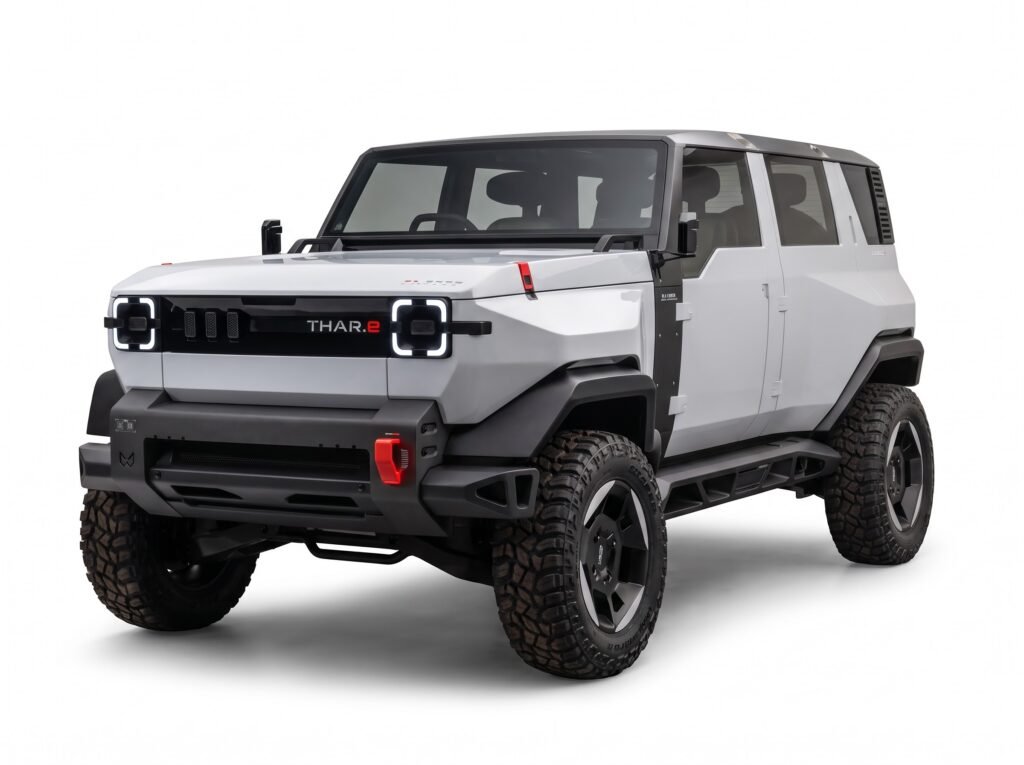
Mahindra Thar.e (Upcoming)
Upcoming (production variants not announced)

Mahindra's electric Thar on the INGLO P1 body-on-frame architecture, revealed August 2023 with a dual-motor all-wheel-drive layout and a five-door body. Production specifications and pricing still to be announced.
*Ex-showroom Price in India
Mahindra Thar.e (Upcoming) EV essentials
Mahindra Thar.e (Upcoming) pros and cons
Pros
- INGLO P1 body-on-frame derived architecture is a far more credible off-road base than a monocoque skateboard
- Dual-motor all-wheel drive allows instant, precise torque distribution without a mechanical transfer case
- Electric motors deliver full torque from zero rpm, which suits rock crawling and technical climbs
- Five-door layout finally answers the biggest practical complaint about the three-door Thar
- The Thar nameplate carries emotional equity in India that almost no electric SUV can match
- Removable roof and door panels retain the open-air character central to the Thar experience
Cons
- Production specification, price, and launch date all remain unannounced
- Battery weight hurts approach and departure angles, articulation, and recovery when stuck
- Charging infrastructure on remote trails and off-road destinations is effectively absent in India
- Off-road energy consumption is high and unpredictable, making range planning harder than on road
- Water wading, a core Thar capability, is harder to engineer safely around a high voltage pack
- Concept features such as removable panels and exposed structure often do not survive to production
Best for
Mahindra Thar.e (Upcoming) specifications
Battery & Charging
Efficiency & Real-world Range
Motor & Performance
Dimensions & Weight
Suspension Brakes & Tyres
Comfort & Tech
Safety
Warranty
Features
Battery & Performance
- INGLO P1 architecture, Mahindra's dedicated EV platform in body-on-frame derived form
- Dual-motor all-wheel-drive layout demonstrated at the concept reveal, one motor per axle
- ~60 kWh battery pack expected based on INGLO platform packaging, not officially announced
- ~450 km range expected, no ARAI or MIDC certification issued yet
- Electronic torque distribution between axles, removing the need for a mechanical transfer case
- Full motor torque available from zero rpm, useful for low-speed technical climbs
- Liquid battery thermal management expected, standard across INGLO production vehicles
- Regenerative braking with selectable levels expected
- Battery placed within the frame structure, keeping the centre of gravity low
Comfort & Interior
- Removable roof and door panels shown at the concept reveal
- Five-door body on a ~2,775 mm wheelbase, far more practical than the three-door ICE Thar
- Flat floor enabled by the electric architecture, improving rear seat space
- Squared-off cabin with exposed structural elements as a deliberate design theme
- Hexagonal lighting signature front and rear, shared across Mahindra's electric design language
- Large digital display setup shown in concept form, production size not announced
- Connected car suite expected, matching Mahindra's production EV specification
- Automatic climate control expected on higher trims
- Washable interior surfaces expected, in keeping with the Thar's open-air use case
Safety
- 6 airbags expected, matching Mahindra's current production EV standard
- ADAS suite expected on higher trims, specification not announced
- Electronic stability control expected as standard on an AWD electric platform
- Hill descent control and hill hold expected, standard for the off-road segment
- Body-on-frame derived INGLO P1 structure, engineered for off-road torsional loads
- High voltage isolation and automatic crash disconnect expected, industry standard
- IP67 rated battery pack expected, important for water wading
- 360-degree camera with off-road view expected on top trims
- Not yet crash tested, no rating issued
Mahindra Thar.e (Upcoming) trims and pricing
Compare available Mahindra Thar.e (Upcoming) trims, their ex-showroom prices and key configuration details.
Thar.e Base (expected)
~60 kWh expected - ~450 km expected - Automatic
Thar.e AWD Dual Motor (expected)
~60 kWh expected - ~420 km expected - Automatic AWD
Thar.e Top AWD (expected)
~60 kWh expected - ~420 km expected - Automatic AWD
About Mahindra Thar.e (Upcoming)
The Mahindra Thar.e is the electric interpretation of India’s most emotionally loaded off-roader, revealed on 15 August 2023 at Mahindra’s Freedom_NU event in Cape Town, South Africa. It shared the stage with the BE and XUV.e concept families, but the Thar.e was the one that stopped the room. Turning the Thar into an electric vehicle is not a routine product decision. The Thar’s identity is built on a ladder frame, a mechanical low-range transfer case, and the sound of a diesel engine working hard. Replacing all of that with a battery and electric motors forces Mahindra to answer a difficult question, which is what actually makes a Thar a Thar once the drivetrain changes completely.
Mahindra’s answer, at least in concept form, is architecture. The Thar.e sits on INGLO, Mahindra’s dedicated electric platform, in a body-on-frame derived P1 configuration rather than the monocoque skateboard used by the BE and XUV.e. That distinction matters for an off-roader, because body-on-frame construction handles the torsional loads of serious off-road driving better than a road-optimised monocoque. At the reveal Mahindra showed a five-door body measuring roughly 4,308 mm long on a 2,775 mm wheelbase, which is substantially longer than the three-door ICE Thar and directly addresses its biggest practical shortcoming. The concept carried a squared-off silhouette, hexagonal lighting signatures, exposed structural elements, removable roof and door panels, and a dual-motor all-wheel-drive layout with one motor per axle.
That dual-motor setup is the technically interesting part. A conventional Thar routes engine torque through a transfer case and differentials, with mechanical locking to force torque where it is needed. An electric off-roader with a motor on each axle distributes torque electronically in milliseconds, with full torque available from a standstill. For low-speed technical work, that is a genuine advantage. What Mahindra has not published is a production specification. Battery capacity, certified range, motor output, charging rate, and the mahindra thar e price are all still unannounced, and the mahindra thar e launch date has not been confirmed. Every performance figure in this listing is therefore an estimate based on the INGLO platform and the segment, and is labelled as such. At EVUnlock, we cross-check specifications against official manufacturer documentation before publishing, and for the Thar.e that documentation currently covers the concept reveal only.
Trending news for Mahindra Thar.e (Upcoming)
Thar.e revealed within Mahindra's Freedom_NU electric roadmap. Mahindra unveiled the Thar.e in Cape Town on 15 August 2023 alongside the BE and XUV.e concept families, presenting a coordinated electric strategy built around the INGLO platform. The Thar.e was positioned as the off-road interpretation, using a body-on-frame derived P1 configuration rather than the monocoque layout of its siblings, which signalled that Mahindra intended a genuinely capable vehicle rather than a styling exercise.
INGLO siblings reach production while the Thar.e waits. Several vehicles from the Freedom_NU reveal have since entered production and gone on sale in India, while the Thar.e has not received a confirmed timeline. Mahindra meanwhile answered the practical demand for a five-door Thar with the petrol and diesel Thar Roxx in August 2024, which suggests the electric version is being treated as a longer-term project rather than an immediate replacement.
Mahindra Thar.e (Upcoming) range and performance
A roughly 60 kWh battery on the INGLO P1 architecture should deliver around 450 km of certified range, with real-world on-road range closer to 350 to 400 km. Off road, expect that to fall sharply, plausibly to 180 to 250 km depending on terrain, because low-speed crawling, wheel slip, and constant elevation change consume energy at rates highway driving never approaches. These are estimates, since Mahindra has published no official figures. Performance is where the electric layout genuinely changes the vehicle. A conventional Thar routes engine torque through a transfer case and differentials, using mechanical locking to force torque to specific wheels. The Thar.e's dual-motor layout distributes torque electronically between axles, responding in milliseconds. For technical low-speed work such as rock crawling this is a real advantage, because full torque is available from a standstill with no clutch or torque converter to modulate. An expected combined output near 280 bhp and 450 Nm would make it comfortably quicker than any diesel Thar, with a 0 to 100 km/h time around 6.5 seconds. The counterweight, in every sense, is mass. An estimated 2,200 kg kerb weight is the enemy of approach angles, articulation, and the practical business of recovering a stuck vehicle.
Mahindra Thar.e (Upcoming) safety overview
The Thar.e has not been crash tested, so no rating exists, though Mahindra's recent record makes a 5 star target realistic given how its recent SUVs have performed in independent testing. Six airbags are expected as standard, matching Mahindra's current production electric vehicles, with an ADAS suite likely on higher trims. Electronic stability control, hill hold, and hill descent control are expected as standard for this segment, and hill descent in particular benefits from regenerative braking, which can hold a controlled speed on steep descents more smoothly than a friction-based system. One structural point deserves attention. The Thar.e uses a body-on-frame derived INGLO P1 architecture rather than a monocoque, and these approaches manage crash energy differently. Body-on-frame construction is preferred for off-road durability and torsional strength, while monocoque structures typically offer more predictable crumple behaviour in on-road impacts. Modern body-on-frame vehicles routinely achieve strong crash ratings, so this is a difference in engineering approach rather than a disadvantage. An IP67 rated battery pack is expected, which matters for a vehicle designed to wade water.
Mahindra Thar.e (Upcoming) battery and charging guide
Mahindra has not published charging specifications for the Thar.e. Based on INGLO production vehicles, expect DC fast charging around 80 kW, delivering 10 to 80 percent in roughly an hour on a 60 kWh pack, and AC charging at 7.2 kW for a full overnight charge in about eight hours. A CCS-II port is the established Indian standard and is expected. V2L capability would be genuinely useful on this vehicle, letting owners run lights, cooking equipment, or tools at a campsite directly from the battery. There is a larger point worth raising for anyone seriously considering an electric off-roader in India. Charging infrastructure follows highways and cities, not trails. The places a Thar is actually taken, including Himalayan passes, forest tracks, and coastal sand, have effectively no charging provision. Off-road consumption is high and unpredictable, and running flat in a remote location is a considerably worse outcome than in a city. Any Thar.e owner would need to plan trips around the range available at the trailhead, treating the return journey as non-negotiable rather than optional.
Mahindra Thar.e (Upcoming) warranty details
Mahindra has not announced warranty terms for the Thar.e. The prevailing standard across the Indian electric vehicle market, which Mahindra applies to its production electric SUVs, is 8 years or 1,60,000 kilometres on the battery and motor, with roughly 3 years or 1,00,000 kilometres on the vehicle itself. Roadside assistance is typically included. For an off-road vehicle, one thing worth checking closely at launch is how the warranty treats damage sustained during off-road use, since some manufacturers exclude or limit coverage for battery or underbody damage incurred off public roads. Final terms will be published at production launch.
Quick verdict: Mahindra Thar.e (Upcoming)
The Thar.e was the most interesting thing Mahindra showed in Cape Town, and also the hardest to deliver. The engineering logic holds up. Instant torque, precise electronic torque distribution, no stall risk, and a low centre of gravity are real advantages in technical off-road driving, and choosing a body-on-frame derived INGLO P1 architecture over a skateboard monocoque shows Mahindra understood what this vehicle actually needs to do. The five-door body fixes the Thar's most persistent practical complaint. What makes it difficult is everything around the drivetrain. A Thar earns its reputation in places without electricity, and battery weight works directly against the qualities that make an off-roader capable. Mahindra has also already answered the loudest customer demand with the petrol and diesel Roxx, which removes the commercial urgency. So the Thar.e occupies an unusual position, a genuinely compelling engineering idea without an obvious deadline. It deserves to be built properly rather than quickly. Until Mahindra publishes production specifications, treat everything here as informed expectation rather than fact.
Mahindra Thar.e (Upcoming) vs rivals: how it compares
Globally the Thar.e's closest reference points are the Rivian R1T and R1S, which use quad-motor layouts and have proven that electric off-roaders can work at a technical level, though at prices far beyond anything relevant to India. The Jeep Recon occupies similar conceptual territory as an electric reading of an established off-road nameplate, wrestling with exactly the same tension between heritage and drivetrain. Within India, the Thar.e would have no direct competitor, since no manufacturer has brought a serious electric off-roader to this market. Its real competition is arguably the petrol and diesel Thar and Thar Roxx, which already do the job well, cost less, and do not depend on charging infrastructure that does not exist where these vehicles are used. Against Mahindra's own road-focused electric SUVs on the INGLO platform, the Thar.e would trade efficiency and refinement for capability and character, which is a fair trade for the right buyer and a poor one for everybody else.
Mahindra Thar.e (Upcoming): who should buy it (and who should not)
There is nothing to buy yet, since Mahindra has not opened bookings and no production version exists. If you want a five-door Thar today, the Thar Roxx is on sale with petrol and diesel engines and directly addresses the practicality gap in the three-door car. If you want an electric SUV from Mahindra now, the production INGLO models are the relevant options, though they are road vehicles rather than off-roaders. When the Thar.e does launch, three things deserve close attention before committing. First, the actual kerb weight and approach and departure angles, since these determine whether it is genuinely capable or merely styled that way. Second, the water wading depth and the battery IP rating. Third, how the warranty handles off-road damage. Do not pay a booking or token amount to any dealer or website claiming to accept Thar.e orders before Mahindra formally opens the order book.
Mahindra Thar.e (Upcoming) ownership and running costs
At an estimated Rs. 25 lakh on-road and roughly 7 km/kWh real-world efficiency, running cost works out to approximately Rs. 1.20 per kilometre at Rs. 8.5 per kWh. Over 15,000 km a year that is around Rs. 18,000 in electricity. The diesel Thar at 15.2 km/l and Rs. 103 per litre costs approximately Rs. 6.78 per kilometre, or Rs. 1,01,700 over the same distance, giving an annual fuel saving of roughly Rs. 83,700. Annual maintenance on an electric SUV in this class typically runs Rs. 10,000 to Rs. 15,000 against Rs. 22,000 to Rs. 30,000 for the diesel Thar, since there is no engine oil, fuel filter, or clutch to service. Insurance on an electric vehicle of this value would be marginally higher than the diesel equivalent because of the battery's replacement cost. All figures are estimates pending official pricing and specifications from Mahindra.
Mahindra Thar.e (Upcoming) tax benefits and incentives
A production Thar.e would qualify for the standard Indian electric vehicle incentives. Section 80EEB of the Income Tax Act allows individual buyers a deduction of up to Rs. 1.5 lakh on interest paid on an electric vehicle loan, worth roughly Rs. 46,800 in tax saved over the loan tenure for someone in the 30 percent bracket. GST on electric vehicles is 5 percent against 28 percent plus cess on comparable diesel SUVs, and this is already reflected in ex-showroom pricing. State-level benefits vary considerably. Delhi offers a purchase subsidy along with a registration fee waiver, Maharashtra and Gujarat offer purchase subsidies, and several states including Uttar Pradesh and Rajasthan waive road tax on electric vehicles. At the estimated price band, the combined benefit in a state with full registration waiver could reach Rs. 2 lakh to Rs. 3 lakh over a comparable diesel SUV. Corporate buyers can additionally claim accelerated depreciation. State policies change frequently, so confirm current incentives at the dealership at the time of purchase.
Mahindra Thar.e (Upcoming) maintenance and service
An electric Thar would eliminate most of what diesel Thar owners currently pay for, including engine oil and filter changes, fuel filters, diesel particulate filter servicing, and clutch replacement. Transfer case and differential servicing also disappear on a dual-motor layout, since there is no mechanical four-wheel-drive hardware. Expect a service interval around 15,000 km or annually, consistent with Mahindra's production electric vehicles. What remains, and would likely run higher than on a road-focused electric SUV, is suspension and tyre wear, because off-road use is punishing on both and an estimated 2,200 kg kerb weight compounds it. All-terrain tyres on a vehicle this heavy may need replacing closer to every 35,000 to 40,000 km. Core service items would be battery coolant, brake fluid checks, cabin filter, and annual battery health diagnostics. Estimated annual servicing cost is Rs. 10,000 to Rs. 15,000 against Rs. 22,000 to Rs. 30,000 for the diesel Thar. Actual intervals and pricing will be confirmed by Mahindra at launch.
EV Running Cost Calculator
*Estimated figures based on entered electricity price, fuel price, mileage and average daily driving. Actual running costs can vary.
Related articles for Mahindra Thar.e (Upcoming)


Frequently asked questions about Mahindra Thar.e (Upcoming)
Is the Mahindra Thar.e launched in India?
Not yet. The Mahindra Thar.e was revealed on 15 August 2023 at Mahindra's Freedom_NU event in Cape Town, South Africa, and the production version has not gone on sale. If you are looking for a five-door Thar available today, that is the Thar Roxx, which is a petrol and diesel vehicle launched in August 2024, not an electric one. Check Mahindra's official website for the current status before making any plans around the Thar.e.
What is the expected Mahindra Thar.e price?
Mahindra has not announced pricing for the Thar.e. Based on the INGLO platform's cost structure and where Mahindra positions its production electric SUVs, industry estimates place the Thar.e roughly between Rs. 20 lakh and Rs. 30 lakh ex-showroom depending on variant and battery configuration. Treat this as an estimate rather than a quote, since Mahindra has confirmed no figure and pricing on the Thar Roxx suggests Mahindra may aim lower to protect volume.
What is the Mahindra Thar.e launch date?
Mahindra has not announced a launch date for the Thar.e. The concept appeared in August 2023 within a broader electric roadmap alongside the BE and XUV.e families, several of which have since reached production. The Thar.e has not received a confirmed timeline. Mahindra also addressed the immediate demand for a five-door Thar through the petrol and diesel Roxx in 2024, which suggests the electric version is a longer-term project rather than an urgent one.
What is the expected Mahindra Thar.e range?
Around 450 km is the expected certified range, based on a battery of roughly 60 kWh and the efficiency Mahindra achieves on its INGLO production vehicles. No ARAI or MIDC certification has been issued, so this is an estimate. Real-world range would likely sit closer to 350 to 400 km on road, and considerably lower off road, where low-speed crawling, wheel slip, and constant elevation change raise consumption well above highway figures.
What platform is the Mahindra Thar.e built on?
The Thar.e uses Mahindra's INGLO electric platform in a P1 configuration, which is body-on-frame derived rather than the monocoque skateboard used for the BE and XUV.e concepts. This matters for an off-roader. Body-on-frame construction handles the torsional flex and structural abuse of off-road driving better, while a monocoque skateboard is optimised for on-road refinement and interior packaging. Mahindra choosing the harder path here signals the Thar.e is meant to be genuinely capable rather than a styling exercise.
Does the Thar.e have four-wheel drive?
Yes, the concept was shown with a dual-motor all-wheel-drive layout, one motor per axle. In an electric off-roader this replaces the mechanical transfer case entirely. Torque split between front and rear is controlled electronically and adjusts in milliseconds, rather than through physical engagement of a differential lock. The practical result is faster, finer traction control on loose or uneven surfaces. Whether every production variant retains dual motors, or whether a cheaper rear-drive version appears, has not been confirmed.
How is the Thar.e different from the Thar Roxx?
They are separate vehicles. The Thar Roxx is a five-door petrol and diesel SUV that Mahindra launched in August 2024 and which is on sale in India now. The Thar.e is the electric version shown as a concept in August 2023, still awaiting production. The Roxx solved the practical demand for a five-door Thar using conventional engines. The Thar.e explores what an electric Thar would be on a dedicated EV platform. Any buying decision today concerns the Roxx.
Can an electric Thar work as a serious off-roader?
Partly. Electric drivetrains bring real off-road advantages, including full torque from zero rpm, precise electronic torque distribution, no stalling risk on steep climbs, and a low centre of gravity from the floor-mounted battery. The problems are equally real. Battery packs are heavy, which compromises approach and departure angles, articulation, and the practicality of recovering a stuck vehicle. Off-road consumption is high and unpredictable, and charging at remote trailheads is effectively non-existent in India. The Thar.e's success depends on how honestly Mahindra engineers around these trade-offs rather than on any headline power figure.
Owner feedback for Mahindra Thar.e (Upcoming)
No approved owner feedback yet. Be the first to share your experience.
Available colours
Mahindra has not announced a production colour palette for the Thar.e. The concept was shown in a single silver show finish at the Freedom_NU reveal in August 2023. The additional shades listed here reflect the current Thar and Thar Roxx colour range, which is the most likely starting point for the electric version. Manufacturers frequently add one exclusive shade to visually separate an electric variant, so an EV-specific colour is a reasonable expectation at launch.