
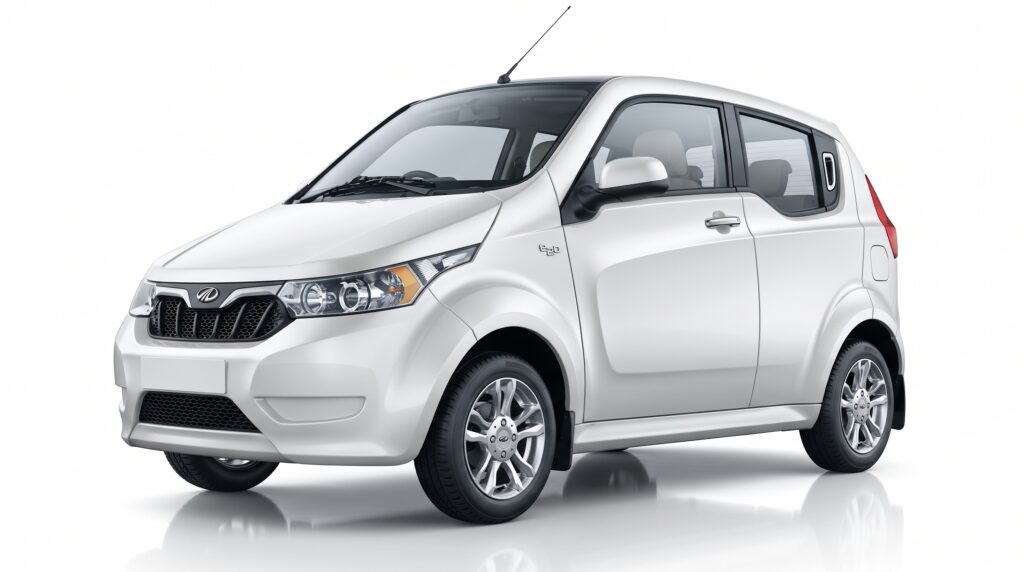
 1 / 4 Images

Mahindra e2o Plus
Electric City Car (Discontinued)

One of India's pioneering electric cars. The Mahindra e2o Plus was a tiny four-seat city EV with a 110-140 km range, sold from 2016 to 2019. It is now discontinued and only found used - a historical, low-volume early EV.
*Ex-showroom Price in New Delhi
Mahindra e2o Plus EV essentials
Mahindra e2o Plus pros and cons
Pros
- A genuine pioneer of electric cars in India
- Tiny, light and very easy to park
- Low running costs for city use
- Connected app and range-boost feature were ahead of their time
- Four-seat practicality in a small package
Cons
- Discontinued in 2019 - no longer sold new
- Aged battery technology and modest 110-140 km range
- Just 85 km/h top speed - city-only
- Limited spare parts and service support today
- No crash-test safety rating
Best for
Mahindra e2o Plus specifications
Battery & Charging
Motor & Performance
Dimensions & Capacity
Comfort & Tech
Status & History
Warranty
Features
Battery & Performance
- Lithium-ion battery (around 15 kWh)
- Claimed range of 110-140 km depending on the variant
- P8 used a 72-volt pack for the longer 140 km range
- Lower trims used a 48-volt battery (around 110 km)
- Charged from a regular home socket (no DC fast charging)
- Regenerative braking
- Connected app with emergency range-boost feature
Comfort & Interior
- Compact four-seat, five-door city cabin
- Touchscreen / connected infotainment (top trims)
- Mahindra connected-car app (locate, charge status)
- Emergency range-boost via app
- Air conditioning
- Power windows (higher trims)
- Easy, light city driving
- Tiny, easy-to-park footprint
Safety
- Seatbelts for all occupants
- ABS (higher trims)
- Reverse parking sensors
- Low-speed city design
- Basic, early-EV safety equipment
- No independent crash-test rating
Mahindra e2o Plus trims and pricing
Compare available Mahindra e2o Plus trims, their ex-showroom prices and key configuration details.
P2 / P4 / P6
19 kW, 48V - ~110 km range - 4 seats
P8 (top)
30 kW, 72V - ~140 km range - longer range
About Mahindra e2o Plus
The Mahindra e2o Plus holds an important place in India’s electric-car story. Long before the Nexon EV or the Tiago EV made electric cars mainstream, the e2o Plus was quietly proving the idea worked. Built by Mahindra Electric and sold from 2016, it was a tiny, four-seat, five-door city car that ran purely on electricity at a time when almost nobody else in India was making EVs at all
Trending news for Mahindra e2o Plus
The Mahindra e2o Plus is remembered as one of the cars that kick-started India's electric-vehicle journey. Built by Mahindra Electric and sold from 2016, this tiny four-seat city EV brought genuinely modern ideas - a connected app, an emergency range-boost feature and zero-emission city driving - to India years before EVs went mainstream.
Sold in P2, P4, P6 and P8 trims with a claimed 110-140 km range and an 85 km/h top speed, it was always a niche, low-volume product. The last e2o Plus rolled off the line on 31 March 2019, with tighter new safety regulations among the reasons for its discontinuation. Today it survives only on the used market, valued more as a pioneering piece of India's EV history than as a practical modern car - but its role in proving that affordable electric city cars could work here is hard to overstate.
Mahindra e2o Plus range and performance
The Mahindra e2o Plus was strictly a city car. Its small lithium-ion battery gave a claimed range of 110 to 140 km - the top P8, with its 72-volt pack and 30 kW motor, managed around 140 km, while the 19 kW, 48-volt P2, P4 and P6 trims were rated at about 110 km. Top speed was 85 km/h, and the P8 did 0-60 km/h in roughly 9.5 seconds.
These are modest figures even by the standards of today's budget EVs, and as an older, discontinued car, real-world range from an aged battery would likely be lower still. The e2o Plus was never meant to be quick or long-legged - its appeal was cheap, simple, zero-emission city mobility, which it delivered well for its time.
Mahindra e2o Plus safety overview
As an early, low-cost city EV, the Mahindra e2o Plus came with basic safety equipment - seatbelts, ABS on higher trims and reverse parking sensors - with its low 85 km/h top speed limiting risk in city use. However, it does not have an independent crash-test rating, and in fact tighter new safety regulations were among the reasons Mahindra discontinued it in 2019. Anyone considering a used example should treat it as a basic, dated city car on safety, and judge it accordingly rather than against modern standards.
Mahindra e2o Plus battery and charging guide
Charging the e2o Plus was simple but basic: it plugged into a regular home socket and took several hours to charge its small battery, with no DC fast charging - in keeping with its early, city-focused design. Its appeal was low running cost rather than charging convenience. For any used example today, the bigger concern is battery health and the availability of charging-related parts and support, given the car has been discontinued for years.
Mahindra e2o Plus warranty details
Any original warranty on the Mahindra e2o Plus has long since expired, and as a discontinued, low-volume model, ongoing manufacturer support, spare parts and service are now limited. Anyone buying a used example should not expect meaningful warranty cover, and should specifically check the condition and remaining life of the battery - the most expensive component - before purchase, as replacement may be difficult or costly for a discontinued EV.
Quick verdict: Mahindra e2o Plus
The Mahindra e2o Plus matters more for what it represents than for what it is today. As one of India's earliest proper electric cars, it proved that affordable, app-connected, zero-emission city motoring could work here, years before the EV boom. But it is a discontinued, dated little car with a short 110-140 km range, an 85 km/h top speed and limited modern support, available only used. It is a lovely piece of EV history and a fine curiosity, but not a sensible everyday car to buy now. For real city EV transport today, a modern option like the Tata Tiago EV, MG Comet EV or PMV EaS-E is the way to go.
Mahindra e2o Plus vs rivals: how it compares
In its day, the e2o Plus had almost no direct rivals - it was one of the only mass-market EVs in India. Compared with today's affordable EVs, though, it is clearly from another era: modern city cars like the Tata Tiago EV and MG Comet EV offer far more range, speed, safety and support, while even tiny micro EVs like the PMV EaS-E are newer and better backed. The e2o Plus's only real advantage now is its place in history and its rock-bottom used pricing. On every practical measure - range, performance, safety and serviceability - current EVs are well ahead.
Mahindra e2o Plus: who should buy it (and who should not)
Only consider a used Mahindra e2o Plus if you specifically want an early, characterful EV as a city-only second car or a piece of history, and you go in with eyes open. Inspect the battery health very carefully - it is the make-or-break component on a car this old - and accept that range will be short, support and parts limited, and safety basic by modern standards. For anyone wanting dependable everyday electric transport, skip it and choose a current model like the Tata Tiago EV, MG Comet EV or PMV EaS-E instead, which offer more range, safety and proper support.
Mahindra e2o Plus ownership and running costs
When new, the e2o Plus was extremely cheap to run - a tiny, efficient city EV charged from a home socket cost very little per kilometre. For a used example today, energy costs remain low, but the real ownership question is the battery: on a car discontinued since 2019, battery degradation and the difficulty or cost of replacement are the dominant factors, and parts and service for a low-volume, out-of-production EV are limited. So while running costs look cheap, the risk and potential cost around the ageing battery should be central to any decision.
Mahindra e2o Plus tax benefits and incentives
When it was on sale, the Mahindra e2o Plus benefited from EV incentives and subsidies that helped bring its effective price down, and EVs in India continue to enjoy road-tax and registration concessions that vary by state, plus the green number plate. For a used e2o Plus today, however, new-purchase incentives no longer apply, and any benefit would relate only to ongoing EV road-tax concessions where applicable. Confirm the current rules with your state RTO, but treat tax benefits as minor for a discontinued used vehicle.
Mahindra e2o Plus maintenance and service
Maintenance is the biggest practical concern with the e2o Plus today. The EV drivetrain itself is simple - no engine, oil or gearbox - but as a discontinued, low-volume model, spare parts and qualified service are now hard to find, and the connected app and software may no longer be fully supported. Most critically, the lithium-ion battery is ageing, and replacement could be difficult or expensive. Anyone considering one should confirm parts and battery support before buying, and budget for the possibility that keeping it running becomes harder over time.
EV Running Cost Calculator
*Estimated figures based on entered electricity price, fuel price, mileage and average daily driving. Actual running costs can vary.
Related articles for Mahindra e2o Plus


Frequently asked questions about Mahindra e2o Plus
Is the Mahindra e2o Plus still available?
No. The e2o Plus was discontinued, with the last unit built on 31 March 2019. Tighter new safety regulations were among the reasons Mahindra wound it down. You can only find it on the used market now, not buy it new.
What was the range of the Mahindra e2o Plus?
It had a claimed range of 110 to 140 km on a full charge. The top P8 variant, with its larger 72-volt battery, managed around 140 km, while the lower P2, P4 and P6 trims were rated at about 110 km.
How much did the Mahindra e2o Plus cost?
When on sale, it was priced from around 5.46 lakh to 8.46 lakh in Delhi (after subsidies), across the P2, P4, P6 and P8 variants. These are historical prices - any value today would be on the used market and depends heavily on the car's condition and battery health.
Why was the Mahindra e2o Plus discontinued?
Mahindra ended production of the e2o Plus in March 2019, with newer, stricter safety regulations cited as a key reason, alongside its niche position in the market. It was a low-volume early EV, and Mahindra later shifted its focus to newer electric models.
Should I buy a used Mahindra e2o Plus?
Only with care, and as a city-only second car or curiosity. The technology is dated, the range is short, and parts and service support are now limited for a discontinued, low-volume EV - so check the battery health closely. For everyday electric transport today, a modern option like the Tata Tiago EV or MG Comet EV makes far more sense.
Owner feedback for Mahindra e2o Plus
No approved owner feedback yet. Be the first to share your experience.
Available colours
The Mahindra e2o Plus was offered in a small range of cheerful, youthful colours suited to a city car, typically including White, Silver, Red, Blue and Yellow. As a discontinued model, colour availability is no longer applicable in the usual sense - these reflect the original car, and used examples come in whatever colour they were originally bought.