
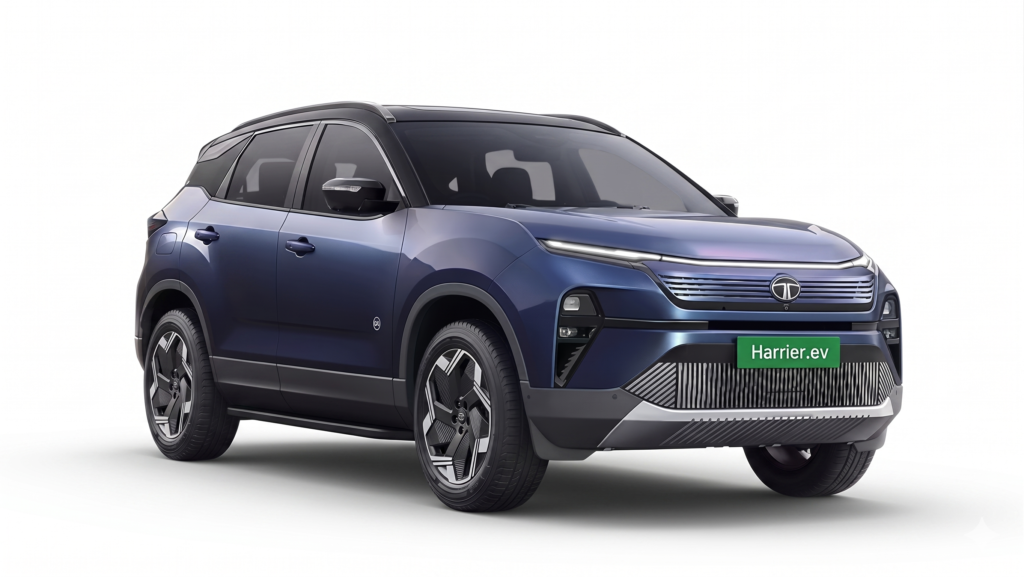
 Featured EV
1 / 2 Images
Featured EV
1 / 2 Images 
Tata Harrier EV
Adventure / Fearless / Empowered (65 kWh and 75 kWh, RWD and QWD)

India's first electric SUV with genuine dual motor all wheel drive and rock crawl terrain modes, offering up to 627 km certified range, 120 kW fast charging, and a 540-degree camera with underbody view.
*Ex-showroom Price in New Delhi
Tata Harrier EV EV essentials
Tata Harrier EV pros and cons
Pros
- 627 km certified range on the 75 kWh pack leads the Indian electric SUV segment
- QWD dual motor system delivers genuine all wheel drive without a mechanical transfer case
- 396 PS and 504 Nm make it faster than most petrol SUVs costing considerably more
- Terrain modes including rock crawl, backed by 205 mm clearance and 600 mm wading depth
- 540-degree camera with underbody view is genuinely useful off road, not a gimmick
- 120 kW DC fast charging makes long distance travel practical rather than theoretical
- 5 Star Bharat NCAP with 7 airbags standard
- V2L and V2V add real utility for outdoor use and helping other EV owners
- Tata operates India's widest EV service and charging network
Cons
- Roughly 2,400 kg kerb weight limits genuine off road recovery despite the terrain modes
- QWD range falls noticeably below the RWD figure, and both fall well below certified numbers in real use
- Top QWD variants approach ₹30 lakh, which is a significant step above rear drive versions
- 5 seats only, with no seven seat option despite the size
- Tyre and suspension wear run higher because of the weight, particularly on larger wheels
- Off road charging infrastructure is effectively non-existent, which limits how far you can genuinely explore
- Prices have been revised since launch, making resale value harder to predict
Best for
Tata Harrier EV specifications
Battery & Charging
Efficiency & Real-world Range
Motor & Performance
Dimensions & Weight
Suspension Brakes & Tyres
Comfort & Tech
Safety
Warranty
Features
Battery & Performance
- 65 kWh pack delivering 538 km certified range
- 75 kWh pack delivering 627 km certified range, among the highest for any Indian electric SUV
- acti.ev+ architecture, an evolution of Tata's dedicated electric platform
- Liquid cooled battery with active thermal management for Indian summer conditions
- IP67 rated pack, sealed against dust and water ingress
- 120 kW DC fast charging, taking the battery from 20 to 80 percent in roughly 25 minutes
- 11 kW AC charging option, giving a full overnight charge in approximately 7 hours
- V2L Vehicle to Load, powering equipment directly from the battery for camping and outdoor use
- V2V Vehicle to Vehicle, able to charge another compatible EV
- Multi-level regenerative braking with paddle shifter control
- 8 year or 1,60,000 km battery and motor warranty
Comfort & Interior
- Large touchscreen infotainment with wireless Android Auto and Apple CarPlay
- Fully digital instrument cluster
- Panoramic sunroof with voice command
- Premium multi-speaker audio system with Dolby Atmos support
- Ventilated and powered front seats with memory function
- Dual zone automatic climate control with rear vents
- Wireless phone charging
- Air purifier with AQI display
- Powered tailgate with gesture control
- Tata iRA connected car suite with remote functions and over the air updates
- Approximately 502 litre boot with a low load lip
- Flat floor from the battery layout, improving rear middle seat comfort
- Ambient interior lighting
Safety
- 5 Star Bharat NCAP rating
- 7 airbags standard
- Level 2 ADAS including adaptive cruise control, autonomous emergency braking and lane keep assist
- Blind spot warning and rear cross traffic alert
- 540-degree camera combining surround view with an underbody view
- Electronic stability control with roll over mitigation
- Hill hold and hill descent control
- Terrain response modes including snow, mud, sand and rock crawl on QWD
- Tyre pressure monitoring system
- ISOFIX child seat anchors
- IP67 rated battery with high voltage automatic crash disconnect
- 600 mm water wading capability
Tata Harrier EV trims and pricing
Compare available Tata Harrier EV trims, their ex-showroom prices and key configuration details.
Harrier EV Adventure 65
65 kWh - 538 km - Automatic RWD
Harrier EV Empowered 75 QWD
75 kWh - Dual motor AWD - Automatic
About Tata Harrier EV
The Tata Harrier EV is the most technically ambitious vehicle Tata has built, and the first Indian electric SUV that treats all wheel drive as engineering rather than marketing. Built on acti.ev+, an evolution of Tata’s dedicated electric platform, it arrives with two battery options and a dual motor QWD system that puts a motor on each axle. That configuration does something no mechanical four wheel drive can. Torque split between front and rear adjusts in milliseconds through software rather than through a transfer case and differentials, which means traction control responds faster and more precisely than any conventional system on loose or uneven surfaces.
The numbers back the ambition. The 65 kWh pack delivers 538 km certified and the 75 kWh delivers 627 km, figures that sit at the top of the segment. The QWD variant produces around 396 PS combined and 504 Nm, taking a 2,400 kg SUV to 100 km/h in roughly 6.3 seconds. That is genuinely fast, quicker than most petrol SUVs costing twice as much. But the specification that says more about the car’s intent is the terrain mode set, which includes rock crawl alongside sand, mud, and snow, paired with 205 mm of ground clearance and 600 mm of water wading capability. Tata built this to actually leave tarmac, not just to look like it could.
What deserves equal attention is the honest limitation. Real world range with QWD engaged and the air conditioning running settles closer to 420 km to 470 km on the 75 kWh, well below the certified figure, and the second motor draws meaningfully more energy than the rear drive variant. Weight is the other constraint. At roughly 2,400 kg, physics eventually wins regardless of how clever the torque vectoring is, particularly when it comes to recovery if you get properly stuck. The 540-degree camera with underbody view is a genuinely useful answer to that, letting you see obstacles beneath the car. At EVUnlock, we cross-check specifications against official manufacturer documentation before publishing.
Trending news for Tata Harrier EV
The Harrier EV brings genuine dual motor all wheel drive to India's mainstream electric SUV segment. Before it arrived, all wheel drive at this price point in an electric vehicle simply did not exist in India. The QWD system, paired with terrain response modes including rock crawl, moved the conversation from ground clearance figures to actual capability.
Competition in the ₹21 to ₹30 lakh electric SUV bracket continues to intensify. More manufacturers are targeting this segment, which puts pressure on pricing and specification. Buyers should check current offers and confirm what has changed since launch rather than assuming introductory pricing or specification still applies.
Tata Harrier EV range and performance
The gap between certified and real world range matters more on this car than most, because the QWD variant has two ways to lose range. The 75 kWh pack is certified at 627 km and delivers roughly 450 km to 500 km in real city driving with the air conditioning on in rear drive form. Engage QWD and that falls to roughly 420 km to 470 km, since the front motor draws additional energy and adds weight. The 65 kWh delivers roughly 390 km to 440 km. Highway driving at a sustained 100 km/h brings all figures down further, since a tall SUV body pushes considerable air. None of this is a failing. ARAI style testing runs at moderate speeds without climate load, and no manufacturer's certified figure survives Indian summer traffic. What matters is planning around the real number rather than the brochure one. On performance the QWD variant is genuinely quick, with approximately 396 PS and 504 Nm taking a 2,400 kg SUV to 100 km/h in around 6.3 seconds. More useful than the headline figure is the low end response. Overtaking on a two lane highway, which requires downshifting and patience in the diesel Harrier, becomes immediate.
Tata Harrier EV safety overview
The Harrier EV holds a 5 Star Bharat NCAP rating with 7 airbags standard, which places it among the safest vehicles in its class in India. The Level 2 ADAS suite includes adaptive cruise control, autonomous emergency braking, lane keep assist, blind spot warning, and rear cross traffic alert. Two safety features deserve particular attention because they address genuine problems rather than adding to a feature list. The 540-degree camera combines conventional surround view with an underbody view, letting you see obstacles beneath the car. On a rough track this is the difference between clearing a rock and damaging the battery pack, and it is unusually useful for a system that could easily have been a gimmick. The second is roll over mitigation within the stability control system. A tall SUV carrying five people has a high centre of gravity, which is precisely the condition that makes roll over a real risk. Mounting a heavy battery in the floor already lowers that centre of gravity substantially compared with the diesel Harrier, and the electronic system adds a further layer. The IP67 battery with 600 mm wading capability handles Indian monsoon conditions properly.
Tata Harrier EV battery and charging guide
120 kW DC fast charging takes the battery from 20 to 80 percent in approximately 25 minutes, which is among the quickest in the segment and genuinely changes how long distance travel works. A meal length stop recovers most of a charge. AC charging is offered at 7.2 kW and 11 kW, with the 11 kW option delivering a full overnight charge in roughly 7 hours at a home wallbox. A CCS-II port is standard. Three practical points shape ownership. Charge rate tapers sharply above 80 percent to protect cell health, so the final portion takes disproportionately long at a fast charger and is rarely worth waiting for unless you need maximum range for the next leg. Public DC fast charging typically costs ₹18 to ₹25 per kWh against ₹8 to ₹9 for home electricity, so the running cost advantage depends heavily on home charging. And for anyone attracted by the off road capability, charging infrastructure follows highways and cities rather than trails, which means remote exploration is limited by the range available at the last charger rather than by the car's capability.
Tata Harrier EV warranty details
Tata covers the Harrier EV with a 3 year or 1,25,000 km vehicle warranty and an 8 year or 1,60,000 km warranty on the battery and motor, with roadside assistance included. The battery warranty is the more significant of the two, since battery replacement is the largest potential expense in electric vehicle ownership and this coverage effectively removes that risk within a typical ownership period. The clause worth reading carefully is the guaranteed state of health percentage, which defines how much capacity degradation is actually covered rather than simply how long the warranty runs. Buyers attracted by the off road capability should also check how the warranty treats damage sustained off public roads, since some manufacturers limit coverage for battery or underbody damage in those circumstances.
Quick verdict: Tata Harrier EV
The Harrier EV is the first electric SUV in India that treats capability as engineering rather than styling. The QWD dual motor system is real all wheel drive, the terrain modes including rock crawl are backed by 205 mm of clearance and 600 mm of wading depth, and the 540-degree underbody camera solves an actual problem rather than adding a line to the brochure. Combine that with 627 km certified range, 120 kW fast charging, 5 Star Bharat NCAP, and 6.3 second acceleration, and the specification is genuinely difficult to argue with at this price. The honest constraints are weight and infrastructure. At roughly 2,400 kg, physics eventually limits what the clever torque vectoring can rescue you from, and recovery becomes difficult if you get properly stuck. Charging infrastructure follows highways, not trails, which means the off road capability is bounded by range rather than by the car. And real world range with QWD sits well below the certified figure. None of that undermines the car. It just means buying it for the capability requires being realistic about where you can actually use it. For buyers who want a fast, well equipped, long range electric SUV that can handle a rough track when needed, this is currently the most complete option in India under ₹30 lakh.
Tata Harrier EV vs rivals: how it compares
Against other electric SUVs in the ₹21 to ₹30 lakh bracket, the Harrier EV's distinguishing claims are all wheel drive and range. Most rivals offer front or rear drive only, which means the QWD variant competes more on capability than on price. The 627 km certified figure sits at or near the top of the segment. What rivals counter with is lower entry pricing and, in some cases, lighter weight and better efficiency. Within Tata's own range, the Harrier EV sits above the Curvv EV in size, power, and price while offering a conventional SUV silhouette rather than a coupé roofline, which means more rear headroom and better visibility. Against the diesel Harrier, the electric version wins on running cost, refinement, low speed responsiveness, and rear seat space thanks to the flat floor, while losing on outright range, refuelling time, and suitability for remote areas. Against petrol SUVs costing considerably more, the QWD variant's 6.3 second acceleration makes an argument that is hard to counter on performance alone.
Tata Harrier EV: who should buy it (and who should not)
Choose QWD only if you will genuinely use it. The dual motor system is excellent, but it costs range, adds weight, and sits at the top of the price range. If your driving is predominantly on tarmac, the rear drive 75 kWh variant gives you more range for less money and remains quick enough for any real world situation. Choose QWD if you regularly drive unpaved roads, live somewhere with heavy monsoon flooding, or genuinely want the terrain capability. Before committing, do four things. Confirm current pricing and variant specification at a dealership, since Tata has revised both since launch. Check which ADAS and camera features are included on your specific trim rather than assuming the full suite. Verify what state subsidies and registration waivers apply where you live, as these can shift the on-road price by two lakh or more at this price point. And if you cannot charge at home, recalculate the running cost savings using public charging rates before deciding, since that changes the ownership arithmetic substantially.
Tata Harrier EV ownership and running costs
At approximately ₹26 lakh on-road for a mid variant and around 7.5 km per kWh real world efficiency, running cost works out to roughly ₹1.10 per kilometre at ₹8.5 per kWh. Over 15,000 km a year that is around ₹16,500 in electricity. The diesel Harrier at 16.35 km/l and ₹94 per litre costs approximately ₹5.75 per kilometre, or ₹86,250 over the same distance, giving an annual fuel saving of roughly ₹70,000. Annual maintenance runs approximately ₹10,000 to ₹15,000 against ₹26,000 to ₹34,000 for the diesel, adding a further ₹16,000 to ₹19,000 of yearly saving. Combined, expect to save around ₹86,000 to ₹89,000 a year at average mileage, and considerably more at higher usage. Against a purchase premium of roughly ₹6 lakh to ₹8 lakh over an equivalent diesel Harrier, payback arrives at approximately seven to nine years at 15,000 km annually, or four to five years at 25,000 km. Insurance runs higher than the diesel because of the battery's replacement value.
Tata Harrier EV tax benefits and incentives
The Harrier EV qualifies for the standard Indian electric vehicle incentives. Section 80EEB of the Income Tax Act allows individual buyers a deduction of up to ₹1.5 lakh on interest paid on an electric vehicle loan, worth roughly ₹46,800 in tax saved over the loan tenure for someone in the 30 percent bracket. GST on electric vehicles is 5 percent against 28 percent plus cess on comparable diesel SUVs, which is already reflected in ex-showroom pricing and represents a very substantial saving at this price point. State-level benefits vary considerably. Delhi offers a purchase subsidy alongside a registration fee waiver, Maharashtra and Gujarat offer purchase subsidies, and states including Uttar Pradesh and Rajasthan waive road tax on electric vehicles. On a car priced around ₹26 lakh, a full registration waiver alone can save ₹2 lakh to ₹3 lakh, which meaningfully shortens the payback period. Corporate and fleet buyers can additionally claim accelerated depreciation. State policies are revised frequently, so confirm current terms at the dealership.
Tata Harrier EV maintenance and service
Service intervals fall at 15,000 km or annually, whichever comes first. The electric drivetrain removes engine oil and filter changes, fuel filters, diesel particulate filter servicing, AdBlue top ups, timing belt replacement, and clutch wear, which together account for most of what diesel Harrier owners currently pay. On QWD variants there is no transfer case or differential servicing either, since torque distribution is handled electronically. What remains is tyre rotation every 10,000 km, brake fluid checks at extended intervals since regenerative braking cuts pad wear substantially, cabin air filter replacement, coolant for the battery thermal system, and an annual battery health diagnostic. Expect ₹10,000 to ₹15,000 annually against ₹26,000 to ₹34,000 for the diesel Harrier. Two items run higher than on a lighter EV. Tyres wear faster at roughly 2,400 kg, and 19 inch rubber is not cheap, so budget for replacement closer to every 35,000 to 40,000 km. Suspension components also work harder. Tata's EV-trained technician network is the most extensive in India, which matters practically when something needs attention outside a major metro.
EV Running Cost Calculator
*Estimated figures based on entered electricity price, fuel price, mileage and average daily driving. Actual running costs can vary.
Related articles for Tata Harrier EV
Frequently asked questions about Tata Harrier EV
What is the Tata Harrier EV price on road?
Ex-showroom pricing starts from approximately ₹21.49 lakh and rises to around ₹30 lakh for top QWD variants. Adding road tax, registration, and insurance typically brings the on-road figure to roughly ₹23 lakh for entry variants in most cities. Several states waive registration charges for electric vehicles, which reduces this considerably. Tata has revised Harrier EV pricing since launch, so confirm current figures at a dealership rather than relying on any published number.
What is the Tata Harrier EV range?
538 km certified on the 65 kWh battery and 627 km on the 75 kWh. Real world range is lower, as with every electric vehicle. Expect roughly 450 km to 500 km from the 75 kWh in city driving with the air conditioning running, and 420 km to 470 km if you have QWD engaged. Sustained highway driving above 100 km/h reduces these figures further, since aerodynamic drag rises sharply with speed on a tall SUV body.
Does the Tata Harrier EV have all wheel drive?
Yes, on QWD variants. QWD is Tata's term for a dual motor layout with one motor on each axle, delivering all wheel drive electronically rather than through a mechanical transfer case. Torque split between front and rear adjusts in milliseconds, which gives faster and finer traction response than a conventional system on loose surfaces. Lower variants are rear wheel drive with a single motor, which is also the more efficient configuration for range.
How fast does the Tata Harrier EV charge?
Approximately 25 minutes from 20 to 80 percent at a 120 kW DC fast charger, which is among the quickest in its segment and makes highway travel genuinely practical. On an 11 kW AC home wallbox a full charge takes around 7 hours, suitable for overnight charging. Note that charge rate tapers sharply above 80 percent to protect cell longevity, so the final portion takes disproportionately long at a fast charger and is rarely worth waiting for.
Can the Tata Harrier EV go off road?
More capably than most electric SUVs, with real caveats. It offers terrain modes including snow, mud, sand and rock crawl on QWD variants, 205 mm ground clearance, 600 mm water wading capability, and a 540-degree camera with underbody view that lets you see obstacles beneath the car. The dual motor layout delivers full torque from a standstill, which suits technical low speed climbs well. The limitation is weight. At roughly 2,400 kg, recovery becomes genuinely difficult if you get stuck, and remote trails have no charging infrastructure. Treat it as highly capable on rough tracks rather than as a substitute for a dedicated off roader.
Is the Tata Harrier EV a 7 seater?
No, the Harrier EV is a 5-seater. Tata's seven seat SUV in the petrol and diesel range is the Safari, and an electric version of that has not reached the market in this body style. What the Harrier EV offers instead is approximately 502 litres of boot space and a flat floor from the battery layout, which makes the rear middle seat considerably more usable than in the diesel Harrier.
What is the Tata Harrier EV running cost?
Approximately ₹1.10 per kilometre at ₹8.5 per kWh electricity and around 7.5 km per kWh real world efficiency. The diesel Harrier at 16.35 km/l and ₹94 per litre costs approximately ₹5.75 per kilometre. Over 15,000 km a year that is a saving of roughly ₹70,000 on fuel alone, with a further ₹15,000 to ₹18,000 saved on maintenance. The saving depends heavily on charging at home, since public DC fast charging costs ₹18 to ₹25 per kWh against ₹8 to ₹9 at home.
What is the difference between Harrier EV RWD and QWD?
The RWD uses a single rear motor, while QWD adds a second motor on the front axle for all wheel drive. QWD brings substantially more power, quicker acceleration, terrain response modes including rock crawl, and better traction on loose or wet surfaces. What it costs you is range, since the second motor draws more energy and adds weight, and price, since QWD sits at the top of the range. If your driving is predominantly on tarmac, the RWD is the more sensible purchase and will go further on a charge.
Owner feedback for Tata Harrier EV
No approved owner feedback yet. Be the first to share your experience.
Available colours
The Harrier EV is offered in a palette including Pristine White, Empowered Oxide, Nainital Nocturne, Pure Grey, Stealth Black, and Coorg Bronze, with dual tone options pairing the body colour with a contrasting black roof on selected trims. The darker earth toned shades suit the SUV proportions particularly well and hide trail dust better than lighter colours, which is worth considering if you intend to actually use the terrain capability. Colour availability varies by variant and is revised periodically, so confirm current options at a dealership.