
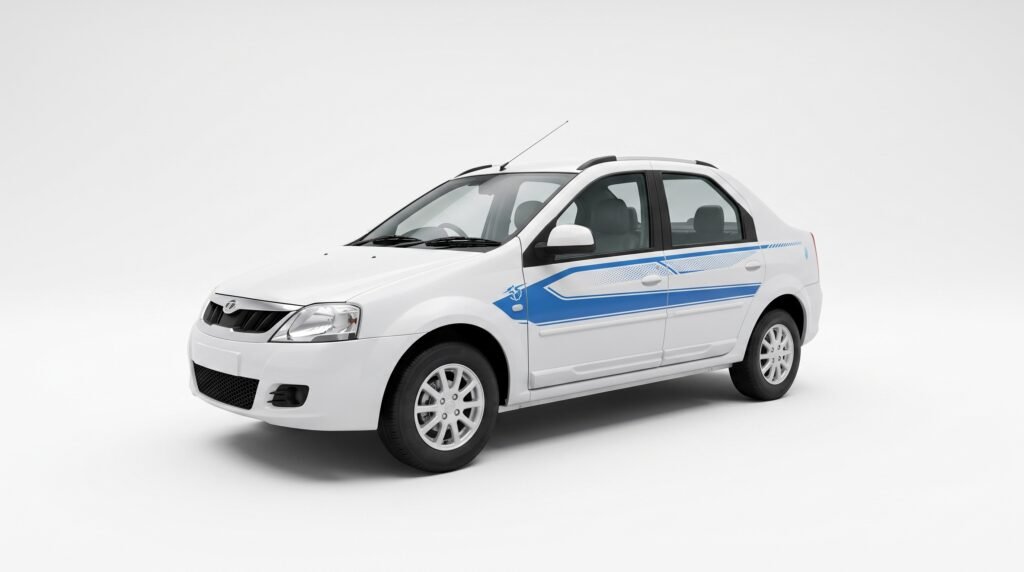
 1 / 1 Images
Mahindra e-Verito
Electric Sedan (Discontinued)

India's first electric sedan. The Mahindra e-Verito paired an 18.6 kWh battery and a 140 km range with proper four-door, five-seat practicality, mainly for fleets and taxis. It is now discontinued and found only used - a pioneering early EV.
*Ex-showroom Price in New Delhi
Mahindra e-Verito EV essentials
Mahindra e-Verito pros and cons
Pros
- India's first electric sedan - a genuine pioneer
- Proper four-door practicality with a real boot
- Supported fast charging (80% in ~1.5 hours)
- Low running costs, ideal for fleets and taxis
- Simple, durable and easy to drive
Cons
- Discontinued - no longer sold new
- Short 140 km range and dated technology
- Just 86 km/h top speed - city-focused
- Modest 42 PS power
- Limited parts and service support today; no crash rating
Best for
Mahindra e-Verito specifications
Battery & Charging
Motor & Performance
Dimensions & Capacity
Comfort & Tech
Status & History
Warranty
Features
Battery & Performance
- 18.6 kWh lithium-ion battery
- Claimed range of 140 km on a full charge
- Single front-mounted motor: 42 PS and 91 Nm
- Fast charging: 80 percent in about 1 hour 30 minutes
- Home AC charging: full charge in around 11.5 hours
- Front-wheel drive
- Regenerative braking
Comfort & Interior
- Proper four-door, five-seat sedan cabin
- Usable boot (around 510 litres)
- Air conditioning
- Power steering
- Power windows (higher trims)
- Simple, durable, fleet-friendly interior
- Comfortable for taxi and city duty
- Basic infotainment (top trims)
Safety
- Driver airbag
- ABS (higher trims)
- Seatbelts for all occupants
- Reverse parking sensors
- Basic, early-EV safety equipment
- No independent crash-test rating
Mahindra e-Verito trims and pricing
Compare available Mahindra e-Verito trims, their ex-showroom prices and key configuration details.
About Mahindra e-Verito
The Mahindra e-Verito was India’s first proper electric sedan, and for a while it was one of the few electric cars on Indian roads at all. Mahindra took its Verito sedan, a car that started life as the Renault Logan, and turned it fully electric. The result was a no-nonsense, four-door, five-seat EV aimed largely at fleets, taxis and government buyers who wanted zero-emission running and a real boot rather than flash or speed
Trending news for Mahindra e-Verito
The Mahindra e-Verito is remembered as India's first electric sedan and one of the vehicles that helped electrify the country's fleets. Built by Mahindra Electric on the Verito (originally the Renault Logan), it offered zero-emission, four-door practicality at a time when EVs were extremely rare in India, which made it popular with taxi operators and government buyers.
With an 18.6 kWh battery, a claimed 140 km range, an 86 km/h top speed and fast charging to 80 percent in about 1.5 hours, it was a simple, hard-working EV rather than an exciting one. Mahindra later discontinued it because the Verito could not meet newer safety and crash regulations, and it went out of production. Today it survives only on the used market, valued as a pioneering piece of India's EV story rather than a modern car - but its role in proving electric sedans could work in Indian fleets was real and important.
Mahindra e-Verito range and performance
The Mahindra e-Verito was built for steady city and fleet duty, not performance. Its 18.6 kWh battery gave a claimed 140 km of range, and the single front motor made 42 PS and 91 Nm for an 86 km/h top speed - enough for taxi runs and city commuting, but no more. As an older, discontinued car, real-world range from an aged battery would likely be lower than the original 140 km figure.
These are modest numbers even against today's budget EVs, which is exactly what you would expect from an early electric sedan. The e-Verito's appeal was never speed or long range - it was cheap, simple, zero-emission four-door transport that fleets could rely on, and for that job it did well in its time.
Mahindra e-Verito safety overview
As an early electric sedan based on an older platform, the Mahindra e-Verito came with basic safety equipment - a driver airbag, ABS on higher trims, seatbelts and parking sensors - rather than a modern safety suite. It does not have an independent crash-test rating, and crucially, it was discontinued precisely because the Verito could not meet the government's newer safety and crash norms. Anyone considering a used example should treat it as a dated, basic car on safety, and weigh that carefully against modern alternatives.
Mahindra e-Verito battery and charging guide
The e-Verito offered both home and fast charging, which was relatively advanced for an early Indian EV. A full charge from a home AC point took around 11.5 hours using its 7.2 kW charger, while fast charging could reach 80 percent in about 1 hour 30 minutes - genuinely useful for keeping a taxi or fleet car in service. For any used example today, the practical concerns are battery health and whether charging-related parts and support are still available for a discontinued model.
Mahindra e-Verito warranty details
Any original warranty on the Mahindra e-Verito has long since expired, and as a discontinued, fleet-focused model, ongoing manufacturer support, spare parts and service are now limited. Anyone buying a used example - often an ex-fleet car - should not expect meaningful warranty cover, and should specifically check the battery's condition and remaining life before purchase, since battery replacement may be difficult or costly for a discontinued EV.
Quick verdict: Mahindra e-Verito
The Mahindra e-Verito earns its place in history as India's first electric sedan, and as a workhorse that quietly proved electric fleets could function here years before EVs went mainstream. But it is a discontinued, dated car with a short 140 km range, an 86 km/h top speed, basic safety and limited modern support, available only used and usually as an ex-fleet vehicle. It is an interesting bit of EV history and could be a cheap city runabout for the right buyer, but it is not a sensible everyday car to buy now. For a modern electric sedan or fleet EV, the Tata Tigor EV is its natural, far more capable successor.
Mahindra e-Verito vs rivals: how it compares
The e-Verito's spiritual successor is the Tata Tigor EV, which does the same compact-electric-sedan job with far more range, better safety, modern features and proper support - so for anyone wanting an electric sedan today, the Tigor EV wins comprehensively. Against the e-Verito's own era, it had almost no direct rivals, which is part of why it mattered. Compared with modern city EVs like the Tata Tiago EV or MG Comet, it is clearly outclassed on range, speed, safety and serviceability. Its only real advantages now are its place in history and rock-bottom used pricing for fleet buyers.
Mahindra e-Verito: who should buy it (and who should not)
Only consider a used Mahindra e-Verito if you want a very cheap, city-only four-door EV - perhaps for short fleet or local runs - and you go in fully aware of its limits. Inspect the battery health closely, as it is the make-or-break component on a car this old, and accept that range is short, safety is basic, and parts and service are limited for a discontinued model. For dependable everyday electric transport, skip it and choose a modern option like the Tata Tigor EV (for a sedan) or the Tata Tiago EV, which offer far more range, safety and proper support.
Mahindra e-Verito ownership and running costs
When new, the e-Verito was very cheap to run - which is exactly why fleets liked it - and a used example still costs little in energy for city use. But the real ownership question on a car discontinued for years is the battery: degradation and the difficulty or cost of replacement are the dominant factors, and parts and service for a low-volume, out-of-production EV are limited. So while running costs look cheap, the risk and potential cost around the ageing battery should be central to any buying decision, especially for an ex-fleet car that may have done high mileage.
Mahindra e-Verito tax benefits and incentives
When it was on sale, the e-Verito benefited from FAME incentives and EV subsidies that brought its effective price down, and EVs in India continue to enjoy road-tax and registration concessions that vary by state, plus the green number plate. For a used e-Verito today, new-purchase incentives no longer apply, and any benefit would relate only to ongoing EV road-tax concessions where applicable. Confirm the current rules with your state RTO, but treat tax benefits as minor for a discontinued used vehicle.
Mahindra e-Verito maintenance and service
Maintenance is a key concern with the e-Verito today. The EV drivetrain is simple - no engine, oil or gearbox - but as a discontinued, fleet-focused model, spare parts and qualified service are now limited, and many examples have led hard taxi lives. Most importantly, the lithium-ion battery is ageing, and replacement could be difficult or expensive. Anyone considering one should confirm parts and battery support before buying, inspect the car thoroughly given its likely fleet history, and budget for the possibility that upkeep becomes harder over time.
EV Running Cost Calculator
*Estimated figures based on entered electricity price, fuel price, mileage and average daily driving. Actual running costs can vary.
Related articles for Mahindra e-Verito

Frequently asked questions about Mahindra e-Verito
Is the Mahindra e-Verito still available?
No. The e-Verito has been discontinued and is out of production. Mahindra ended it because the underlying Verito could not meet newer safety and crash regulations. You can only find it on the used market now, typically as an ex-fleet vehicle.
What was the range of the Mahindra e-Verito?
It had a claimed range of 140 km on a full charge from its 18.6 kWh battery. As an older, discontinued EV, real-world range from an aged battery would likely be lower, so check battery health carefully on any used example.
How much did the Mahindra e-Verito cost?
When on sale, it was priced from around 9.5 lakh (D2) to 10 lakh (D6) ex-showroom in Delhi, including FAME incentives. These are historical prices - any value today would be on the used market and depends heavily on condition and battery health.
How long did the Mahindra e-Verito take to charge?
A full home AC charge took around 11.5 hours, while fast charging could take it to 80 percent in about 1 hour 30 minutes. The fast-charge capability made it more practical for fleet and taxi use than a home-charge-only EV.
Why was the Mahindra e-Verito discontinued?
Mahindra discontinued the e-Verito mainly because the Verito on which it was based could not meet the government's newer safety and crash norms. As a niche, fleet-focused early EV, it was wound down rather than re-engineered, and Mahindra later moved on to newer electric projects.
Owner feedback for Mahindra e-Verito
No approved owner feedback yet. Be the first to share your experience.
Available colours
The Mahindra e-Verito was offered in a small, conservative range of colours suited to its fleet and taxi role, typically including White, Silver, Grey and Blue. As a discontinued model, colour availability is no longer applicable - used examples come in whatever colour they were originally supplied, with white being especially common for fleet cars.