
 1 / 5 Images



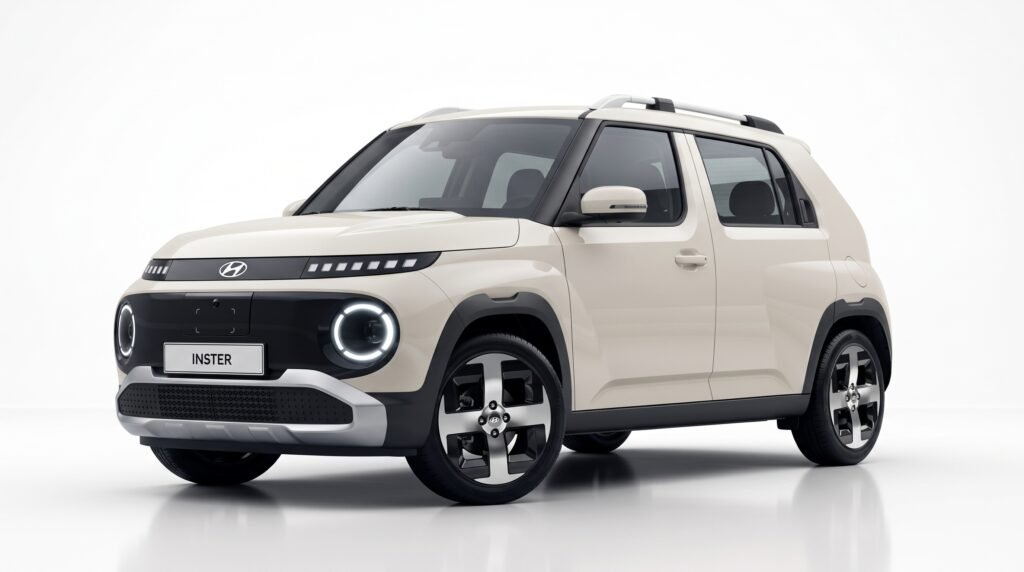
Hyundai Inster
Standard Range and Long Range (Europe and international markets)

A small electric car with sliding rear seats and a fully flat folding bench, offering up to 355 km WLTP. On sale in Europe and other markets, with no India launch announced.
*Ex-showroom Price in Europe and international markets (India availability not announced)
Hyundai Inster EV essentials
Hyundai Inster pros and cons
Pros
- Sliding rear seats and a fully flat folding bench are exceptional for a car this small
- 355 km WLTP is a genuinely usable figure, and WLTP is a realistic standard
- Luggage space expands to around 1,059 litres, far beyond what the footprint suggests
- Heat pump availability protects winter range, which many small EVs skip to save cost
- Vehicle to load output adds practical utility for outdoor use
- Driver assistance suite is comprehensive for the segment
- 3,825 mm length makes urban parking and narrow streets genuinely easy
- Hyundai build quality and an established international service network
Cons
- No Hyundai Inster launch announced for India, so it cannot be bought here
- 4 seats rather than 5, which limits family use
- 97 PS on the Standard Range is modest, and neither version is quick
- Small footprint means rear space is tight for taller adults despite the sliding seats
- European pricing places it above several larger electric cars in some markets
- Import and homologation costs would make Indian pricing difficult if it ever arrived
- Top speed around 140 km/h limits sustained highway use
- Higher trims add cost quickly, and the heat pump is not standard everywhere
Best for
Hyundai Inster specifications
Battery & Charging
Efficiency & Real-world Range
Motor & Performance
Dimensions & Weight
Suspension Brakes & Tyres
Comfort & Tech
Safety
Warranty
Features
Battery & Performance
- Two battery options at approximately 42 kWh Standard Range and 49 kWh Long Range
- Up to 355 km WLTP on the Long Range, a realistic standard unlike CLTC
- DC fast charging from 10 to 80 percent in approximately 30 minutes
- AC charging at 11 kW delivering a full charge in around 4 hours
- Heat pump available on higher trims, which meaningfully protects winter range
- Vehicle to load power output, allowing external equipment to run from the battery
- Battery preconditioning to optimise fast charging performance
- Battery mounted low in the floor, lowering centre of gravity on a tall narrow body
- 8 year or 160,000 km battery warranty in most markets
Comfort & Interior
- Sliding rear seats, genuinely rare in a car of this size
- Rear bench folds completely flat, expanding luggage space to around 1,059 litres
- Front seats also fold flat, allowing a full length loading surface
- Twin 10.25 inch displays for instruments and infotainment on higher trims
- Wireless Android Auto and Apple CarPlay
- Heated seats and heated steering wheel on higher trims
- Automatic climate control with heat pump option
- Vehicle to load socket for powering external devices
- Upright seating giving good visibility for the footprint
- Ambient lighting on higher trims
- Inster Cross variant adds roof rails and rugged exterior treatment
Safety
- Forward Collision Avoidance Assist
- Lane Keeping Assist and Lane Following Assist
- Blind Spot Collision Warning on higher trims
- Smart Cruise Control with stop and go on higher trims
- Driver Attention Warning
- Rear Cross Traffic Collision Warning
- Multiple airbags including side and curtain
- Electronic stability control standard
- Hill start assist
- Euro NCAP assessed for the European market
- High voltage automatic disconnect in a collision
Hyundai Inster trims and pricing
Compare available Hyundai Inster trims, their ex-showroom prices and key configuration details.
Inster Standard Range
42 kWh - approx 300 km WLTP - 97 PS FWD
Inster Long Range
49 kWh - approx 355 km WLTP - 115 PS FWD
Inster Cross
49 kWh - rugged styling, roof rails, raised stance
About Hyundai Inster
The Hyundai Inster is a small electric car that solves a problem most manufacturers have avoided, which is how to make a genuinely tiny EV without making it feel cheap or compromised. It is derived from the Hyundai Casper sold in South Korea, stretched and re-engineered for electric power and international markets. At roughly 3,825 mm long it sits well below any conventional hatchback, yet Hyundai gave it something almost no car this size offers, which is sliding rear seats and a rear bench that folds completely flat.
Two battery options are offered, approximately 42 kWh and 49 kWh, with the larger Long Range version delivering around 355 km on the WLTP cycle. WLTP is a considerably more realistic standard than the CLTC figures Chinese manufacturers quote, so that 355 km translates to genuinely usable real world range in the region of 280 km to 310 km for city driving. The Standard Range covers around 300 km WLTP. Power sits at approximately 97 PS for the smaller battery and 115 PS for the Long Range, driving the front wheels. DC fast charging takes the car from 10 to 80 percent in around 30 minutes.
What makes the Inster interesting is that Hyundai did not treat small as an excuse to strip things out. Higher trims offer a heat pump, vehicle to load power output, a digital instrument cluster paired with a matching central screen, and driver assistance including forward collision avoidance and lane keeping. In Europe it is priced from roughly EUR 23,000 to EUR 29,000 depending on market and specification. On India, Hyundai has not announced an Inster launch, and the car would face a difficult pricing equation here given import and homologation costs. Anyone researching it as an India purchase should treat it as unavailable rather than imminent. At EVUnlock, we cross-check specifications against official manufacturer documentation before publishing.
Trending news for Hyundai Inster
The Inster gives Hyundai a genuine entry point in the small electric car segment. Derived from the Korean market Casper and re-engineered for electric power and international sale, it addresses a segment where most manufacturers have either withdrawn or never entered, since small cars carry thin margins and battery costs hit them hardest proportionally.
Small electric cars remain scarce in most markets despite clear demand. Manufacturers have concentrated on SUVs where margins are healthier, leaving buyers who want a compact, affordable electric car with limited choice. The Inster's approach of adding genuine practicality through sliding and flat folding seats rather than simply shrinking a larger car is a more thoughtful answer than most rivals have offered.
Hyundai Inster range and performance
The Long Range Inster's 355 km WLTP figure deserves more respect than a raw number comparison suggests, because WLTP is a considerably tougher standard than the CLTC cycle Chinese manufacturers quote. A 355 km WLTP car and a 355 km CLTC car are not equivalent, with the WLTP vehicle typically delivering 15 to 25 percent more real capability. In practice expect around 280 km to 310 km in city driving and 230 km to 260 km at sustained highway speeds. Cold weather is where the heat pump option earns its cost, since heating a cabin with resistive elements draws a disproportionate share of a small battery and can cut winter range severely without one. On performance the Inster is unhurried rather than quick, with 115 PS and 147 Nm giving a 0 to 100 km/h time around 10.6 seconds on the Long Range. That understates how it feels below 50 km/h, where instant torque and a 3,825 mm footprint make it genuinely nimble in traffic. Top speed near 140 km/h is adequate rather than generous for motorway use.
Hyundai Inster safety overview
The Inster has been assessed by Euro NCAP for the European market, and carries a driver assistance suite that is comprehensive for a car this size. Forward Collision Avoidance Assist, Lane Keeping Assist, and Driver Attention Warning are standard, with Smart Cruise Control including stop and go, Blind Spot Collision Warning, and Rear Cross Traffic Collision Warning available on higher trims. Multiple airbags including side and curtain are fitted. One structural characteristic worth noting relates to the body shape. Small tall cars carry a relatively high centre of gravity for their track width, which can make them feel less settled in emergency lane changes. Mounting the battery low in the floor counteracts this substantially, giving the Inster a lower centre of gravity than the petrol Casper it derives from. No Indian safety rating exists, since the car is not sold here.
Hyundai Inster battery and charging guide
DC fast charging takes the Inster from 10 to 80 percent in approximately 30 minutes, which is competitive for the battery size. AC charging at 11 kW delivers a full charge in around 4 hours, comfortably covering an overnight or workday charge. A CCS2 port is used. Battery preconditioning is supported, which warms the pack to an optimal temperature before a fast charging stop and matters more than most buyers realise, since a cold battery accepts charge far more slowly. If your car supports preconditioning and you are navigating to a charger, using the built in navigation to set that charger as a destination usually triggers it automatically. Vehicle to load is supported through an interior socket, allowing laptops, small appliances, or camping equipment to run directly from the battery. For a car aimed partly at outdoor and leisure use, that is more useful than it sounds.
Hyundai Inster warranty details
Warranty terms vary by market. In Europe Hyundai typically offers a five year vehicle warranty, with the battery covered for eight years or 160,000 kilometres, which is the prevailing international standard. Roadside assistance is generally included. Since the Inster is not sold in India, no Indian warranty terms exist and there would be no local support for a privately imported example. For buyers in markets where it is available, the clause worth reading closely is the guaranteed battery state of health percentage, since that defines how much capacity degradation is actually covered rather than simply how long the coverage lasts.
Quick verdict: Hyundai Inster
The Inster is one of the more thoughtfully designed small electric cars available anywhere, and its strength is not the specification sheet but the packaging. Sliding rear seats and a bench that folds completely flat turn a 3,825 mm car into something that can swallow 1,059 litres when needed, which is the kind of practical flexibility that changes how usable a small car actually is. Hyundai resisted the temptation to treat small as an excuse to strip out equipment, so heat pump availability, vehicle to load output, and a comprehensive driver assistance suite are all present on higher trims. The 355 km WLTP figure is genuinely usable, and WLTP being a realistic standard means that number holds up better than an equivalent CLTC claim would. The limits are honest ones. Four seats rather than five restricts family use, performance is adequate rather than engaging, and European pricing places it above some larger electric cars. For Indian readers the practical conclusion is simple, since Hyundai has announced no India launch and the car cannot be bought here.
Hyundai Inster vs rivals: how it compares
In European markets the Inster competes against a thin field, since most manufacturers have concentrated on electric SUVs where margins are healthier. Against small electric cars from Fiat, Citroen, and Dacia, the Inster generally offers more range and considerably more interior flexibility, at a higher price. Against larger electric hatchbacks from Volkswagen and Renault, it trades outright space and power for a smaller footprint and easier urban use, and the pricing overlap means the choice comes down to whether you value compactness or capacity. Against Chinese small electric cars entering Europe, the Inster's advantages are Hyundai's established service network and a WLTP rather than CLTC range figure, while its disadvantage is price. For Indian readers, no direct comparison is meaningful since the car is not sold here, though the Inster is a reasonable benchmark for what the international small EV segment now delivers.
Hyundai Inster: who should buy it (and who should not)
If you are in India, the Inster is not a purchase option, since Hyundai has announced no launch, no pricing, and no local homologation or service arrangement. Private import is impractical given warranty and support considerations. If you are buying in a market where the Inster is available, three things deserve attention. Choose the Long Range unless your driving is genuinely local, since the extra battery and the more powerful motor together make a meaningful difference to usability rather than just to the specification sheet. Prioritise the heat pump if you live somewhere with real winters, because on a battery this size resistive heating consumes range quickly and no cosmetic upgrade compensates for that. And spend time with the rear seats during the test drive, since the sliding and flat folding arrangement is the Inster's genuine differentiator and worth confirming it suits how you actually load the car.
Hyundai Inster ownership and running costs
Ownership costs depend on market and no Indian figures apply, since the car is not sold here. As an indicative calculation, at roughly 7 km per kWh real world efficiency the Inster would cost approximately EUR 0.03 to EUR 0.05 per kilometre on typical European domestic electricity rates, against considerably more for a petrol equivalent. Using Indian reference rates for comparison purposes only, at ₹8.5 per kWh that works out to approximately ₹1.21 per kilometre against roughly ₹5.15 for a petrol hatchback at 20 km/l and ₹103 per litre. Small electric cars generally have low maintenance costs, since there is no engine servicing and regenerative braking substantially extends brake pad life. The larger variable in Europe is electricity pricing, which varies widely between countries and has a bigger effect on running cost than any specification difference between rival cars.
Hyundai Inster tax benefits and incentives
Electric vehicle incentives vary considerably by market and none apply to the Inster in India, since the car is not sold here. Across European markets, support ranges from direct purchase grants to reduced VAT, company car tax advantages, exemption from urban congestion and low emission zone charges, and free or discounted parking in some cities. These differ substantially between countries and change frequently, so buyers should confirm what applies locally at the time of purchase rather than relying on published figures. For reference, if a vehicle of this type were sold in India it would qualify for Section 80EEB loan interest deduction of up to ₹1.5 lakh, GST at 5 percent against 28 percent plus cess on petrol equivalents, and state-level subsidies and registration waivers that vary by state.
Hyundai Inster maintenance and service
Electric drivetrains remove engine oil changes, spark plugs, air filters, fuel filters, and clutch wear entirely, which accounts for most routine servicing on a petrol equivalent. What remains is tyre rotation, brake fluid checks at extended intervals since regenerative braking substantially reduces pad wear, cabin air filter replacement, coolant for the battery thermal system, and periodic battery health diagnostics. On a car this light, tyre and brake wear are both low, which keeps running costs down further. Hyundai's international service network is well established, so parts availability and technician training are not concerns in markets where the Inster is sold. In India there is no Inster service arrangement at all, since the car is not offered here, which alone rules out ownership regardless of any other consideration.
EV Running Cost Calculator
*Estimated figures based on entered electricity price, fuel price, mileage and average daily driving. Actual running costs can vary.
Related articles for Hyundai Inster
Frequently asked questions about Hyundai Inster
Is the Hyundai Inster available in India?
No. Hyundai has not announced an Inster launch for India, and the car is not on sale here. It is sold in Europe and other international markets. Hyundai has a strong India presence and manufactures locally, so a route exists in principle, but nothing has been announced regarding the Inster specifically. Buyers should treat it as unavailable in India rather than upcoming.
What is the Hyundai Inster price?
In Europe the Inster starts from approximately EUR 23,000 and runs to around EUR 29,000 for higher trims and the Cross variant, though pricing varies considerably by market and local incentives. No India pricing exists because the car is not sold here. Converting European prices directly to rupees would be misleading, since import duties, homologation, and local taxation would change the figure substantially.
What is the Hyundai Inster range?
Approximately 300 km WLTP on the 42 kWh Standard Range and 355 km on the 49 kWh Long Range. WLTP is a considerably more realistic test standard than the CLTC figures Chinese manufacturers quote, so these numbers translate reasonably well to actual driving. Expect roughly 280 km to 310 km real world from the Long Range in city conditions, dropping in cold weather unless the car has the heat pump option.
How many seats does the Hyundai Inster have?
Four. Unlike some small cars that squeeze in a five seat bench, Hyundai chose four proper seats with a sliding rear bench, which prioritises comfort and flexibility over headline seat count. The rear seats slide fore and aft to trade legroom against luggage space, and fold completely flat when maximum cargo capacity is needed. Front seats also fold flat, allowing a full length loading surface.
What is the Hyundai Inster boot space?
Approximately 280 litres with the rear seats in place, expanding to around 1,059 litres with them folded flat. That expanded figure is remarkable for a car measuring 3,825 mm long, and it comes from the sliding rear bench and completely flat folding design rather than from clever measurement. This flexibility is arguably the Inster's single strongest practical feature.
Does the Hyundai Inster have a heat pump?
Available on higher trims rather than standard across the range. A heat pump matters more on small electric cars than large ones, because heating the cabin using resistive elements draws a substantial share of a small battery. In cold conditions a heat pump can preserve meaningfully more range than resistive heating. If you live somewhere with real winters and are choosing between trims, this is worth prioritising over cosmetic upgrades.
What is the Hyundai Inster Cross?
A variant with rugged exterior styling, roof rails, a slightly raised stance, and unique interior trim, positioned above the standard Long Range. Mechanically it uses the same 49 kWh battery and drivetrain, so the changes are largely visual and practical rather than functional. Roof rails add genuine utility for anyone carrying bulky items regularly, but buyers should not expect any meaningful off road capability from the treatment.
How does WLTP range compare with ARAI and CLTC?
WLTP, used in Europe, is the most realistic of the three and generally lands closest to actual driving. CLTC, used in China, is the most optimistic and typically reads 15 to 25 percent higher than WLTP for the same vehicle. ARAI, used in India, sits between them but is also generous relative to real conditions. This matters when comparing cars across markets, since a 355 km WLTP figure represents considerably more real capability than a 355 km CLTC figure would.
Owner feedback for Hyundai Inster
No approved owner feedback yet. Be the first to share your experience.
Available colours
Hyundai offers the Inster in a palette that leans toward muted, slightly unconventional shades rather than the conventional silver and grey that dominate small cars, with khaki and ivory options giving it a distinct character. Availability varies by market and trim, and the Inster Cross variant typically carries its own colour and trim combinations. Manufacturers routinely narrow colour choices for individual markets, so local availability may be more limited than the full international range. Confirm current options with a Hyundai dealer in your market.