
 1 / 2 Images


Hindustan Motors Ambassador EV
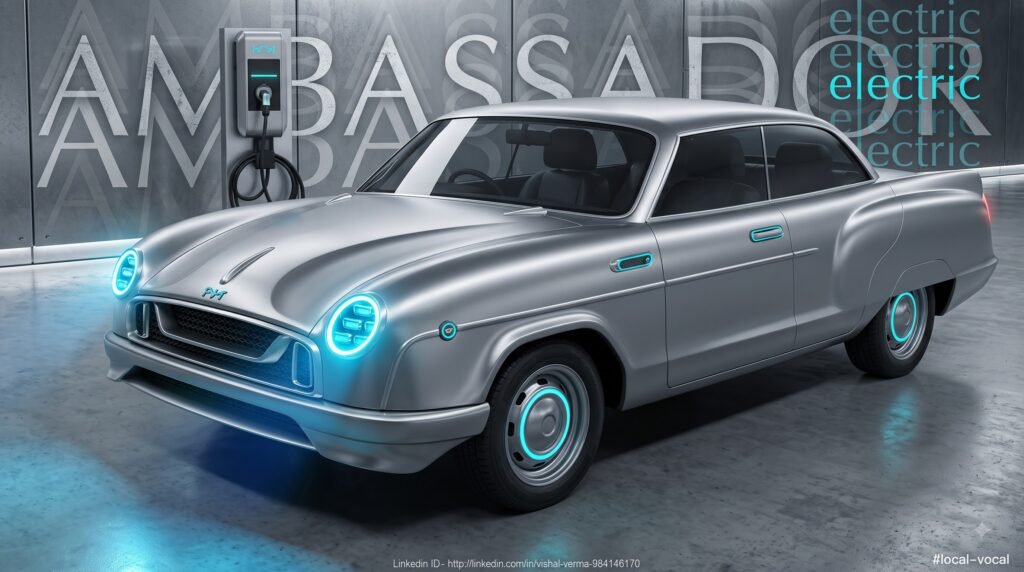
Rumoured Electric Sedan (unconfirmed)

Unconfirmed. The viral 2026 Ambassador image is a design student's 2022 college render, not an official design. The brand is owned by Stellantis, and no revival has been officially announced.
*Ex-showroom Price in Kolkata
Hindustan Motors Ambassador EV EV essentials
Hindustan Motors Ambassador EV pros and cons
Pros
- The Ambassador nameplate carries enormous emotional recognition in India
- The original was genuinely comfortable and exceptionally spacious in the rear
- Hindustan Motors and Stellantis do operate a real joint venture facility near Chennai
- Stellantis owns the trademark and has the platforms to build an EV
- Hindustan Motors did publicly state in 2022 that work was underway
- India has no retro-modern electric sedan, so the space is genuinely open
- A chauffeur-focused electric Ambassador would suit the government and fleet market
Cons
- No official announcement exists from Hindustan Motors, Stellantis or Citroen
- The viral 2026 Ambassador image is a design student's 2022 college render
- Hindustan Motors does not own the Ambassador brand - Stellantis does
- No prototype has ever been shown publicly
- No specification, price, battery figure or launch date has been published
- Reviving a dormant brand requires very large investment
- Stellantis has faced its own commercial challenges in the Indian market
- Ambassador production ended in 2014 - the manufacturing base is long gone
- Numerous websites report the revival as confirmed when it is not
Best for
Hindustan Motors Ambassador EV specifications
Reality Check - read this first
Verified facts
Reported but unconfirmed
What has never been announced
Informed estimates if it were built
The original Ambassador - for reference
How to judge a launch claim
Electric sedans you CAN buy today
Features
Battery & Performance
- IMPORTANT: no Ambassador EV exists - no battery specification has ever been announced
- Media reports suggest a target range of 250 to 350 km, aimed at urban commuting
- A 250-350 km range in a compact sedan would imply roughly 30 to 45 kWh
- An urban electric sedan would typically use a 70 to 100 kW motor
- CCS-II would be the charging standard, as on every EV sold in India
- If built on a Stellantis platform, front-wheel drive would be expected
- Stellantis sells the Citroen eC3 and eC3X in India using a 29.2 kWh air-cooled pack
- A rebadged Stellantis product would most plausibly share that hardware
- The original Ambassador used a 1.5-litre diesel or 1.8-litre petrol engine
- Note: every figure here is inference or unverified media reporting
- Note: neither Hindustan Motors nor Stellantis has confirmed any specification
Comfort & Interior
- No equipment list has ever been announced for an Ambassador EV
- The original Ambassador was known for an exceptionally spacious rear seat
- It offered a large boot and a high, upright seating position
- Its soft suspension made it famously comfortable over poor road surfaces
- The upright glasshouse gave excellent all-round visibility
- Any revival would be expected to reference these traits in marketing
- A modern Ambassador would need a touchscreen, connected features and climate control to compete
- Retro-modern design revivals typically emphasise nostalgic detailing over outright practicality
- If based on an existing Stellantis model, its equipment would carry over
- Note: no interior of any Ambassador EV has ever been shown
Safety
- No Ambassador EV exists, so no safety equipment has been specified
- No crash test has been conducted and no rating exists
- The original Ambassador predated modern crash safety regulation entirely
- Any new vehicle would have to meet current Indian safety norms
- Six airbags are now mandatory expectations in the Indian sedan segment
- A Bharat NCAP rating would be commercially important for a revived icon
- If built on a Stellantis platform, that platform's safety engineering would apply
- Stellantis vehicles in India carry varying safety specifications by model
- Note: nostalgia does not transfer safety performance - a revived nameplate needs its own testing
Hindustan Motors Ambassador EV trims and pricing
Compare available Hindustan Motors Ambassador EV trims, their ex-showroom prices and key configuration details.
No production variants exist
No Ambassador EV has been built, shown or announced by any manufacturer
Rumoured: Urban electric sedan
Media reports suggest a 250-350 km range city sedan built at the Hindustan Motors-Stellantis Chennai facility - unconfirmed
Most likely scenario
An existing Stellantis model rebadged as Ambassador, rather than a ground-up revival - speculation only
About Hindustan Motors Ambassador EV
Start with the single most important fact about the Ambassador EV: the widely circulated image of a sleek futuristic Ambassador that has appeared across social media and countless car websites is not an official design. It is a render created by a design student in 2022 as a college project, which the internet mistakenly promoted as leaked prototype imagery. Almost every article announcing a 2026 Ambassador is built on that image.
With that established, here is what is actually true. Hindustan Motors stopped building the Ambassador at its Uttarpara plant in West Bengal in 2014, after nearly six decades in production. On 11 February 2017 the company, part of the C.K. Birla Group, sold the Ambassador brand and its trademarks to France’s PSA Group – the Peugeot-Citroen parent, now part of Stellantis – for Rs 80 crore. The proceeds went towards clearing dues to employees and lenders. That transaction matters more than anything else here: Hindustan Motors does not own the Ambassador name any more. Stellantis does.
There is a genuine thread underneath the noise. In 2022 Hindustan Motors stated that it was working with Peugeot to bring the Ambassador back in a new design, and described the work as being in advanced stages. Hindustan Motors and Stellantis do operate a joint venture facility near Chennai, and reports have suggested a revived Ambassador could be built there. Reported specifications include a 250 to 350 km range aimed at urban commuting, with launch timing variously quoted as March 2026 or September 2026.
But none of that has been officially announced. There is no confirmation from Hindustan Motors, from Stellantis, or from Citroen. No prototype has been shown. No specification has been published. No booking has opened.
The realistic assessment is that an Ambassador EV remains a possibility rather than a product – and that if it ever arrives, the most likely form is an existing Stellantis model wearing the Ambassador badge rather than a ground-up revival of the original car.
Trending news for Hindustan Motors Ambassador EV
The most useful news about the Ambassador EV is a correction rather than an announcement.
The revival story circulating across social media and Indian car websites centres on a widely shared image of a sleek, futuristic sedan wearing the Ambassador name. That image is not an official design and never was. It is a render created by a design student in 2022 as a college project, which was picked up online and republished as though it were leaked prototype imagery. Every headline announcing a confirmed 2026 Ambassador traces back to it.
The verified facts run differently. Hindustan Motors ended Ambassador production at its Uttarpara plant in West Bengal in 2014. On 11 February 2017 it sold the Ambassador brand and its trademarks to France's PSA Group for Rs 80 crore, using the proceeds to clear dues owed to employees and lenders. PSA merged with Fiat Chrysler to form Stellantis in 2021, so Stellantis now holds the Ambassador trademark. Hindustan Motors does not own the name it is popularly credited with reviving.
There is a genuine thread beneath the noise. In 2022 Hindustan Motors stated it was working with Peugeot to bring the Ambassador back in a new design and described the work as being in advanced stages. Hindustan Motors and Stellantis do operate a joint venture facility near Chennai, and reports have suggested a revived Ambassador could be built there with a 250 to 350 km range.
But there has been no official announcement from Hindustan Motors, Stellantis or Citroen, no prototype has been shown, and no specification has been published. As of August 2026 the Ambassador EV remains a possibility discussed in reporting rather than a product anyone can point to.
Hindustan Motors Ambassador EV range and performance
There is no verified range or performance data for an Ambassador EV, because no such vehicle has been built, shown or specified by any manufacturer.
Media reports have suggested a target range of 250 to 350 km on a single charge, positioned for urban commuting with occasional intercity use. That figure does not trace to an official statement from Hindustan Motors or Stellantis, and no battery capacity, motor output, torque, top speed or acceleration figure has been published by anyone.
Working from the reported range produces some reasonable inference. A 250 to 350 km claimed range in a compact sedan would imply a battery in the region of 30 to 45 kWh, and an urban sedan of that type would typically use a motor producing 70 to 100 kW. Real-world range would realistically land around 200 to 270 km. Front-wheel drive would be expected on any Stellantis-derived platform.
One concrete reference point is worth noting. Stellantis already sells the Citroen eC3 and eC3X in India, using a 29.2 kWh air-cooled lithium-ion pack producing 57 PS with a claimed 325 km MIDC range. If an Ambassador EV were to emerge as a rebadged Stellantis product - which is the most commercially plausible route - that hardware is the nearest existing template, and it would sit at the lower end of the reported range band rather than the upper.
For historical context, the original Ambassador used a 1.5-litre diesel or 1.8-litre petrol engine in its later years, and was never a quick car. Its appeal rested entirely on ride comfort, rear seat space and mechanical simplicity. Any revival trading on that heritage would sensibly prioritise the same qualities over performance - which makes a modest urban EV specification consistent with the brand, even if none has been confirmed.
Hindustan Motors Ambassador EV safety overview
No Ambassador EV exists, so there is no safety specification, no crash test result and no rating of any kind. No airbag count has been announced, no ADAS specification given, and no structural detail published.
There is an important point about heritage and safety that this listing is a good occasion to make. The original Ambassador was designed in the 1950s, based on the Morris Oxford Series III, and predates modern crash safety regulation entirely. It had no airbags, no ABS, no crumple zone engineering and no crash testing in the modern sense. Its reputation for solidity came from heavy steel construction, which is not the same thing as occupant protection - a rigid body without controlled deformation transfers more impact energy to occupants, not less.
Nostalgia does not transfer safety performance. If an Ambassador EV were ever built, it would be an entirely new vehicle required to meet current Indian safety norms, and it would need its own independent crash testing to earn any rating. A Bharat NCAP result would be commercially important for a revived icon, because a nameplate trading on emotional recognition would be badly damaged by a poor safety score.
If a revival emerged as a rebadged Stellantis product, that platform's existing safety engineering and any published ratings would apply. Stellantis vehicles sold in India carry varying safety specifications by model, and the Citroen eC3X - the most likely template - has no published Bharat NCAP or Global NCAP crash rating.
For anyone shopping today, the practical point stands: buy a car with a published crash rating from Bharat NCAP or Global NCAP. Several electric sedans and hatchbacks on sale in India have one.
Hindustan Motors Ambassador EV battery and charging guide
No charging specification exists for an Ambassador EV, because no such vehicle has been announced or built.
If one were produced for the Indian market, the charging port would be CCS-II, which is the national standard and is used by every electric vehicle sold in India today. That much can be stated with confidence regardless of who builds it.
Beyond that, only inference is possible. For a battery in the estimated 30 to 45 kWh region, DC fast charging from 10 to 80 percent would typically take somewhere between 35 and 60 minutes depending on the charger and the pack's thermal management. Home AC charging on a 7.4 kW wallbox would fill a battery of that size in roughly five to seven hours, making overnight charging straightforward.
The nearest existing reference is the Citroen eC3X, Stellantis's current electric offering in India, which uses a 29.2 kWh air-cooled pack and takes about 57 minutes for a 0 to 80 percent DC charge, or roughly 10.5 hours on a home charger. Notably, that pack is air-cooled rather than liquid-cooled, which is a meaningful engineering compromise in Indian heat and affects both fast-charging behaviour and long-term battery health. If an Ambassador EV emerged as a rebadged Stellantis product sharing that hardware, the same consideration would apply.
None of this describes an actual vehicle. It describes what a vehicle would plausibly do if it existed, based on the platforms available to the companies involved.
For anyone genuinely shopping for an affordable electric sedan today, the Tata Tigor EV offers a published 315 km ARAI range with a 59-minute DC charge and a 4-star Global NCAP rating - real figures on a car you can drive.
Hindustan Motors Ambassador EV warranty details
No warranty terms exist for an Ambassador EV, because no such vehicle has been announced, built or sold.
There is, however, a genuinely important ownership consideration buried in this story that applies well beyond the Ambassador, and it concerns what happens to support when a manufacturer exits a market.
Hindustan Motors ceased Ambassador production in 2014 and subsequently sold the brand entirely. Owners of the last Ambassadors found themselves with a vehicle whose manufacturer had stopped building cars, whose brand had been sold to a foreign company with no obligation to support it, and whose parts supply depended increasingly on the independent aftermarket. That the Ambassador remained repairable at all is down to its mechanical simplicity and the enormous number built over six decades - a modern EV in the same situation would fare very differently, because battery modules, power electronics and vehicle software cannot be sourced or fixed by an independent workshop.
This is the single most practical lesson the Ambassador story offers a modern EV buyer. Before committing to any vehicle from a manufacturer with an uncertain position, establish what happens to warranty obligations, parts supply and software support if that manufacturer exits, is acquired, or discontinues the model. Ask specifically about battery module availability, because that is the component whose absence renders an EV worthless rather than merely inconvenient.
Established manufacturers with long-term commitments to India, large service networks and multiple models in production carry that risk far better than newer entrants or revived nameplates.
If an Ambassador EV were ever announced, those questions would be the first to ask - not the specification sheet.
Quick verdict: Hindustan Motors Ambassador EV
The Hindustan Motors Ambassador EV is, as of August 2026, a story rather than a car - and understanding why is more valuable than any specification could be.
The emotional pull is real. The Ambassador was India's most recognisable vehicle for the better part of six decades, the default government car, famously comfortable and famously repairable. An electric revival is an appealing idea, and India genuinely has no retro-modern electric sedan occupying that space.
But the evidence does not support a product. There is no official announcement from Hindustan Motors, Stellantis or Citroen. No prototype has been shown. No specification, price, battery figure or launch date has been published. And the image that launched a thousand headlines - the sleek futuristic Ambassador shared endlessly online - is a design student's 2022 college project, not a leaked official design.
The structural obstacle is the one most coverage omits entirely. Hindustan Motors sold the Ambassador brand and its trademarks to PSA Group in February 2017 for Rs 80 crore, and Stellantis holds them today. Hindustan Motors cannot revive the Ambassador alone, because it does not own the name.
What genuinely exists is thinner than the headlines suggest: a 2022 statement from Hindustan Motors that it was working with Peugeot on a new Ambassador design, and a real HM-Stellantis joint venture facility near Chennai. That is a foundation for a possibility, not evidence of a product.
If the badge does return, the commercially realistic form is an existing Stellantis model wearing the Ambassador name rather than a ground-up recreation. Rebuilding a dormant brand from scratch requires investment that is difficult to justify.
What to do: do not plan a purchase around this vehicle. If you want an affordable electric sedan today, the Tata Tigor EV is on sale with a published crash rating. If you want the Ambassador's rear-seat comfort, the MG Windsor EV delivers it better than anything at the price.
Hindustan Motors Ambassador EV vs rivals: how it compares
There is no Ambassador EV to compare, so the useful comparisons are against what exists and what the Ambassador actually stood for.
Against the Tata Tigor EV: this is the closest thing on sale to what an affordable electric Ambassador would be - a compact electric sedan with a proper boot, priced from Rs 12.49 lakh, with a 26 kWh battery, 315 km ARAI range and a 4-star Global NCAP rating. Every figure is published and verifiable, and Tata operates India's largest EV service network. If the idea of an affordable Indian electric sedan appeals, this is the actual answer.
Against the Citroen eC3X: relevant because Citroen is a Stellantis brand, and Stellantis owns the Ambassador trademark. The eC3X uses a 29.2 kWh air-cooled pack with a claimed 325 km MIDC range, from Rs 11.99 lakh. If an Ambassador EV ever emerges as a rebadged Stellantis product, this is the most likely donor hardware - which makes it a useful preview of what such a car would actually be.
Against the MG Windsor EV: this is the closest thing in spirit to what the Ambassador was famous for. The Ambassador's defining quality was rear seat comfort - it was a car you were driven in. The Windsor EV delivers exactly that with a rear bench reclining through 135 degrees, a panoramic glass roof and enormous space, from Rs 14.70 lakh. It is India's best-selling EV, which suggests the Ambassador's core appeal remains commercially valid.
Against the original Ambassador: any revival would share only a name. The original was a 1950s Morris Oxford derivative with no modern safety engineering, a leisurely diesel or petrol engine, and appeal built on comfort, space and repairability rather than technology. A modern EV wearing the badge would be an entirely different machine.
Hindustan Motors Ambassador EV: who should buy it (and who should not)
You cannot buy an Ambassador EV. No such vehicle has been built, announced or specified by any manufacturer.
If you arrived here from an article headlined as a confirmed 2026 Ambassador launch, that article is almost certainly built on an unofficial render created by a design student in 2022. There is no official announcement from Hindustan Motors, Stellantis or Citroen, no prototype has been shown, and no specification exists.
Do not plan a purchase around this vehicle, and be cautious of any dealer, website or intermediary claiming to accept bookings or deposits for it. A vehicle with no announced specification, price or launch date cannot legitimately be booked.
A useful four-part test applies to any launch claim you encounter, and the Ambassador EV fails all four. Is there an official manufacturer statement? No. Are there photographs of a physical prototype, rather than a render? No. Has a specification been published? No. Have bookings opened or a price been announced? No. Any vehicle failing all four should be treated as rumour regardless of how many websites report it.
What to buy instead depends on what drew you here. If it was the idea of an affordable Indian electric sedan, the Tata Tigor EV is on sale from Rs 12.49 lakh with a 315 km ARAI range and a 4-star Global NCAP rating. If it was the Ambassador's legendary rear-seat comfort, the MG Windsor EV offers a 135-degree reclining rear bench and enormous cabin space from Rs 14.70 lakh. If budget is the binding constraint, the Citroen eC3X starts at Rs 11.99 lakh - and notably comes from Stellantis, the company that actually owns the Ambassador name.
If a genuine Ambassador EV is ever announced, it will arrive with a manufacturer press release, photographs of a real car and a published specification. Until then, this page will say so.
Hindustan Motors Ambassador EV ownership and running costs
No ownership cost can be calculated for a vehicle that does not exist and has no announced price or battery capacity. What follows is what an Ambassador EV would plausibly cost to run if it matched the specification reported in media coverage.
If it arrived with a battery in the estimated 30 to 45 kWh region delivering a real-world 200 to 270 km, charging at a home tariff of around Rs 10 per unit would cost roughly Rs 300 to Rs 450 for a full charge. Across around 235 km of real range, that works out near Rs 1.30 per kilometre - low, because a modest battery in a light urban sedan is efficient by nature.
Against petrol: the original Ambassador returned around 13 kmpl in its later years, which at Rs 95 per litre would cost roughly Rs 7.30 per kilometre today. An electric equivalent would therefore save around Rs 6 per kilometre - though comparing a modern EV against a 1950s-derived design flatters the comparison considerably. Against a current petrol sedan returning 19 kmpl, the saving would be closer to Rs 3.70 per kilometre.
Servicing on any EV runs at roughly a third to a half of a petrol equivalent, with no engine oil, filters, spark plugs, clutch or exhaust.
The cost that cannot be estimated, and that matters most for a revived nameplate, is depreciation. A brand returning after more than a decade of absence, with no established service network for the new product and no track record for the vehicle, carries genuine residual value uncertainty. Buyers of first-generation products from revived brands have historically fared poorly on resale.
For anyone running real numbers today, do it against a car you can actually buy. The Tata Tigor EV costs around Rs 1.20 per kilometre on home charging with a published 315 km ARAI range - verifiable figures on a vehicle with a service network behind it.
Hindustan Motors Ambassador EV tax benefits and incentives
No Ambassador EV exists, so no buyer has claimed an incentive on one. This section covers the provisions that would apply to any electric vehicle purchase in India today.
GST on electric vehicles is charged at 5 percent, against a much higher rate plus cess on comparable petrol cars. On an affordable sedan, that difference is proportionally very significant and is already built into the ex-showroom price of every EV sold in India.
Road tax and registration exemptions vary substantially by state. Delhi, Maharashtra, Gujarat, Tamil Nadu, Karnataka, Telangana and several others waive or sharply reduce these charges on electric vehicles, while other states offer nothing. On a budget EV, the waiver can represent a meaningful share of total on-road cost, so your state of registration matters more here than on an expensive car. Notably, Tamil Nadu - where the Hindustan Motors and Stellantis joint venture facility is located - has an active EV policy supporting both manufacturing and purchase.
Under Section 80EEB of the Income Tax Act, individual buyers financing an electric vehicle can claim a deduction of up to Rs 1.5 lakh on the interest paid on the loan, subject to the loan being sanctioned within the eligible window and the buyer using the old tax regime.
Green number plates additionally exempt EVs from certain city-level restrictions and permit requirements in some regions.
There is a historical footnote worth noting. Manufacturing-linked incentives under schemes such as the production-linked incentive programme have influenced where manufacturers choose to build EVs in India, and the Tamil Nadu location of the HM-Stellantis facility is consistent with that pattern - though this reflects manufacturing strategy rather than any confirmation of an Ambassador product.
Confirm current policy with your dealer and state transport department before budgeting on any incentive.
Hindustan Motors Ambassador EV maintenance and service
No maintenance schedule exists for an Ambassador EV, because no such vehicle has been built. But the Ambassador's own history offers one of the most instructive maintenance lessons available to an EV buyer, and it is worth setting out properly.
The original Ambassador earned genuine affection for being repairable almost anywhere in India. Its mechanical simplicity, the vast number built across six decades and a deep independent parts ecosystem meant a village mechanic could keep one running indefinitely. That characteristic did more for the car's reputation than any specification ever did.
An electric vehicle offers no equivalent. There is no engine oil, no filters, no spark plugs, no clutch and no exhaust - servicing is largely inspection, and routine costs run at roughly a third to a half of a petrol car. That is the good news. The difficult news is that when something does go wrong, an EV cannot be fixed by a general mechanic. Battery modules, power electronics, thermal management systems and vehicle software all require manufacturer-specific parts, diagnostic equipment and trained technicians. An independent workshop cannot substitute.
That inverts the Ambassador's defining virtue, and it is the single most important thing for an Indian EV buyer to understand. The practical implications are concrete. Check that an authorised service centre exists within reasonable distance before buying. Confirm that battery modules are available as spares rather than only complete packs. Establish what happens to software support and parts supply if the model is discontinued or the manufacturer exits.
Those questions matter far more on an EV than they ever did on an Ambassador - and they matter most on vehicles from revived brands, new entrants or manufacturers with uncertain market positions.
EV Running Cost Calculator
*Estimated figures based on entered electricity price, fuel price, mileage and average daily driving. Actual running costs can vary.
Related articles for Hindustan Motors Ambassador EV

Frequently asked questions about Hindustan Motors Ambassador EV
Is the Hindustan Motors Ambassador EV real?
Not as a confirmed product. No Ambassador EV has been officially announced by Hindustan Motors, by Stellantis or by Citroen. No prototype has been shown, no specification published and no bookings opened. The widely shared image of a sleek futuristic Ambassador that appears on social media and across car websites is not an official design - it is a render created by a design student in 2022 as a college project, which spread online as though it were leaked prototype imagery. Most articles announcing a 2026 Ambassador are built on that image.
Who owns the Ambassador brand now?
Stellantis. On 11 February 2017, Hindustan Motors - part of the C.K. Birla Group - sold the Ambassador brand including its trademarks to France's PSA Group for Rs 80 crore. PSA, the parent of Peugeot and Citroen, subsequently merged with Fiat Chrysler to form Stellantis in 2021. The proceeds from the sale were used by Hindustan Motors to clear dues owed to employees and lenders. This is the most important fact in the whole story: Hindustan Motors cannot revive the Ambassador on its own, because it no longer owns the name.
Is Hindustan Motors actually working on an Ambassador comeback?
There is a genuine thread, but it falls well short of a confirmed product. In 2022 Hindustan Motors stated that it was working with Peugeot to bring the Ambassador back in a new design, describing the work as being in advanced stages. Hindustan Motors and Stellantis do operate a joint venture facility near Chennai. What has not happened is any official announcement, any prototype reveal, any published specification, or any confirmed timeline from either company. A statement made in 2022 that work is underway is not the same as a product.
When will the Ambassador EV launch?
No launch date exists. Media reports have variously quoted March 2026 and September 2026, but neither Hindustan Motors nor Stellantis has announced anything, and those dates have come and gone in reporting without any accompanying official confirmation. The honest answer is that nobody outside the companies knows whether a product exists at all, let alone when it might arrive. Treat any specific date you see quoted as speculation.
What are the reported Ambassador EV specifications?
Media reports have suggested a driving range of 250 to 350 km on a single charge, positioned for urban commuting and occasional intercity travel, with manufacturing at the Hindustan Motors and Stellantis facility near Chennai. That is essentially the extent of the reported detail. No battery capacity, motor output, torque, top speed, dimensions, weight, charging speed or equipment list has been published by anyone. For a vehicle supposedly close to launch, that absence of engineering detail is the clearest signal of how speculative this is.
What was the original Hindustan Ambassador?
The Ambassador was India's most recognisable car for decades. Based on the Morris Oxford Series III, it was built by Hindustan Motors at its Uttarpara plant in West Bengal from 1958 until production ended in 2014 - nearly six decades. It was the default government and official car in India for much of that period, known for an exceptionally spacious rear seat, a very comfortable ride over poor roads and a reputation for being repairable anywhere. Its decline came as modern, more efficient cars from Maruti Suzuki and others made its ageing design uncompetitive.
If it happens, what would an Ambassador EV most likely be?
The most plausible outcome is not a ground-up recreation of the original car. Reviving a dormant brand from scratch requires enormous investment in platform development, tooling, manufacturing and dealer network - a commitment that is difficult to justify commercially, particularly given Stellantis's own position in the Indian market. The more realistic scenario, if the badge returns at all, is an existing Stellantis product wearing the Ambassador name. Stellantis already sells the Citroen eC3 and eC3X in India, and a rebadged variant would be a far cheaper route to putting an Ambassador back on Indian roads.
Why do so many websites say the Ambassador EV is confirmed?
Because a single unofficial image went viral and was repeatedly treated as evidence. The render created by a design student in 2022 was picked up and republished as though it were a leaked official design, and each site that reported it added apparent credibility for the next. Headlines then escalated from 'could return' to 'comeback confirmed' without any new information appearing. It is a useful case study in how automotive rumours build. Before believing any launch claim, look for three things: an official manufacturer statement, photographs of a physical prototype, and a published specification. None of the three exists here.
Owner feedback for Hindustan Motors Ambassador EV
No approved owner feedback yet. Be the first to share your experience.
Available colours
No colour palette exists for an Ambassador EV, because no such vehicle has been announced or shown. The shades listed here are the historical colours most associated with the original Hindustan Ambassador, included for reference rather than as any indication of a future range. White was overwhelmingly the most common Ambassador finish, particularly on the government and official fleet vehicles that made the car a national fixture, and it remains the colour most people picture when the name is mentioned. Black was the mark of senior official use and carried genuine status. Cream and pale beige were common on private examples and taxi fleets, and dark blue appeared on later variants. If a revival ever emerged, a retro-modern product trading on nostalgia would very likely lead with white and black to invoke exactly those associations - that is standard practice for heritage relaunches worldwide, and it would cost nothing to implement. But this is reasoning about what a manufacturer would sensibly do, not information about what any manufacturer plans. Any colour palette published for a 2026 Ambassador elsewhere is speculation, most of it derived from the same unofficial render that generated the rest of the story.