
 1 / 2 Images
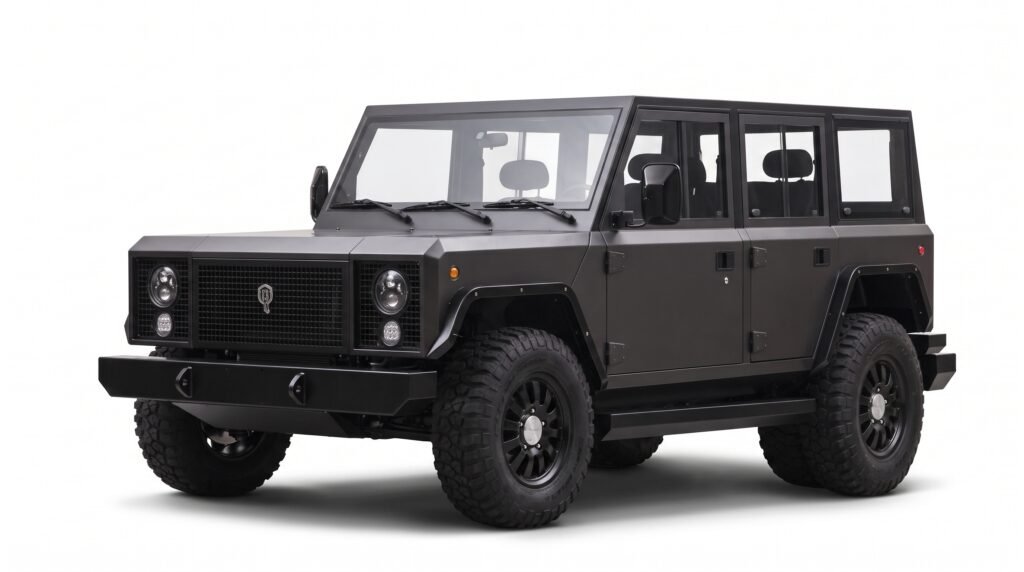
Bollinger B1
Electric Off-Road SUV (Cancelled)

Bollinger's wildly boxy, hardcore electric off-road SUV. It promised a 120 kWh battery, ~200 miles of range, 614 hp and serious off-road hardware at 125,000 dollars - but it was delayed indefinitely in 2022 and never reached production. Historical reference.
*Ex-showroom Price in Detroit
Bollinger B1 EV essentials
Bollinger B1 pros and cons
Pros
- Genuinely hardcore, no-compromise off-road design
- Strong power and torque (614 hp, 905 Nm)
- Serious off-road hardware (portal axles, big clearance)
- Clever pass-through cargo and removable panels
- An icon of bold, original EV design
Cons
- Never reached production - delayed indefinitely in 2022
- Cannot be bought, new or used (essentially none exist for sale)
- Bollinger later faced serious financial difficulties
- Very high announced price (125,000 dollars)
- No crash-test rating, no real-world verification
Best for
Bollinger B1 specifications
Battery & Charging
Motor & Performance
Off-Road & Design
Status & History
Safety
Warranty
Features
Battery & Performance
- 120 kWh battery for roughly 200 miles of range
- Dual-motor all-wheel drive: 614 hp and 905 Nm
- Two-speed gearbox with high and low range for off-roading
- Fast charging was planned (never finalised in production)
- Built on a rugged, purpose-designed EV platform
- Strong torque for serious off-road and towing ability
- Note: the B1 was delayed indefinitely in 2022 and never produced
Comfort & Interior
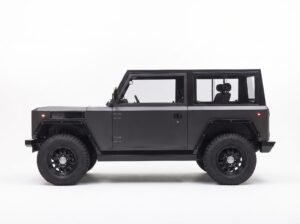
- Extremely boxy, slab-sided, utilitarian design
- Removable doors, roof panels and windows
- Pass-through cargo channel (frunk straight through to the bed)
- Stripped-back, function-first interior
- Portal axles for huge ground clearance (~15 inches)
- Hydropneumatic suspension with big wheel travel
- Built for off-road and hard work, not luxury
- Four-seat rugged cabin
Safety
- Heavy-duty body-on-frame style structure
- All-wheel-drive traction
- Off-road-focused braking and chassis
- Basic, function-first safety equipment
- No independent crash-test rating
Bollinger B1 trims and pricing
Compare available Bollinger B1 trims, their ex-showroom prices and key configuration details.
Bollinger B1 (announced)
120 kWh - ~200 mi - 614 hp - AWD off-roader
About Bollinger B1
The Bollinger B1 was, for a while, one of the most hardcore electric SUVs anyone had ever drawn up. Bollinger Motors, a small US startup, showed it off back in 2017 as an unapologetically rugged, all-electric off-roader. There were no soft edges, no styling flourishes, nothing trying to look friendly. It was basically a rolling steel box on portal axles, built for going places, not for the school run.
Under that slab-sided body the numbers were serious. The B1 used a 120 kWh battery for roughly 200 miles of range, and a dual-motor all-wheel-drive setup making 614 hp and a huge 905 Nm of torque, enough for a 4.5-second 0-60 mph and a 100 mph top speed. The off-road hardware was the real story though: portal axles for around 15 inches of ground clearance, hydropneumatic suspension, big wheel travel, and a clever pass-through that let you slide long loads straight through the cabin. The doors, roof panels and windows could even come off. Bollinger set the price at 125,000 dollars.
Here is the part that matters most. The B1 never actually made it to production. After years of delays, Bollinger announced in January 2022 that it was putting the B1 and B2 on hold indefinitely so it could focus on commercial trucks, and the consumer SUV effectively died there. The company itself has since faced serious financial trouble. So the B1 is a vehicle you cannot buy and never could, no matter how desirable the spec sheet looks. Everything below describes what it was meant to be, not a truck you can own.
Trending news for Bollinger B1
The Bollinger B1 is one of the great what-ifs of the EV world. Bollinger Motors revealed it in 2017 as a brutally boxy, hardcore electric off-road SUV, and it quickly built a cult following thanks to its slab-sided design, serious off-road hardware and big power figures - 614 hp, 905 Nm, around 200 miles of range from a 120 kWh battery, and a 125,000-dollar price.
But it never made it. After repeated delays, Bollinger announced in January 2022 that it was shelving the B1 and the B2 pickup indefinitely to focus on commercial trucks, and the company has since run into serious financial difficulties. So the B1 stands as one of the boldest electric SUV designs nobody could actually buy - a cult concept that ran out of road, and a reminder of how hard it is for EV startups to turn a striking idea into a real, sellable vehicle.
Bollinger B1 range and performance
On its announced specs, the Bollinger B1 was no slouch despite its workhorse looks. The 120 kWh battery promised around 200 miles of range, and the dual-motor all-wheel-drive system made 614 hp and a massive 905 Nm, good for a 0-60 mph time of about 4.5 seconds and a 100 mph top speed. A two-speed gearbox with low range, portal axles and long-travel suspension meant it was built to be genuinely capable off-road, not just quick in a straight line.
The catch is that none of this was ever delivered to customers. With the B1 cancelled before production, these are target figures for a vehicle that did not reach the market. So while the numbers read well, they describe an unrealised design rather than a proven, real-world machine.
Bollinger B1 safety overview
The Bollinger B1 was designed as a heavy-duty, utilitarian off-roader with a tough structure and all-wheel-drive traction, but it was a function-first vehicle with basic safety equipment rather than a feature-laden modern SUV. Crucially, because it never entered production, it has no independent crash-test rating from any recognised body. There is no real-world safety data to quote, and no manufacturer behind it to provide recalls or support. As with everything about the B1, the safety picture is that of an unrealised concept rather than a vehicle on the road.
Bollinger B1 battery and charging guide
Bollinger planned for the B1 to support fast charging alongside home charging, drawing on its large 120 kWh battery. But the charging details were never finalised in a production vehicle, because the B1 was cancelled before it reached the market. So there are no confirmed real-world charging speeds or times to rely on - the charging information is part of an announced specification for a vehicle that was never actually built and sold.
Bollinger B1 warranty details
There is no meaningful warranty to discuss for the Bollinger B1, because it never went into production and was never sold to consumers. Bollinger shelved the B1 indefinitely in 2022 and later faced serious financial difficulties, so there is no active consumer-vehicle business or warranty support behind it. For practical purposes, the B1 should be treated as an unproduced concept with no ownership or warranty framework at all.
Quick verdict: Bollinger B1
The Bollinger B1 is one of the most charismatic electric vehicles that never happened. Its uncompromising, boxy, off-road-first design and strong on-paper numbers made it a genuine cult favourite, and for a while it looked like a refreshingly tough alternative to slick, screen-heavy EVs. But after years of delays, Bollinger shelved it indefinitely in 2022 to chase commercial trucks, and the company later hit serious financial trouble, so the B1 never reached production. It is a fantastic design to admire and a cautionary tale to learn from, but it is not a vehicle you can buy. If you want a rugged electric off-roader you can actually own, look at options like the Rivian R1S or the GMC Hummer EV instead.
Bollinger B1 vs rivals: how it compares
In spirit, the Bollinger B1 was chasing the same rugged-EV territory as the Rivian R1S, the GMC Hummer EV SUV and even the boxy Mercedes EQG, and it was arguably the most extreme and utilitarian of all of them. But the comparison stops at the concept stage: those rivals are real, supported, crash-tested vehicles you can actually buy, while the B1 was cancelled before production and has no company meaningfully behind it. Against any of them, the B1 cannot compete on the basics of availability, support, safety verification or resale. Its advantage was pure design and attitude; on everything an owner actually needs, the real, on-sale alternatives win comfortably.
Bollinger B1: who should buy it (and who should not)
There is essentially nothing to buy here, so the practical advice is simple: you cannot purchase a Bollinger B1, because it never went into production. There is no new stock, effectively no used market, and no manufacturer support. If you are drawn to the B1's rugged, boxy character, channel that interest into an electric off-roader you can actually own and rely on, such as the Rivian R1S or the GMC Hummer EV. Treat the B1 purely as an inspiring design study and a piece of EV history, not as a vehicle on your shopping list.
Bollinger B1 ownership and running costs
Ownership cost is not a meaningful question for the Bollinger B1, because the vehicle was never produced or sold. There is no purchase price to pay in practice, no running costs to calculate, and no service or parts ecosystem, because the consumer SUV was cancelled and the company moved on. Any discussion of cost is purely hypothetical, based on the announced 125,000-dollar price and EV running costs that were never realised. In short, the B1 has no real-world ownership-cost story to tell.
Bollinger B1 tax benefits and incentives
EV tax incentives are irrelevant to the Bollinger B1 in any practical sense, because it was never produced or sold. Incentive schemes apply to vehicles you can actually buy from operating manufacturers, which the B1 is not. Even when it was announced, its 125,000-dollar price would have sat above many incentive caps. So there are no meaningful tax benefits to factor in - it is simply not a purchasable vehicle for which incentives could apply.
Bollinger B1 maintenance and service
Maintenance is a non-issue in the normal sense, because the Bollinger B1 was never built for customers, so there is no service network, no spare-parts supply and no maintenance schedule to follow. The handful of prototypes that exist would be effectively unsupportable as everyday vehicles. If you are interested in the B1's rugged, repair-friendly philosophy - simple, boxy, accessible mechanicals - that idea lives on better in production off-roaders you can actually service and own. As a real ownership proposition, the B1 has no maintenance story.
EV Running Cost Calculator
*Estimated figures based on entered electricity price, fuel price, mileage and average daily driving. Actual running costs can vary.
Related articles for Bollinger B1

Frequently asked questions about Bollinger B1
How much is a Bollinger B1?
Bollinger announced a starting price of 125,000 dollars for the B1. However, the price is academic: the B1 never went into production, so you cannot actually buy one at that price, or any other. It remains an announced figure for a vehicle that was never sold.
When will the Bollinger B1 be available?
It will not. Originally targeted for around 2021, the B1 was repeatedly delayed, and in January 2022 Bollinger announced it was putting the B1 (and the B2 pickup) on hold indefinitely to focus on commercial trucks. The consumer SUV was effectively cancelled and never reached buyers.
How boxy is the Bollinger B1?
About as boxy as a road vehicle gets. The B1 was deliberately designed with flat, slab-sided panels, sharp right angles and almost no curves - closer to a steel container or a military vehicle than a normal SUV. That extreme, function-first boxiness was the whole point: maximum interior space, easy repairs and a tough, utilitarian look.
What were the Bollinger B1's specs?
The B1 was set to use a 120 kWh battery for around 200 miles of range, with dual motors making 614 hp and 905 Nm, a 0-60 mph time of about 4.5 seconds and a 100 mph top speed. It had serious off-road hardware: portal axles, around 15 inches of ground clearance, hydropneumatic suspension and a two-speed gearbox.
What happened to the Bollinger B1 and Bollinger Motors?
Bollinger pivoted away from consumer vehicles. After years of delays it shelved the B1 and B2 in January 2022 to focus on commercial trucks like the B4 chassis cab, and the company has since faced significant financial difficulties. As a result, the B1 was never produced and there is no business actively supporting it as a consumer SUV.
Owner feedback for Bollinger B1
No approved owner feedback yet. Be the first to share your experience.
Available colours
The Bollinger B1 was shown in tough, utilitarian finishes that suited its no-nonsense, off-road character, including military-style Green and Grey along with White, Black and a high-visibility Yellow. As a vehicle that never reached production, colour availability never became a real-world choice - these simply reflect how the B1 was presented.