
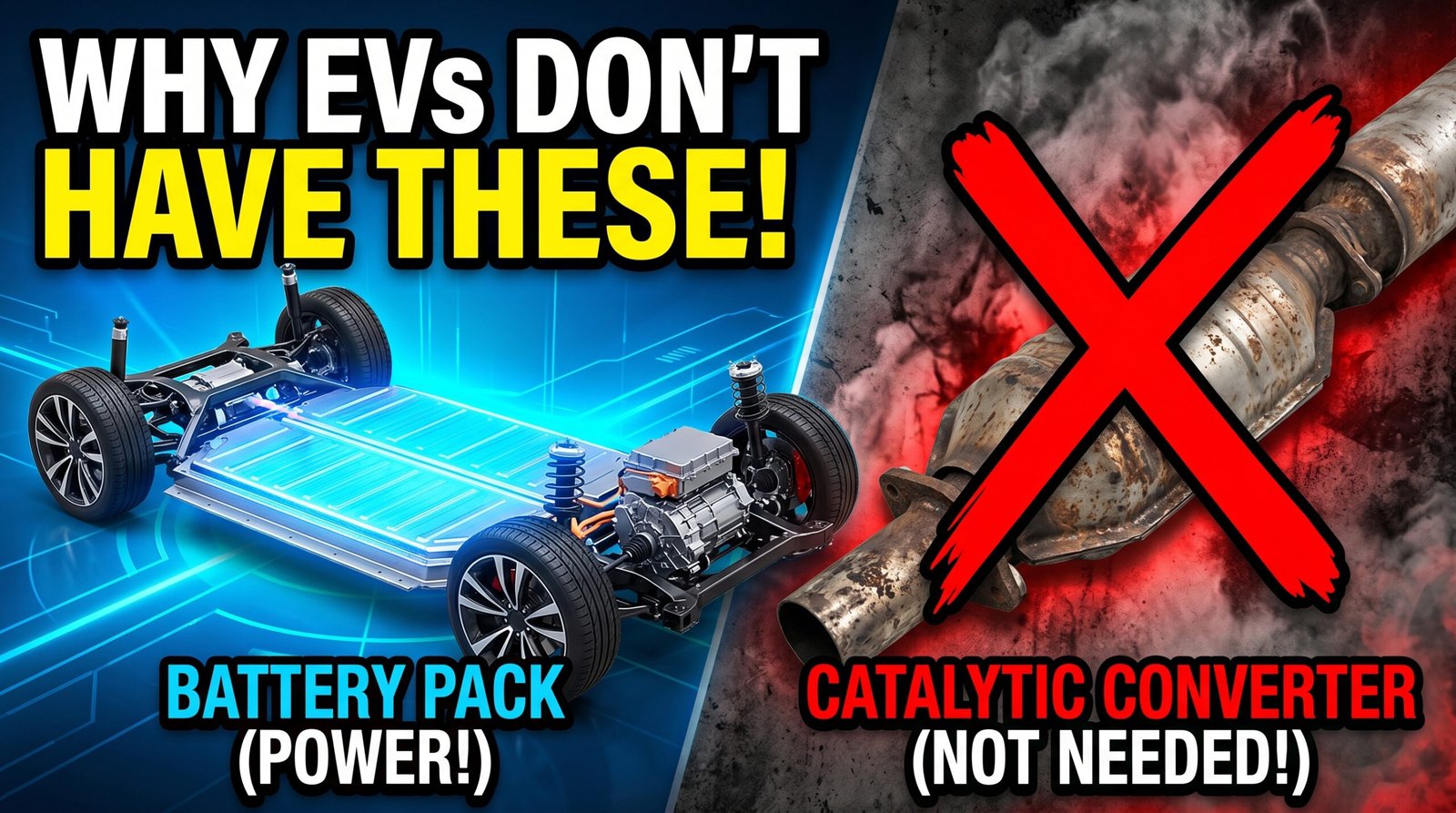
No. Neither a Tesla nor any other fully electric car has a catalytic converter, because neither has an engine or an exhaust system for one to clean. A catalytic converter exists purely to treat the toxic gases a petrol or diesel engine produces, and a battery electric vehicle like a Tesla Model 3, Tata Nexon EV or MG ZS EV produces none. The exception that catches people out is hybrids, which still carry one, and current theft data says hybrids are not even the biggest converter target anymore.
Why electric cars don’t have catalytic converters
A catalytic converter has exactly one job, and an EV never generates the thing it exists to treat.
Does a Tesla have a catalytic converter?
No. A Tesla, like every other battery electric vehicle, has no engine, no combustion, no exhaust pipe and therefore nothing for a catalytic converter to process. The part simply is not fitted on any Tesla model, because there is no exhaust system for it to sit in.
This surprises people mainly because a Tesla still looks and drives like a normal car. Pop the frunk or look underneath and the absence becomes obvious. No tailpipe, no muffler, no resonator, no oxygen sensors, and no converter. It is not that Tesla removed the part. There was never anywhere to put it.
At EVUnlock, we cross-check specifications against official manufacturer documentation before publishing.
What a catalytic converter actually does
A catalytic converter chemically converts the toxic output of burning fuel into less harmful gases. Combustion produces carbon monoxide, nitrogen oxides and unburnt hydrocarbons, and the converter uses a honeycomb structure coated in platinum, palladium and rhodium to turn those into carbon dioxide, nitrogen and water vapour before they leave the tailpipe.
It is clever chemistry, but it is also a patch on a fundamentally dirty process. The part exists only because combustion pollutes. An engine that did not pollute would never have needed one, and that is exactly the position an electric motor is in.
Why an EV has nothing for one to clean
A battery electric car sends electricity from a pack to one or more motors. There is no fuel, no combustion and no exhaust gas produced anywhere in that process, so a catalytic converter has no job to do and is not fitted.
This absence is also a large part of why EVs carry far fewer parts overall. No exhaust system means no muffler, no resonator, no oxygen sensors and no converter, an entire chain of components that a combustion car needs and an EV never had a reason to include.
Catalytic converter theft and electric cars
The part’s absence has a very practical upside, and the theft picture has shifted enough in the last year that older advice on this topic is now out of date.
Can a catalytic converter be stolen from an EV?
No, because there is nothing under the car to steal. Thieves target converters for the precious metals inside, rhodium especially, and an EV simply has none of that hardware fitted.
Rhodium is the reason this crime exists at all, and Carfax theft data tracks it closely each year. It traded above 11,000 dollars an ounce in March 2026 before easing to roughly 8,500 dollars by May, after sitting closer to 5,000 dollars through most of 2024 and 2025. A converter can be sawn off from underneath a parked car in under a minute with a battery-powered saw. For anyone parking on a street or in an open lot, driving something with nothing worth cutting off is a genuine, if rarely mentioned, ownership advantage. Rates vary by city, which the VAHAN registration data can help contextualise for India specifically.
Which vehicles actually get targeted in 2026
The old assumption that hybrids top every theft list is no longer accurate nationally, though it still holds in specific regions. Worth getting this right, because a lot of content on this topic is running on 2022 data.
| List | Most targeted vehicles | Why |
|---|---|---|
| National, 2025 data (Carfax) | Full-size trucks and SUVs, led by the Ford F-150 | Ground clearance lets a thief work without a jack |
| Western US region | Toyota Prius and other hybrids | Cooler-running converters retain more recoverable precious metal |
| Standard petrol converter, scrap value | Roughly 25 to 300 dollars | Typical platinum group metal content |
| Hybrid converter, scrap value | Up to 1,400 dollars | Higher retained metal content from cooler operation |
The mechanism behind hybrid vulnerability is worth understanding rather than just memorising. A hybrid’s petrol engine switches off frequently, so its converter spends less time at full operating temperature. Lower heat means less corrosion, and less corrosion means more of the original platinum, palladium and rhodium survives intact. A Prius converter can carry several thousand dollars of rhodium alone, which is precisely why it stays a favourite target even as trucks now lead the raw national count.
Hybrids do have catalytic converters
This is the exception that catches people out, and it is where a lot of buyers get the wrong idea. A hybrid or plug-in hybrid, such as a Toyota Prius or a Maruti Grand Vitara hybrid, still carries a petrol engine, so it still has a full exhaust system and a catalytic converter.
If someone tells you a hybrid is basically electric, this is the part of the car where that claim falls apart completely. For catalytic converter purposes, a hybrid behaves exactly like a petrol car, and on current data it is a more attractive target in some regions than a straight petrol equivalent. Anyone cross-shopping a hybrid against a pure EV should weigh this alongside our electric cars comparisons.
What EVs have instead, and where the emissions question goes
Removing the converter does not remove the emissions question. It just moves it somewhere else.
Do electric cars have any exhaust system at all?
No. There is no exhaust pipe, no muffler, no oxygen sensor and no catalytic converter on a battery electric vehicle. Without combustion there are no gases to expel, so the entire system a petrol car needs for emissions control is simply absent rather than replaced with something else.
Are EVs completely emission-free then?
At the tailpipe, yes, an EV emits nothing while driving. Its full footprint depends on how the electricity charging it was generated, so the question does not disappear; it moves upstream to the power grid.
In India, coal still supplied around 68 per cent of electricity generation as of 2026, though renewable generation grew faster than ever in 2025 and non-fossil sources already account for half of installed capacity. An EV charged from that grid today is meaningfully cleaner than a petrol car across its lifetime, largely because a large power plant burns fuel far more efficiently than a small engine ever can, a gap tracked in detail by the Ember India energy data, and it gets cleaner every year as more renewable capacity comes online, which is not something a petrol car’s exhaust system can ever do. Running costs and the fuller emissions picture are covered in our EV buying guides.
Do plug-in hybrids get any benefit here?
Only partially, and this is a genuine grey area rather than a simple no. A plug-in hybrid can cover short trips on electricity alone with zero tailpipe output for that portion of driving, but it still carries the full petrol engine, exhaust and catalytic converter for everything beyond battery range.
Treat a PHEV as a petrol car with an electric assist for this specific question, not as a part-time EV. Our upcoming EV listings flag which models are full battery electric versus plug-in hybrid, since the spec sheet does not always make it obvious. The converter is present, it ages the same way a hybrid’s does, and it remains a theft target on exactly the same basis.
Frequently asked questions
Do Teslas have catalytic converters?
No. A Tesla has no engine, no combustion and no exhaust system, so there is nowhere for a catalytic converter to sit and nothing for one to process. This applies to every Tesla model, since all of them are fully battery electric with no combustion component anywhere in the drivetrain.
Do electric cars have catalytic converters?
No. Fully electric cars produce no combustion gases, so a catalytic converter would have nothing to treat and is not fitted to any battery electric vehicle. This applies equally to a Tesla, a Tata Nexon EV, an MG ZS EV or any other pure EV regardless of brand or market.
Do hybrid cars have catalytic converters?
Yes. Hybrids and plug-in hybrids retain a petrol engine alongside the electric motor, so they keep a full exhaust system and a catalytic converter exactly like a conventional petrol car. This is the main exception to remember, since a hybrid is not electric enough to skip this part.
Can a catalytic converter be stolen from a Tesla or other EV?
No, because there is no converter fitted to steal. This makes every EV immune to a crime that remains common on petrol cars, trucks and especially hybrids. It is a genuine practical advantage for anyone who parks on the street, though it is rarely the reason people choose an EV.
Which vehicles are most targeted for catalytic converter theft in 2026?
Nationally, full-size trucks and SUVs now lead, with the Ford F-150 at the top, because their ground clearance lets a thief work without jacking the vehicle up. Hybrids like the Toyota Prius still lead specifically in the western United States, where their cooler-running converters retain more recoverable precious metal despite the shift in the national ranking.
Why don’t electric cars need catalytic converters?
Because they do not burn fuel. A catalytic converter exists solely to clean the toxic exhaust produced by combustion, and an electric motor produces no exhaust of any kind, so there is nothing for the part to treat and no reason to fit one.
Do electric cars have any exhaust system at all?
No. An EV has no exhaust pipe, muffler, oxygen sensor or catalytic converter. Without combustion, there are no gases to expel, so the entire exhaust system found on a petrol car is absent rather than replaced by an electric equivalent.
Are EVs completely emission free?
At the tailpipe, yes, an EV emits nothing while being driven. Its overall footprint depends on how the electricity used to charge it was generated, so the honest answer shifts the question to the power grid rather than eliminating it entirely.
Do plug-in hybrids have catalytic converters?
Yes. A PHEV retains its petrol engine and full exhaust system for use once electric-only range is exhausted, so it keeps a catalytic converter that ages and is targeted for theft the same way a conventional hybrid’s is. Electric-only trips produce no tailpipe emissions, but the car is not exempt overall.
Is a rhodium-free electric car cheaper to insure because of theft risk?
It can be a minor factor. Insurance pricing accounts for regional theft rates, and a vehicle type with zero catalytic converter theft exposure removes one line item insurers price for. It is rarely a deciding factor on its own, since EV insurance costs are shaped more heavily by battery and repair costs than by this specific risk.
A Tesla has no catalytic converter for the same reason any electric car does not; there is no exhaust for one to sit in. The part worth remembering is the exception: a hybrid keeps its petrol engine and everything that comes with it, catalytic converter included, and current theft data says that still makes it a target in a lot of the country. If you are weighing a hybrid against a full EV, our electric cars section covers what is currently on sale.

Gagandeep Singh
Founder, EV UnlockGagandeep Singh is an Electronics and Communication Engineering graduate from BGIET Sangrur and holds an M.Tech in eMobility from IIT Madras (CODE IITM). He is the founder of EV Unlock, an independent electric vehicle research platform. His work combines engineering knowledge, SEO strategy and electric mobility research to deliver verified EV specifications, buying guides and charging information that help buyers make confident, informed decisions.