
 1 / 2 Images
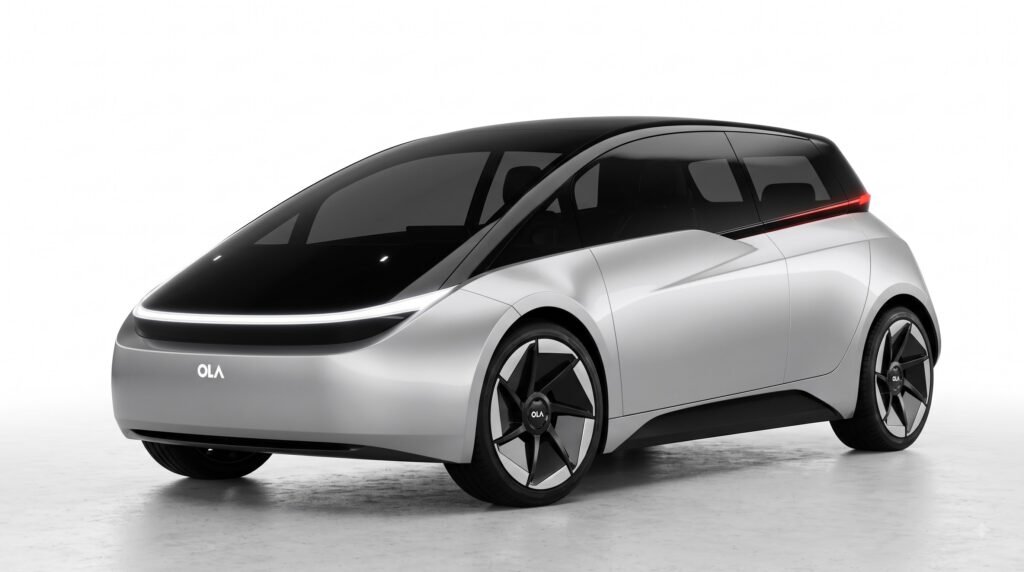
Ola Electric Car
Electric Car (project suspended)

Project shelved. Unveiled 15 August 2022 claiming 500+ km range, sub-4-second acceleration and a 0.21 Cd drag coefficient - suspended so Ola could focus on two-wheelers. No launch date exists.
*Ex-showroom Price in Bengaluru
Ola Electric Car EV essentials
Ola Electric Car pros and cons
Pros
- The 2022 claims were genuinely ambitious - 500+ km and sub-4-second acceleration
- A drag coefficient below 0.21 Cd would have been world-class if achieved
- Ola was building domestic cell manufacturing rather than importing packs
- The Hypercharger network gave it charging infrastructure most startups lack
- MoveOS gave Ola genuine in-house software capability, unusual in India
- Design was striking - all-glass roof, handleless doors, clean surfacing
- Ola indicated any future car would target mass-market affordability
Cons
- Project suspended - no launch date, timeline or specification exists
- Not a single specification was ever formally published
- No battery capacity, motor output or charging figure was disclosed
- Ola Electric's two-wheeler market share fell from about 24.8% to under 6% in a year
- The company reported a Rs 1,833 crore net loss for FY26
- ICRA downgraded Ola Electric's credit rating
- Ola has stated it continues to evaluate its liquidity position
- No crash test, warranty framework or four-wheeler service network exists
- Car listings showing it as upcoming with prices are stale data, not news
Best for
Ola Electric Car specifications
Reality Check - read this first
What Ola actually claimed (August 2022)
What Ola never disclosed
Informed estimates from the claims
Ola's supporting technology programmes
Ola Electric company position (reported)
Why the car did not happen
What you can buy today instead
Features
Battery & Performance
- IMPORTANT: the car was never built - no battery specification was ever published
- Claimed range of over 500 km on a single charge
- Claimed 0 to 100 km/h in under four seconds
- A 500 km-plus range would imply a battery in the region of 75 to 90 kWh
- Sub-four-second acceleration would require a dual-motor layout and 400 bhp-plus
- Ola was separately developing its own 4680-format lithium-ion cells in India
- Cell manufacturing was planned at Ola's Gigafactory in Tamil Nadu
- Ola planned its own Hypercharger fast-charging network to support the vehicle
- MoveOS vehicle software with over-the-air updates was promised
- Assisted driving capability was claimed, with no specification given
- Drag coefficient below 0.21 Cd claimed - genuinely low and range-beneficial
- No motor output, torque figure, battery capacity or charging speed was ever disclosed
- Note: every claim above comes from a 2022 presentation, not a specification sheet
Comfort & Interior
- All-glass panoramic roof spanning the cabin
- Coupe-like sloping roofline
- Doors with no external handles - flush and fully retractable
- Keyless entry with no physical key
- Sleek full-LED headlamps
- MoveOS software platform with over-the-air feature updates
- One of the most advanced onboard computers in a four-wheeler, per Ola's claim
- Assisted driving capability claimed
- Minimalist, screen-led cabin implied by the design language
- Five-seat layout expected
- Connected vehicle features via Ola's own software ecosystem
- Note: no interior was shown in detail at the 2022 unveiling
- Note: no equipment list was ever published
Safety
- Assisted driving capability was claimed but never specified
- No airbag count was ever disclosed
- No ADAS specification was published
- No crash test was ever conducted - the car did not reach production
- No structural or body engineering details were released
- Handleless doors raise emergency-access design questions never publicly addressed
- All-glass roof designs require specific rollover engineering, never detailed
- Ola has no crash-test record in four-wheelers of any kind
- Note: vehicles that never reach production carry no verified safety data whatsoever
Ola Electric Car trims and pricing
Compare available Ola Electric Car trims, their ex-showroom prices and key configuration details.
Ola Car Prototype (15 August 2022)
As unveiled - 500+ km claimed range, sub-4-second 0-100 km/h, 0.21 Cd, all-glass roof, handleless doors
Cancelled: Performance flagship
The 2022 concept as shown - originally targeted for 2024 production, shelved
Indefinite: Mass-market model
Ola indicated any future car would be affordable and mass-market rather than a performance flagship - no timeline exists
About Ola Electric Car
Read this before anything else: the Ola electric car has been shelved. Ola Electric suspended the project to concentrate on its two-wheeler business, and as of August 2026 there is no launch date, no production timeline and no confirmed specification. If you arrived here from a listing showing it as upcoming with an expected price, that listing is stale.
The announcement itself was memorable. On 15 August 2022, Independence Day, founder Bhavish Aggarwal unveiled a prototype electric car with claims that made headlines across India: over 500 km of range, 0 to 100 km/h in under four seconds, and a drag coefficient below 0.21 Cd, which Ola described as making it the sportiest car ever built in India. The design showed an all-glass roof, sleek LED headlamps and doors with no visible handles and no key. Inside, Ola promised one of the most advanced computers ever fitted to a four-wheeler, assisted driving capability, and its own MoveOS software receiving regular over-the-air updates. Production was targeted for 2024.
It did not happen. Reports indicate Ola Electric suspended the car programme to focus resources on two-wheelers, with the intention of eventually returning to the four-wheeler market with a mass-market, affordable model rather than the performance flagship shown in 2022.
The wider context matters, and it is not encouraging. Ola Electric’s core two-wheeler business has contracted sharply. Its electric two-wheeler market share fell from around 24.8 percent in January 2025 to under 6 percent by January 2026. The company reported a net loss of Rs 336 crore for the June 2026 quarter with sales down about 45 percent year on year, following a full-year FY26 net loss of Rs 1,833 crore. ICRA downgraded its credit rating, and the company has stated it continues to evaluate its liquidity position while pursuing additional capital.
A company under that kind of pressure in its established business is not realistically going to fund a new car programme in the near term. Treat the Ola car as a shelved ambition rather than a forthcoming product.
Trending news for Ola Electric Car
There is no news about the Ola car itself, and the reason is the story.
The project was unveiled on 15 August 2022 with a 2024 production target, and reports indicate Ola Electric subsequently suspended it to focus on two-wheelers. No prototypes have been seen testing publicly since, no specification has been published, and no launch date exists.
The relevant news is about the company. Ola Electric's core two-wheeler business has contracted severely. Its electric two-wheeler market share fell from around 24.8 percent in January 2025 to under 6 percent by January 2026. The company reported a net loss of Rs 1,833 crore for FY26, and Rs 336 crore for the June 2026 quarter with sales down roughly 45 percent year on year to Rs 455 crore. ICRA downgraded Ola Electric's credit rating, citing competition and losses. The company has stated it continues to evaluate its liquidity position while pursuing additional capital through a proposed qualified institutional placement.
That context settles the question more definitively than any product announcement could. Developing a car from scratch typically requires several thousand crore and four to five years of engineering. A company working to stabilise its established business is not in a position to fund that, and Ola has indicated that any eventual return to four-wheelers would target a mass-market affordable model rather than the performance flagship shown in 2022 - a completely different product.
Despite all of this, several Indian car websites continue to list the Ola car as an upcoming model with expected prices ranging from Rs 10 lakh to Rs 40 lakh. Those are stale database entries rather than reported news. The spread in those estimates - a four-fold range - is itself evidence that nobody has any actual information.
Ola Electric Car range and performance
Almost nothing verifiable exists here, and that absence is worth understanding rather than glossing over.
At the August 2022 unveiling, Ola claimed over 500 km of range and 0 to 100 km/h in under four seconds, along with a drag coefficient below 0.21 Cd. Those were the only performance figures given. Battery capacity, motor output, torque and top speed were never disclosed - which is unusual for a vehicle presented as reaching production within two years.
Working backwards from the claims produces some informative estimates. A 500 km-plus range in a car of this type would require a battery in the region of 75 to 90 kWh. Sub-four-second acceleration in a family-sized sedan needs roughly 400 bhp or more, which in practice means a dual-motor all-wheel-drive layout. Real-world range on such a car would realistically have landed around 380 to 420 km.
The 0.21 Cd drag coefficient claim deserves specific comment because it is the most technically interesting number Ola gave. That figure would place it among the most aerodynamic production cars in the world - the Mercedes-Benz EQS, widely regarded as a benchmark, achieves around 0.20 Cd, and very few cars go below 0.25. Achieving that requires enormous investment in aerodynamic development, active aero components and packaging discipline. It is not impossible, but for a company with no four-wheeler engineering history it was an extraordinary claim to make at a first unveiling.
There is also an internal contradiction worth flagging. A 500 km, sub-four-second, 0.21 Cd performance sedan and the mass-market affordable car Ola later described are entirely different vehicles requiring different platforms, batteries and price points. Ola never reconciled the two publicly.
None of it was ever built, tested or certified.
Ola Electric Car safety overview
The Ola car has no safety rating, no published safety specification, and no crash test data of any kind. It never reached production, and Ola never released details.
No airbag count was disclosed. No ADAS specification was given beyond a general claim of assisted driving capability. No body structure, material or crash engineering detail was published. Ola has no four-wheeler crash-test record of any kind, in India or elsewhere.
Two design elements shown in 2022 raise engineering questions that were never publicly addressed, and they are worth noting because they are genuinely difficult problems rather than trivial ones.
The handleless doors, with no external handle and no physical key, require a carefully engineered emergency access solution. If a vehicle loses power in a collision, first responders need to be able to open the doors, and cars using flush retractable handles typically fit mechanical backup releases and clearly marked emergency access points. How Ola intended to solve this was never explained.
The all-glass roof spanning the cabin similarly requires specific rollover structure engineering. Cars with large panoramic glass roofs compensate with reinforced A, B and C pillars and roof rails to maintain crush resistance. Again, no detail was given.
Neither point suggests the car would have been unsafe - both are solved problems on production vehicles worldwide. The point is that solving them requires engineering investment and validation testing that was never demonstrated publicly.
The broader lesson applies to any startup vehicle. Announced specifications tell you nothing about crash performance. Published crash ratings from Bharat NCAP or Global NCAP, on cars actually delivered to customers, are the only meaningful evidence - and every established manufacturer selling EVs in India today has them.
Ola Electric Car battery and charging guide
No charging specification was ever published for the Ola car - no charging speed, no port standard, no 10 to 80 percent time and no AC charging figure.
What Ola did have, and what made the car programme strategically coherent on paper, was supporting infrastructure. The company was building the Ola Hypercharger network, a fast-charging network intended to serve its own vehicles, and was separately developing in-house 4680-format lithium-ion cells at its Gigafactory in Tamil Nadu. Very few Indian startups have attempted cells, charging infrastructure and vehicle software simultaneously, and that vertical integration was a genuine differentiator in the original pitch.
Had the car reached production, the charging port would almost certainly have been CCS-II, which subsequently became the Indian standard. A battery in the estimated 75 to 90 kWh region would have needed high-power DC charging to be practical, and the Hypercharger network was presumably intended to supply it.
Those programmes now serve the two-wheeler business, which is where Ola's resources have been redirected.
For anyone reading this while shopping, the useful takeaway is about how to evaluate charging claims generally. A manufacturer's charging figure means little without three things: the port standard, the specific 10 to 80 percent time in minutes, and the charger power in kilowatts that the figure assumes. A claim quoted without all three is not comparable to anything. Every established EV sold in India today publishes all three, and they can be checked against owner reports - which is precisely the evidence a shelved concept can never provide.
Ola Electric Car warranty details
No warranty terms were ever announced for the Ola car, because it never reached a commercial launch where such terms would be defined.
More significantly, no four-wheeler service infrastructure was ever established. Ola Electric's service network was built for two-wheelers - scooters are serviced very differently from cars, requiring different equipment, different technician training, different parts inventory and different workshop space. Building a nationwide four-wheeler service capability from scratch is one of the largest capital commitments in launching a car, and it is frequently underestimated in startup announcements.
This matters practically. Ola Electric has itself faced widely reported service challenges in its two-wheeler business, and the company has acknowledged working on service operations. Extending into four-wheelers would have compounded that challenge substantially.
For anyone evaluating any vehicle from a new manufacturer, the questions worth asking before the specification sheet are these. How many cars has the company actually delivered to customers. Where is the nearest authorised service centre, and how far is that from home. Are battery modules and major components available as spares. What happens to warranty obligations if the company changes strategic direction or runs into financial difficulty.
Those questions are not cynical - they are what distinguishes a purchase from a bet. The Ola car illustrates the extreme case, where none of those questions could be answered because the vehicle never existed. But the same questions apply, in gentler form, to any low-volume or newly launched product.
Established manufacturers carry service networks, parts inventories and warranty obligations that outlast individual models. That is what you pay for alongside the car.
Quick verdict: Ola Electric Car
The Ola electric car was a striking announcement that never became a product, and the honest assessment has to separate the ambition from the outcome.
The ambition was real and, in places, admirable. Ola was building in-house 4680 cells at a Tamil Nadu Gigafactory, operating its own Hypercharger network, and developing MoveOS as genuine in-house vehicle software. Very few Indian companies had attempted that level of vertical integration. The car's claimed 0.21 Cd drag coefficient, if achieved, would have placed it among the most aerodynamic vehicles in the world.
The outcome is that almost nothing was substantiated. No battery capacity, motor output, torque figure, top speed, dimension or charging specification was ever published - for a vehicle presented as reaching production within two years. That gap between presentation and engineering detail was the clearest early signal of how far the project actually was from production.
And the company context has since closed the question. Ola Electric's two-wheeler market share fell from around 24.8 percent to under 6 percent between January 2025 and January 2026. FY26 brought a Rs 1,833 crore net loss. ICRA downgraded the credit rating. The company has stated it continues to evaluate its liquidity while pursuing additional capital. A car programme requires several thousand crore and four to five years - resources that are not available to a business working to stabilise its core operations.
So the Ola car is best understood as an ambition that outran both the engineering and the balance sheet.
If you arrived here because a website listed it as upcoming with an expected price: that listing is stale, and no Ola announcement supports it.
What to buy instead: any established manufacturer's EV. They share three things this car never had - cars delivered to customers, published crash ratings, and a service network that will still exist in five years.
Ola Electric Car vs rivals: how it compares
Comparing an unbuilt car against real products is only useful to show what waiting would cost you.
Against the Hyundai Creta Electric: the Creta Electric claims up to 510 km - essentially matching Ola's 500 km-plus claim - and delivers it with a published AIS 040 certification, a class-leading 39-minute 10 to 80 percent fast charge, six airbags standard, a Level 2 ADAS suite and one of India's largest service networks. It is on sale from around Rs 18.03 lakh. Every claim is verifiable.
Against the Mahindra BE 6 and XEV 9e: if performance was the appeal, these deliver it on a purpose-built born-electric platform with 5-star Bharat NCAP ratings and LFP battery packs. They are not sub-four-second cars, but they are genuinely quick, and they exist.
Against the Tata Nexon EV and Curvv EV: Tata offers the largest EV service network in India, published crash ratings and years of real-world owner data. For a first EV purchase, that combination outweighs almost any specification advantage.
Against the Pravaig Extinction MK1: the closest Indian parallel - another ambitious startup EV, revealed with bold claims, that never reached production. The difference is that Pravaig redirected its engineering into the Defy SUV and shipped a product. Ola redirected into two-wheelers under financial pressure.
Against Tesla, the comparison implied by the 2022 presentation: Tesla reached mass production before making performance claims its cars could not meet. The sequence matters. Announcing first and engineering afterwards is the pattern that produces cars like this one.
The pattern across all of these is consistent. Every gap the Ola car would have filled is served today by something you can drive, price and verify.
Ola Electric Car: who should buy it (and who should not)
You cannot buy an Ola electric car. It was never produced, no units were delivered, and there is no used market.
If you arrived here from a listing showing the Ola car as upcoming with an expected price between Rs 10 lakh and Rs 40 lakh, that listing is a stale database entry rather than reported news. The four-fold spread in those price estimates is itself evidence that nobody has real information. No Ola announcement supports any of them.
Do not wait for it. There is no launch date, no published specification, no prototype testing publicly, and Ola Electric is under significant financial pressure in its core two-wheeler business. Ola has indicated any eventual return to four-wheelers would target a mass-market affordable model, but with no timeline attached that is an aspiration rather than something to plan around.
What to buy instead depends on what attracted you. If it was range, the Hyundai Creta Electric claims up to 510 km with a verified 39-minute fast charge. If it was performance, the Mahindra BE 6 and XEV 9e deliver it on a born-electric platform with 5-star Bharat NCAP ratings. If it was value, the MG Windsor EV is India's best-selling EV. If service network reach matters most, Tata's EVs have the largest footprint in the country.
The broader lesson worth carrying into any EV purchase, and particularly any purchase from a newer brand, comes down to three checks that matter more than the specification sheet. First, have cars actually been delivered to customers in volume. Second, has an independent crash rating been published by Bharat NCAP or Global NCAP. Third, is there a service centre within reasonable distance, with parts availability and trained technicians.
A specification is a promise. Those three things are evidence. The Ola car had the first and none of the rest.
Ola Electric Car ownership and running costs
No ownership cost can be calculated for the Ola car, because no price, battery capacity or efficiency figure was ever published and no vehicle was ever delivered. What follows is a reconstruction from the claims, useful for understanding what was being promised.
If the car had arrived with a battery in the estimated 75 to 90 kWh region delivering a real-world 380 to 420 km, charging at a home tariff of around Rs 10 per unit would have cost roughly Rs 750 to Rs 900 for a full charge. Across around 400 km of real range, that works out near Rs 2.05 per kilometre - typical for a large, powerful electric car, where weight and performance both cost efficiency.
Against petrol: a comparable performance sedan returning about 15 kmpl at Rs 100 per litre costs roughly Rs 6.65 per kilometre. The Ola car would therefore have saved around Rs 4.60 per kilometre - close to Rs 69,000 a year at 15,000 km.
The cost that was never addressed is the one that mattered. A 75 to 90 kWh battery pack represents an enormous share of a vehicle's bill of materials, and building a car capable of sub-four-second acceleration with a 0.21 Cd body requires investment in aerodynamics, structure, thermal management and drivetrain that runs to several thousand crore before the first customer car is built.
That is the arithmetic behind the shelving. Ola's stated later intention - a mass-market affordable car - reflects a recognition that the original product was not economically achievable at the volumes a new entrant could realistically reach.
For anyone evaluating an EV today, the practical takeaway is simpler: run cost-per-kilometre calculations on published, certified figures from cars you can actually buy. Estimates built on unpublished specifications are not planning tools.
Ola Electric Car tax benefits and incentives
The Ola car never reached production, so no buyer ever claimed an incentive on one. This section covers the provisions that would have applied and that remain relevant to any EV purchase today.
GST on electric vehicles is charged at 5 percent, against a much higher rate plus cess on comparable petrol vehicles. On a car at the estimated price points discussed for the Ola, that difference would have been substantial in absolute terms, and it is already built into the ex-showroom price of every EV sold in India.
Road tax and registration exemptions vary substantially by state. Delhi, Maharashtra, Gujarat, Tamil Nadu, Karnataka, Telangana and several others waive or sharply reduce these charges for electric vehicles, while other states offer nothing. Ola Electric is headquartered in Bengaluru with manufacturing in Tamil Nadu - both states with meaningful EV policy support.
Under Section 80EEB of the Income Tax Act, individual buyers financing an electric vehicle can claim a deduction of up to Rs 1.5 lakh on the interest paid on the loan, subject to the loan being sanctioned within the eligible window and the buyer using the old tax regime.
Green number plates additionally exempt EVs from certain city-level restrictions and permit requirements in some regions.
One piece of historical context is relevant here. The FAME subsidy scheme in force when the Ola car was announced in 2022 was considerably more generous than what followed, and several EV incentives have since been narrowed or allowed to lapse. Product plans built partly around incentive assumptions have repeatedly been disrupted as those policies changed - a risk that applies to manufacturers and buyers alike.
Confirm current policy with your dealer and state transport department before budgeting on any incentive.
Ola Electric Car maintenance and service
No maintenance schedule exists for the Ola car, and no four-wheeler service infrastructure was ever built to support one.
An electric car of the type described would have needed no engine oil, no filters, no spark plugs, no clutch and no exhaust system, with servicing consisting largely of inspection - brake fluid, battery thermal management coolant, cabin air filter, tyre rotation, suspension checks and software and battery health checks. Regenerative braking would have extended brake life considerably. Annual costs would typically run at a third to a half of a comparable petrol car.
Two elements shown in 2022 would have carried specific maintenance implications worth noting.
The handleless doors use retractable or flush mechanisms with motors, sensors and seals. These are known to be more failure-prone than conventional handles, particularly in dusty and high-temperature conditions, and they are more expensive to repair. Owners of cars with flush handles worldwide report them as a recurring service item.
The all-glass roof spanning the cabin adds weight, increases cabin heat load in Indian summers, and depends on shade mechanisms and seals that need to keep working. Replacement glass on a bespoke panoramic roof is expensive.
The more important point concerns support rather than servicing. Ola Electric's service network was built for two-wheelers, and cars require entirely different equipment, training, parts inventory and workshop space. No four-wheeler capability was ever established.
Before buying from any newer manufacturer, establish three things: the location of the nearest authorised service centre, whether battery modules and major components are stocked as spares, and what happens to support obligations if the company changes direction. Those questions matter more than any figure on a specification sheet.
EV Running Cost Calculator
*Estimated figures based on entered electricity price, fuel price, mileage and average daily driving. Actual running costs can vary.
Related articles for Ola Electric Car

Frequently asked questions about Ola Electric Car
Has the Ola electric car launched?
No, and it is not going to in the foreseeable future. Ola Electric unveiled a prototype on 15 August 2022 with a production target of 2024, but reports indicate the company subsequently suspended the car programme to focus its resources on its two-wheeler business. There is no launch date, no production timeline and no published specification. No prototypes have been seen testing publicly since the unveiling.
Why was the Ola electric car cancelled?
Ola Electric suspended the project to concentrate on its two-wheeler business, which is where the company's revenue comes from. The wider context explains why that decision was necessary. Ola Electric's electric two-wheeler market share fell from around 24.8 percent in January 2025 to under 6 percent by January 2026. The company reported a net loss of Rs 1,833 crore for FY26 and Rs 336 crore for the June 2026 quarter with sales down roughly 45 percent, ICRA downgraded its credit rating, and Ola has stated it continues to evaluate its liquidity position while seeking additional capital. Developing a car costs several thousand crore - that is not available to a company in this position.
What were the Ola electric car specifications?
Very few were ever given, which is itself notable. At the August 2022 unveiling Ola claimed over 500 km of range, 0 to 100 km/h in under four seconds, and a drag coefficient below 0.21 Cd. It also promised one of the most advanced onboard computers in a four-wheeler, assisted driving capability, and its MoveOS software with over-the-air updates. Battery capacity, motor output, torque, top speed, dimensions, weight, seating and charging speed were never disclosed. For a vehicle presented as production-bound within two years, that absence of detail was unusual.
Will Ola build a car in the future?
Ola has indicated that when it does return to four-wheelers, it would focus on a mass-market, affordable model rather than the performance flagship shown in 2022 - which is a more realistic ambition. However, no timeline exists, and the company's current financial position makes a near-term car programme improbable. Developing a car from scratch typically requires several thousand crore and four to five years. Treat any future Ola car as an aspiration rather than a plan you can wait for.
What was the expected price of the Ola electric car?
Ola never announced one, and media estimates varied so widely they were essentially guesses - figures from Rs 10 lakh to Rs 40 lakh appeared across different Indian car websites. That spread reflects genuine uncertainty about what the car would have been. A vehicle with 500 km of range and sub-four-second acceleration would realistically have cost well above Rs 30 lakh; a mass-market model of the kind Ola later described would sit far lower. The two are entirely different products, and Ola never clarified which it was building.
Should I wait for the Ola electric car?
No. There is no launch date, no specification and no evidence of an active programme, and Ola Electric is under significant financial pressure in its core business. Several Indian car websites still list the Ola car as upcoming with expected prices attached - those are stale database entries rather than reported news, and no Ola announcement supports them. If you want an electric car in India today, established manufacturers offer verified specifications, published crash ratings, real warranties and service networks.
Was the Ola car related to Ola's scooters?
Only through shared company resources and technology ambitions, not as a derivative product. Ola Electric's business is electric two-wheelers, principally the S1 range of scooters. The car was to be a separate four-wheeler programme, though it would have drawn on Ola's planned in-house 4680 cell manufacturing at its Tamil Nadu Gigafactory, its Hypercharger fast-charging network and its MoveOS software platform. Those shared foundations were part of the strategic logic - and the deterioration of the two-wheeler business is precisely why the car programme could not continue.
What should I buy instead?
If you were drawn by the range and performance claims, established manufacturers deliver both today with verified figures. The Hyundai Creta Electric offers up to 510 km claimed range with a 39-minute fast charge. The Mahindra BE 6 and XEV 9e offer strong performance on a born-electric platform with 5-star Bharat NCAP ratings. The Tata Curvv EV and Nexon EV combine range with India's largest EV service network. All of them share three things the Ola car never had: cars delivered to customers, published crash ratings, and a service network that will still exist in five years.
Owner feedback for Ola Electric Car
No approved owner feedback yet. Be the first to share your experience.
Available colours
Ola never announced a production colour palette for its car, because the vehicle never reached a commercial launch. What is documented is the prototype shown on 15 August 2022, which appeared in a pale silver-white finish contrasted against the gloss black of its full-length glass roof and window surrounds, on dark alloy wheels. That treatment was a deliberate presentation choice - pale bodywork against a black glass roof maximises the visual impact of a panoramic roof under stage lighting, and it is the combination almost every manufacturer chooses when unveiling a car with glass as its headline feature. Ola's two-wheeler range has typically been sold in a broad, youthful palette including bright colours alongside neutrals, and a car programme aimed at younger buyers would plausibly have followed a similar approach with six to eight options. None of that was ever confirmed. Any colour palette published for this vehicle elsewhere is speculation, and since the project has been shelved, no production colour information will exist unless Ola revives the programme and announces a specification.