
 Featured EV
1 / 2 Images
Featured EV
1 / 2 Images 
Mahindra Vision.X
Compact Urban SUV (Concept)

Concept only. Previews the next-generation XUV 3XO on Mahindra's multi-energy NU_IQ platform - sub-4m urban SUV, 2,665 mm wheelbase, BE 6-style dual-screen cabin. Production expected around 2027.
*Ex-showroom Price in New Delhi
Mahindra Vision.X EV essentials
Mahindra Vision.X pros and cons
Pros
- Previews the replacement for one of India's best-selling compact SUVs
- 2,665 mm wheelbase promises more cabin space than the XUV 3XO's 2,600 mm
- BE 6-derived dual-screen cockpit is a major step up for the segment
- Genuinely striking design - X-shaped grille, full-width tail lights, flush handles
- NU_IQ platform is modular and built for global markets from the outset
- Mahindra's compact SUVs have a strong safety record - the XUV 3XO holds 5 stars
- Multi-energy platform means buyers may get a genuine choice of powertrain
- Designed jointly by Mahindra's Mumbai and UK design studios
Cons
- Concept only - no price, no launch date, no verified specification
- Production not expected before 2027, with some reports suggesting 2028
- NU_IQ is multi-energy - the production Vision.X may be petrol rather than electric
- No battery capacity, range, power or charging figures have been published
- Estimated pricing is media speculation with no Mahindra input
- Concept design elements are routinely diluted before production
- Sub-4m segment is the most competitive in India - Nexon, Venue, Sonet, Brezza, Kylaq
- Mahindra has not confirmed whether an EV version will exist at all
Best for
Mahindra Vision.X specifications
Reality Check - read this first
NU_IQ Platform (official Mahindra detail)
Positioning & Segment
Exterior Design
Interior & Technology
Expected Powertrain (unconfirmed)
Design Philosophy & Development
Safety Intent
Features
Battery & Performance
- IMPORTANT: no battery or powertrain specification has been published by Mahindra
- Built on the all-new NU_IQ modular multi-energy platform
- NU_IQ supports electric, petrol and hybrid powertrains on the same architecture
- Flat-floor design suits a floor-mounted battery pack in an electric version
- Platform supports front-wheel drive and all-wheel drive configurations
- Left and right-hand drive capability built in for global markets
- If electric, LFP chemistry is likely, matching the BE 6 and XEV 9e
- LFP offers thermal stability and long cycle life, well suited to Indian conditions
- CCS-II charging port expected, matching every current Mahindra EV
- Mahindra's current INGLO electric SUVs support 175 kW-class DC fast charging
- A Vision.X-based EV has been reported as a potential XUV400 replacement
- Production of NU_IQ vehicles begins in 2027
- Note: the production Vision.X may be petrol rather than electric - powertrain line-up unconfirmed
Comfort & Interior
- Cockpit-style cabin layout borrowed from the Mahindra BE 6
- Dual digital displays - one for instrumentation, one for infotainment
- Connected car technology suite
- Voice assistance
- Next-generation Integrated Domain Architecture for vehicle electronics
- Command seating position, per Mahindra's NU_IQ platform claims
- Super spacious cabin with class-leading boot space, per Mahindra
- 2,665 mm wheelbase - longer than the XUV 3XO's 2,600 mm
- Flush door handles for a cleaner profile and better aerodynamics
- Sleek, aerodynamically shaped outside rear-view mirrors
- Minimalist dashboard treatment expected in production
- Significant equipment upgrade expected over the outgoing XUV 3XO
Safety
- NU_IQ platform designed for lightweight construction with top-tier safety standards
- Flat-floor architecture allows a structurally rigid, battery-protecting floor
- Mahindra states it is targeting class-leading safety across the NU_IQ range
- Mahindra's BE 6 and XEV 9e both hold 5-star Bharat NCAP ratings
- The outgoing XUV 3XO holds a 5-star Bharat NCAP rating
- Level 2 ADAS is standard across Mahindra's current electric SUVs and expected here
- Silver skid plates front and rear on the concept
- Full-width LED tail lights improve rear conspicuity
- Note: the Vision.X is a concept and has never been crash-tested
- Note: no airbag count or detailed safety equipment list has been published
Mahindra Vision.X trims and pricing
Compare available Mahindra Vision.X trims, their ex-showroom prices and key configuration details.
Vision.X Concept (as shown)
Freedom_NU event, 15 August 2025 - sub-4m urban SUV concept on the NU_IQ platform, Sculptural Athleticism design theme
Expected: Petrol (production)
Reported expectation - NU_IQ supports ICE, and Mahindra markets it as the first flat-floor ICE SUV platform
Expected: Electric (production)
Reported expectation - a Vision.X-based EV could also replace the XUV400 in Mahindra's range
About Mahindra Vision.X
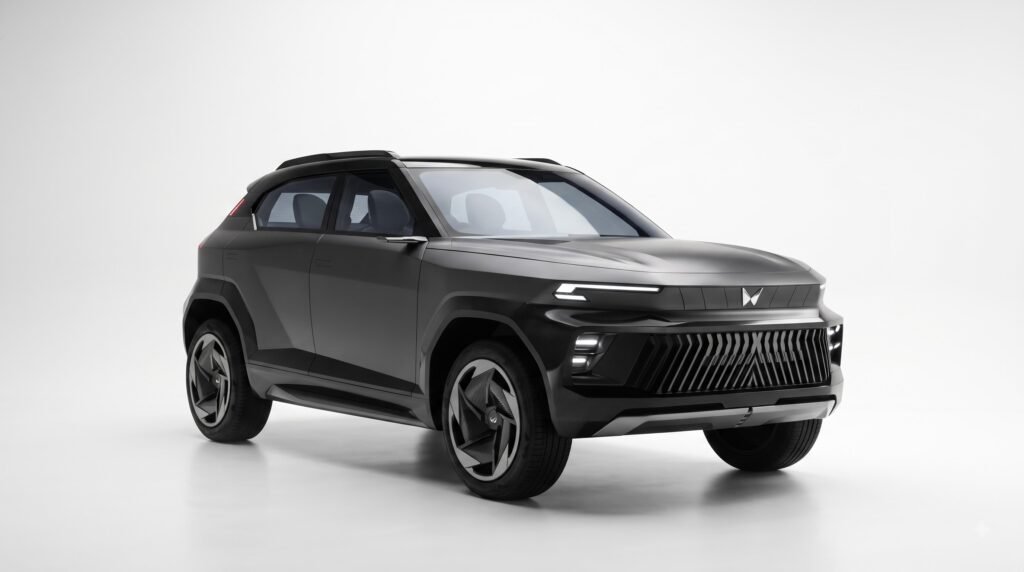
The Mahindra Vision.X is the concept that previews the next Mahindra XUV 3XO – and with it, the shape of Mahindra’s most important volume product. Revealed on 15 August 2025 at the Freedom_NU event in Mumbai as part of Mahindra’s Global Vision 2027 announcement, it sits alongside three sibling concepts – Vision.S, Vision.T and Vision.SXT – all built on the company’s new NU_IQ platform.
Where the Vision.T explores rugged off-road capability, the Vision.X pursues what Mahindra calls Sculptural Athleticism, and it represents the company’s new urban design direction. It is a sub-four-metre compact SUV, the segment that sells in the largest numbers in India, and the production version is expected to replace the XUV 3XO around 2027.
The design is a clean break from Mahindra’s current compact SUV. Up front sits an X-shaped multi-slat grille flanked by futuristic headlamps and daytime running lights, with two air intake vents and silver skid plates below. Down the side there are flush door handles, sleek mirrors and squared-off wheel arches finished in gloss black. At the rear, a raked windscreen meets a roof spoiler above full-width LED tail lights and a chunky bumper with an integrated faux diffuser.
Inside, Mahindra has borrowed the cockpit-like layout from the BE 6, with dual digital displays – one for instrumentation, one for infotainment – along with connected car technology and voice assistance. For a segment where cabins have traditionally been functional rather than impressive, that is a significant step up.
Underneath sits NU_IQ, and this is the more important story. Mahindra describes it as a modular, multi-energy monocoque platform with a flat-floor architecture, supporting multiple body styles, front and all-wheel drive, and left and right-hand drive. It carries a 2,665 mm wheelbase – considerably longer than the XUV 3XO’s 2,600 mm – which should deliver noticeably more cabin space in the same sub-four-metre footprint.
One caveat matters for anyone specifically shopping for an EV: NU_IQ explicitly supports petrol, hybrid and electric powertrains, and Mahindra markets it as delivering the first flat-floor ICE SUV. The production Vision.X may well arrive in petrol form alongside or instead of an electric version. Mahindra has announced no price, no battery specification and no confirmed launch date.
Trending news for Mahindra Vision.X
Two developments define where the Vision.X stands.
First, this was a strategy announcement rather than a single concept reveal. On 15 August 2025 Mahindra unveiled its Global Vision 2027 at the Freedom_NU event in Mumbai, presenting the new NU_IQ platform alongside four concepts - Vision.S, Vision.T, Vision.SXT and Vision.X - each assigned a distinct design character. The platform is a modular, multi-energy monocoque with a flat-floor architecture, supporting electric, petrol and hybrid powertrains, front and all-wheel drive, and both left and right-hand drive for global markets. Mahindra confirmed production on NU_IQ begins in 2027. The design work was shared between the Mahindra India Design Studio in Mumbai and Mahindra Advanced Design Europe in Banbury, UK, under the company's HEARTCORE philosophy.
Second, and more consequential for buyers, the Vision.X is widely reported to preview the next-generation XUV 3XO. That matters because the XUV 3XO is one of Mahindra's highest-volume products in India's most competitive segment. Moving it to NU_IQ would bring a longer 2,665 mm wheelbase, a BE 6-derived dual-screen cabin and a platform engineered for global markets. Reports also suggest a Vision.X-based electric variant could replace the XUV400, which would consolidate Mahindra's compact SUV range onto one modern architecture.
The caveat for EV-focused readers: Mahindra has confirmed no powertrain for the production Vision.X. NU_IQ is explicitly multi-energy, and Mahindra promotes it as delivering the first flat-floor ICE SUV - so a petrol version is at least as likely as an electric one.
Mahindra Vision.X range and performance
No range, power or performance figures have been published for the Vision.X, and no powertrain has been confirmed. This section covers what the platform enables and what the segment norms suggest.
The NU_IQ platform supports electric, petrol and hybrid powertrains, with front-wheel drive or all-wheel drive. That flexibility is the whole point of the architecture, and it means Mahindra can decide the production line-up based on market conditions closer to 2027 rather than committing now.
If an electric version arrives, some reasonable inference is possible. Mahindra's current electric SUVs use LFP battery packs, and a sub-four-metre compact SUV would typically carry something in the 35 to 45 kWh region - large enough for meaningful range without adding the weight and cost that would push the car out of its segment. Class norms for that battery size suggest a claimed range somewhere around 350 to 450 km, with real-world figures landing perhaps 25 to 30 percent below that. For comparison, Mahindra's larger BE 6 uses 59 kWh and 79 kWh packs, which would be excessive for a sub-four-metre car.
An electric version would bring the usual urban advantages: instant torque from a standstill making it feel quicker in traffic than its figures suggest, near-silent running, and single-speed operation with no gearshifts.
If a petrol version arrives, Mahindra's existing turbocharged petrol engines in the XUV 3XO would be the obvious starting point, and the flat-floor NU_IQ architecture is specifically engineered to accommodate an internal combustion powertrain without the packaging compromises that usually follow when an EV platform is adapted.
On dimensions, the 2,665 mm wheelbase is the number that matters most practically. Against the current XUV 3XO's 2,600 mm, that should translate into noticeably better rear legroom within the same sub-four-metre length - a meaningful gain in a segment where rear space is the most common complaint.
Mahindra Vision.X safety overview
The Vision.X is a concept and has never been crash-tested. There is no rating from Bharat NCAP or any other programme, and Mahindra has published no airbag count or detailed safety equipment list for it.
What can be assessed is the platform intent and Mahindra's track record, and both point in a reassuring direction.
On the platform, Mahindra describes NU_IQ as combining lightweight construction with top-tier safety standards. The flat-floor architecture has a structural benefit regardless of powertrain: a rigid floor structure contributes to torsional stiffness, and in an electric version it also forms a protective enclosure around the battery pack.
On track record, Mahindra has made crash performance central to its brand positioning in India, and the results back it. The current XUV 3XO - the car the Vision.X is expected to replace - holds a 5-star Bharat NCAP rating. So do the BE 6 and XEV 9e electric SUVs. A next-generation model on a newer platform arriving with anything less would be commercially very difficult for Mahindra, and would undercut a positioning the company has spent years building.
Level 2 ADAS is now standard across Mahindra's current electric SUVs and increasingly common in the sub-four-metre segment, so its inclusion on a 2027 product would be expected rather than remarkable.
One detail visible on the concept is the full-width LED tail light bar, which improves rear conspicuity - a small but genuine safety benefit in Indian traffic conditions.
All of this is intent and inference, not specification. Nothing has been confirmed for a production vehicle that does not yet exist.
Mahindra Vision.X battery and charging guide
Mahindra has published no charging specification for the Vision.X, and has not confirmed that a production version will be electric at all. This section covers what would apply if an electric variant arrives.
The charging port would almost certainly be CCS-II, the Indian standard used by every current Mahindra electric vehicle and compatible with essentially all public charging networks in the country.
Mahindra's born-electric SUVs on the INGLO platform - the BE 6 and XEV 9e - support DC fast charging in the 175 kW class, among the fastest available in India. A sub-four-metre compact SUV with a smaller battery would not need that much and would likely be specified lower, since charging speed is limited by what a smaller pack can safely accept. For a battery in the 35 to 45 kWh region, a 10 to 80 percent DC charge in the region of 35 to 50 minutes would be a realistic expectation based on current segment norms.
Home AC charging with an overnight full charge would be the daily pattern for most owners, as with any compact EV. A 7.4 kW wallbox would typically fill a battery of this size in five to seven hours.
If LFP chemistry is used, as on Mahindra's current EVs, one practical advantage follows: LFP tolerates being charged to 100 percent regularly without the accelerated ageing that affects nickel-based chemistries, so the usual advice to cap daily charging at 80 percent does not apply as strictly.
Vehicle-to-Load capability is offered on Mahindra's current electric SUVs and would be a reasonable expectation here, though it has not been confirmed.
All of the above is inference from Mahindra's existing products and segment norms. No figure on this page comes from a Mahindra announcement about the Vision.X.
Mahindra Vision.X warranty details
No warranty terms have been announced for the Vision.X, since it is a concept rather than a product, and the powertrain has not been confirmed.
What can be stated is Mahindra's current position. The company's born-electric SUVs on the INGLO platform launched with battery warranty terms designed around long-term ownership confidence, including lifetime battery warranty provisions for first owners on certain variants. Lifetime warranty terms always carry conditions on mileage, transferability and servicing, so the exact wording matters far more than the headline and should be read in full.
On the internal combustion side, Mahindra's standard vehicle warranty applies across its petrol and diesel range, with extended warranty packages available at purchase.
Because the Vision.X sits on a multi-energy platform, the warranty structure a buyer eventually gets will depend on which powertrain they choose - and those structures differ substantially. An electric variant would carry separate battery and motor coverage on top of the vehicle warranty; a petrol variant would not.
When the production car is announced, the questions worth asking are the standard ones and they matter regardless of powertrain. For an electric version: what is the battery capacity degradation threshold below which a replacement is covered, does coverage transfer to a second owner, and what servicing schedule keeps it valid. For any version: what the standard term is, what extended options cost, and what roadside assistance actually includes.
One genuine advantage that will apply whichever powertrain arrives: Mahindra operates a large service network across India extending well into smaller towns, which matters more in practice than any figure on a specification sheet.
Quick verdict: Mahindra Vision.X
The Vision.X matters more than its concept-car status suggests, because of what it previews: the next generation of one of Mahindra's highest-volume products, in India's most competitive segment.
The substance is in the platform. NU_IQ is a genuinely new, in-house modular architecture engineered from the outset for multiple powertrains, both drive layouts and both steering positions - which signals global ambition rather than a domestic-only product. Its 2,665 mm wheelbase against the current XUV 3XO's 2,600 mm should fix the sub-four-metre segment's most persistent weakness, which is rear cabin space. And borrowing the BE 6's dual-screen cockpit would lift the interior well above what this class has traditionally offered.
The design deserves credit too. The X-shaped multi-slat grille, full-width LED tail lights, flush door handles and squared-off arches with gloss black accents give the Vision.X a genuinely distinctive presence - and Mahindra's decision to give it an urban character, distinct from the rugged Vision.T, shows a coherent strategy rather than four variations on one theme.
The reservations are real. This is a concept with no price, no specification and no confirmed launch date, and production is not expected before 2027 with some reports pointing to 2028. Concept features routinely disappear before production. And for anyone specifically shopping for an EV, the most important caveat is that NU_IQ is a multi-energy platform - Mahindra markets it as delivering the first flat-floor ICE SUV, and the production Vision.X may well be petrol.
Who should follow it: XUV 3XO and XUV400 owners, and anyone tracking where India's sub-four-metre SUV segment goes next.
Who should buy now: everyone who needs a car before 2027. The XUV 3XO is on sale with a 5-star Bharat NCAP rating, and the XUV400 is Mahindra's electric compact SUV available today.
Mahindra Vision.X vs rivals: how it compares
The Vision.X cannot be bought, so the useful comparisons are against what exists and against its own siblings.
Against the Mahindra XUV 3XO: the 3XO is the car the Vision.X is expected to replace, and it is on sale now with petrol and diesel options, a 5-star Bharat NCAP rating and established pricing. What the Vision.X would add is a longer 2,665 mm wheelbase for more cabin space, a modern flat-floor platform, a BE 6-derived dual-screen cabin and a far more distinctive design. What the 3XO offers is availability, and for anyone buying in the next two years that settles it.
Against the Mahindra XUV400: the XUV400 is Mahindra's current electric compact SUV. Reports suggest a Vision.X-based EV could replace it, consolidating Mahindra's compact SUV range onto NU_IQ. If you want an electric Mahindra in this size today, the XUV400 is the only answer.
Against the Vision.T: the two concepts show how differently one platform can be dressed. Vision.T is rugged-adventure - boxy, all-terrain tyres, tailgate spare wheel, serious off-road angles. Vision.X is urban - sculpted surfaces, flush handles, a roof spoiler and a faux diffuser. Same architecture, opposite characters.
Against the segment it will enter: the Tata Nexon, Hyundai Venue, Kia Sonet, Maruti Brezza and Skoda Kylaq all compete in sub-four-metre India, and several offer strong safety ratings and long equipment lists. The Vision.X's advantages on paper are wheelbase and cabin technology; its challenge is that by 2027 every rival will have moved on too.
Against the Mahindra BE 6: the BE 6 is larger, born-electric and considerably more expensive from around Rs 18.90 lakh. It is the source of the Vision.X's cockpit design, but it plays in a different price bracket.
Mahindra Vision.X: who should buy it (and who should not)
You cannot buy a Vision.X, so this covers whether to wait and what to watch.
The direct advice: if you need a car within the next two years, buy something available. Production on the NU_IQ platform is not expected to begin before 2027, and some reports place the Vision.X-based model in 2028. Mahindra has announced no price, no specification and no firm date for this vehicle specifically.
What to buy instead depends on your requirement. If you want a Mahindra compact SUV now, the XUV 3XO is on sale with petrol and diesel options and a 5-star Bharat NCAP rating. If you specifically want an electric Mahindra in this size, the XUV400 is the current answer. If your budget stretches and you want Mahindra's modern electric engineering, the BE 6 sits above both.
If you do want to track the Vision.X, four signals matter more than media launch estimates. First, Mahindra confirming the production powertrain line-up - this is the single most important unknown, and it determines whether this is an EV at all. Second, official specifications being published: dimensions, battery capacity or engine details, and certified range or fuel economy. Third, bookings opening. Fourth, homologation or certification records appearing in public filings.
One question worth asking specifically when the production car is announced: how much of the concept's cabin survived. Dual digital displays borrowed from the BE 6 would be a genuine segment upgrade, but screens are among the first things cost-engineered out of a high-volume compact SUV. Whether Mahindra keeps them will tell you a lot about how the production car is positioned.
When it launches, apply standard due diligence: verify the crash rating rather than assuming it inherits the XUV 3XO's, check rear seat space in person against the wheelbase claim, and if it is electric, confirm the real-world range against owner reports rather than the certified figure.
Mahindra Vision.X ownership and running costs
No ownership cost can be calculated for the Vision.X, because Mahindra has confirmed neither a price nor a powertrain. What follows is the shape of the answer under each scenario.
If an electric version arrives with a battery in the 35 to 45 kWh region and a real-world range of around 280 to 340 km, charging at a home tariff of around Rs 10 per unit would cost roughly Rs 350 to Rs 450 for a full charge. That works out to approximately Rs 1.30 per kilometre - the typical figure for a compact electric SUV, and low because a small, light vehicle is efficient by nature.
Against petrol: a comparable sub-four-metre petrol SUV returning about 18 kmpl at Rs 100 per litre costs roughly Rs 5.55 per kilometre. An electric version would therefore save around Rs 4.25 per kilometre - close to Rs 51,000 a year at 12,000 km, or Rs 85,000 at 20,000 km.
Break-even depends on the price gap between the petrol and electric variants, which is unknown. In the current market, electric compact SUVs typically carry a premium of Rs 5 to Rs 8 lakh over petrol equivalents, which at Rs 4.25 saved per kilometre implies recovery somewhere between 1,20,000 and 1,90,000 km. That favours high-mileage drivers and makes the case weaker for someone covering 10,000 km a year.
If a petrol version arrives, running costs would follow segment norms with no charging infrastructure needed and no range planning required.
Servicing on an electric version would run at roughly a third to a half of a petrol equivalent - no engine oil, filters, spark plugs, clutch or exhaust - with regenerative braking extending brake life considerably.
The factor that cannot be estimated is depreciation on a first-generation product on a brand-new platform, which historically carries more uncertainty than a proven model.
Mahindra Vision.X tax benefits and incentives
The tax treatment of a production Vision.X depends entirely on which powertrain it arrives with, and that has not been confirmed. This distinction matters more here than on most listings, because NU_IQ supports electric, petrol and hybrid.
If an electric version is offered, it would qualify for India's standard EV provisions. GST on electric vehicles is charged at 5 percent, against a much higher rate plus cess on comparable petrol SUVs, and that difference is built into the ex-showroom price. Road tax and registration exemptions vary substantially by state - Delhi, Maharashtra, Gujarat, Tamil Nadu, Karnataka, Telangana and others waive or sharply reduce them for electric vehicles, while some states offer nothing. Under Section 80EEB, individual buyers financing an electric vehicle can claim a deduction of up to Rs 1.5 lakh on loan interest, subject to the loan being sanctioned within the eligible window and the buyer using the old tax regime. Green number plates additionally exempt EVs from certain city-level restrictions in some regions.
If a petrol version is offered, none of the above applies. However, the Vision.X's expected sub-four-metre length carries its own significant tax benefit in India: vehicles under four metres with smaller engines attract a lower GST rate than larger SUVs. This is precisely why the sub-four-metre segment exists in the form it does, and why almost every manufacturer engineers to that length limit. A sub-four-metre petrol Vision.X would therefore still be more favourably taxed than a larger petrol SUV.
Businesses should note the more favourable depreciation treatment available on electric vehicles specifically.
All of these policies are revised periodically, and several EV incentives have been narrowed in recent years. Any benefit factored into a decision to wait until 2027 or 2028 may not exist by then.
Mahindra Vision.X maintenance and service
No service schedule exists for the Vision.X, and the maintenance profile depends on which powertrain the production car receives. Both scenarios are worth understanding.
If electric: there would be no engine oil, no oil or combustion air filter, no spark plugs, no timing belt, no clutch and no exhaust system. Servicing would be largely inspection - brake fluid, battery thermal management coolant, cabin air filter, tyre rotation, suspension checks and battery and software health checks. Across Mahindra's current EV range that means longer intervals and annual costs at roughly a third to a half of a petrol equivalent. Regenerative braking extends brake pad and disc life considerably, with the standard caveat that lightly used rear brakes benefit from inspection and cleaning at each service to prevent rust or seizing.
If petrol: conventional servicing applies - oil changes, filters, spark plugs and the usual wear items - at segment-normal cost and intervals.
One consideration applies regardless of powertrain, and it is specific to a new platform. The Vision.X would be among the first vehicles on NU_IQ, and first-generation products on new architectures historically see more teething issues than established models. Early adopters should expect a higher likelihood of software updates and minor recalls in the first year or two, and should factor in that parts and diagnostic familiarity at service centres take time to mature. This is not a reason to avoid the car, but it is a reason to keep the warranty documentation carefully and to use authorised service centres during the warranty period.
Tyres would be the ordinary consumable, with an electric version wearing them somewhat faster due to added battery weight.
Mahindra's service network reach across India, including smaller towns, remains one of the strongest practical arguments for the brand whichever powertrain arrives.
EV Running Cost Calculator
*Estimated figures based on entered electricity price, fuel price, mileage and average daily driving. Actual running costs can vary.
Related articles for Mahindra Vision.X

Frequently asked questions about Mahindra Vision.X
Is the Mahindra Vision.X on sale?
No. The Vision.X is a concept vehicle, revealed on 15 August 2025 at Mahindra's Freedom_NU event in Mumbai as part of the company's Global Vision 2027 announcement. It is not on sale, bookings have not opened, and Mahindra has announced no price, powertrain specification or confirmed launch date. Production of vehicles on the underlying NU_IQ platform is planned to begin in 2027, with some reports suggesting the Vision.X-based model may arrive in 2028.
Is the Mahindra Vision.X an electric vehicle?
This needs a careful answer. The Vision.X sits on Mahindra's NU_IQ platform, which the company explicitly describes as a multi-energy architecture supporting electric, petrol and hybrid powertrains - and Mahindra markets it as delivering the first flat-floor ICE SUV. So the production Vision.X may arrive as a petrol model, an electric model, a hybrid, or several of these. Reports suggest a Vision.X-based electric version could replace the XUV400 in Mahindra's range, but nothing has been confirmed. Do not assume the production car will be electric until Mahindra announces the powertrain line-up.
Will the Vision.X replace the Mahindra XUV 3XO?
Yes, that is the widely reported plan. The production version of the Vision.X concept is expected to become the next-generation XUV 3XO, moving the model from its current platform to the new in-house NU_IQ architecture. The XUV 3XO is one of Mahindra's highest-volume products, so this is a commercially significant transition. Reports also suggest a Vision.X-based electric variant could take over from the XUV400, consolidating Mahindra's compact SUV offerings onto a single modern platform.
What is the Mahindra NU_IQ platform?
NU_IQ is Mahindra's all-new modular, multi-energy monocoque platform, announced at the Freedom_NU event in August 2025 as the foundation of the company's Global Vision 2027. It uses a flat-floor architecture and supports multiple body styles, electric, petrol and hybrid powertrains, front and all-wheel drive, and left and right-hand drive configurations. Mahindra highlights lightweight construction with top-tier safety standards, a next-generation Integrated Domain Architecture for vehicle electronics, command seating and class-leading boot space. The platform carries a 2,665 mm wheelbase and production begins in 2027.
How big will the Mahindra Vision.X be?
The Vision.X is expected to be a sub-four-metre compact SUV, keeping it within the length limit that attracts favourable tax treatment in India and placing it directly against the Tata Nexon, Hyundai Venue, Kia Sonet, Maruti Brezza and Skoda Kylaq. The NU_IQ platform carries a 2,665 mm wheelbase, which is meaningfully longer than the current XUV 3XO's 2,600 mm - so despite the same overall footprint, cabin space should improve noticeably. Mahindra also claims class-leading boot space for the platform.
What will the Mahindra Vision.X look like inside?
The concept showed a cockpit-style cabin layout borrowed from the Mahindra BE 6, with dual digital displays - one serving as the instrument cluster and the other as the infotainment screen - along with connected car technology and voice assistance. Reports suggest the production car will adopt a minimalist dashboard design retaining the dual-screen setup. For the sub-four-metre segment, where cabins have traditionally prioritised function over presentation, this would be a substantial upgrade over the outgoing XUV 3XO.
What is Sculptural Athleticism?
It is the design theme Mahindra assigned to the Vision.X within its four-concept lineup. Each concept was given a distinct character: Vision.S expresses Sporty Solidity, Vision.T and Vision.SXT reflect a Born Iconic spirit, and Vision.X showcases Sculptural Athleticism - the company's new urban design direction, as opposed to the rugged-adventure language of the Vision.T. All four sit under Mahindra's broader HEARTCORE design philosophy, developed around a theme of contrasting elements, and were created jointly by the Mahindra India Design Studio in Mumbai and Mahindra Advanced Design Europe in Banbury, UK.
What will the Mahindra Vision.X cost?
Mahindra has announced nothing. For context, the current XUV 3XO that it is expected to replace starts in the region of Rs 8 lakh and runs to around Rs 16 lakh ex-showroom depending on variant and powertrain, and a next-generation model on a newer platform would typically be positioned at or above that. An electric version would sit considerably higher, since Mahindra's BE 6 starts around Rs 18.90 lakh. Any specific figure quoted elsewhere is media estimation rather than manufacturer guidance.
Should I wait for the Vision.X or buy an XUV 3XO now?
If you need a vehicle within the next two years, buy the XUV 3XO. It is on sale, priced, available in petrol and diesel, and carries a 5-star Bharat NCAP rating. The Vision.X is a concept with no confirmed launch date, price or specification, and production is not expected before 2027 with some reports pointing to 2028. Concepts also lose distinctive features on the way to production. If you want an electric Mahindra compact SUV today, the XUV400 is available, and the BE 6 sits above it.
Owner feedback for Mahindra Vision.X
No approved owner feedback yet. Be the first to share your experience.
Available colours
Mahindra has not announced a production colour palette for the Vision.X, because it remains a concept. What is documented is the show car's finish: a metallic body colour offset by gloss black squared-off wheel arch cladding and silver skid plates front and rear - a contrast treatment that emphasises the sculpted surfacing Mahindra describes as Sculptural Athleticism. Concept vehicles are almost always finished in bespoke paint developed specifically for auto show lighting and rarely reach production unchanged, so treat this as indicative of the design intent rather than a future option. For a realistic sense of what a production palette would look like, the current Mahindra XUV 3XO offers the best guide: it is sold in a range of around six to eight shades including a white, a silver, a grey, a black, a red and at least one distinctive signature colour, with dual-tone contrast roof options on higher variants. Mahindra's electric models additionally carry at least one shade specific to the electric range. A production Vision.X would plausibly follow a similar structure, and the gloss black arch cladding shown on the concept is the kind of detail that typically survives to production because it is inexpensive and visually effective. The confirmed palette will be added here once Mahindra announces production specification.