
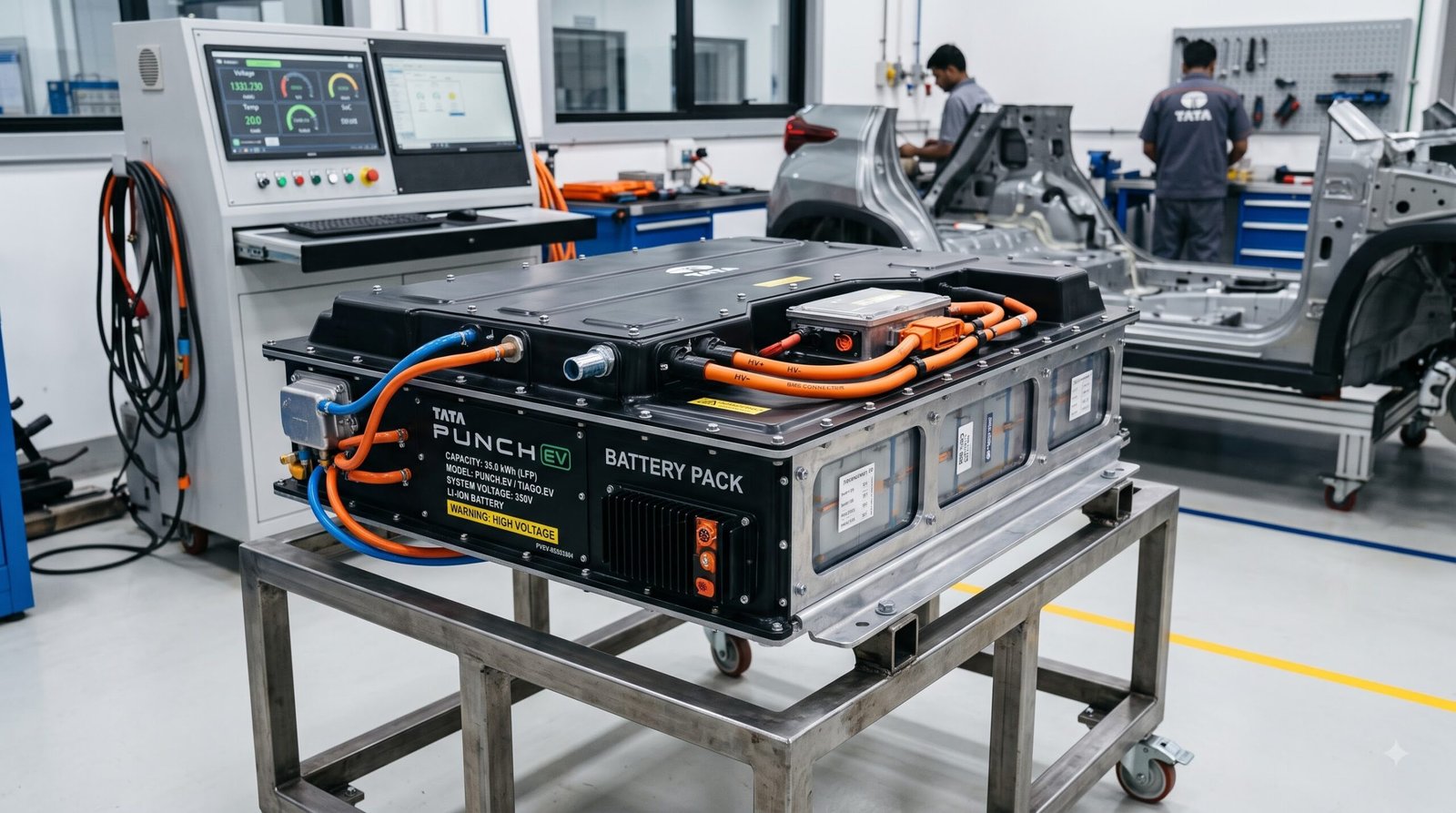
Lifetime, meaning fifteen years with unlimited kilometres, on the 40 kWh Punch EV for the first private owner. The 30 kWh version gets 8 years or 1,60,000 km instead. Two conditions decide whether you actually keep the lifetime cover, and one of them wipes it out completely if a second owner misses a single step. Here is the full Tata Punch EV battery warranty position for 2026.
Tata Punch EV battery warranty period
Tata splits the Punch EV into two warranty zones, and since the 2026 facelift the two battery packs no longer get the same treatment either.
What is the battery warranty on the Tata Punch EV?
The 40 kWh Punch EV carries a Lifetime HV Battery Warranty with unlimited kilometres for the first private owner. Tata defines lifetime as fifteen years from the date of first registration at the RTO, following the Motor Vehicles Act, 1988.
The 30 kWh Punch EV is not on Tata’s lifetime warranty list. It runs on the older structure of 8 years or 1,60,000 km, whichever comes first.
That gap between variants is new, and it is the single most important thing a Punch EV buyer needs to know in 2026. Tata’s own warranty page lists Punch.ev 40 alongside Sierra.ev, Harrier.ev, Curvv.ev, Nexon.ev 45 and Tiago.ev 24. The 30 kWh Punch does not appear.
At EVUnlock, we cross-check specifications against official manufacturer documentation before publishing.
Base model vs top model: which Punch EV gets lifetime warranty
Battery pack size decides it, not the variant trim name. Any Punch EV with the 40 kWh pack gets lifetime cover. Any Punch EV with the 30 kWh pack gets 8 years or 1,60,000 km.
The Punch EV range runs from Rs 9.69 lakh for the Smart 30 kWh to Rs 12.59 lakh at the top, across Smart, Adventure and Empowered trims. The 40 kWh pack claims 468 km on the ARAI MIDC cycle, per Tata’s official Punch EV page. Expect meaningfully less in real driving, since certified range figures come from a lab cycle rather than a highway. The 30 kWh delivers roughly 270 km certified.
So the buyer choosing the entry variant to save money is also choosing the shorter warranty. On a car this size that trade is worth thinking about properly, because the price gap between packs buys you range, faster charging and the warranty upgrade in one go. Full variant details sit on our Tata Punch EV specifications page.
Tata Punch EV motor and vehicle warranty
The rest of the car runs on 3 years or 1,25,000 km, whichever comes first. That covers suspension, electricals, air conditioning, interior trim and body panels.
The drive motor sits with the high voltage system rather than the general vehicle warranty on Tata’s EVs, which is why people searching for Punch EV motor warranty separately usually find conflicting answers. Confirm the exact motor term in your own warranty booklet, because Tata’s public warranty page details the HV battery specifically and leaves the motor to the owner’s manual.
This split is where most service centre arguments start. Year four, the cabin blower fails, and the owner arrives quoting a lifetime warranty. It does not apply. Only the high voltage battery gets that.
| Cover | Punch EV 40 kWh | Punch EV 30 kWh |
|---|---|---|
| HV battery, first private owner | Lifetime (15 years), unlimited km | 8 years / 1,60,000 km |
| HV battery, second owner onwards | 8 years / 1,60,000 km | 8 years / 1,60,000 km |
| Non private registration | 8 years / 1,60,000 km | 8 years / 1,60,000 km |
| Vehicle warranty | 3 years / 1,25,000 km | 3 years / 1,25,000 km |
| SoH claim threshold | Below 70 percent | Below 70 percent |
Lifetime battery warranty terms and conditions
Two words in Tata’s policy do all the work, and neither means what a casual reader assumes. Lifetime is a defined period. Unlimited has conditions attached.
What lifetime and unlimited actually mean
Lifetime means fifteen years from first registration, not the working life of the car and not your lifetime. Register a Punch EV 40 today and cover ends around 2041.
Unlimited kilometres rests on an assumption of fair personal usage. Tata’s wording excludes extraordinary use or usage outside what would reasonably be expected for a vehicle not used for commercial or trade purposes. In plain terms, a family car doing 20,000 km a year is fine. A car running airport transfers on a private registration is the situation that clause exists for.
I have some sympathy for Tata here, because an unlimited kilometre promise without a fair use clause would be unworkable. But it does mean unlimited is not a number, it is a judgement, and judgement calls get made by the party writing the cheque.
Who qualifies for the lifetime warranty
The lifetime cover applies to registrations in the name of private individuals, and to company perk car scheme registrations for an employee, including later transfer of that same car to that same employee.
It does not apply to vehicles used for display, demonstration, test drives, courtesy purposes, commercial operations, fleet management or taxi services. It also excludes private registrations held by a company, corporate body, firm or trust where the vehicle is used for commercial or trade purposes. In all of those cases the Punch EV 40 falls back to 8 years or 1,60,000 km.
Anyone buying a demo car at a discount should read that list twice. The saving on a demonstrator can be several tens of thousands of rupees. The warranty difference between lifetime and eight years is worth considerably more than that.
The second owner rule that cancels lifetime cover
Every second or subsequent owner must inform Tata Passenger Electric Mobility Limited of the ownership transfer. Without that notification, the lifetime HV battery warranty does not apply to them at all.
Even with correct notification, a second owner does not inherit lifetime cover. They get 8 years or 1,60,000 km, counted from the original first registration date rather than from the resale date. A four year old Punch EV 40 therefore carries four years of battery cover for its next owner, not fifteen.
This is the detail I would most want a used EV buyer to know, and it is the one almost nobody explains. Miss the notification and you are not stepping down from lifetime to eight years. You are stepping down to nothing on the battery. Verify the registration and transfer record on the VAHAN portal and get the TPEM notification done in writing before money changes hands.
The 70 percent State of Health threshold
A battery claim stands when State of Health falls below 70 percent of nominal energy during the warranty period. Tata publishes this figure, which is more transparency than most manufacturers offer.
If the pack does drop below that line, Tata repairs or replaces it, at its own discretion, and restores capacity either to the steady state SoH the pack held before the work or to 80 percent SoH, whichever is higher.
Worth understanding what that means in practice. Gradual capacity loss is expected behaviour for lithium cells and does not trigger anything. Your Punch EV showing eight percent less range in year four has no claim, because that is the chemistry doing exactly what it should. The warranty is protection against a pack failing early, not a guarantee that it stays new.
What the Punch EV battery warranty does not cover
Warranty covers things breaking. It does not cover things getting old, and most rejected EV battery claims in India come down to owners not knowing the difference.
Why individual cells matter more than the pack
The most common high voltage complaint from Indian EV owners is not a dead battery. It is one or two weak cells inside an otherwise healthy pack, showing up as a sudden state of charge drop or the car entering limp mode at low charge.
The mechanism is worth knowing before you buy. When cells sit in parallel banks, the battery management system reads the bank rather than each cell. A cell with slightly lower internal resistance takes a disproportionate share of current on every charge and discharge, ages faster than its neighbours, and can fail years before the pack should. Large prismatic cells carry enough capacity to be wired in series only, which lets the BMS watch each one and balance it. That is a structural advantage of the prismatic LFP packs Tata now uses, and it is a large part of why newer Tata packs behave better than the older cylindrical cell designs that generated most of India’s cell failure complaints.
It also explains why a single failed cell does not get swapped out. Drop a fresh low resistance cell into a bank of aged ones and current rushes through the new cell while the old ones idle. Tata replaces the module instead. Our guide to EV battery warranty rules in India covers how other manufacturers handle the same problem.
What voids your Punch EV battery warranty
A few things will end your cover:
- Pack opened or repaired at an unauthorised workshop
- Any modification to the high voltage system, wiring or BMS software
- Flood damage, submersion, or impact damage to the pack casing
- A faulty or non approved charging setup that damages the pack
- Missed services or a service book with gaps in it
- Carrying on driving after a battery warning light appears
- For lifetime cover specifically, using a privately registered car for commercial purposes
The service record catches more people than the rest combined. Claims get assessed against paperwork, and a gap in your history weakens your position even when the fault has nothing to do with the service you skipped.
Punch EV battery replacement cost after warranty
Tata does not publish a replacement price for the Punch EV pack. Indian LFP pack pricing has generally been quoted around Rs 6,000 to Rs 9,000 per kWh, which puts a 40 kWh pack somewhere near Rs 2.5 lakh to Rs 3.5 lakh at current rates.
Treat that as an estimate rather than a quote. Cell prices have fallen year after year, and a replacement in 2041 should cost far less in real terms than the same job today. Module level repair has also become common, so one dead module does not mean a full pack invoice.
There is a separate route worth knowing about. Tata now offers the Punch EV under a Battery as a Service arrangement, with the entry price dropping to around Rs 6.49 lakh because you lease the pack rather than own it. That changes the warranty question entirely, since the pack stays Tata’s responsibility. Whether the per kilometre subscription works out cheaper depends on your annual running, and it is a different calculation from the one in this article. Charging access shapes it too, which our EV charging station guide covers city by city.
Can you extend the Punch EV warranty?
Tata sells extended warranty packages through dealers, adding one, two or three years on top of the three year vehicle warranty, up to 1,25,000 km. These extend the vehicle warranty rather than the high voltage battery term.
If you have the 40 kWh car, the battery is already covered for fifteen years and an extension adds nothing there. If you have the 30 kWh car, ask the dealer specifically whether any extension touches the battery, because the answer is usually no. Keeping the pack healthy in the meantime is the better investment, and our EV charging and battery care guides cover the habits that matter.
Frequently asked questions
What is the battery warranty on the Tata Punch EV?
The 40 kWh Punch EV carries a lifetime HV battery warranty with unlimited kilometres for the first private owner, where lifetime means fifteen years from first registration. The 30 kWh version gets 8 years or 1,60,000 km. Second owners on either pack get 8 years or 1,60,000 km, counted from the original registration date.
What is the Tata Punch EV battery warranty period exactly?
Fifteen years from the date of first registration for the 40 kWh pack with a private first owner, with no kilometre cap under fair personal use. For the 30 kWh pack, and for every second owner, the period is 8 years or 1,60,000 km, whichever arrives first, always measured from first registration rather than from purchase.
Does the Punch EV base model get lifetime battery warranty?
No. Lifetime cover applies only to the 40 kWh pack. The Smart 30 kWh entry variant runs on 8 years or 1,60,000 km. Pack size decides the warranty rather than trim level, so any Punch EV specified with the 40 kWh battery qualifies regardless of which trim it sits in.
Is the Tata Punch EV battery warranty transferable?
Partially. The second owner must notify Tata Passenger Electric Mobility Limited of the ownership transfer, and without that notification no lifetime cover applies at all. Even with notification, a second owner receives 8 years or 1,60,000 km from the original registration date rather than continuing lifetime cover.
What does lifetime mean in Tata’s EV battery warranty?
Tata defines lifetime as fifteen years from the date of first registration at the regional transport office, in line with the Motor Vehicles Act, 1988. It is a fixed period rather than the working life of the vehicle or the owner. Unlimited kilometres within that period assumes fair personal, non commercial use.
Does range loss qualify for a battery warranty claim?
Only if State of Health falls below 70 percent of nominal energy during the warranty period. Gradual capacity loss above that line is expected behaviour for lithium cells and sits outside cover. If a pack does drop below 70 percent, Tata restores it to the prior steady state SoH or 80 percent, whichever is higher.
Does the Punch EV warranty cover the motor?
The drive motor sits with the high voltage system on Tata EVs rather than under the general vehicle warranty, but Tata’s public warranty page details the HV battery specifically. Check the exact motor term in your own warranty booklet or owner’s manual, since public sources give inconsistent answers on this point.
Is the warranty different if I buy a demo or test drive Punch EV?
Yes, and the difference is large. Vehicles registered for display, demonstration, test drives, courtesy use, fleet operations or taxi service are excluded from lifetime cover and fall back to 8 years or 1,60,000 km. The discount on a demonstrator is usually smaller than the value of the warranty you give up.
How much does a Punch EV battery replacement cost outside warranty?
Tata publishes no official price. Indian LFP pack pricing has generally been quoted around Rs 6,000 to Rs 9,000 per kWh, suggesting roughly Rs 2.5 lakh to Rs 3.5 lakh for a 40 kWh pack at current rates. Treat that as an estimate, since cell costs keep falling and module level repair often avoids full replacement.
Does the Punch EV BaaS option change the battery warranty?
Yes, because under Battery as a Service you lease the pack rather than own it, which leaves the battery as Tata’s responsibility. The entry price drops to around Rs 6.49 lakh with a per kilometre charge on top. Whether that works out cheaper depends on your annual running rather than on warranty terms alone.
What documents do I need for a battery warranty claim?
Keep the registration certificate, the original warranty booklet, the complete authorised service record and the purchase invoice. If you bought the car used, keep proof of the TPEM ownership transfer notification too. Report any battery warning light immediately rather than continuing to drive, since delay can affect the outcome of a claim.
Lifetime cover on the 40 kWh Punch EV is the strongest battery warranty in this segment, and Tata deserves credit for publishing its SoH threshold when most manufacturers bury it. What matters is knowing which version you are buying, that lifetime means fifteen years, and that a used buyer who skips the TPEM notification loses the cover entirely. Check your pack size on the invoice before you assume anything. More on living with an EV sits in our EV ownership guides.

Gagandeep Singh
Founder, EV UnlockGagandeep Singh is an Electronics and Communication Engineering graduate from BGIET Sangrur and holds an M.Tech in eMobility from IIT Madras (CODE IITM). He is the founder of EV Unlock, an independent electric vehicle research platform. His work combines engineering knowledge, SEO strategy and electric mobility research to deliver verified EV specifications, buying guides and charging information that help buyers make confident, informed decisions.