
 Featured EV
1 / 3 Images



Mahindra Vision.T
Electric Off-road SUV (Concept)

Concept only. The electric Thar's next chapter, on Mahindra's new multi-energy NU_IQ platform - 2,665 mm wheelbase, 10.3 m turning radius, 34.9-degree departure angle. Production expected around 2027.
*Ex-showroom Price in New Delhi
Mahindra Vision.T EV essentials
Mahindra Vision.T pros and cons
Pros
- Genuinely rugged design that carries the Thar identity honestly
- Off-road geometry is serious: 28-degree approach, 34.9-degree departure, 28.2-degree breakover
- Segment-first penta-link rear suspension with class-best ground clearance
- 2,665 mm wheelbase promises far more cabin space than the current Thar
- Class-best 10.3 metre turning radius despite the length
- Physical controls retained below the touchscreen - rare and welcome
- Mahindra targeting 5-star Global NCAP and Euro NCAP ratings
- Instant electric torque is genuinely superior for off-road crawling
- NU_IQ platform designed with global markets and right and left-hand drive in mind
Cons
- Concept only - no price, no launch date, no verified specification
- Production not expected until 2027, and possibly late 2027 or early 2028
- NU_IQ is a multi-energy platform - the production Thar may not be electric-only
- No battery capacity, range or charging figures have been published
- Estimated pricing spans Rs 12 lakh to Rs 22 lakh - far too wide to plan around
- Concept interiors and exteriors are routinely diluted before production
- Electric range is the weak point of any boxy, unaerodynamic off-roader
- Charging infrastructure on remote off-road routes remains a genuine constraint
- Mahindra already sells the Thar Roxx, so there is internal overlap to resolve
Best for
Mahindra Vision.T specifications
Reality Check - read this first
NU_IQ Platform (official Mahindra detail)
Dimensions & Off-road Geometry
Expected Powertrain (unconfirmed)
Exterior Design
Interior & Technology
Safety Intent
The Vision concept family
Features
Battery & Performance
- IMPORTANT: no battery specification has been published by Mahindra
- Built on the all-new NU_IQ modular multi-energy platform
- NU_IQ uses a flat-floor architecture that suits a floor-mounted battery pack
- Platform supports front-wheel drive and all-wheel drive configurations
- Production version widely expected to use dual-motor all-wheel drive
- Reported likelihood of sharing LFP battery technology with the BE 6 and XEV 9e
- LFP chemistry offers thermal stability and long cycle life, well suited to Indian conditions
- Instant electric torque is genuinely advantageous for low-speed off-road crawling
- Single-speed automatic transmission removes clutch and gear shifting off-road
- Regenerative braking expected, useful on steep descents
- CCS-II charging port expected, matching every current Mahindra EV
- Direct evolution of the Thar.e concept Mahindra showed in 2023
- Note: NU_IQ also supports petrol and hybrid powertrains - the production Thar may not be electric-only
Comfort & Interior
- Free-standing digital instrument cluster
- Large portrait-oriented touchscreen infotainment system
- Row of physical controls beneath the touchscreen - a deliberate usability choice
- Flat three-spoke steering wheel
- Grab handles mounted on the dashboard for off-road bracing
- Prominent centre tunnel console
- Panoramic sunroof
- Command seating position, per Mahindra's NU_IQ platform claims
- Super spacious cabin with class-leading boot space, per Mahindra
- 2,665 mm wheelbase - longer than a Hyundai Creta's 2,610 mm
- Hard-wearing interior materials rather than plush finishes
- Next-generation Integrated Domain Architecture for vehicle electronics
- Roof-mounted carrier hooks for external gear
- Exposed door hinges and practical, serviceable detailing
Safety
- Mahindra states it is targeting 5-star ratings from Global NCAP and Euro NCAP
- NU_IQ platform designed for lightweight construction with top-tier safety standards
- Flat-floor architecture allows a structurally rigid battery-protecting floor
- Penta-link rear suspension - a segment first - improves stability and control
- Class-best ground clearance reduces underbody impact risk off-road
- 10.3 metre turning radius aids low-speed manoeuvring and trail navigation
- Mahindra's current BE 6 and XEV 9e both hold 5-star Bharat NCAP ratings
- Level 2 ADAS is standard across Mahindra's current electric SUVs and expected here
- Note: the Vision.T is a concept and has never been crash-tested
- Note: no airbag count or specific safety equipment list has been published
Mahindra Vision.T trims and pricing
Compare available Mahindra Vision.T trims, their ex-showroom prices and key configuration details.
Vision.T Concept (as shown)
Freedom_NU event, 15 August 2025 - electric off-road SUV concept on the NU_IQ platform
Expected: Rear-wheel drive (production)
Reported expectation - single-motor entry version, smaller LFP battery
Expected: Dual-motor AWD (production)
Reported expectation - all-wheel drive, larger battery, full off-road capability
About Mahindra Vision.T
The Mahindra Vision.T is the clearest look yet at what an electric Thar will become. Revealed on 15 August 2025 at Mahindra’s Freedom_NU event in Mumbai alongside three sibling concepts – Vision.S, Vision.X and Vision.SXT – it is the direct evolution of the Thar.e concept Mahindra showed in 2023, and it previews a production SUV expected around 2027.
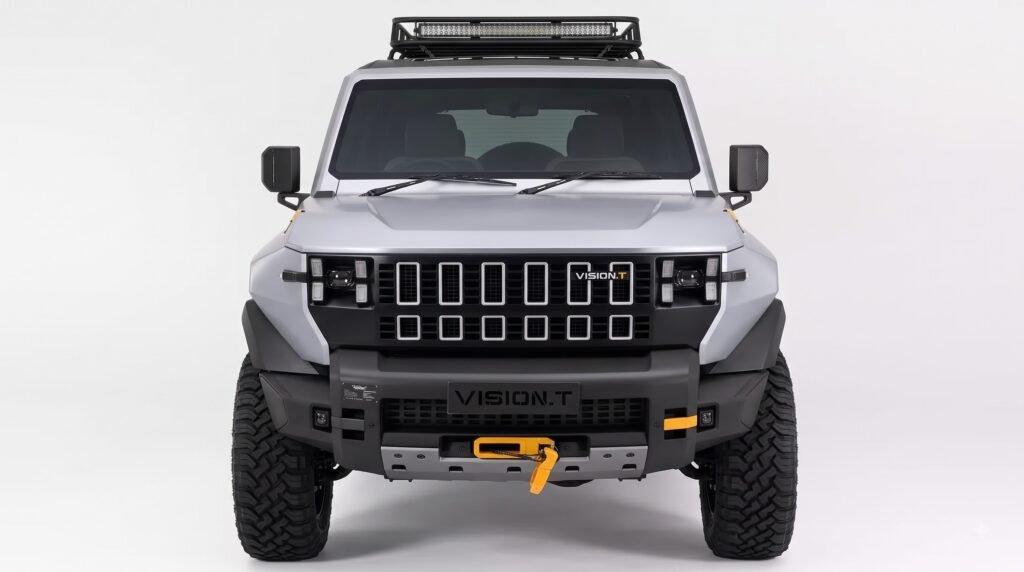
It is unmistakably a Thar. The split grille with horizontal slats, the bonnet latches, the quarter glass treatment, the flared wheel arches and the tailgate-mounted spare wheel all carry over from the Thar Roxx. What is new is the face: a central square LED headlamp unit flanked by four individual LED daytime running lights, and a conventional Mahindra grille replacing the sealed-off panel of the earlier Thar.e. Off-road bumpers, a tow hook, all-terrain tyres, exposed door hinges and roof-mounted carrier hooks complete a design that is genuinely rugged rather than decoratively so.
Underneath sits Mahindra’s new NU_IQ platform, and this is the more consequential story. Mahindra describes it as an all-new modular multi-energy architecture with a flat-floor design, supporting multiple body styles, front and all-wheel drive, and left and right-hand drive. It is engineered for SUVs between 3,990 mm and 4,320 mm, and the Vision.T sits toward the larger end with a 2,665 mm wheelbase – longer than a Hyundai Creta’s – while still achieving a claimed class-best 10.3 metre turning radius.
The off-road numbers are the ones that matter for a Thar. Mahindra quotes approach angles up to 28 degrees, departure angles reaching 34.9 degrees and breakover angles of 28.2 degrees, along with a segment-first penta-link rear suspension and class-best ground clearance.
Inside, a free-standing digital instrument cluster sits alongside a large portrait touchscreen with physical controls beneath it, a flat three-spoke steering wheel, dashboard grab handles, a prominent centre tunnel and a panoramic sunroof. Materials look hard-wearing rather than plush, which suits the brief.
One important caveat: Vision.T is a concept. Mahindra has announced no price, no battery specification and no confirmed launch date, and NU_IQ is explicitly a multi-energy platform that also supports petrol and hybrid powertrains – so the production Thar may not be electric-only.
Trending news for Mahindra Vision.T
Two developments define where the Vision.T stands.
First, the Freedom_NU reveal in August 2025 was a platform announcement as much as a car announcement. Mahindra unveiled four Vision concepts simultaneously - Vision.T, Vision.S, Vision.X and Vision.SXT - all sitting on the newly announced NU_IQ architecture, with production rollout planned from 2027. That is a considerably more substantial statement than showing a single concept: it tells you Mahindra has committed to a modular platform intended to spawn a family of products across different characters and powertrains. Mahindra published real engineering detail alongside the reveal, including a 2,665 mm wheelbase, a claimed class-best 10.3 metre turning radius, off-road angles of 28 degrees approach, 34.9 degrees departure and 28.2 degrees breakover, and a segment-first penta-link rear suspension. Concepts do not usually come with that level of specification unless the engineering is well advanced.
Second, the Vision.T design has been patented in India. Patent filings are typically a step towards production rather than a design exercise, and they usually appear when a company intends to protect a shape it plans to build. Combined with Mahindra's stated 2027 rollout, that points to a genuine product rather than a show-stand statement - though it remains a signal, not a confirmation.
The caveat that matters most for an EV-focused reader: Mahindra markets NU_IQ explicitly as a multi-energy platform and highlights it as delivering the first flat-floor ICE SUV. The Vision.T was shown as an electric vehicle, but the production version's powertrain line-up has not been confirmed and may well include petrol or hybrid options.
Mahindra Vision.T range and performance
No range or performance figures have been published for the Vision.T, so this section covers what is known about the platform and what can reasonably be inferred.
On powertrain, the concept was shown as an electric vehicle, continuing from the Thar.e of 2023, and the production version is widely expected to use a dual-motor all-wheel-drive layout. Reports suggest it could share LFP battery technology with the BE 6 and XEV 9e - Mahindra's current born-electric SUVs, which use packs of 59 kWh and 79 kWh. If the Vision.T adopts similar hardware, that would be the sensible expectation for capacity.
Range is where honest expectations matter. The BE 6 achieves strong claimed figures partly because it is a relatively aerodynamic crossover. The Vision.T is a deliberately boxy off-roader with all-terrain tyres, flared arches, a tailgate-mounted spare wheel and roof hooks - every one of which costs efficiency. A vertical windscreen and a large frontal area are aerodynamically expensive at highway speeds. Whatever battery it carries, expect meaningfully lower range than a similarly-sized road-focused electric SUV. That is the fundamental trade-off of an electric off-roader and no manufacturer has fully solved it.
Where electric drive genuinely wins is off-road. Instant torque from zero rpm, delivered precisely and independently to each axle on a dual-motor layout, is better suited to low-speed rock crawling and steep technical climbs than any petrol engine that needs revs to make power. There is no clutch to slip, no gear to select and no stall risk. Regenerative braking also provides controlled descent without riding the brakes.
The published chassis numbers support serious capability: 28 degrees approach, 34.9 degrees departure, 28.2 degrees breakover, class-best ground clearance and a segment-first penta-link rear suspension. The 2,665 mm wheelbase - longer than a Creta's - should also transform interior space compared with the current three-door Thar, while the 10.3 metre turning radius keeps it manageable on tight trails and in city parking.
Mahindra Vision.T safety overview
The Vision.T is a concept and has never been crash-tested. There is no rating from Bharat NCAP, Global NCAP or Euro NCAP, and Mahindra has published no airbag count or detailed safety equipment list.
What Mahindra has stated is its intent, and the intent is notably ambitious. The company says it is targeting 5-star ratings from both Global NCAP and Euro NCAP for vehicles on this platform. The Euro NCAP reference is significant - it signals export ambitions, and Euro NCAP's protocol is considerably more demanding than the Indian programmes, requiring extensive active safety and driver assistance content alongside structural performance.
On the platform, Mahindra describes NU_IQ as combining lightweight construction with top-tier safety standards. The flat-floor architecture has a structural benefit for an electric version: a rigid floor structure protects a battery pack while contributing to overall torsional stiffness. The segment-first penta-link rear suspension should improve stability and body control, which matters for a tall vehicle both on road and off it.
Mahindra's recent record supports taking these claims seriously. Both the BE 6 and the XEV 9e hold 5-star Bharat NCAP ratings, and Level 2 ADAS is standard across the company's current electric SUVs. Mahindra has made crash performance a central plank of its brand positioning in India, so a flagship on a new platform arriving without a strong rating would be commercially difficult.
One off-road specific consideration worth noting for any future electric version: battery pack underbody protection becomes far more important on a vehicle intended for rough terrain than on a road car. How Mahindra armours the floor, and what ground clearance the production car actually delivers, will be among the more important details to look for when specifications are published.
Mahindra Vision.T battery and charging guide
Mahindra has published no charging specification for the Vision.T. What follows is the platform context and what Mahindra's current electric SUVs offer, which is the best available guide.
The charging port would almost certainly be CCS-II, the Indian standard used across every Mahindra electric vehicle and compatible with essentially all public charging networks in the country.
Mahindra's current born-electric SUVs on the INGLO platform - the BE 6 and XEV 9e - support high-power DC fast charging in the 175 kW class, which is among the fastest available in India. If the Vision.T's production version shares that electrical architecture, similar capability would be expected. Home AC charging with an overnight full charge would be the standard daily pattern, as with any current EV.
There is one consideration specific to this vehicle that deserves thought. An off-road SUV is bought partly to go where roads are poor and infrastructure is thin, and that is precisely where charging is least available. A weekend trail trip 200 km from the nearest DC charger is a genuinely different proposition in an EV than in a diesel Thar carrying a jerrycan. Prospective buyers of any electric off-roader need to think carefully about route planning, and about whether their actual use involves remote areas or mostly weekend trails within reach of infrastructure.
Vehicle-to-Load capability would be particularly valuable on this vehicle - powering camping equipment, tools or lighting from the battery is a natural fit for the off-road use case, and Mahindra offers V2L on its current electric SUVs. It has not been confirmed for the Vision.T.
LFP battery chemistry, if used, tolerates daily full charging better than nickel-based alternatives, which suits a vehicle that may be charged to 100 percent before every trip.
Mahindra Vision.T warranty details
No warranty terms have been announced for the Vision.T, since it is a concept rather than a product. What follows is Mahindra's current position, which is the most useful available reference.
Mahindra's born-electric SUVs on the INGLO platform - the BE 6 and XEV 9e - launched with battery warranty terms structured around long-term ownership confidence, including lifetime battery warranty provisions for first owners on certain variants. Because lifetime warranty terms carry conditions on mileage, transferability and servicing, the exact wording matters enormously and is worth reading in full rather than taking at headline value.
For a vehicle intended for off-road use, there is an additional dimension that most EV warranty discussions ignore. Off-road driving subjects a vehicle to underbody impacts, water crossings, dust ingress and sustained low-speed high-load operation - all of which can interact with warranty terms. When the production Vision.T is announced, the questions worth asking are specific: is damage from off-road use covered, what water fording depth is warranted, does underbody impact damage to the battery pack void coverage, and what inspection is required after off-road use.
Those are not hypothetical concerns. They are the practical difference between a vehicle marketed as go-anywhere and one that is actually warranted to go anywhere.
Standard EV warranty due diligence also applies: establish the battery capacity degradation threshold below which a replacement is covered, confirm whether coverage transfers to a second owner, and check the servicing schedule required to keep the warranty valid.
Mahindra operates a large service network across India including smaller towns, which matters more for an off-road vehicle than for a city car - breakdowns happen further from help.
Quick verdict: Mahindra Vision.T
The Vision.T is the most convincing electric off-roader concept an Indian manufacturer has shown, and the reason is that Mahindra published engineering rather than just styling.
The numbers do the talking. Approach, departure and breakover angles of 28, 34.9 and 28.2 degrees are serious off-road figures, not marketing gestures. A segment-first penta-link rear suspension and class-best ground clearance suggest genuine chassis investment. A 2,665 mm wheelbase - longer than a Hyundai Creta's - promises to fix the current Thar's biggest practical weakness, which is cabin space, while a claimed 10.3 metre turning radius keeps it usable. Concepts do not normally arrive with this level of detail unless the underlying engineering is well advanced, and the design patent filed in India points the same way.
The design deserves credit too. It carries the Thar identity honestly - bonnet latches, tailgate-mounted spare, exposed door hinges, flared arches - rather than reinterpreting it into something soft. And retaining a row of physical controls beneath the touchscreen is a genuinely welcome decision on a vehicle that will be operated with gloves, in the dark, over rough ground.
The reservations are the ones that apply to any concept, plus one specific to this case. Production is not expected before 2027 and possibly later. No price, battery capacity, range or charging figure has been published, and estimates spanning Rs 12 lakh to Rs 22 lakh are too wide to be useful. Concept features routinely disappear before production. And critically for anyone shopping specifically for an EV, NU_IQ is a multi-energy platform - the production Vision.T may be offered with petrol or hybrid powertrains, not electric only.
Who should follow it: Thar enthusiasts, and anyone who wants a genuinely capable electric off-roader from an Indian manufacturer.
Who should buy something now: everyone who needs a vehicle before 2027. The Thar Roxx is on sale, and the BE 6 is Mahindra's electric SUV you can actually drive today.
Mahindra Vision.T vs rivals: how it compares
The Vision.T has no direct rival yet, so the useful comparisons are against what exists.
Against the Mahindra Thar Roxx: the Roxx is the five-door Thar you can buy today, on sale with published prices and multiple powertrains. What the Vision.T would add is a longer 2,665 mm wheelbase, a modern flat-floor platform, penta-link rear suspension, a considerably more advanced cabin and - if it arrives as an EV - instant torque that genuinely improves technical off-roading. What the Roxx offers that the Vision.T cannot is availability. For anyone who needs a capable Mahindra off-roader in the next two years, this is the answer.
Against the Mahindra Thar.e concept: the Vision.T is its direct evolution. The changes are mostly at the front - a conventional Mahindra grille with horizontal slats replaces the Thar.e's sealed panel, and a central square LED headlamp flanked by four individual DRLs replaces the earlier treatment. More importantly, the Vision.T arrives with the NU_IQ platform and real published specifications, which the Thar.e never had.
Against the Mahindra BE 6: if you want an electric Mahindra SUV now, the BE 6 is it - born-electric INGLO platform, 59 kWh and 79 kWh LFP battery options, a 5-star Bharat NCAP rating and Level 2 ADAS, from around Rs 18.90 lakh. It is a road-focused crossover rather than an off-roader, so it answers a different question, but it is available and proven.
Against the Maruti Jimny: the Jimny is the closest thing on sale to a compact, genuinely capable, boxy off-roader in India. It is petrol-only, considerably less powerful and far less equipped, but it exists and it is affordable. An electric Vision.T would outclass it on torque, technology and cabin space - whenever it arrives.
Against global electric off-roaders: nothing comparable is sold in India at anywhere near the Vision.T's estimated price. That gap is precisely the opportunity Mahindra is targeting.
Mahindra Vision.T: who should buy it (and who should not)
You cannot buy a Vision.T, so this covers whether to wait and what to watch for.
The straightforward advice: if you need a vehicle within the next two years, buy something else. Production is not expected before 2027, some reports suggest late 2027 or early 2028, and Mahindra has announced no price, specification or firm date. The Thar Roxx is on sale now and delivers most of what a Thar buyer actually wants. If you want an electric Mahindra SUV, the BE 6 is available and proven.
If you do want to track the Vision.T, four signals matter far more than media launch estimates. First, Mahindra publishing official specifications - battery capacity, power output, certified range and ground clearance. Second, confirmation of the production powertrain line-up, which will settle whether this is an EV, a petrol SUV or both. Third, bookings opening. Fourth, homologation or certification records appearing in public filings.
There is one question worth watching more closely than the others, and it is specific to buying an electric off-roader. Ask how the production vehicle handles the realities of the use case: what water fording depth is rated, how the battery pack is armoured underneath, what the actual ground clearance is with the pack fitted, and whether off-road damage affects warranty coverage. These are the details that separate a genuinely capable electric off-roader from a styling exercise, and they are rarely covered in launch coverage.
Also be realistic about charging. An off-road vehicle goes where infrastructure is thin. If your use involves genuinely remote areas, model your actual routes against India's charging network before committing to an electric off-roader from any manufacturer.
When it launches, test drive it on rough surfaces rather than a smooth demonstration loop, and check whether the concept's physical controls survived into production - that detail tells you a lot about how seriously the vehicle was engineered for real use.
Mahindra Vision.T ownership and running costs
No ownership cost can be calculated precisely for a concept with no confirmed price or battery capacity. What follows is a reasoned estimate using Mahindra's current electric SUVs as reference.
If a production Vision.T arrives with a battery in the 59 to 79 kWh range shared with the BE 6, and delivers a real-world 350 to 450 km given its boxy shape, then charging at a home tariff of around Rs 10 per unit would cost roughly Rs 590 to Rs 790 for a full charge. That works out to approximately Rs 1.70 to Rs 1.80 per kilometre - reasonable for a large SUV, though higher per kilometre than a small EV because weight and aerodynamics both work against it.
Against diesel: a Thar Roxx diesel returning about 15 kmpl at Rs 95 per litre costs roughly Rs 6.30 per kilometre. An electric Vision.T would therefore save around Rs 4.50 per kilometre - close to Rs 68,000 a year at 15,000 km.
Public DC charging at Rs 18 to Rs 24 per unit roughly doubles or triples the cost per kilometre, which matters more on an off-road vehicle likely to travel away from home charging.
Servicing follows the EV pattern: no engine oil, filters, spark plugs, clutch or exhaust, with annual costs typically a third to a half of a diesel equivalent. Regenerative braking extends brake life considerably.
Two costs specific to this vehicle deserve planning. First, all-terrain tyres on a heavy electric SUV are expensive and wear faster than road tyres - budget properly for this, as it will be the dominant consumable. Second, off-road use accelerates wear on suspension bushes, underbody components and protective plates, so maintenance costs will run above those of a road-only EV regardless of powertrain savings.
The genuine unknown is depreciation. Electric off-roaders are a new category in India with no residual value history, and a first-generation product on a brand-new platform carries more uncertainty than most.
Mahindra Vision.T tax benefits and incentives
If the Vision.T reaches production as an electric vehicle, it would qualify for India's standard EV tax provisions. This section covers those, with one important caveat specific to this vehicle.
The caveat first: NU_IQ is a multi-energy platform, and Mahindra markets it as delivering the first flat-floor ICE SUV. If the production Vision.T is offered with petrol or hybrid powertrains alongside or instead of an electric version, only the electric variant would qualify for EV tax treatment. Confirm the powertrain of the specific variant you are considering before assuming any of the following applies.
For an electric version: GST on electric vehicles is charged at 5 percent, against a much higher rate plus cess on comparable petrol and diesel SUVs. On a vehicle in the Rs 15 to 22 lakh band that difference is substantial in absolute terms and is already reflected in the ex-showroom price.
Road tax and registration exemptions vary substantially by state. Delhi, Maharashtra, Gujarat, Tamil Nadu, Karnataka, Telangana and several others waive or sharply reduce these charges for electric vehicles, which on an SUV at this price can amount to a significant sum. Other states offer nothing, so your state of registration materially changes the on-road price.
Under Section 80EEB, individual buyers financing an electric vehicle can claim a deduction of up to Rs 1.5 lakh on loan interest, subject to the loan being sanctioned within the eligible window and the buyer using the old tax regime.
Businesses should note the more favourable depreciation treatment available on electric vehicles.
Green number plates exempt EVs from certain city-level restrictions in some regions.
EV incentive policies are revised frequently and several have been narrowed in recent years. Any benefit factored into a decision to wait until 2027 may not exist by then.
Mahindra Vision.T maintenance and service
No service schedule exists for the Vision.T, but the maintenance profile of an electric off-road SUV is predictable in shape, and there are considerations here that do not apply to a road car.
The electric powertrain advantages are the usual ones and they are substantial. No engine oil, no oil or combustion air filter, no spark plugs, no timing belt, no clutch and no exhaust system. Servicing would consist largely of inspection - brake fluid, battery thermal management coolant, cabin air filter, tyre rotation, suspension checks and battery and software health checks. Across Mahindra's current EV range that means longer intervals and annual costs at roughly a third to a half of a diesel equivalent.
Regenerative braking extends brake life significantly, and on steep descents it does work the friction brakes would otherwise do - a genuine advantage off-road.
What differs on an off-roader is everything underneath. Suspension bushes, ball joints, protective skid plates, underbody panels and driveshaft boots all take punishment that a road car never sees. Water crossings introduce the risk of moisture ingress into bearings and electrical connectors. Dust ingress affects air filtration and cooling. Any off-road vehicle needs a post-trip inspection routine, and on an electric one that routine should explicitly include the battery pack enclosure and its underbody protection.
All-terrain tyres are the dominant consumable. They are expensive, they wear faster than road tyres, and on a heavy electric SUV they wear faster still. Correct pressures matter doubly - underinflation costs range as well as tyre life, and off-road pressure adjustments must be reversed properly before returning to tarmac.
If the production vehicle uses LFP chemistry as expected, battery care is simpler than on nickel-based packs: charging to 100 percent regularly is acceptable, which suits a vehicle topped up fully before every trip.
Mahindra's service network reaches well beyond metros, which matters more here than on a city car.
EV Running Cost Calculator
*Estimated figures based on entered electricity price, fuel price, mileage and average daily driving. Actual running costs can vary.
Related articles for Mahindra Vision.T


Frequently asked questions about Mahindra Vision.T
Is the Mahindra Vision.T on sale?
No. The Vision.T is a concept vehicle, revealed on 15 August 2025 at Mahindra's Freedom_NU event in Mumbai. It is not on sale, bookings have not opened, and Mahindra has announced no price, battery specification or confirmed launch date. A production version is expected around 2027, with some reports suggesting late 2027 or early 2028. The design has been patented in India, which is typically a step towards production but is not a guarantee of one.
Is the Mahindra Vision.T an electric vehicle?
The concept was shown as an electric vehicle, continuing from the electric Thar.e concept of 2023. However, this needs an important caveat. The underlying NU_IQ platform is explicitly described by Mahindra as a multi-energy architecture supporting multiple powertrains, and Mahindra even markets it as delivering the first flat-floor ICE SUV. That means the production version of this vehicle may be offered with petrol or hybrid powertrains alongside or instead of a pure electric option. Until Mahindra confirms the production powertrain line-up, do not assume the road-going Vision.T will be electric-only.
What is the Mahindra NU_IQ platform?
NU_IQ is Mahindra's all-new modular multi-energy platform, unveiled at the Freedom_NU event in August 2025. It is a monocoque architecture with a flat-floor design engineered for SUVs measuring between 3,990 mm and 4,320 mm, supporting multiple body styles, front and all-wheel drive, left and right-hand drive, and multiple powertrain types. Mahindra highlights lightweight construction with top-tier safety standards, a next-generation Integrated Domain Architecture for vehicle electronics, command seating and class-leading boot space. Production models on the platform are planned to begin rolling out from 2027.
How capable will the Mahindra Vision.T be off-road?
The published geometry is genuinely serious. Mahindra quotes approach angles of up to 28 degrees, departure angles reaching 34.9 degrees and breakover angles of 28.2 degrees, all described as exceeding class standards, along with class-best ground clearance. The vehicle uses a segment-first penta-link rear suspension, and the 10.3 metre turning radius helps considerably on tight trails. An electric powertrain also brings a real off-road advantage that petrol engines cannot match: instant, precisely controllable torque from zero rpm, which is exactly what low-speed rock crawling and steep climbs demand.
How does the Vision.T differ from the Thar.e concept?
The Vision.T is the direct evolution of the Thar.e that Mahindra showed in 2023, and the changes are mostly at the front. The Thar.e used a sealed-off panel where a grille would normally sit; the Vision.T replaces that with a conventional Mahindra grille featuring horizontal slats, and adopts a central square LED headlamp unit flanked by four individual LED daytime running lights. The Vision.T also sits on the newly announced NU_IQ platform and comes with far more published technical detail - wheelbase, turning radius and off-road angles - which suggests a design considerably closer to production readiness.
What will the Mahindra Vision.T cost?
Mahindra has announced nothing. Media estimates range from around Rs 12.50 lakh to Rs 22 lakh, which is an unusually wide spread and reflects how little is confirmed. For context, Mahindra's BE 6 - a born-electric SUV on the INGLO platform - starts around Rs 18.90 lakh, and a dual-motor all-wheel-drive electric off-roader with this level of hardware would realistically sit at or above that rather than at the bottom of the estimated band. Treat the lower figures with caution.
How big is the Mahindra Vision.T?
The NU_IQ platform is engineered for SUVs between 3,990 mm and 4,320 mm long, and the Vision.T sits toward the larger end of that range. Its wheelbase is 2,665 mm, which is notably longer than a Hyundai Creta's 2,610 mm and considerably more than the current three-door Thar - so interior space should be a major improvement over the Thar most people know. Despite that length, Mahindra claims a class-best turning radius of 10.3 metres, which matters both in city parking and on tight trails.
Should I wait for the Vision.T or buy a Thar Roxx now?
If you need a vehicle within the next two years, buy the Thar Roxx - it is on sale, priced, proven and available in multiple powertrains. The Vision.T is a concept with no confirmed launch date, no price and no specification, and production is not expected before 2027 at the earliest. Concepts also routinely lose their most distinctive features on the way to showrooms. If you specifically want an electric off-roader and can wait indefinitely, the Vision.T is worth tracking - but set a review date rather than an open-ended wait, and watch for Mahindra publishing official specifications rather than media launch estimates.
What are the other Mahindra Vision concepts?
Mahindra revealed four Vision concepts together at the Freedom_NU event on 15 August 2025, each previewing a different character on the NU_IQ platform. Vision.T is the rugged, go-anywhere off-roader covered on this page. Vision.S focuses on sporty performance. Vision.SXT is positioned as a balance of muscle and refinement. Vision.X emphasises athletic design. Together they show how one modular platform is intended to spawn several distinct products, with production rollout planned from 2027.
Owner feedback for Mahindra Vision.T
No approved owner feedback yet. Be the first to share your experience.
Available colours
Mahindra has not announced a production colour palette for the Vision.T, because it remains a concept. The Vision family was presented at the Freedom_NU event in muted, earthy show finishes rather than bright colours - a deliberate choice that suits a rugged off-roader and lets the boxy surfacing, flared arches and hardware details read clearly under show lighting. Concept vehicles are almost always finished in bespoke paint that never reaches production, so treat these as indicative of tone rather than actual future options. For a sense of what a production palette would likely include, Mahindra's current off-road range offers useful guidance: the Thar and Thar Roxx are sold in a mix of earthy greens and greys, a red, a white and a black, typically with contrasting roof options on higher variants, and Mahindra's electric SUVs add at least one signature shade specific to the electric range. A production Vision.T would plausibly follow a similar structure, with matte and satin finishes an increasingly common option on off-road models. The confirmed palette will be added here once Mahindra announces production specification.