
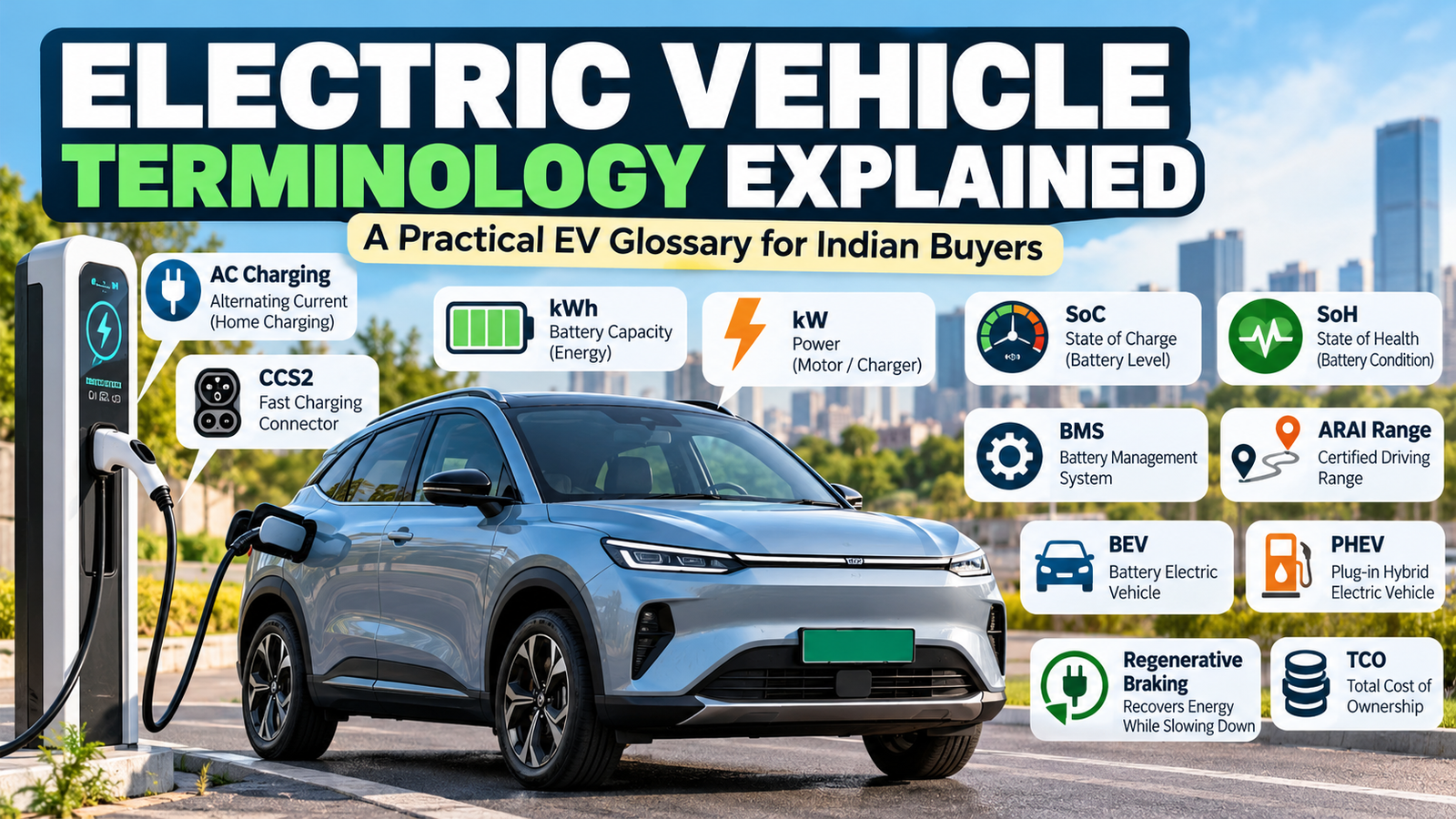
A 40 kWh battery. A 7.4 kW home charger. A 50 kW DC fast charger. A claimed driving range of 400 kilometres.
Those four numbers could appear on the same electric car’s specification sheet. Yet they describe four very different things. Confuse even two of them, and you could end up buying a car that takes longer to charge or costs more to run than you expected.
Electric vehicle terminology can look unnecessarily technical. Manufacturers talk about battery chemistry, charging capacity, State of Health and regenerative braking, often without explaining what those terms mean once the car leaves the showroom.
The good news is that you don’t need an electrical engineering degree to understand an EV.
This guide explains the terminology that actually matters, from how the battery stores energy to why a 150 kW charging station cannot necessarily charge your car at 150 kW.
Understanding the Different Types of Electric Vehicles
Not every vehicle described as electric runs entirely on electricity. Some still carry an internal combustion engine, while others don’t need petrol or diesel at all.
EV (Electric Vehicle)
EV is the broad term for a vehicle that uses an electric motor for propulsion.
In everyday Indian automotive discussions, EV usually refers to a fully battery-powered car, scooter or motorcycle. Technically, the wider category also includes vehicles combining electric motors with conventional engines.
BEV (Battery Electric Vehicle)
A BEV runs entirely on electricity stored in a rechargeable battery. It doesn’t have a petrol or diesel engine.
Cars such as the Tata Tiago EV and Hyundai Ioniq 5 belong to this category.
If someone refers to a pure electric car, they generally mean a BEV.
HEV (Hybrid Electric Vehicle)
A hybrid electric vehicle combines an internal combustion engine with an electric motor and battery.
A conventional HEV charges its battery through the engine and regenerative braking rather than through an external charging cable.
The Toyota Hyryder strong hybrid is an example of this approach.
PHEV (Plug-in Hybrid Electric Vehicle)
A PHEV also combines an engine with an electric motor, but its battery can be recharged from an external electricity supply.
It can cover a certain distance using electric power alone before relying on the combustion engine, depending on the vehicle and operating mode.
The difference is straightforward: an HEV doesn’t normally plug in, while a PHEV does.
FCEV (Fuel Cell Electric Vehicle)
A fuel cell electric vehicle uses hydrogen to produce electricity through a fuel cell, which powers an electric motor.\
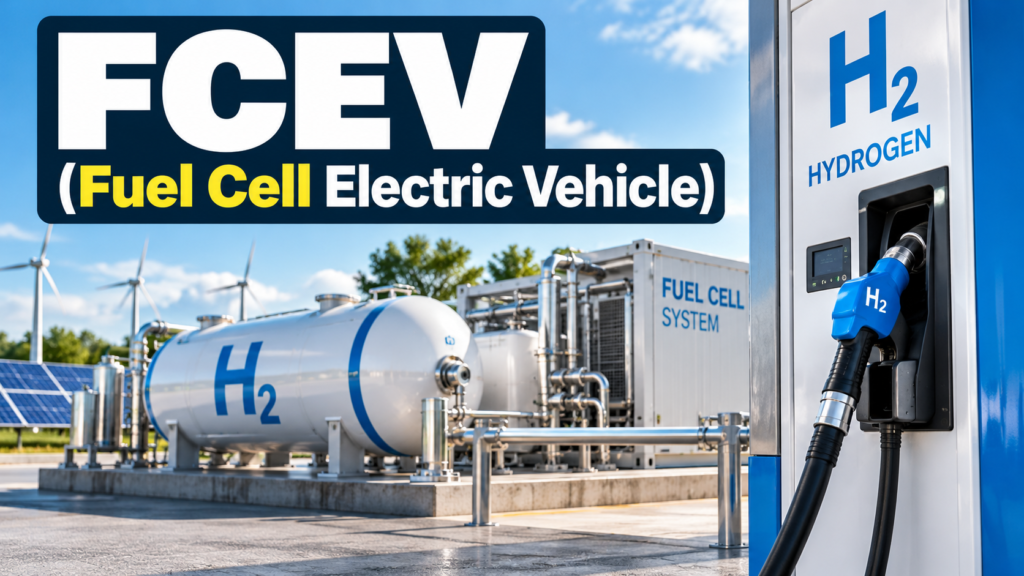
Unlike a battery electric car, its primary energy supply comes from refuelling with hydrogen. A battery may still help manage energy and recover braking power.
ICE (Internal Combustion Engine)
ICE is the abbreviation for the petrol or diesel engine found in conventional vehicles.
When manufacturers compare an EV against its ICE counterpart, they mean the battery-powered version versus the combustion-engine version.
For a broader look at battery-electric models, explore electric cars listed on EVUnlock.
kW vs kWh: The Most Important Difference in EV Terminology
Imagine buying a petrol car where the brochure describes the fuel tank in horsepower and the engine output in litres.
It would make no sense.
Yet EV specifications regularly confuse buyers in much the same way because kilowatts and kilowatt-hours look almost identical.
kW (Kilowatt): Power, Not Battery Size
A kilowatt measures power — the rate at which energy is delivered or used.
In an EV, kW commonly describes the output of an electric motor or the power of a charger.
A 100 kW motor tells you about the vehicle’s power capability. A 50 kW charging station tells you how quickly that equipment can potentially supply electrical energy.
Neither number tells you how much energy the battery stores.
kWh (Kilowatt-hour): The Battery’s Energy Capacity
A kilowatt-hour measures energy.
One kWh is the energy transferred when power flows at 1 kW for one hour.
A battery with 40 kWh of usable capacity can theoretically deliver 40 kW for one hour, or 10 kW for four hours, before accounting for operating limits and losses.
For buyers, kWh is roughly comparable to the size of a petrol car’s fuel tank. It indicates how much energy is available, not how far the vehicle will necessarily travel.
Two electric cars with identical battery capacities can have significantly different driving ranges because their energy consumption differs.
| EV specification | What it measures | Why it matters |
|---|---|---|
| 40 kWh battery | Stored electrical energy | Influences available driving range |
| 100 kW motor | Motor power | Influences performance |
| 7.4 kW AC charger | Charging power | Influences home charging time |
| 60 kW DC charging limit | Maximum stated DC charging power | Influences fast-charging capability |
| 7 km/kWh efficiency | Distance per unit of energy | Influences range and running cost |
A simple rule: kWh tells you how much energy is available. kW tells you how quickly energy can be used or transferred.
EV Battery Terminology: What the Specifications Really Mean
The battery is one of the most expensive components in an electric vehicle, so understanding its specifications is especially important.
Battery Pack, Cell and Module
A battery cell is an individual unit that stores electrical energy.
Manufacturers combine cells into larger structures to form a battery pack. Some designs group cells into modules before assembling the pack, while others use cell-to-pack construction without conventional modules.
The complete pack also includes electrical connections, protective structures and systems for monitoring and controlling the battery.
Gross Capacity vs Usable Battery Capacity
A battery’s gross capacity is its total nominal energy capacity. Usable capacity is the portion the vehicle makes available for normal driving.
For example, imagine an EV with a gross battery capacity of 50 kWh but a usable capacity of 47 kWh.
The remaining capacity is reserved by the battery management system to help protect the cells and maintain suitable operating limits.
When comparing range or calculating electricity consumption, usable capacity is usually the more relevant figure.
Manufacturers don’t always disclose both values, so check exactly which battery figure is being advertised.
SoC (State of Charge)
State of Charge describes how full the battery currently is, expressed as a percentage.
At 80% SoC, the battery has approximately 80% of its managed usable charge remaining. At 20%, it is running low.
Think of SoC as the electric equivalent of a fuel gauge.
It does not tell you whether the battery is healthy. That’s a different measurement.
SoH (State of Health)
State of Health indicates the battery’s condition compared with a defined reference, usually when it was new.
A battery reporting 90% capacity-based SoH is estimated to retain around 90% of its original reference capacity.
Battery age, usage patterns, temperature and charging history can all influence degradation.
SoH should not be confused with the percentage shown on the dashboard. One measures long-term battery condition; the other measures current charge.
Different manufacturers can calculate SoH differently, so a diagnostic reading should be interpreted with the relevant battery specification and warranty terms.
BMS (Battery Management System)
The BMS is the electronic control system responsible for monitoring and managing the battery.
It tracks important parameters such as cell voltage, current and temperature. It also helps estimate SoC and protect the battery from operating outside its permitted limits.
When a battery becomes too hot, too cold or approaches its charging limits, the BMS can restrict charging or power delivery.
That is one reason an EV may temporarily accept less charging power than its advertised maximum.
LFP vs NMC Batteries
These abbreviations describe two common lithium-ion battery chemistries.
LFP (Lithium Iron Phosphate) batteries are valued for their generally lower material cost, thermal stability and long cycle-life potential.
NMC (Nickel Manganese Cobalt) batteries generally offer higher energy density, allowing more energy to be stored within a given battery weight or volume.
Neither chemistry automatically makes a vehicle better.
Pack engineering, battery management, cooling and manufacturer calibration also matter. An efficiently designed LFP-equipped EV can be a better ownership choice than a poorly engineered vehicle using a more energy-dense chemistry.
Battery Degradation and Cycle Life
Battery degradation is the gradual reduction in a battery’s ability to store or deliver energy as it ages.
Cycle life describes how many charge-discharge cycles a battery can complete before reaching a defined performance threshold.
One equivalent full cycle represents energy throughput equal to the battery’s capacity. It does not necessarily mean charging from 0% to 100% in a single session.
Battery lifespan depends on chemistry, temperature, charging habits, operating conditions and pack design.
For ownership-specific questions, read EVUnlock’s EV battery warranty guide and battery replacement cost guide.
EV Charging Terminology: AC, DC, CCS2 and Charging Speed
Charging is where technical terminology starts affecting your daily schedule.
A charger might advertise 120 kW, but that doesn’t mean every EV connected to it will receive 120 kW.
Understanding the equipment on both sides of the cable explains why.
AC Charging (Alternating Current)
Electricity supplied through ordinary household and commercial electrical systems is generally alternating current.
EV batteries store energy as direct current, so AC power must be converted before it can be stored.
During AC charging, the vehicle’s onboard charger performs this conversion.
Home wallboxes and many workplace charging points use AC charging. The maximum charging power depends on the electrical connection, equipment and vehicle.
OBC (Onboard Charger)
The onboard charger is the component inside the EV that converts incoming AC electricity into DC electricity for the battery.
Suppose your vehicle supports only 3.3 kW AC charging.
Connecting it to a 7.4 kW AC wallbox will not automatically make it charge at 7.4 kW. The onboard charger still limits the power the car can accept.
This is why buyers should check the OBC rating rather than only the charging equipment supplied with the car.
DC Fast Charging (Direct Current Charging)
A DC fast charger converts electricity into DC outside the vehicle and supplies it to the battery through the vehicle’s charging system.
This bypasses the onboard AC charger, allowing significantly higher charging power when the vehicle supports it.
DC charging is particularly useful during highway journeys, when waiting overnight isn’t practical.
However, actual power depends on the charger, the vehicle’s charging limit, battery temperature, State of Charge and other conditions.
EVSE (Electric Vehicle Supply Equipment)
EVSE is the technical term for equipment that safely connects an EV to an electricity supply for charging.
It can include control electronics, protection systems, connectors, cables and communication functions.
A household AC wallbox is commonly called a charger, although the AC-to-DC conversion usually takes place inside the vehicle.
India’s NITI Aayog EV Charging Infrastructure Handbook explains the difference between AC and DC charging equipment.
Type 2 and CCS2 Connectors
A connector is the physical interface between the charging cable and the vehicle.
Type 2 is a widely used connector for AC charging on passenger EVs in India.
CCS2 (Combined Charging System Type 2) supports DC fast charging and incorporates the Type 2 connector arrangement with additional DC power contacts.
A vehicle with a CCS2 inlet can generally use compatible Type 2 AC charging equipment through the upper portion of the inlet.
Connector compatibility is important. A charger having sufficient power doesn’t help if its connector is incompatible with your vehicle.
Bharat AC-001 and Bharat DC-001
These are Indian charging standards associated with earlier EV infrastructure requirements.
Bharat AC-001 provides low-power AC charging through multiple outputs, while Bharat DC-001 was designed for lower-voltage DC charging applications.
They remain relevant when discussing older charging equipment and certain vehicle segments.
Modern passenger electric cars commonly use Type 2 AC and CCS2 DC interfaces, but buyers should verify their exact vehicle specification.
Charging Curve and Charging Taper
A charging curve shows how charging power changes as the battery fills.
Fast charging is not normally delivered at one constant power level from empty to full.
An EV may accept high power over part of a charging session, then progressively reduce that power as its State of Charge rises.
This reduction is called charging taper.
It explains why manufacturers often quote 10–80% DC charging times instead of 0–100%.
Consider a hypothetical EV with a 40 kWh usable battery and a 60 kW peak charging rating.
Charging from 10% to 80% requires approximately 28 kWh of energy to be added to the battery.
At a constant 60 kW, that would take 28 minutes before losses. In reality, the EV may only reach 60 kW briefly, making the actual charging time longer.
Peak charging power is useful, but the complete charging curve gives a much better picture of road-trip convenience.
CPO, OCPP and Public Charging
A Charge Point Operator (CPO) manages charging infrastructure, including charger operation and maintenance.
OCPP (Open Charge Point Protocol) enables communication between compatible charging stations and their management systems.
For a driver, these terms are less important than connector compatibility, charger reliability, payment access and actual power availability.
For home charging and battery management, see whether leaving an EV plugged in overnight is safe.
EV Range and Efficiency Terminology
Range is probably the first EV specification most Indian buyers check.
It is also one of the easiest to misunderstand.
ARAI Range and Certified Range
ARAI stands for the Automotive Research Association of India, an automotive testing and certification organisation.
In Indian EV brochures, ARAI-certified range refers to a driving-distance figure established through a prescribed test procedure.
It provides a standardised reference for comparison, but it is not a guarantee of the distance every owner will achieve.
Real-world consumption changes with driving speed, terrain, weather, air-conditioning use, tyre condition and passenger load.
Different test-cycle figures should not be compared as though they were measured under identical conditions.
WLTP, EPA and NEDC
These abbreviations refer to different vehicle testing systems.
WLTP (Worldwide Harmonised Light Vehicles Test Procedure) is used for vehicle efficiency and range certification in several markets, including Europe.
EPA range refers to driving-range estimates established under US Environmental Protection Agency procedures.
NEDC (New European Driving Cycle) is an older testing cycle that still appears in some vehicle specifications and international market data.
A car advertised with 450 km WLTP range should not automatically be considered equivalent to another car advertised with 450 km under NEDC or an Indian certification cycle.
Always compare range figures based on the same testing methodology wherever possible.
Real-World Range
Real-world range is the distance an EV actually covers under everyday driving conditions.
It depends on much more than battery capacity.
High-speed motorway travel usually demands more energy because aerodynamic resistance rises substantially with speed. Climate control, hills and heavy acceleration also influence consumption.
Meanwhile, regenerative braking can recover some energy during deceleration, making stop-and-go urban conditions relatively favourable for many EVs.
That is why a city commute and a highway journey can produce very different efficiency figures in the same car.
km/kWh and kWh/100 km
These are two ways of describing electric vehicle efficiency.
km/kWh tells you how far the EV travels using one unit of electrical energy. Higher is better.
kWh/100 km tells you how much energy the EV consumes over 100 kilometres. Lower is better.
Suppose a car delivers 7 km/kWh.
Its energy consumption is approximately 14.3 kWh/100 km.
The two figures describe the same efficiency, just from different directions.
Range Anxiety
Range anxiety describes the concern that an EV might run out of usable charge before reaching its destination or a suitable charging station.
It isn’t simply about battery size.
A vehicle with moderate range and dependable charging access may be more practical than a long-range EV without convenient charging.
For longer journeys, planning charging stops and keeping a realistic reserve matter more than chasing the highest brochure number.
EVUnlock’s EV road-trip guide for India explores charging stops and travel costs in more detail.
Electric Motor and Driving Terminology
An EV may have fewer conventional mechanical components than a petrol car, but its electric drivetrain introduces a different set of terms.
Torque
Torque describes rotational force, commonly measured in newton-metres (Nm).
Electric motors can deliver strong torque from very low speeds, which explains why many EVs feel responsive in city traffic.
However, torque alone doesn’t establish how quick a car will be. Motor power, gearing, vehicle weight and traction also influence acceleration.
Regenerative Braking
Regenerative braking allows the electric motor to recover some of the vehicle’s kinetic energy while slowing down.
Instead of dissipating all that energy as heat through conventional brakes, the motor operates as a generator and returns some energy to the battery.
It improves efficiency, particularly where frequent slowing down is required.
But regenerative braking cannot recover every unit of energy used during acceleration, and conventional friction brakes remain essential.
One-Pedal Driving
In vehicles that support it, one-pedal driving allows the driver to control much of the acceleration and deceleration using the accelerator pedal.
Lifting the pedal activates regenerative deceleration, potentially slowing the vehicle substantially or bringing it to a stop, depending on the system.
It does not eliminate the brake pedal or the need to use it when necessary.
Inverter and DC-DC Converter
An inverter controls the electrical power supplied to the traction motor, typically converting DC electricity from the battery into AC for the motor.
A DC-DC converter changes one DC voltage level into another, often supplying lower-voltage systems such as lighting, electronics and the auxiliary battery.
These systems are essential to how an EV delivers power, even though owners rarely need to operate them directly.
Smart EV Features and Ownership Terms
Electric vehicles are increasingly connected to software systems, charging networks and even external electrical equipment.
A few more abbreviations are worth understanding before purchase.
V2L (Vehicle-to-Load)
V2L allows a compatible EV to supply electrical power to external appliances or equipment.
Depending on the vehicle’s rated output and supported accessories, it may be used for devices such as laptops, lights or other suitable electrical loads.
V2L availability should never be assumed merely because a car has a large battery.
V2G (Vehicle-to-Grid)
V2G describes technology that allows a compatible electric vehicle to send electrical energy back to the electricity grid.
It requires suitable vehicle hardware, bidirectional charging equipment, communication systems and applicable grid arrangements.
It is a capability being developed and deployed in selected applications, not a standard function of every EV.
OTA (Over-the-Air Updates)
OTA updates allow vehicle software to be updated wirelessly.
Depending on the model, these updates can address software issues, change supported functions or introduce new features.
Not every vehicle system can necessarily be updated remotely, and hardware limitations remain.
TCO (Total Cost of Ownership)
TCO means the total financial cost of owning and operating a vehicle over a specified period.
For an EV, that may include purchase price, financing, electricity, insurance, maintenance, tyres, applicable fees and eventual resale value.
This is more useful than comparing only the ex-showroom prices of an EV and a petrol car.
BaaS (Battery-as-a-Service)
Battery-as-a-Service is a commercial arrangement in which the vehicle battery is offered separately from the vehicle purchase, typically under a rental or subscription model.
It may reduce the initial purchase amount, but the buyer takes on ongoing battery-related payments.
The actual value depends on the agreement, usage charges, contract conditions and long-term ownership plans.
Putting EV Terminology to Work: A Simple Indian Charging Cost Example
Consider a hypothetical electric car with these specifications:
- Usable battery capacity: 40 kWh
- Real-world efficiency: 7 km/kWh
- Household electricity rate: ₹8 per kWh
- Electricity drawn from the wall for a full recharge: approximately 45 kWh
The estimated driving range from the usable battery capacity is:
40 kWh × 7 km/kWh = 280 km
The estimated electricity bill for that recharge is:
45 kWh × ₹8 = ₹360
Dividing the cost by the estimated driving distance gives:
₹360 ÷ 280 km = approximately ₹1.29 per km
The extra 5 kWh in this example represents an assumed difference between energy drawn from the wall and energy delivered to the battery, including charging losses and associated consumption.
These are illustrative calculations, not tested specifications for any particular electric car.
Actual electricity rates, charging efficiency, usable battery capacity and real-world range vary.
But the calculation demonstrates why efficiency matters.
A larger battery does not automatically mean lower running costs. If a heavier electric SUV consumes substantially more energy per kilometre than a compact electric hatchback, it may cost more to operate despite having a longer driving range.
The EV Terms Buyers Should Check Before Booking
The next time you visit an electric car showroom, concentrate on the specifications that affect actual ownership.
Start with usable battery capacity, certified range and expected real-world efficiency. Ask how much AC charging power the vehicle accepts and what its DC charging performance looks like between 10% and 80%.
Then examine the battery chemistry, warranty wording, charging connector, service support and any subscription conditions.
These questions usually tell you more than a dramatic acceleration claim or a large touchscreen.
Frequently Asked Questions
What is electric vehicle terminology?
Electric vehicle terminology is the collection of technical words and abbreviations used to describe EV batteries, motors, charging equipment, efficiency, range, software and ownership. Common examples include kW, kWh, SoC, SoH, BMS, CCS2 and regenerative braking.
What is the difference between kW and kWh in electric vehicles?
kW measures power, while kWh measures energy. An EV’s motor and charger power are usually specified in kW, while battery energy capacity is specified in kWh.
What does SoC mean in an EV?
SoC stands for State of Charge. It indicates the battery’s current charge level as a percentage of its managed usable capacity.
What does SoH mean in an EV battery?
SoH stands for State of Health. It is an estimate of the battery’s condition compared with its original reference condition, commonly expressed as a percentage.
What does CCS2 mean in EV charging?
CCS2 stands for Combined Charging System Type 2. It is a charging interface used for DC fast charging on many modern electric cars, including numerous models sold in India.
Does a bigger EV battery always provide more range?
No. Range also depends on vehicle efficiency, weight, aerodynamics, driving speed, weather and the amount of battery capacity available for use. A more efficient EV can travel further than a less efficient vehicle despite having a smaller battery.
Is fast charging always faster than home charging?
A compatible DC fast charger generally provides considerably more charging power than typical home AC equipment. However, actual charging speed is determined by the vehicle, charger, battery temperature and State of Charge.
What is the most important EV specification for Indian buyers?
There is no single specification that determines whether an EV is a good purchase. Usable battery capacity, real-world range, home charging compatibility, DC charging capability and battery warranty should be assessed together.
Final Thoughts
Electric vehicle terminology becomes much easier once you separate three basic ideas: how much energy the battery stores, how efficiently the car uses it and how quickly the battery can be recharged.
Most other specifications build on those fundamentals.
A larger kWh figure doesn’t guarantee the longest real-world range. A powerful public charger doesn’t guarantee the shortest charging stop. And a battery displaying 100% SoC tells you nothing about its long-term State of Health.

Gagandeep Singh
Founder, EV UnlockGagandeep Singh is an Electronics and Communication Engineering graduate from BGIET Sangrur and holds an M.Tech in eMobility from IIT Madras (CODE IITM). He is the founder of EV Unlock, an independent electric vehicle research platform. His work combines engineering knowledge, SEO strategy and electric mobility research to deliver verified EV specifications, buying guides and charging information that help buyers make confident, informed decisions.
2 thoughts on “Electric Vehicle Terminology Explained: A Practical EV Glossary for Indian Buyers”