
 1 / 2 Images
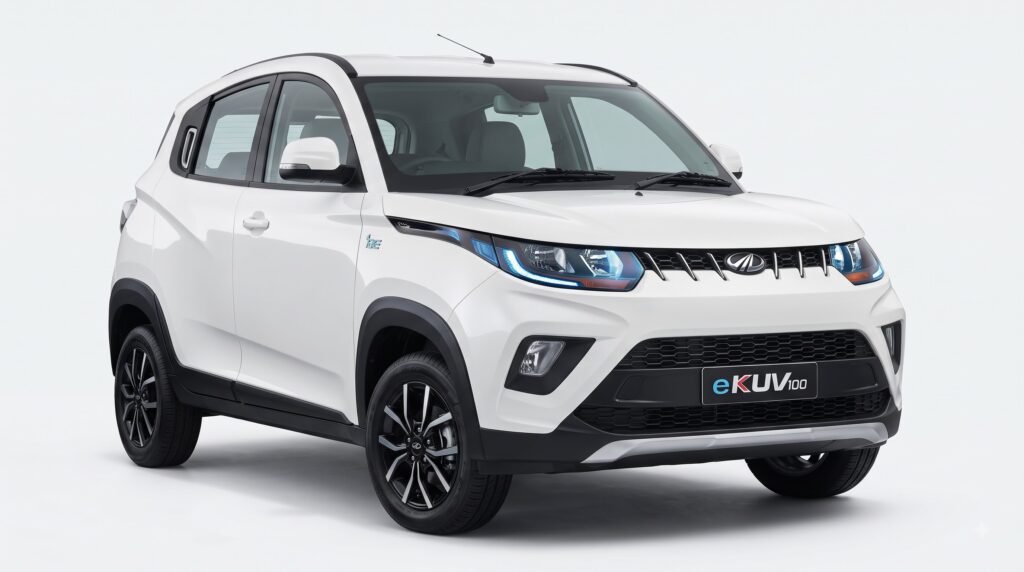
Mahindra eKUV100
Compact Electric SUV (never launched)

Never launched. Shown production-ready at Auto Expo 2020 with a 15.9 kWh battery, 147 km claimed range and an announced Rs 8.25 lakh price - but the base KUV100 was discontinued in 2023 and Mahindra moved to born-electric platforms.
*Ex-showroom Price in New Delhi
Mahindra eKUV100 EV essentials
Mahindra eKUV100 pros and cons
Pros
- Would have been India's cheapest electric car at Rs 8.25 lakh
- Genuine SUV stance with 170 mm ground clearance, unusual at that price
- Practical five-seat cabin from a proven body shell
- Well equipped for the money: touchscreen, cruise control, connected app
- Fast charging to 80 percent in 55 minutes was competitive for 2020
- Low-voltage architecture kept cost and complexity down
- Would have been an ideal urban second car
- Mahindra's large service network would have supported it
Cons
- Never launched - no production car was ever sold
- The base KUV100 NXT was discontinued in April 2023 with no replacement
- 147 km claimed range was thin even by 2020 standards
- 85 km/h top speed ruled out highway use entirely
- Only a single driver airbag specified
- Mahindra's EV strategy has moved to born-electric INGLO platforms
- Car websites still list it as upcoming - that data is stale, not news
- No warranty, colour palette or variant structure was ever finalised
Best for
Mahindra eKUV100 specifications
Reality Check - read this first
Battery, Motor & Charging (Auto Expo 2020 spec)
Efficiency & Real-world Estimate
Dimensions & Chassis
Cabin, Features & Connectivity
Safety (as specified in 2020)
Why it never happened
Mahindra EVs you CAN buy today
Features
Battery & Performance
- 15.9 kWh lithium-ion battery pack
- 40 kW electric motor producing 54 PS and 120 Nm
- Company-claimed range of 147 km on a full charge
- Top speed of 85 km/h - deliberately capped for city use
- Fast charging to 80 percent in 55 minutes
- Regular charging: full charge in around six hours
- Low-voltage electric architecture, simpler and cheaper than high-voltage systems
- Single-speed automatic transmission - no clutch or gearshifts
- Regenerative braking
- Blue Sense Plus app support for remote battery monitoring
- Would have been India's most affordable electric car at Rs 8.25 lakh
- Positioned as the successor to the Mahindra e2o and e2o Plus
- Note: all figures come from the Auto Expo 2020 showcase - no production car was ever built
Comfort & Interior
- Touchscreen infotainment system
- Apple CarPlay and Android Auto
- Bluetooth connectivity and AM/FM radio
- GPS navigation
- Cruise control
- Power steering and power windows
- Power door locks with keyless entry
- Cooled glovebox
- Adjustable headrests with lumbar support
- Front and rear cupholders
- Luggage hooks in the boot
- Front USB charging port
- Blue Sense Plus connected car app: remote diagnostics, battery monitoring, remote climate control
- Five-seat cabin with an ergonomic, upright dashboard layout
- Compact SUV proportions with 170 mm ground clearance
Safety
- ABS with Electronic Brakeforce Distribution
- Driver airbag
- ISOFIX child seat mounts
- Hill descent control
- Tyre Pressure Monitoring System
- Engine immobiliser
- Anti-theft alarm
- Central locking with keyless entry
- Disc brakes at the front, drum brakes at the rear
- 85 km/h top speed acted as a built-in safety ceiling
- Note: only a driver airbag was specified - well short of 2026 expectations
- Note: never crash-tested by Global NCAP or Bharat NCAP as it did not reach production
Mahindra eKUV100 trims and pricing
Compare available Mahindra eKUV100 trims, their ex-showroom prices and key configuration details.
eKUV100 (as shown, Auto Expo 2020)
15.9 kWh - 147 km claimed - 54 PS / 120 Nm - touchscreen, cruise control, Blue Sense Plus connected app
Alternative reported pricing
Some sources quoted a tentative Rs 8-10 lakh band before the announced figure
About Mahindra eKUV100
The Mahindra eKUV100 is the most complete electric car India never got. It was not a vague concept sketch – Mahindra showed a production-ready version at the Auto Expo 2020, published a full specification, and even announced a price of Rs 8.25 lakh, which would have made it comfortably the most affordable electric car on sale in India. Then it simply never reached a single showroom.
The package made sense on paper. A 15.9 kWh lithium-ion battery drove a 40 kW motor producing 54 PS and 120 Nm, good for a company-claimed 147 km of range and an 85 km/h top speed. Fast charging took it to 80 percent in 55 minutes; a regular charger needed about six hours. Ground clearance was 170 mm, and it kept the KUV100’s practical five-seat cabin with a touchscreen infotainment system, cruise control, Android Auto and Apple CarPlay, and Mahindra’s Blue Sense Plus connected app for remote diagnostics, battery monitoring and climate control.
So what happened? Two things, and the second is decisive. First, range anxiety – 147 km was thin even in 2020, and Mahindra reportedly grew uneasy about launching a car whose range would define its brand’s EV reputation. Second, and far more consequential: the base car died. Mahindra discontinued the petrol KUV100 NXT in April 2023, citing weak sales and the cost of updating it for BS6 Phase 2 emission norms, and confirmed no replacement was planned. An electric version of a car that is no longer in production is not a product Mahindra can build.
Meanwhile Mahindra’s electric strategy moved on entirely. The XUV400 arrived in 2023, and then the born-electric INGLO platform brought the BE 6 and XEV 9e – modern, long-range, 5-star-rated electric SUVs operating in a completely different league from a converted 15.9 kWh hatchback.
You will still find the eKUV100 listed on car websites with expected launch dates and prices attached. Treat those with scepticism. Mahindra has issued no formal cancellation, but the base vehicle is out of production and the company’s entire EV effort has shifted to purpose-built platforms. Realistically, this car is history rather than pipeline.
Trending news for Mahindra eKUV100
Two facts define the eKUV100's status, and neither of them appears on the car listing pages that still show it as upcoming.
First, the base vehicle is gone. Mahindra discontinued the petrol KUV100 NXT in April 2023, driven by weak sales and the expense of re-engineering it for BS6 Phase 2 emission norms, and confirmed at the time that no replacement was planned. This is the single most important fact about the eKUV100 and it is routinely omitted. The eKUV100 was a conversion of the KUV100 body shell - not a purpose-built EV - so with the donor car out of production and no successor, there is no straightforward path to building it. The KUV100 has also been withdrawn from export markets including South Africa.
Second, Mahindra's electric strategy moved decisively elsewhere. The XUV400 arrived in 2023 as the company's mainstream electric SUV, and it was followed by the born-electric INGLO platform underpinning the BE 6 and XEV 9e - modern, long-range EVs with 5-star Bharat NCAP ratings that compete at a completely different level. A 15.9 kWh conversion with 147 km of claimed range does not fit anywhere in that strategy.
Despite all of this, several Indian car portals continue to list the eKUV100 as an upcoming model with expected launch dates attached, some as recent as November 2026. Those entries are stale database records rather than reported news, and no Mahindra announcement supports them. Mahindra has never formally cancelled the project, which is why the listings persist - but absence of a cancellation statement is not evidence of a launch.
Mahindra eKUV100 range and performance
All figures here come from Mahindra's Auto Expo 2020 specification. No production eKUV100 was ever built or independently tested, so nothing has been verified in the real world.
Mahindra claimed 147 km from the 15.9 kWh battery. Applying the typical gap between Indian claimed figures and real-world results, a production car would likely have delivered around 110 to 125 km with the air-conditioning running - enough for a 40 to 60 km daily commute with charging every second or third day, but genuinely tight for anything more demanding.
That number is the heart of why the car never launched. Even in 2020 it was thin; by 2026, with the Tata Tiago EV and MG Comet EV offering more and Mahindra's own BE 6 offering several times more, it would look untenable. Mahindra was reportedly uneasy about launching a car whose range would shape public perception of the brand's electric capability, and in hindsight that caution looks justified.
Performance was modest but appropriate to the brief. The 40 kW motor produced 54 PS and 120 Nm, and because electric torque arrives instantly, the eKUV100 would have felt nippy pulling away from traffic lights despite the modest output - the same characteristic that makes small EVs feel quicker than their figures suggest. Top speed was capped at 85 km/h, which comfortably handles city and suburban roads but rules out highway driving entirely.
The chassis was carried over from the KUV100: independent McPherson strut suspension at the front, a semi-independent twist beam at the rear, discs at the front and drums at the rear. Ground clearance of 170 mm was genuinely useful, giving the eKUV100 an SUV stance that few cars at Rs 8.25 lakh could have matched - and that would have been one of its stronger selling points against the hatchback-shaped competition.
Mahindra eKUV100 safety overview
The eKUV100 was never crash-tested, by Global NCAP, Bharat NCAP or anyone else, because no production car existed to test. Bharat NCAP did not even exist when the car was shown in 2020.
The specification Mahindra published listed ABS with Electronic Brakeforce Distribution, a driver airbag, ISOFIX child seat mounts, hill descent control, a Tyre Pressure Monitoring System, an engine immobiliser, an anti-theft alarm and central locking with keyless entry. Braking was by disc at the front and drum at the rear.
That list needs reading in context. In 2020, a single driver airbag on a car priced around Rs 8.25 lakh was not unusual - dual front airbags only became mandatory in India shortly afterwards, and six airbags were confined to considerably more expensive cars. By 2026 standards, however, it would be badly outdated. The MG Comet EV, Tata Tiago EV and Tata Punch EV all offer substantially more, and the Punch EV carries a 5-star Bharat NCAP rating.
The 85 km/h top speed had an incidental safety benefit, removing high-speed driving from the equation entirely - the same logic Tata applies to the fleet-focused Xpres-T EV.
One point worth noting for anyone comparing the eKUV100 against Mahindra's current cars: the company's safety positioning has transformed since 2020. The BE 6 and XEV 9e both carry 5-star Bharat NCAP ratings and Mahindra now markets crash performance as a core brand attribute. A single-airbag conversion would sit awkwardly against that positioning, which is another reason the eKUV100 no longer fits the company's plans.
Mahindra eKUV100 battery and charging guide
The charging specification Mahindra published in 2020 was competitive for its time and is worth recording accurately.
Fast charging took the 15.9 kWh battery to 80 percent in 55 minutes. Because the pack was small, that translated to a genuinely useful top-up - roughly 100 km of claimed range in under an hour. A regular home charger needed about six hours for a full charge, which fits an overnight pattern comfortably.
Those numbers benefit from the small battery. A 15.9 kWh pack fills far faster than the 40 to 60 kWh packs common in 2026, which is one of the few areas where the eKUV100's modest specification worked in its favour. The flip side is obvious: a small battery that charges quickly still only holds a small amount of energy.
The eKUV100 used a low-voltage electric architecture rather than the high-voltage systems used in modern EVs. That kept manufacturing cost, component complexity and safety-system requirements down, which is how Mahindra reached the Rs 8.25 lakh price point. The trade-off is a ceiling on charging speed and performance that a high-voltage system does not have - and it is a significant part of why this approach has largely been abandoned in favour of purpose-built high-voltage platforms.
Mahindra's Blue Sense Plus connected app would have supported remote battery monitoring and remote climate control, letting owners check charge state and pre-cool the cabin from their phone. That was a genuinely forward-looking inclusion for an affordable Indian car in 2020, and it is now standard across the segment.
For context on how far things have moved: the Hyundai Creta Electric now covers 10 to 80 percent in 39 minutes on a battery more than three times larger.
Mahindra eKUV100 warranty details
Mahindra never announced warranty terms for the eKUV100, because the car never reached the point of a commercial launch where those terms would have been finalised.
What can be said is what Mahindra offered around that period and what it offers now. In the eKUV100's era, Mahindra's electric offerings - principally the e2o Plus - carried battery warranties structured around the modest packs of the time. Today, Mahindra covers the battery on its current electric vehicles with substantially longer terms, reflecting both improved battery technology and much larger packs.
If the eKUV100 had launched at Rs 8.25 lakh, a warranty structure comparable to what Tata offered on the Tiago EV and Tigor EV - in the region of 8 years or 1,60,000 km on the battery - would have been the competitive requirement. Anything less would have struggled against rivals, because battery replacement anxiety is the dominant concern for first-time EV buyers at the affordable end of the market.
For anyone who arrived at this page while shopping, the practical takeaway concerns what to check on whichever EV you do buy. Get the battery capacity degradation threshold in writing - the level below which a replacement is covered. Confirm whether the warranty transfers to a second owner. Check what servicing schedule is required to keep coverage valid. These lines determine what a warranty is actually worth, and they are easy to skip past when a dealer leads with a headline number.
Mahindra's service network remains one of the largest in India and would have supported the eKUV100 well - which was one of the more compelling arguments for the car when it was shown.
Quick verdict: Mahindra eKUV100
The Mahindra eKUV100 is worth remembering as a missed opportunity rather than a bad car.
At Rs 8.25 lakh it would have been India's most affordable electric car by a clear margin, wrapped in a practical five-seat body with genuine SUV ground clearance of 170 mm and a reasonable equipment list including a touchscreen, cruise control and a connected app. For a household wanting a cheap, simple urban second car, that combination had real appeal, and Mahindra's service network reach would have supported it well.
What killed it was arithmetic rather than ambition. A 147 km claimed range was thin in 2020 and would be indefensible now. A single driver airbag would not survive contact with 2026 buyer expectations. And most fundamentally, the KUV100 body it was built on went out of production in April 2023 with no replacement - which removed the physical basis for the car entirely. Mahindra then redirected its electric investment into the born-electric INGLO platform, and the BE 6 and XEV 9e that emerged are engineered to a standard a 15.9 kWh conversion could never reach.
The consequence is that Mahindra exited the affordable EV segment and has not returned. The space the e2o Plus and eKUV100 would have occupied is now served by the MG Comet EV and Tata Tiago EV instead.
If you arrived here because a car website listed the eKUV100 as upcoming: that listing is stale. There is no production car, no launch date supported by any Mahindra announcement, and no realistic path to one.
What to buy instead: the MG Comet EV or Tata Tiago EV at the affordable end, the Tata Punch EV if you want the SUV stance the eKUV100 promised, or the Mahindra XUV400 if you specifically want a Mahindra.
Mahindra eKUV100 vs rivals: how it compares
The eKUV100 can only be compared against cars you can actually buy, and that comparison is instructive.
Against the MG Comet EV: the Comet occupies the price point the eKUV100 was aimed at and is on sale now. It is smaller - a two-door city car rather than a five-door SUV shape - and offers less ground clearance, but it exists, it is well equipped for the money, and it has found a genuine audience. This is the closest thing to what the eKUV100 was meant to be.
Against the Tata Tiago EV: the Tiago EV is the more direct practical equivalent, a five-door electric hatchback with more range than the eKUV100 claimed, a choice of battery sizes and Tata's much larger EV service network. It costs more than Rs 8.25 lakh, but it is available, certified and driveable.
Against the Tata Punch EV: this is what the eKUV100 aspired to be. SUV stance, genuine ground clearance, a modern born-electric Acti.EV platform, far more range and a 5-star Bharat NCAP rating. It costs considerably more, but the gap in capability is enormous - and it illustrates why Mahindra concluded that a 15.9 kWh conversion had no future.
Against the Mahindra XUV400 EV: Mahindra's own accessible electric SUV, on sale now with a real battery and highway capability. If you want a Mahindra EV without stepping up to the BE 6, this is the answer.
Against the Mahindra BE 6 and XEV 9e: no meaningful comparison exists. These are born-electric, long-range, 5-star-rated SUVs with Level 2 ADAS. The distance between them and the eKUV100 is the clearest possible illustration of how far Indian EVs moved between 2020 and today - and why Mahindra chose to compete at the top rather than the bottom.
Mahindra eKUV100: who should buy it (and who should not)
You cannot buy an eKUV100, so this section covers what to do if you came here looking for one.
First, do not wait for it. Several Indian car websites still list the eKUV100 as an upcoming model with expected launch dates attached. Those entries are stale database records, not reported news, and no Mahindra announcement supports them. The base KUV100 has been out of production since April 2023 with no replacement, and Mahindra's electric investment has moved entirely to born-electric platforms. A launch is not realistically in prospect.
Second, work out which part of the eKUV100 appealed to you, because different alternatives answer different motivations.
If it was the price - around Rs 8.25 lakh for an electric car - the MG Comet EV is the closest available option, though it is a smaller two-door city car. The Tata Tiago EV costs more but offers a proper five-door body and more range.
If it was the SUV stance and 170 mm ground clearance, the Tata Punch EV delivers that with far more range, a modern platform and a 5-star Bharat NCAP rating. It costs meaningfully more, but nothing at the eKUV100's intended price offers that combination.
If it was the Mahindra badge and service network, the XUV400 EV is the accessible entry point to Mahindra's electric range, with the BE 6 and XEV 9e above it.
Third, whatever you buy, apply the due diligence the eKUV100's story teaches. Check the certified range against real-world owner reports rather than the brochure figure, since the gap is what undid this car. Confirm airbag count and crash rating rather than assuming. And verify the battery warranty terms in writing, including the degradation threshold that triggers a replacement.
Mahindra eKUV100 ownership and running costs
No real ownership cost data exists for the eKUV100 because no production car was ever delivered. What follows is a reconstruction from the announced specification, which is useful mainly for understanding what the car would have offered.
Charging: filling the 15.9 kWh battery at a home tariff of around Rs 10 per unit would have cost roughly Rs 159. Against a likely real-world range of about 120 km, that works out to approximately Rs 1.32 per kilometre - genuinely low, because a small battery in a light car is efficient by nature.
Against petrol: the petrol KUV100 returned about 18 kmpl, which at Rs 100 per litre costs roughly Rs 5.55 per kilometre. The eKUV100 would therefore have saved around Rs 4.20 per kilometre. At 12,000 km a year - realistic for an urban second car - that is close to Rs 50,000 saved annually.
Break-even: the eKUV100 at Rs 8.25 lakh would have cost roughly Rs 2.5 to Rs 3 lakh more than a comparable petrol KUV100. At Rs 4.20 saved per kilometre, that difference would have been recovered at around 60,000 to 70,000 km - roughly five years for a 12,000 km-a-year owner. That is a genuinely attractive payback period, and considerably better than most EVs achieve, precisely because the price premium was small.
Servicing would have followed the EV pattern: no engine oil, filters, spark plugs, clutch or exhaust, with annual costs at roughly a third to a half of the petrol KUV100. Regenerative braking would have extended brake life, and the small 14-inch-class tyres would have been inexpensive to replace.
The numbers explain why the eKUV100 generated so much interest. The economics worked. What did not work was the range, and ultimately the disappearance of the car it was based on.
Mahindra eKUV100 tax benefits and incentives
The eKUV100 never launched, so no buyer ever claimed an incentive on one. This section covers the provisions that would have applied and that apply to any EV you buy instead.
GST on electric vehicles is charged at 5 percent, against a much higher rate plus cess on comparable petrol cars. On a car at the eKUV100's intended Rs 8.25 lakh price point, that difference is proportionally very significant - it is a large part of how affordable EVs reach their headline prices at all.
Road tax and registration exemptions vary substantially by state. Delhi, Maharashtra, Gujarat, Tamil Nadu, Karnataka, Telangana and others waive or sharply reduce these charges on electric vehicles, while other states offer nothing. On an affordable EV the waiver can represent a meaningful share of the total on-road cost, so your state of registration matters more here than on an expensive car.
Under Section 80EEB of the Income Tax Act, individual buyers financing an electric vehicle can claim a deduction of up to Rs 1.5 lakh on the interest paid on the loan, subject to the loan being sanctioned within the eligible window and the buyer using the old tax regime.
Green number plates additionally exempt EVs from certain city-level restrictions and permit requirements in some regions.
One relevant historical note: the FAME subsidy scheme in force when the eKUV100 was announced was considerably more generous than what followed, and part of the Rs 8.25 lakh price expectation rested on incentives that have since been narrowed or withdrawn. That is a useful reminder for anyone considering waiting for a future EV - incentives you factor into a decision today may not exist when the car arrives.
Confirm current policy with your dealer and state transport department before budgeting.
Mahindra eKUV100 maintenance and service
No maintenance schedule was ever published for the eKUV100, but the general EV picture applies and there are two points worth drawing out.
An electric car of this type would have needed no engine oil, no oil or combustion air filter, no spark plugs, no timing belt, no clutch and no exhaust system. Servicing would have consisted largely of inspection - brake fluid, cabin air filter, tyre rotation, suspension checks and a battery and software health check. Annual costs would typically run at a third to a half of the petrol KUV100.
Brake wear would have been low thanks to regenerative braking, with the standard EV caveat: rear drum brakes see very little use on an electric car and can accumulate rust or seize if the vehicle sits unused for long periods. Inspection and cleaning at every service is the fix, and this applies to any EV with rear drums.
The first eKUV100-specific point is the low-voltage architecture. It would have been simpler and cheaper to service than a high-voltage system, requiring less specialised equipment and fewer safety protocols - a genuine advantage for a car intended to be maintained at ordinary Mahindra workshops across small-town India. That accessibility was part of the design logic.
The second point is the one that now matters most, and it is a cautionary lesson rather than a maintenance tip. If you are ever tempted by a rare or short-production EV, parts availability is the risk that outweighs every specification. The eKUV100 illustrates the extreme version - a car so short-lived it never existed at all - but the principle applies to any low-volume model. Before buying an unusual EV, check that the manufacturer still produces the platform, that battery modules remain available, and that trained technicians exist within reasonable distance.
Mahindra's service network is among India's largest, which would have been a real strength for this car had it arrived.
EV Running Cost Calculator
*Estimated figures based on entered electricity price, fuel price, mileage and average daily driving. Actual running costs can vary.
Related articles for Mahindra eKUV100

Frequently asked questions about Mahindra eKUV100
Has the Mahindra eKUV100 launched in India?
No. The eKUV100 was shown as a concept at Auto Expo 2018 and in production-ready form at Auto Expo 2020, and Mahindra even announced a price of Rs 8.25 lakh - but the car never reached a single dealership. No production units were built or sold. You cannot buy one, and there is no used market for it either, because none were ever delivered to customers.
Why was the Mahindra eKUV100 never launched?
Two reasons, and the second is decisive. First, range concerns - a claimed 147 km was thin even in 2020, and Mahindra was reportedly reluctant to define its EV reputation with a car of that range. Second, and more fundamental, the base vehicle went out of production: Mahindra discontinued the petrol KUV100 NXT in April 2023 due to weak sales and the cost of updating it for BS6 Phase 2 emission norms, and confirmed no replacement was planned. You cannot build an electric version of a car that no longer exists on the production line.
Is the Mahindra eKUV100 still going to launch?
Realistically, no - although Mahindra has never issued a formal cancellation statement. You will still find car websites listing the eKUV100 as upcoming with expected launch dates such as November 2026, but that is stale listing data rather than fresh news. The evidence points the other way: the base KUV100 has been out of production since 2023 with no successor, and Mahindra's entire electric effort has shifted to the born-electric INGLO platform behind the BE 6 and XEV 9e. Treat any specific launch date you see quoted with real scepticism.
What were the Mahindra eKUV100 specifications?
As shown at Auto Expo 2020: a 15.9 kWh lithium-ion battery driving a 40 kW motor producing 54 PS and 120 Nm, with a company-claimed range of 147 km and a top speed of 85 km/h. Fast charging reached 80 percent in 55 minutes, and a regular charger took about six hours for a full charge. It had 170 mm of ground clearance, McPherson strut front suspension with a semi-independent twist beam at the rear, disc brakes at the front and drums at the rear, and seating for five.
What was the announced price of the Mahindra eKUV100?
Mahindra announced Rs 8.25 lakh ex-showroom, with some earlier reports quoting a tentative Rs 8 to 10 lakh band. At Rs 8.25 lakh it would have been the most affordable electric car in India by a clear margin - which is precisely what made the eKUV100 significant, and what makes its non-arrival notable. No car has quite filled that price point in the years since.
What should I buy instead of the Mahindra eKUV100?
It depends on your budget. At the affordable end, the MG Comet EV and Tata Tiago EV are the closest things to what the eKUV100 promised - small, city-focused electric cars you can actually buy. If you want the SUV stance the eKUV100 offered, the Tata Punch EV delivers it with far more range and a 5-star Bharat NCAP rating. If you specifically want a Mahindra EV, the XUV400 sits at the accessible end of the range, while the BE 6 and XEV 9e are the modern born-electric flagships.
How does the eKUV100 compare with Mahindra's current EVs?
There is no meaningful comparison, and that gap explains why it was shelved. The eKUV100 was a converted petrol hatchback with a 15.9 kWh battery, 147 km of claimed range, an 85 km/h top speed and one airbag. The BE 6 and XEV 9e are built on the purpose-designed INGLO platform with far larger batteries, several hundred kilometres of real range, highway-capable performance, Level 2 ADAS and 5-star Bharat NCAP ratings. Mahindra chose to compete at the top of the market with credible engineering rather than at the bottom with a conversion, and on the evidence of how those cars have been received, that was the right call.
Was the eKUV100 related to the Mahindra e2o?
Yes, in positioning rather than engineering. The eKUV100 was intended to replace the Mahindra e2o and e2o Plus as the company's affordable urban electric offering - a low-voltage city runabout aimed at buyers who wanted cheap, simple electric transport. The e2o Plus was discontinued, and with the eKUV100 never arriving, Mahindra effectively exited the affordable EV segment entirely and did not return to it. That gap is part of why the MG Comet EV and Tata Tiago EV found space in the market.
Owner feedback for Mahindra eKUV100
No approved owner feedback yet. Be the first to share your experience.
Available colours
Mahindra never finalised a production colour palette for the eKUV100, because the car never reached a commercial launch where a palette would have been confirmed. What is documented is how the car appeared publicly: the Auto Expo 2020 show vehicle wore a bright blue body with a contrasting white roof, a two-tone treatment Mahindra used across several of its compact models at the time and one that suited the KUV100's tall, upright proportions well. Blue has long been the colour manufacturers reach for to signal an electric powertrain, and Mahindra followed that convention here. Had the car launched, a production palette of five or six options would have been likely - typically a signature blue, white, silver, a grey and one bold shade, with dual-tone roof options on higher variants, which was the standard structure for Mahindra compact models in that period. The petrol KUV100 NXT was offered in a comparatively wide palette including several dual-tone combinations. None of this was ever confirmed for the electric version, and no production colour information exists.