
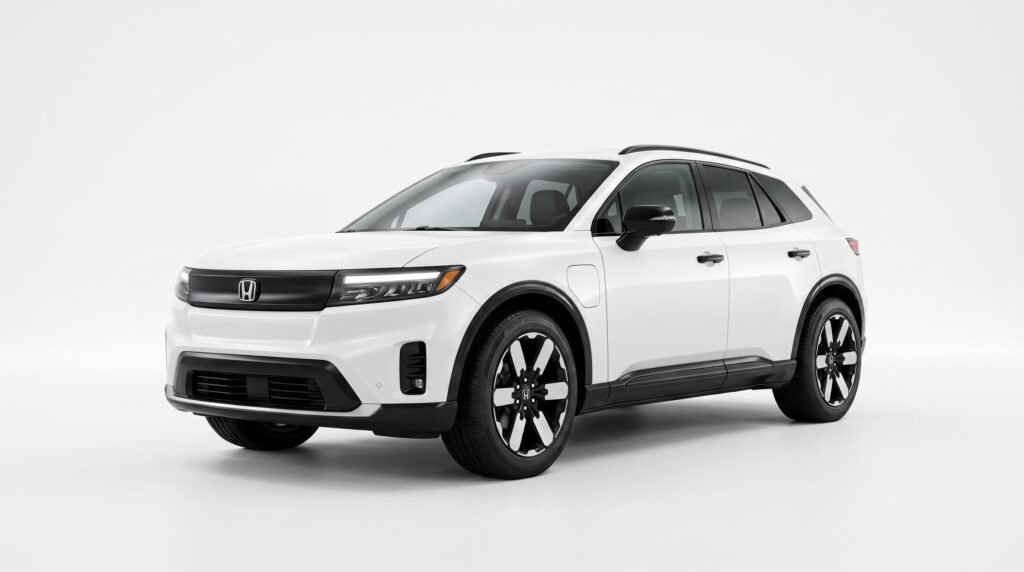
 1 / 1 Images
Honda Elevate EV (Upcoming)
Upcoming (variant structure not yet published)

Honda's first India-developed electric SUV, built on the 5 star Global NCAP rated Elevate. Confirmed for a 2026 window, with specification and pricing still to be announced.
*Ex-showroom Price in New Delhi
Honda Elevate EV (Upcoming) EV essentials
Honda Elevate EV (Upcoming) pros and cons
Pros
- Built on the 5 Star Global NCAP rated Elevate, one of the safest mid-size SUV bodies in India
- 220 mm ground clearance is class leading and genuinely useful on poor roads
- Honda SENSING ADAS is already proven on the petrol Elevate rather than a first attempt
- 458 litre boot is practical for a family, larger than several rivals in the segment
- India-developed and India-produced, which should help keep pricing competitive
- Honda's build quality and reliability reputation reduce first-EV hesitation
- Flat floor from the battery layout fixes the petrol Elevate's compromised rear middle seat
- Familiar SUV proportions make it an easy switch for existing Honda owners
Cons
- Not launched yet, with no confirmed price, battery, range, or on-sale date
- Honda is a late entrant behind Tata, Hyundai, MG, and Mahindra in this exact segment
- Honda operates no EV fast charging network in India, unlike Tata
- Adapted-from-petrol platform rather than a dedicated EV architecture, which typically costs interior space and efficiency
- No AWD option expected, unlike some rivals in the price band
- This would be Honda's first EV in India, so no local reliability or resale track record exists
- Honda has historically priced conservatively rather than aggressively, which is a risk here
- EV-trained technician coverage across Honda's network is unproven
Best for
Honda Elevate EV (Upcoming) specifications
Battery & Charging
Efficiency & Real-world Range
Motor & Performance
Dimensions & Weight
Suspension Brakes & Tyres
Comfort & Tech
Safety
Warranty
Features
Battery & Performance
- Battery expected between 50 kWh and 60 kWh based on segment positioning
- Certified range expected around 450 km to 500 km, ARAI testing pending
- India-developed programme, engineered for Indian ambient temperatures and duty cycles
- Underfloor battery packaging expected, preserving the Elevate's 458 litre boot
- Liquid battery thermal management expected, standard for this segment in India
- Regenerative braking with selectable levels expected
- DC fast charging support expected, delivering 10 to 80 percent in roughly 45 to 60 minutes
- Battery warranty expected at 8 years or 1,60,000 km, matching the Indian segment norm
- Flat floor from the battery layout, improving rear middle seat usability over the petrol car
Comfort & Interior
- 10.25 inch touchscreen infotainment with wireless Android Auto and Apple CarPlay
- 7 inch digital driver display, with an EV specific cluster expected
- Single-pane electric sunroof
- Automatic climate control with rear AC vents
- Wireless phone charging on higher trims
- Honda Connect connected car suite with remote functions
- Leatherette upholstery on top trims
- 458 litre boot, among the more usable in the segment
- 220 mm ground clearance, class leading for a mid-size SUV
- Cabin pre-conditioning via app while plugged in, expected on the EV
- Cruise control, upgraded to adaptive with Honda SENSING
Safety
- Petrol Elevate holds a 5 Star Global NCAP rating for adult and child occupant protection
- 6 airbags standard across the petrol Elevate range, expected to carry to the EV
- Honda SENSING ADAS suite expected, already offered on the petrol Elevate
- Collision Mitigation Braking System within Honda SENSING
- Adaptive Cruise Control and Lane Keeping Assist within Honda SENSING
- Road Departure Mitigation and Auto High Beam
- Vehicle Stability Assist and Hill Start Assist
- Multi-angle rearview camera
- ISOFIX child seat anchors
- High voltage isolation and automatic crash disconnect expected on the EV
- Battery pack mounted low, lowering centre of gravity versus the petrol Elevate
Honda Elevate EV (Upcoming) trims and pricing
Compare available Honda Elevate EV (Upcoming) trims, their ex-showroom prices and key configuration details.
Elevate EV Base (expected)
50 kWh expected - 450 km expected - Automatic
Elevate EV Mid (expected)
55 kWh expected - 475 km expected - Automatic
Elevate EV Top (expected)
60 kWh expected - 500 km expected - Automatic with Honda SENSING
About Honda Elevate EV (Upcoming)
The Honda Elevate EV is Honda’s first electric car for India, and it carries an unusually heavy burden for a debut product. Honda Cars India confirmed the electric Elevate as part of its India electrification roadmap shortly after the petrol Elevate went on sale in September 2023, committing to a launch by 2026 with development and production handled locally rather than adapted from a global model. That decision matters. It means the Elevate EV is being engineered around Indian road conditions, Indian charging infrastructure, and Indian price expectations from the start.
The petrol Elevate gives a clear picture of what the electric version will physically be. It is a 4,312 mm mid-size SUV on a 2,650 mm wheelbase, with 220 mm of ground clearance, a 458 litre boot, and a 5 star Global NCAP rating for both adult and child occupant protection. Those are genuinely strong foundations, and the ground clearance in particular is class leading. The electric version is expected to keep the same body and dimensions, with EV specific changes to the front fascia, wheels, and underfloor packaging for the battery. Honda SENSING, the ADAS suite already offered on the petrol car, is expected to carry over.
On pricing, Honda has not published final figures. The petrol Elevate sits between roughly ₹11.9 lakh and ₹16.7 lakh ex-showroom, while mid-size electric SUVs in India occupy the ₹17 lakh to ₹26 lakh band. That places the Elevate EV somewhere around ₹18 lakh to ₹24 lakh on current segment logic. The harder question is not price but timing. Honda arrives after Tata, Hyundai, MG, and Mahindra have established products, service networks, and owner bases in this exact segment. What Honda brings is build quality, a proven safety structure, and SENSING. What it lacks is a charging network of its own and any EV ownership track record in India. Every performance figure in this listing is an estimate based on the segment and the petrol Elevate, clearly labelled as such. At EVUnlock, we cross-check specifications against official manufacturer documentation before publishing.
Trending news for Honda Elevate EV (Upcoming)
Honda confirms an India-developed EV programme built around the Elevate. Honda Cars India has repeatedly reaffirmed that its first electric vehicle for the Indian market will be based on the Elevate SUV, with local development and local production, targeting a 2026 launch. This differs from Honda's approach in other markets, where it has largely adapted global e:N and 0 Series products.
Honda enters India's most contested electric SUV segment. By the time the Elevate EV arrives, the mid-size electric SUV space already includes established products from Tata, Hyundai, MG, and Mahindra, several with years of accumulated owner data. Honda's late entry means the Elevate EV will need sharp pricing and a clear differentiator rather than brand equity alone.
Honda Elevate EV (Upcoming) range and performance
Honda has published no range or performance figures, so nothing here is certified. Based on the mid-size electric SUV segment in India, a 50 kWh to 60 kWh battery would place the Elevate EV at roughly 450 km to 500 km on the ARAI cycle. Real world range in Indian city conditions with the air conditioning running would realistically settle between 340 km and 400 km, dropping to around 290 km to 340 km at sustained highway speeds where aerodynamic drag dominates on a tall SUV body. On performance, a single front motor producing 150 PS to 170 PS would deliver a 0 to 100 km/h time in the 8.5 to 9.5 second range, comfortably quicker than the petrol Elevate's 1.5 litre i-VTEC which produces 121 PS and 145 Nm. The more meaningful difference is low speed response, where instant electric torque transforms city driving in a way no acceleration figure conveys. Honda has not indicated any all-wheel-drive variant.
Honda Elevate EV (Upcoming) safety overview
The petrol Honda Elevate holds a 5 star Global NCAP rating for both adult and child occupant protection, one of the strongest results achieved by a mid-size SUV in India. Since the Elevate EV is based on the same body structure, its passive safety foundation is well established, though the EV variant has not been separately crash tested and carries no rating of its own. Six airbags are standard across the petrol range and are expected to carry over. Honda SENSING, the brand's ADAS suite, includes Collision Mitigation Braking, Adaptive Cruise Control, Lane Keeping Assist, Road Departure Mitigation, and Auto High Beam. One advantage specific to the electric version comes from the battery itself. Mounting a heavy pack low in the floor drops the centre of gravity considerably compared with a petrol SUV of the same height, which improves stability in emergency lane changes more effectively than any electronic aid. High voltage isolation and automatic battery disconnect in a collision are standard industry practice and expected.
Honda Elevate EV (Upcoming) battery and charging guide
Honda has not announced charging specifications. Based on what competing mid-size electric SUVs in India offer, DC fast charging in the 50 kW to 70 kW range is a reasonable expectation, delivering 10 to 80 percent in roughly 45 to 60 minutes on a 50 kWh to 60 kWh pack. AC charging is likely at 7.2 kW as standard, giving an overnight full charge at home in approximately 7 to 9 hours. A CCS-II port is the established standard for this segment in India. One practical consideration deserves emphasis. Honda does not operate a branded fast charging network in India, unlike Tata which has invested heavily in highway charging infrastructure. Elevate EV owners would depend entirely on third party charge point operators, and coverage varies considerably outside major metros. For a buyer with reliable home charging and predominantly urban driving this is minor. For anyone regularly driving intercity, it is worth investigating charger availability on your usual routes before committing.
Honda Elevate EV (Upcoming) warranty details
Honda has not announced warranty terms for the Elevate EV. Honda Cars India currently offers a 3 year standard warranty on its petrol models, with extended warranty plans available. For the battery and motor, the established Indian market norm across Tata, Hyundai, MG, and Mahindra is 8 years or 1,60,000 kilometres, and Honda would face competitive pressure to match this. Final warranty terms, including the guaranteed battery state of health percentage, will be confirmed at launch. That state of health clause is the term worth reading closely, since it defines how much capacity degradation is actually covered rather than simply how long the warranty runs.
Quick verdict: Honda Elevate EV (Upcoming)
The Honda Elevate EV has one genuine advantage and one genuine problem. The advantage is the car underneath it. The Elevate is a 5 star Global NCAP rated, well-built, sensibly packaged mid-size SUV with 220 mm of ground clearance, a 458 litre boot, and a proven ADAS suite. Building an EV on that base is a sound decision, and the flat floor a battery layout brings would fix the petrol car's compromised rear middle seat. The problem is timing and infrastructure. Honda arrives in India's most crowded EV segment years after rivals established themselves, with an adapted platform rather than a dedicated EV architecture, and without a charging network of its own. Price decides the outcome. Near ₹18 lakh with SENSING included, the Elevate EV becomes a credible alternative on safety and refinement. At ₹22 lakh or above, buyers will struggle to justify it over products with more range, faster charging, and years of local ownership data behind them. Until Honda publishes actual numbers, this remains a promising car with everything still to prove.
Honda Elevate EV (Upcoming) vs rivals: how it compares
The mid-size electric SUV segment is where Indian EV competition is fiercest. Hyundai's offering leads on sales volume and carries a strong safety record. Tata's products in this bracket bring the widest EV service and charging network in India along with years of accumulated owner data, which matters for resale confidence. Mahindra competes on dedicated EV platform engineering and claimed range. MG offers a value proposition with an established local presence. Against this field, the Elevate EV's distinguishing claims are likely to be its 5 star Global NCAP body, Honda SENSING, 220 mm ground clearance, and a 458 litre boot that beats several rivals. Its likely weaknesses are efficiency and packaging, since an adapted petrol platform rarely matches a purpose-built EV architecture on either count, plus the absence of any Honda charging infrastructure. Against the petrol Elevate itself, the electric version would win on running cost and refinement while losing on purchase price and refuelling convenience.
Honda Elevate EV (Upcoming): who should buy it (and who should not)
Do not plan a purchase around the Honda Elevate EV until Honda publishes confirmed pricing and specification. If you need a mid-size electric SUV now, established options from Tata, Hyundai, MG, and Mahindra are all available with real ownership histories, which is a considerably better basis for a decision than projections. If you specifically want a Honda and can wait, four things deserve scrutiny at launch. Whether Honda SENSING is standard or restricted to top trims, since that materially changes the value equation. The actual battery warranty terms including the state of health guarantee. Whether the EV retains the petrol car's full 220 mm ground clearance after battery packaging. And charger availability on the routes you actually drive, since Honda operates no network of its own. Do not pay any booking amount before Honda formally opens the order book.
Honda Elevate EV (Upcoming) ownership and running costs
At an estimated ₹20 lakh on-road and 8 km per kWh real world efficiency, running cost would be approximately ₹1.05 per kilometre at ₹8.5 per kWh. Over 15,000 km a year that is roughly ₹15,900 in electricity. The petrol Elevate CVT at 16.92 km/l ARAI and ₹103 per litre costs approximately ₹6.09 per kilometre, or ₹91,350 over the same distance, giving an annual fuel saving of roughly ₹75,000. Annual maintenance on an EV in this class typically runs ₹8,000 to ₹14,000 against ₹18,000 to ₹25,000 for the petrol equivalent, adding a further ₹10,000 of yearly saving. Against a purchase premium of roughly ₹5 lakh over a comparable petrol Elevate, payback arrives at approximately six years at 15,000 km annually, or three to four years at 25,000 km. A loan of ₹20 lakh on-road with 10 percent down at 8.5 percent over 7 years works out to approximately ₹27,600 a month. All figures will be revised once Honda announces official pricing.
Honda Elevate EV (Upcoming) tax benefits and incentives
If launched at the estimated price band, the Honda Elevate EV would qualify for the standard Indian electric vehicle incentives. Section 80EEB of the Income Tax Act allows individual buyers a deduction of up to ₹1.5 lakh on interest paid on an electric vehicle loan, worth approximately ₹46,800 in tax saved over the loan tenure for someone in the 30 percent bracket. GST on electric vehicles is 5 percent against 28 percent plus cess on comparable petrol vehicles, already reflected in ex-showroom pricing and a substantial saving at this price point. State-level incentives vary. Delhi offers a purchase subsidy and registration fee waiver, Maharashtra and Gujarat offer purchase subsidies, and several states including Uttar Pradesh and Rajasthan waive road tax on electric vehicles. On a car priced around ₹20 lakh, a full registration waiver alone can save ₹1.4 lakh to ₹2 lakh. Corporate buyers can additionally claim accelerated depreciation. State EV policies change frequently, so confirm current benefits at the dealership at the time of purchase.
Honda Elevate EV (Upcoming) maintenance and service
Honda has not published a service schedule for the Elevate EV. Based on how electric vehicles are serviced in this segment in India, a 15,000 kilometre or annual interval is the likely pattern. Electric powertrains remove the recurring costs Honda petrol owners are used to, including engine oil, oil filters, spark plugs, air filters, and CVT fluid. What remains is tyre rotation roughly every 10,000 km, brake fluid checks at extended intervals since regenerative braking substantially reduces pad wear, cabin air filter replacement, coolant for the battery thermal system, and an annual battery health check. Estimated annual servicing cost is ₹8,000 to ₹14,000 against ₹18,000 to ₹25,000 for the petrol Elevate. One practical caveat matters here. Honda's EV-trained technician coverage across India is entirely unproven, since the Elevate EV would be its first electric product in this market. Early owners in smaller cities may find fewer equipped workshops than Tata or Hyundai buyers, so confirm that your nearest Honda service centre is EV-capable rather than assuming it.
EV Running Cost Calculator
*Estimated figures based on entered electricity price, fuel price, mileage and average daily driving. Actual running costs can vary.
Related articles for Honda Elevate EV (Upcoming)
Frequently asked questions about Honda Elevate EV (Upcoming)
Is Honda launching an EV in India?
Yes. Honda Cars India has confirmed that its first electric vehicle for India will be based on the Elevate SUV, with the programme developed and produced locally. Honda stated a launch target of 2026. Beyond that confirmation, Honda has not released battery capacity, range, price, or a specific on-sale date, so check Honda's official website for the current status before making plans around it.
What is the Honda Elevate EV launch date?
Honda confirmed a 2026 launch window but has not announced a specific date. Any exact date circulating on websites or social media is speculation rather than an official Honda announcement. Given the 2026 window is now current, buyers should verify directly with a Honda dealership whether the car has gone on sale rather than relying on pre-launch estimates.
What is the expected Honda Elevate EV price in India?
Around ₹18 lakh to ₹24 lakh ex-showroom is the reasonable expectation, though Honda has confirmed nothing. The petrol Elevate spans roughly ₹11.9 lakh to ₹16.7 lakh, and mid-size electric SUVs in India currently sit between ₹17 lakh and ₹26 lakh. Where exactly Honda pitches it will largely determine whether the Elevate EV is competitive, since it enters a segment with established rivals.
What is the expected Honda Elevate EV range?
Roughly 450 km to 500 km certified is the expectation on a battery of 50 kWh to 60 kWh, though ARAI certification is only issued at homologation so no official figure exists yet. Real world range in Indian city conditions with the air conditioning running would realistically be around 340 km to 400 km, with highway driving reducing that further.
Will the Honda Elevate EV have ADAS?
Very likely. The petrol Elevate already offers Honda SENSING, which includes Collision Mitigation Braking, Adaptive Cruise Control, Lane Keeping Assist, Road Departure Mitigation, and Auto High Beam. Since the EV is based on the same vehicle, SENSING is widely expected to carry over, probably on higher trims. Confirm which specific features are included on your chosen variant at launch rather than assuming the full suite.
Is the Honda Elevate EV a 7 seater?
No. The Honda Elevate is a 5 seater mid-size SUV and the electric version is expected to keep that layout. Honda has announced no 7 seat variant of the Elevate in petrol or electric form. Buyers looking for a 7 seat electric SUV in India will need to consider other manufacturers, as Honda has no such product announced for this market.
How does the Honda Elevate compare with rivals on ground clearance?
The Elevate's 220 mm is class leading among mid-size SUVs in India, where most rivals sit between 190 mm and 210 mm. On broken roads, unpaved approaches, and monsoon waterlogging this is a genuine practical advantage rather than a specification point. Whether the EV retains the full 220 mm depends on how Honda packages the battery underfloor, which has not been confirmed.
Can I book the Honda Elevate EV now?
Honda has not opened official bookings as of the latest available information. Do not pay a booking or token amount to any dealer or third-party website claiming to accept Elevate EV bookings before Honda formally opens the order book. Verify directly with an authorised Honda dealership or the Honda Cars India website.
Owner feedback for Honda Elevate EV (Upcoming)
No approved owner feedback yet. Be the first to share your experience.
Available colours
Honda has not announced the colour palette for the Elevate EV. The options listed here are the petrol Elevate's current colours, which are the most likely starting point for the electric version. Manufacturers frequently add one EV-exclusive shade to visually separate the electric variant, so an additional colour unique to the Elevate EV is a reasonable expectation at launch. Dual tone options with a contrasting black roof are offered on the petrol Elevate and would likely continue.