
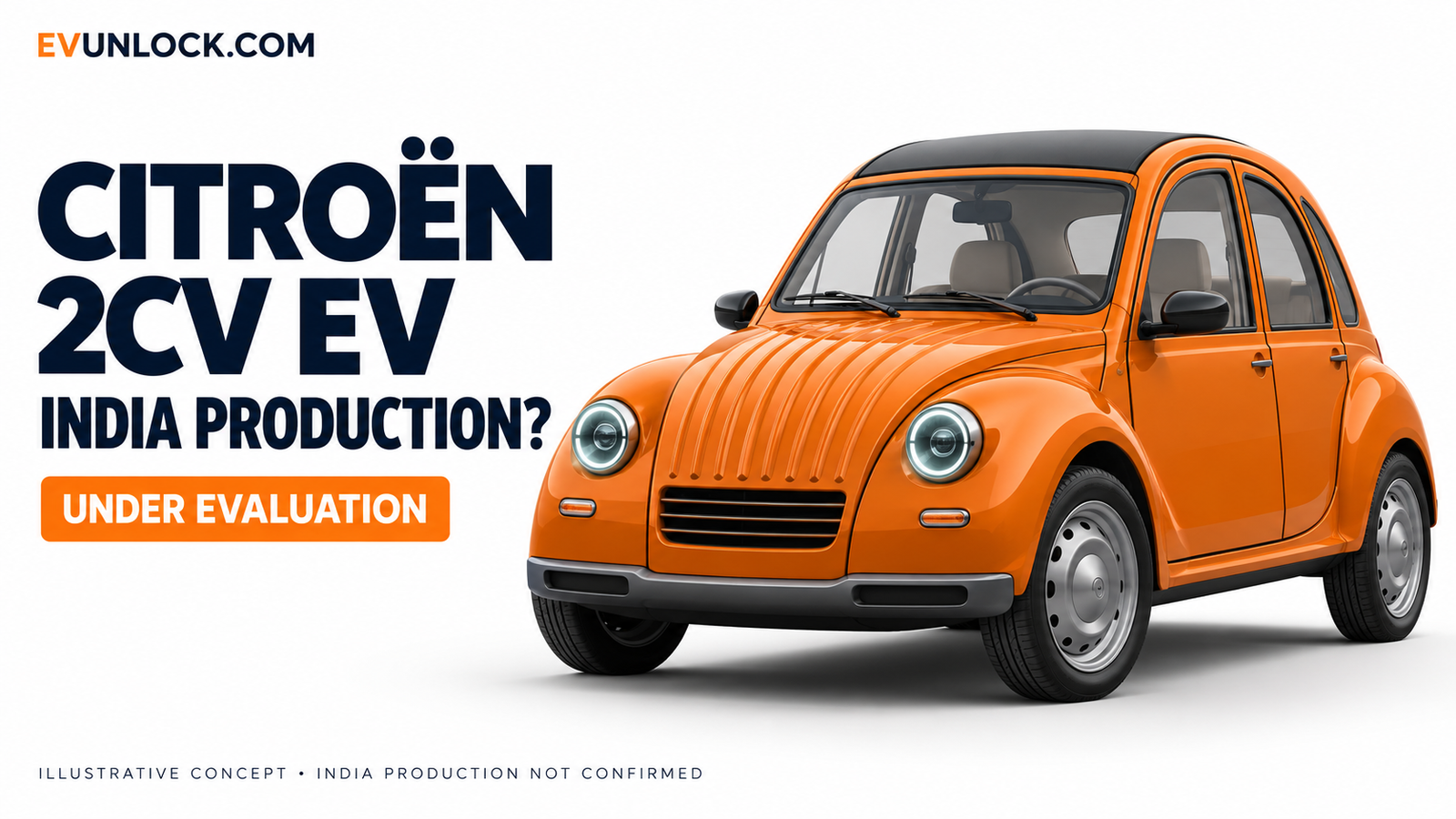
India could have a role in building Citroën’s small electric car, according to a new report. However, the company’s official announcement still points to European manufacturing.
25 October 2026
Citroën is reportedly assessing India as a manufacturing location for its future 2CV-inspired electric hatchback, potentially opening an export opportunity for its Indian operations. But there is an unresolved question: the company has publicly described the forthcoming model as European-built.
Autocar India reported on 24 October, citing industry sources, that India is being evaluated for production serving domestic buyers and overseas markets. That is an assessment of possible manufacturing options, rather than an announced factory allocation.
What Citroën Has Actually Confirmed
Citroën’s official 2 CV Concept announcement, dated 11 October, describes a compact electric model expected to join its range by 2028. The concept measures 3.76 metres and previews a car positioned between the Ami and C3.
The company is targeting a European starting price of around €15,000. Its release explicitly identifies Europe as the manufacturing location.
The documents reviewed do not establish whether India could become an additional production base, supply particular markets or participate through component exports. They also do not announce a change to the European manufacturing plan.
For Indian readers, that distinction matters. A report about production feasibility does not establish an Indian launch date, showroom price or booking timeline.
Why India Is Being Considered
Autocar’s report identifies the existing Thiruvallur facility in Tamil Nadu as part of the manufacturing case. It already produces Citroën vehicles and has an export business, giving the company an established industrial base to assess.
The broader commitment is firmer. In its 15 October India strategy announcement, parent company Stellantis outlined approximately ₹4,000 crore in fresh investment and 12 product introductions across Jeep and Citroën over three years.
That programme includes seven new products and five major upgrades, with the first introduction scheduled for the second quarter of 2027. An A-segment car is among the planned vehicle categories, but the announcement does not name the 2CV as that Indian product.
Existing factories and a wider investment programme make an India assessment plausible. They do not, by themselves, establish that this particular car has received production approval.
Could India Become an Export Hub?
The commercial case would depend on the cost of delivering a finished vehicle to its destination.
As a manufacturing assessment, that means comparing more than assembly costs. Battery sourcing, tooling expenditure, transport, regulatory compliance and the number of cars each factory could produce would all influence the decision.
Export orders could help spread development and factory costs across more vehicles. However, that benefit would need to outweigh shipping expenses and any additional complexity from producing the car in multiple locations.
Citroën’s stated European manufacturing plan makes those unanswered questions central to this story. India remains a reported option; a confirmed export programme would require a separate company announcement.
What Would It Mean for Indian Buyers?
The €15,000 target should not be converted into rupees and presented as an expected Indian price. It refers to the European programme, with a different cost structure and market positioning.
The official concept material reviewed does not provide a production battery capacity, certified range or charging specification. Without those details, comparisons based on purchase price or everyday usability would be premature.
Battery specification would also affect affordability and ownership costs. EVUnlock’s guide to EV battery costs in India provides background on that part of the buying decision; it does not establish costs for the forthcoming Citroën.
The next meaningful development would be confirmation of a manufacturing location and the markets it will serve. Until then, the 2CV report offers a possible expansion of India’s role within Stellantis—not a car that Indian buyers can yet order.

Gagandeep Singh
Founder, EV UnlockGagandeep Singh is an Electronics and Communication Engineering graduate from BGIET Sangrur and holds an M.Tech in eMobility from IIT Madras (CODE IITM). He is the founder of EV Unlock, an independent electric vehicle research platform. His work combines engineering knowledge, SEO strategy and electric mobility research to deliver verified EV specifications, buying guides and charging information that help buyers make confident, informed decisions.