
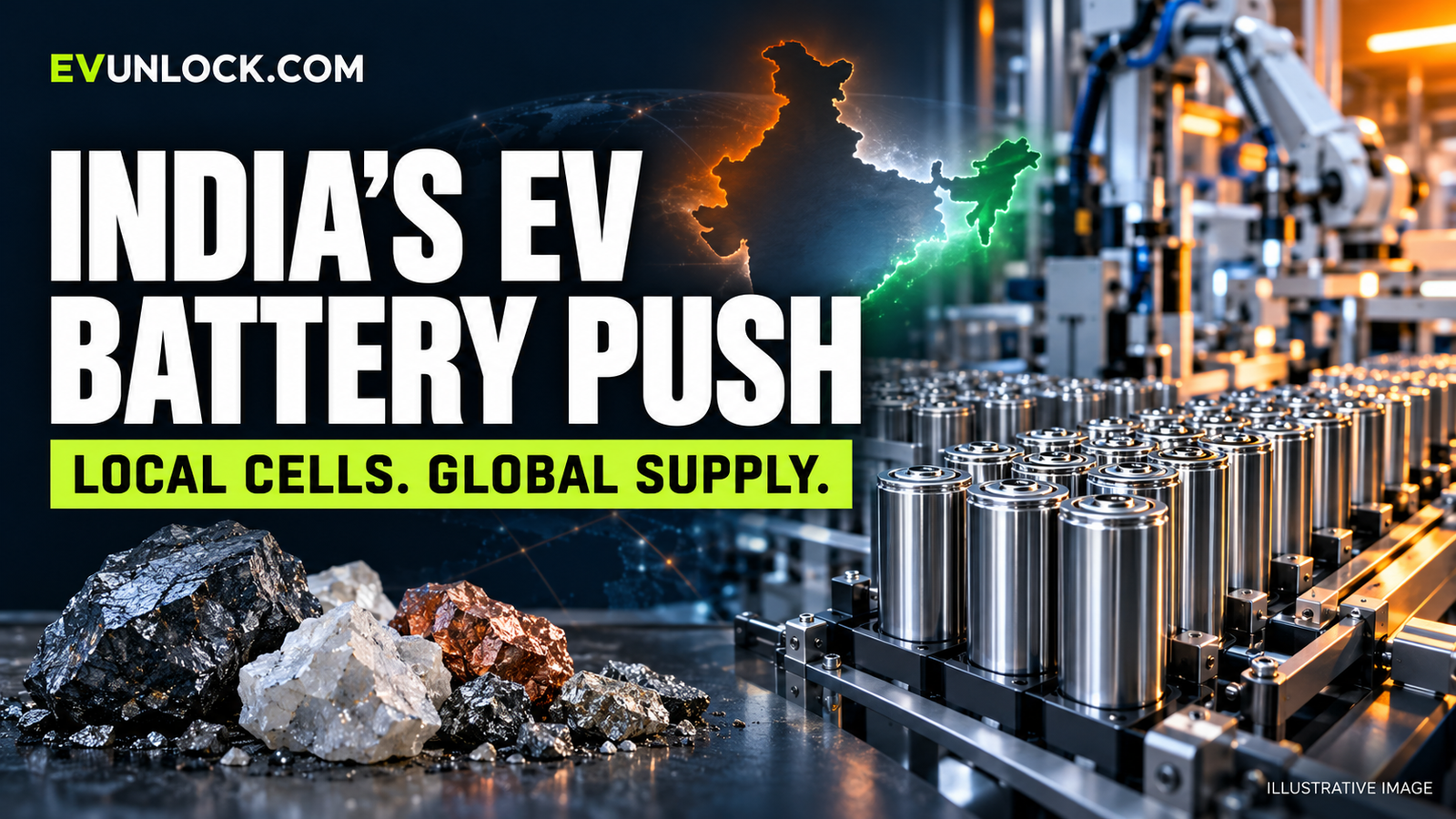
Discussions at REI Expo and The Battery Show India highlighted the work needed to turn India’s manufacturing ambitions into dependable battery supplies.
25 October 2026
India’s effort to build a stronger EV battery industry brought mineral supplies, manufacturing technology and international partnerships into focus at the Renewable Energy India Expo and The Battery Show India in Greater Noida.
Industry representatives and officials discussed how Indian manufacturing could work with overseas mineral suppliers and technology providers. Coverage published by ETAuto on October 24 highlighted cooperation opportunities involving Australia, Germany and Scotland. It did not identify a new investment agreement involving an individual EV manufacturer.
The discussions formed part of the events held from October 22 to 24 at India Expo Mart. For the automotive industry, they addressed a practical question: how much of the battery supply chain can India build locally, and which capabilities will still require international partners?
Mineral access and manufacturing expertise need to come together
Australia’s High Commissioner to India, Philip Green, highlighted the potential to combine Australian mineral resources and engineering expertise with India’s manufacturing strengths.
Germany’s contribution could include battery research, power electronics and factory automation, according to Anandi Iyer, director of the Fraunhofer Office in India. Scotland’s First Minister John Swinney also pointed to opportunities linking Scottish technology with Indian talent and manufacturing scale.
These discussions point towards a practical approach to localisation: develop more capability within India while securing access to materials and expertise from abroad. The next step will be translating those opportunities into supply contracts, technology agreements and operating production lines.
India already has a battery manufacturing programme
The government’s Advanced Chemistry Cell programme provides the policy backdrop. A Ministry of Heavy Industries statement dated February 13, 2026 describes an ₹18,100-crore production-linked incentive scheme targeting 50 GWh of domestic cell manufacturing capacity.
That figure is a programme target, rather than a statement of how much capacity is operating today. The distinction matters when assessing announcements about India’s battery industry.
The ministry’s scheme framework also requires beneficiaries to achieve at least 25% domestic value addition and increase it to 60% within five years. This places importance on the value created within India, beyond the location of the final assembly plant.
The difficult work sits further up the supply chain
The ministry’s February statement identified several implementation challenges: limited access to technology, shortages of skilled workers, imported machinery and inadequate availability of upstream materials such as cathode and anode active materials and electrolytes.
A factory therefore needs more than a building and an announced production capacity. Its equipment, trained workforce and material suppliers must come together before it can deliver cells consistently.
The wider EV industry faces a similar challenge. In its June 23 report on component localisation, IEEFA found that domestic manufacturing remained uneven. Structural and mechanical components benefited from India’s established automotive capabilities, while advanced electronics and specialised materials continued to present difficulties.
Recycling adds another source of critical materials
India is also pursuing recovery of minerals from used batteries and other waste. On April 30, the Ministry of Mines said 58 companies had been assessed as eligible under its ₹1,500-crore critical mineral recycling incentive scheme.
The ministry described project execution as the next stage. Eligibility and proposed capacity should therefore be distinguished from facilities that have started commercial production.
Recycling gives the manufacturing strategy another route to material supply. Its contribution will depend on projects progressing from proposals to actual recovery operations.
What does this mean for EV buyers?
The potential benefit is a more dependable domestic supply base. Over time, competitive local production could help manufacturers manage costs and availability. The expo discussions, however, provide no basis for predicting a specific reduction in electric-car prices or replacement battery bills.
For someone buying an EV now, the useful checks remain model-specific: battery warranty, service support and the terms governing repairs or replacement. EVUnlock’s electric vehicle terminology guide explains the battery and charging terms buyers will encounter.
The next meaningful milestones will be commissioned factories, consistent commercial output and material supplies reaching manufacturers. Those developments will show how much of India’s battery ambition is becoming production.

Gagandeep Singh
Founder, EV UnlockGagandeep Singh is an Electronics and Communication Engineering graduate from BGIET Sangrur and holds an M.Tech in eMobility from IIT Madras (CODE IITM). He is the founder of EV Unlock, an independent electric vehicle research platform. His work combines engineering knowledge, SEO strategy and electric mobility research to deliver verified EV specifications, buying guides and charging information that help buyers make confident, informed decisions.